
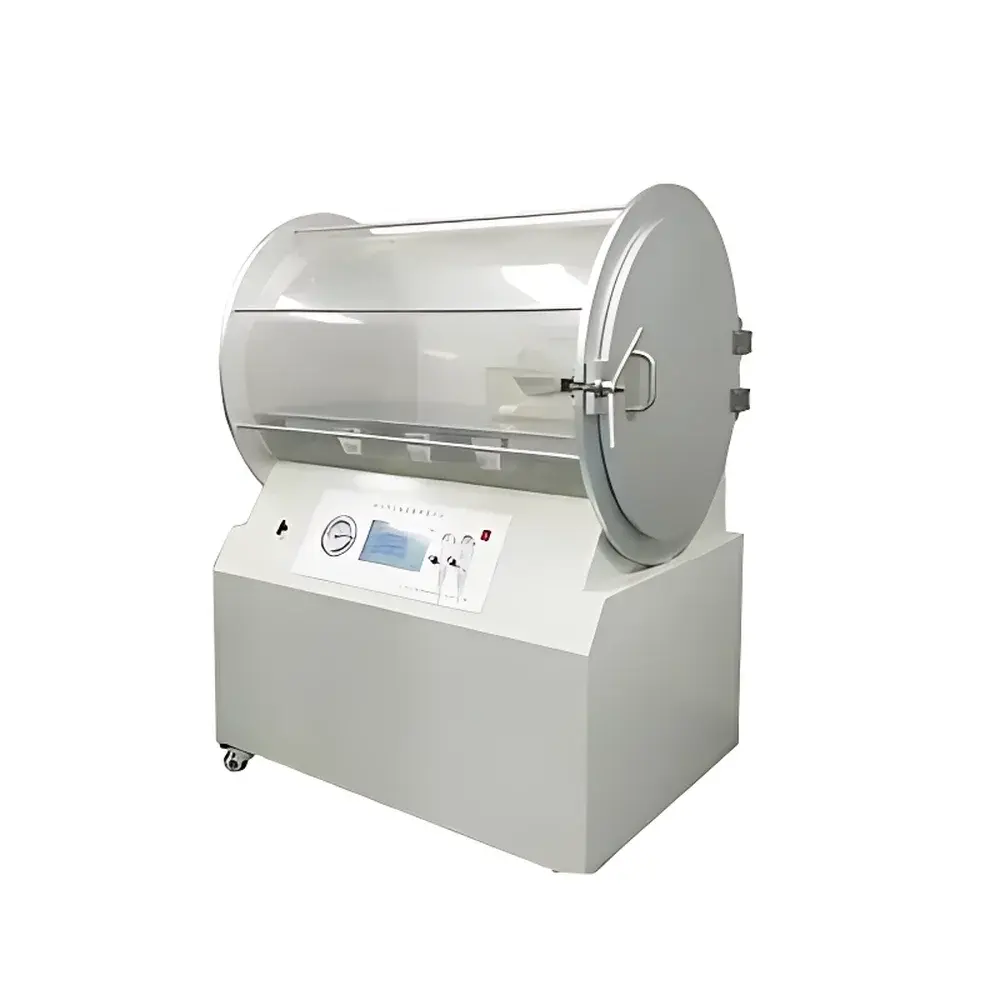
TOW-INT ProOx-810L Hypobaric Hypoxia Chamber for Animal Research
| Brand | TOW-INT |
|---|---|
| Origin | Shanghai, China |
| Manufacturer Type | Direct Manufacturer |
| Product Origin | Domestic (China) |
| Model | ProOx-810L |
| Pricing | Upon Request |
Overview
The TOW-INT ProOx-810L Hypobaric Hypoxia Chamber is an engineered platform for preclinical simulation of high-altitude environmental conditions in rodent and small-to-medium-sized animal models (e.g., mice, rats, rabbits, dogs, non-human primates). It operates on the principle of controlled hypobaric hypoxia—reducing ambient pressure to lower partial pressure of oxygen (pO₂) while maintaining normoxic gas composition—thereby replicating physiological stressors encountered at elevations up to 12,000 meters above sea level. Unlike nitrogen-dilution or gas-blending systems, this chamber achieves true altitude simulation via vacuum-based pressure regulation, enabling precise replication of barometric and respiratory challenges associated with acute or chronic high-altitude exposure. Designed for longitudinal studies, the system supports uninterrupted operation for up to 30 days with autonomous monitoring and fail-safe control logic, making it suitable for mechanistic investigations in pulmonary, neurological, cardiovascular, and metabolic research domains.
Key Features
- Programmable multi-stage pressure profiles: supports stepwise, cyclic, and time-scheduled altitude transitions (e.g., simulated ascent/descent protocols)
- Real-time dynamic visualization of chamber pressure (kPa), calculated equivalent altitude (m), and O₂ concentration (% vol) via integrated touchscreen HMI
- Automated gas exchange cycle compliant with AAALAC and NIH Guide for Care and Use of Laboratory Animals standards, ensuring appropriate CO₂ clearance and humidity management
- Dual-redundant safety architecture: emergency depressurization valve, independent overpressure/underpressure cutoff sensors, and hardware-triggered venting upon power loss or controller fault
- Structural integrity certified: chamber body fabricated from 25 mm thick optical-grade acrylic with reinforced aluminum alloy frame and stainless-steel load-bearing components; equipped with locking casters for lab mobility and positional stability
- Low-noise (<55 dB(A)) dual-stage vacuum system with integrated gas buffer volume to eliminate turbulent airflow and minimize mechanical stress on animals during pressure transitions
- Multi-stage filtration: HEPA + activated carbon + hydrophobic membrane filters ensure particulate-free, odorless, and pathogen-reduced air supply to the chamber interior
Sample Compatibility & Compliance
The ProOx-810L accommodates standard IVC-compatible cages (up to 16 mouse cages or 4 rabbit-sized enclosures) within its 1200 × 800 mm (L × Ø) cylindrical chamber volume. Its design conforms to ISO 554 (standard atmospheres for conditioning and testing), ASTM E2912-22 (standard practice for hypobaric chamber qualification), and EU Directive 2010/63/EU on protection of animals used for scientific purposes. All firmware and data logging modules are structured to support GLP-compliant workflows—including user-access controls, electronic signatures, and audit trail generation per FDA 21 CFR Part 11 requirements when paired with optional validated software packages. Chamber calibration certificates traceable to NIM (National Institute of Metrology, China) are provided with each unit.
Software & Data Management
The embedded control system runs proprietary TOW-OS v3.2 firmware, supporting local parameter configuration, real-time graphing, and event-triggered logging. Experimental sessions generate timestamped .csv files containing pressure, temperature, relative humidity, and derived altitude/O₂ values—exportable directly to USB storage media for offline analysis in MATLAB, Python (Pandas), or GraphPad Prism. Optional integration with LabArchives ELN or Benchling enables metadata-rich experiment documentation. Remote monitoring via Ethernet (TCP/IP) or optional Wi-Fi module allows secure access through authenticated web interface (HTTPS) without exposing internal lab networks. All logged data include CRC-32 checksums and are write-protected post-acquisition to prevent tampering.
Applications
The ProOx-810L serves as a core infrastructure tool in translational hypoxia research, particularly for modeling:
- High-altitude pulmonary edema (HAPE) and cerebral edema (HACE) pathogenesis and therapeutic intervention screening
- Pulmonary arterial hypertension (PAH) progression under chronic intermittent hypoxia
- Hypoxia-induced ferroptosis, necroptosis, and mitochondrial dysfunction in adipose, splenic, and neural tissues
- Neurocognitive deficits and blood–brain barrier disruption following acute hypobaric exposure
- Renal apoptosis and endothelial dysfunction mediated by NF-κB and PPARγ signaling pathways
- Pharmacokinetic/pharmacodynamic evaluation of hypoxia-targeted compounds (e.g., epicatechin gallate, astragaloside IV, eleutheroside B)
Published applications span peer-reviewed journals including International Journal of Pharmaceutics, European Journal of Pharmacology, Biomedicine & Pharmacotherapy, and Antioxidants, validating its utility in rigorous hypothesis-driven discovery.
FAQ
What is the maximum simulated altitude achievable with the ProOx-810L?
The chamber achieves pressures corresponding to 12,000 m (≈10.7 kPa absolute), replicating the barometric and hypoxic conditions found at extreme altitudes.
Can the system operate unattended for extended durations?
Yes—it supports continuous 30-day operation with automated pressure maintenance, alarm logging, and self-diagnostic routines.
Is the chamber compatible with physiological telemetry systems?
Yes—integrated RS485 and analog I/O ports enable synchronization with commercial telemetry platforms (e.g., Data Sciences International, Ponemah) for concurrent ECG, core temperature, SpO₂, and respiration rate acquisition.
Does TOW-INT provide IQ/OQ/PQ documentation?
Yes—3Q validation packages (Installation, Operational, Performance Qualification) are available upon request, aligned with GMP Annex 15 and ISO/IEC 17025 requirements.
Can temperature be independently controlled during hypobaric operation?
Yes—the optional integrated thermoregulation module provides stable setpoint control from –40 °C to +40 °C, with dual-mode capability (refrigeration/heating) and ±0.3 °C uniformity across the chamber volume.




