
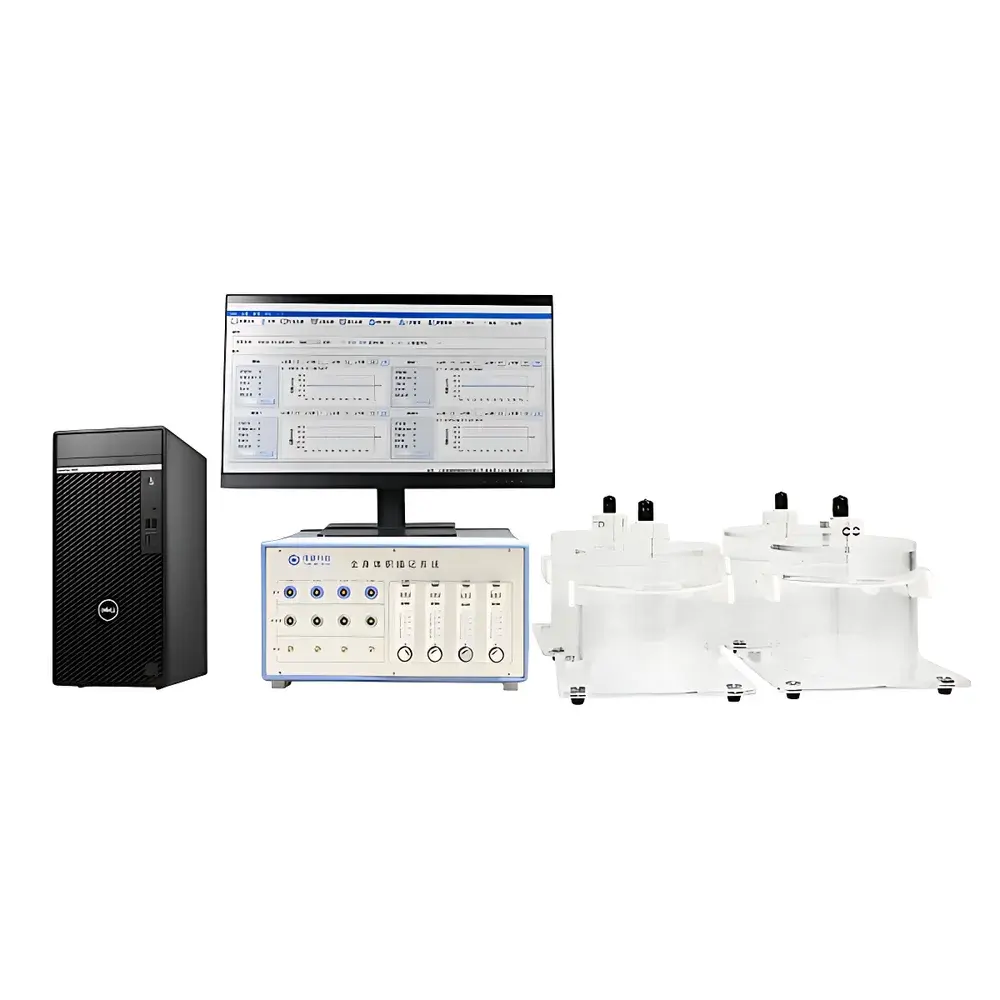
TOW-INT WBP-4MR Whole Body Plethysmography System
| Brand | TOW-INT |
|---|---|
| Origin | Shanghai, China |
| Manufacturer | Yes |
| Domestic Product | Yes |
| Model | WBP-4MR |
| Pricing | Upon Request |
Overview
The TOW-INT WBP-4MR Whole Body Plethysmography System is a non-invasive, unrestrained pulmonary function assessment platform engineered for longitudinal, high-throughput respiratory phenotyping in conscious, freely moving laboratory animals. It operates on the principle of whole-body barometric plethysmography (WBP), measuring real-time pressure fluctuations within sealed, temperature- and humidity-stabilized chambers caused by spontaneous breathing. Unlike invasive methods requiring tracheostomy, mechanical ventilation, or general anesthesia—which introduce confounding physiological artifacts—the WBP-4MR captures naturalistic respiratory behavior without surgical intervention or pharmacological suppression. This enables robust quantification of airway responsiveness, bronchoconstriction dynamics, and ventilatory patterns under physiologically relevant conditions. The system is validated for use across diverse preclinical models of asthma, COPD, pulmonary fibrosis, allergic inflammation, hypoxia, and drug-induced respiratory toxicity, supporting mechanistic studies aligned with NIH, EMA, and FDA-recommended non-invasive pulmonary endpoints.
Key Features
- Modular 4-channel architecture supporting simultaneous, independent monitoring of up to four animals—compatible with mice, rats, guinea pigs, rabbits, cats, dogs, miniature swine, and non-human primates.
- Integrated feeding and hydration ports enabling continuous, uninterrupted measurements over extended durations (≥72 h), critical for circadian rhythm studies and chronic exposure protocols.
- Automated baseline drift compensation and active offset control to maintain signal stability during long-term acquisitions.
- Optional high-frequency oscillatory nebulization module for precise, synchronized aerosol delivery of bronchoconstrictors (e.g., methacholine, histamine) or therapeutics directly into the chamber airflow path.
- Acoustically damped chamber design with vibration-isolated mounting and low-noise transducer electronics to maximize signal-to-noise ratio (SNR) and minimize environmental interference.
- Gas manifold interface supporting external supply of medical-grade N₂, O₂, CO₂, or custom gas mixtures for controlled hypoxia, hypercapnia, or normoxic challenge paradigms.
- Four-gas auto-switching capability via software-controlled solenoid valves, compliant with ISO 8573-1 compressed air quality standards for laboratory gas handling.
Sample Compatibility & Compliance
The WBP-4MR accommodates standard rodent cages (e.g., IVC-compatible dimensions) and features adjustable chamber inserts for species-specific volume optimization—ensuring accurate tidal volume estimation across body weights from 10 g (neonatal mice) to 30 kg (miniature swine). All wetted surfaces are constructed from autoclavable, USP Class VI-certified polycarbonate and stainless steel, meeting ISO 10993 biocompatibility requirements. The system adheres to GLP-compliant data integrity standards: audit trails, electronic signatures, and 21 CFR Part 11–ready software architecture support regulatory submissions (FDA IND/CTA, EMA MAA). Experimental protocols align with ASTM E2913-22 (Standard Guide for Noninvasive Respiratory Assessment in Rodents) and NIH Office of Laboratory Animal Welfare (OLAW) guidelines for minimally disruptive physiological monitoring.
Software & Data Management
The proprietary WBP Analysis Suite v5.x provides real-time visualization, automated parameter extraction, and batch processing of raw pressure waveforms. It computes 16 standardized respiratory indices—including Ti, Te, PIF, PEF, f, Vt, MV, PenH, EF50, and Volbal—with configurable smoothing filters and artifact rejection thresholds. Data export is natively supported to CSV, Excel (.xlsx), and plain-text (.txt) formats for downstream statistical analysis in R, Python (SciPy/Pandas), or GraphPad Prism. The software supports scheduled calibration routines, automatic chamber volume compensation, and time-synchronized integration with third-party telemetry systems (e.g., DSI, Ponemah) for concurrent ECG, core temperature, locomotor activity, or EEG acquisition. All datasets are timestamped with NTP-synchronized precision and stored in hierarchical folder structures compliant with FAIR (Findable, Accessible, Interoperable, Reusable) principles.
Applications
The WBP-4MR serves as a core platform for translational respiratory research in academic, CRO, and pharmaceutical settings. Key applications include: (1) Airway hyperresponsiveness (AHR) profiling in murine OVA- or HDM-sensitized asthma models; (2) Longitudinal tracking of ventilatory decline in bleomycin-induced pulmonary fibrosis; (3) Evaluation of inhaled biologics and nanoparticle formulations for lung deposition efficiency and functional impact; (4) Hypoxia tolerance assessment in genetic models of sleep-disordered breathing; (5) Preclinical safety pharmacology per ICH S7B/S7A, including detection of drug-induced bronchospasm or respiratory depression; (6) Validation of novel anti-inflammatory compounds targeting IL-4/IL-13, TSLP, or NLRP3 pathways, as evidenced in peer-reviewed publications (e.g., Nature Communications, JCI Insight, ATS Journals). Its compatibility with GLP workflows makes it suitable for regulatory toxicology studies supporting Investigational New Drug (IND) applications.
FAQ
Is the WBP-4MR compatible with existing telemetry or behavioral monitoring systems?
Yes—via TTL-triggered synchronization and analog/digital I/O ports, the system integrates with commercial telemetry platforms (DSI, Data Sciences International), video-tracking systems (EthoVision, Noldus), and environmental controllers.
Can PenH be used as a surrogate for airway resistance in regulatory submissions?
PenH is a dimensionless, chamber-specific index validated for comparative AHR screening in rodents. While not equivalent to invasively measured RL, it is widely accepted in preclinical asthma studies per NIH/NHLBI consensus guidelines when combined with complementary endpoints (e.g., PEF, EF50).
Does the system support automated calibration without manual intervention?
Yes—the optional AutoCalibration Module performs real-time, chamber-specific volume and pressure transducer recalibration using integrated reference pistons and NIST-traceable pressure sources, eliminating operator-dependent error.
What level of technical support and validation documentation is provided?
TOW-INT delivers IQ/OQ/PQ protocol templates, 21 CFR Part 11 compliance reports, instrument qualification records, and application-specific SOPs—all available upon installation and maintained through annual software updates and hardware service contracts.





