
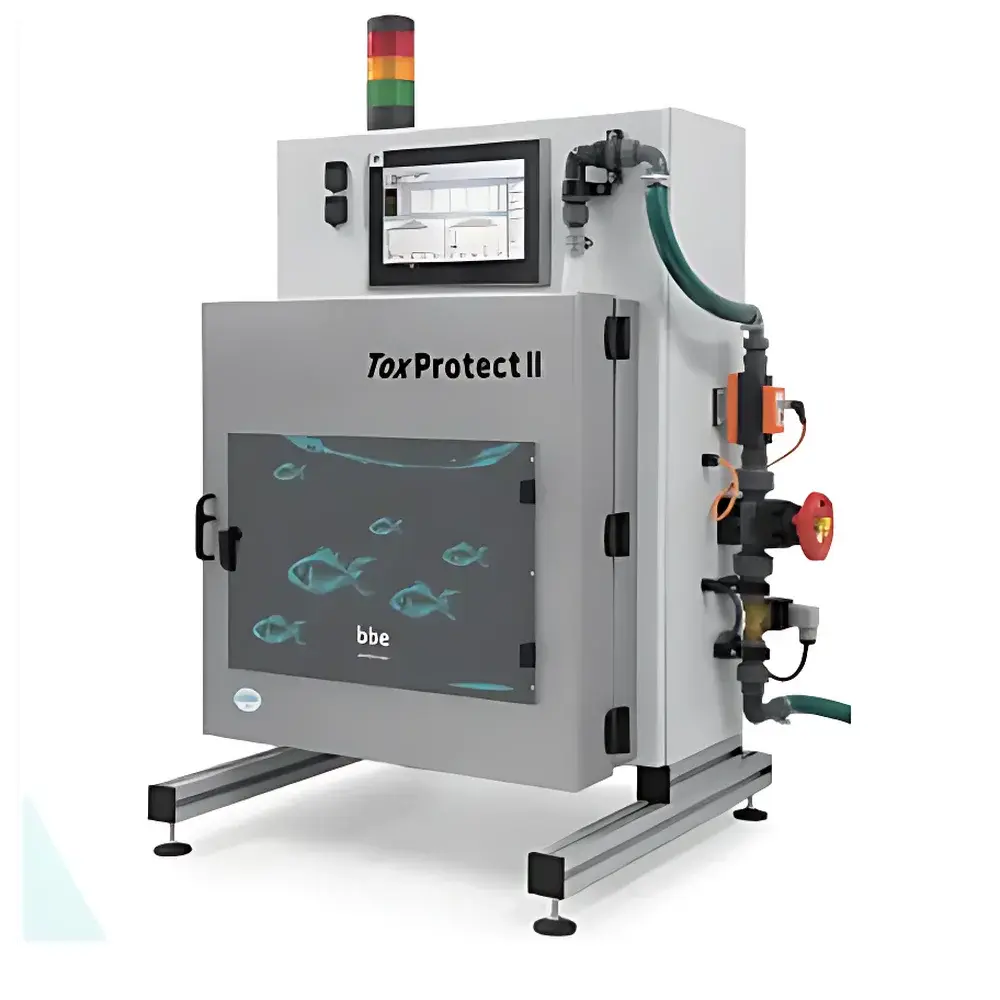
Tox protectII Fish Toxicity Monitor – Optical Grating Behavioral Detection System
| Brand | BBE / bbe Moldaenke |
|---|---|
| Origin | Germany |
| Manufacturer Type | Direct Manufacturer |
| Import Status | Imported |
| Model | Tox protectII |
| Instrument Type | Online Monitoring System |
| Test Organism | Live Fish (e.g., Danio rerio or Oncorhynchus mykiss) |
| Operating Temperature Range | 5–28 °C |
| Measurement Chamber Volume | 9 L (customizable) |
| Detection Principle | Real-time optical grating-based behavioral activity monitoring |
| Communication Interfaces | RS-485, Ethernet, Modbus TCP, optional GSM/SMS and analog alarm outputs |
| Alarm Modes | Local visual (tricolor LED), audible, remote SMS/fax/email via integrated gateway |
| Compliance | Designed for GLP-aligned operation |
Overview
The Tox protectII Fish Toxicity Monitor is an online, real-time biological early-warning system engineered for continuous assessment of acute aquatic toxicity in source water, drinking water intake channels, and industrial process streams. Unlike chemical-specific sensors, this instrument employs live fish—typically zebrafish (Danio rerio) or rainbow trout (Oncorhynchus mykiss)—as whole-organism biosensors. Its core measurement principle relies on non-invasive, high-resolution optical grating technology to quantify spontaneous swimming behavior as a physiological proxy for neuro-motor integrity and respiratory function. The system continuously monitors beam interruptions across 78 spatially distributed infrared light barriers within a thermostatically controlled 9-L measurement chamber. Activity intensity—calculated as total beam breaks per unit time, normalized by fish count—is tracked second-by-second against statistically derived baseline thresholds. A rapid, statistically significant deviation triggers a multi-stage alert protocol, including primary behavioral anomaly detection and secondary verification via photostimulus challenge (controlled high-intensity light pulse), thereby minimizing false positives from transient environmental fluctuations.
Key Features
- Online, 24/7 autonomous operation with minimal maintenance intervals (typical service cycle: ≥6 months)
- Integrated precision thermoregulation (5–28 °C range, ±0.3 °C stability) ensuring consistent metabolic baseline across seasonal variations
- Modular optical grating array (78 independent IR channels) enabling spatially resolved motion mapping without physical tagging or restraint
- Dual-phase alarm logic: primary detection based on spontaneous activity decline; secondary confirmation via standardized photostimulus response assay
- Onboard data logger with ≥30-day local storage (CSV + binary format); timestamped, tamper-evident records compliant with ALCOA+ principles
- Flexible communication architecture supporting RS-485 (Modbus RTU), Ethernet (Modbus TCP), and optional GSM module for SMS/email alerts
- Configurable tricolor status display (green = normal, yellow = warning, red = confirmed toxicity event) plus relay outputs for integration into SCADA or PLC systems
Sample Compatibility & Compliance
The Tox protectII accepts raw or filtered surface water, groundwater, treated drinking water, and pre-treated industrial influents without chemical pretreatment. It is validated for use with standard test fish species maintained under OECD Guideline 203 (Fish Acute Toxicity Test) husbandry conditions. While not a replacement for laboratory-based regulatory bioassays, the system meets functional requirements outlined in DIN SPEC 38407-10 (German standard for biological early-warning systems) and aligns with the conceptual framework of ISO 20426:2020 (Water quality — Guidance on biological early-warning systems). Data integrity features—including electronic signatures, audit trails, and user-access-level controls—support compliance with FDA 21 CFR Part 11 when deployed in GMP-regulated utilities or pharmaceutical water systems.
Software & Data Management
The proprietary ToxControl software provides real-time visualization of activity trends, statistical baselines (rolling 72-hr median + MAD-based outlier filtering), and event chronology with waveform export. All measurements are stored with full metadata: temperature, flow rate (if external sensor integrated), calibration timestamps, and operator annotations. Export formats include CSV (for LIMS ingestion), PDF summary reports (ISO-compliant), and XML (for enterprise data lakes). Software update history and configuration changes are logged automatically. Remote access is secured via TLS 1.2+ and role-based authentication (admin/operator/viewer). Audit logs meet ISO/IEC 17025 clause 7.10.2.2 requirements for traceability of all analytical decisions.
Applications
- Drinking water utilities: Early detection of accidental or intentional contamination at raw water intakes and post-filtration points
- Reservoir and watershed management: Integration with hydrological telemetry for event-triggered toxicity surveillance
- Food & beverage manufacturing: Continuous monitoring of process water used in cleaning-in-place (CIP) rinse cycles and final product contact lines
- Pharmaceutical facilities: Verification of purified water (PW) and water-for-injection (WFI) system integrity during routine operation
- Ecotoxicological screening labs: Complementary tool for rapid hazard ranking prior to definitive OECD or ASTM bioassay execution
- Emergency response units: Mobile deployment for post-spill or post-flood water safety triage
FAQ
What fish species are recommended for routine operation?
Zebrafish (Danio rerio) are preferred for their robustness, small size, and well-characterized behavioral responses; rainbow trout (Oncorhynchus mykiss) may be used where cold-water compatibility is required.
How frequently must fish be replaced?
Under optimal feeding and water quality conditions, fish cohorts typically remain viable for 4–6 weeks; automated feeding and waste removal extend cohort longevity and reduce manual intervention.
Does the system require chemical reagents or consumables?
No—operation is reagent-free; only standard aquarium-grade filtration media and certified fish feed are needed for long-term deployment.
Can Tox protectII distinguish between toxicant classes?
It does not identify specific compounds but provides high sensitivity to neurotoxicants, respiratory inhibitors (e.g., cyanide, azide), and general CNS depressants—patterns that inform downstream analytical prioritization.
Is validation support available for regulatory submissions?
BBE provides IQ/OQ documentation templates, performance qualification protocols aligned with ISO 20426, and technical assistance for method transfer into utility QA/QC frameworks.







