
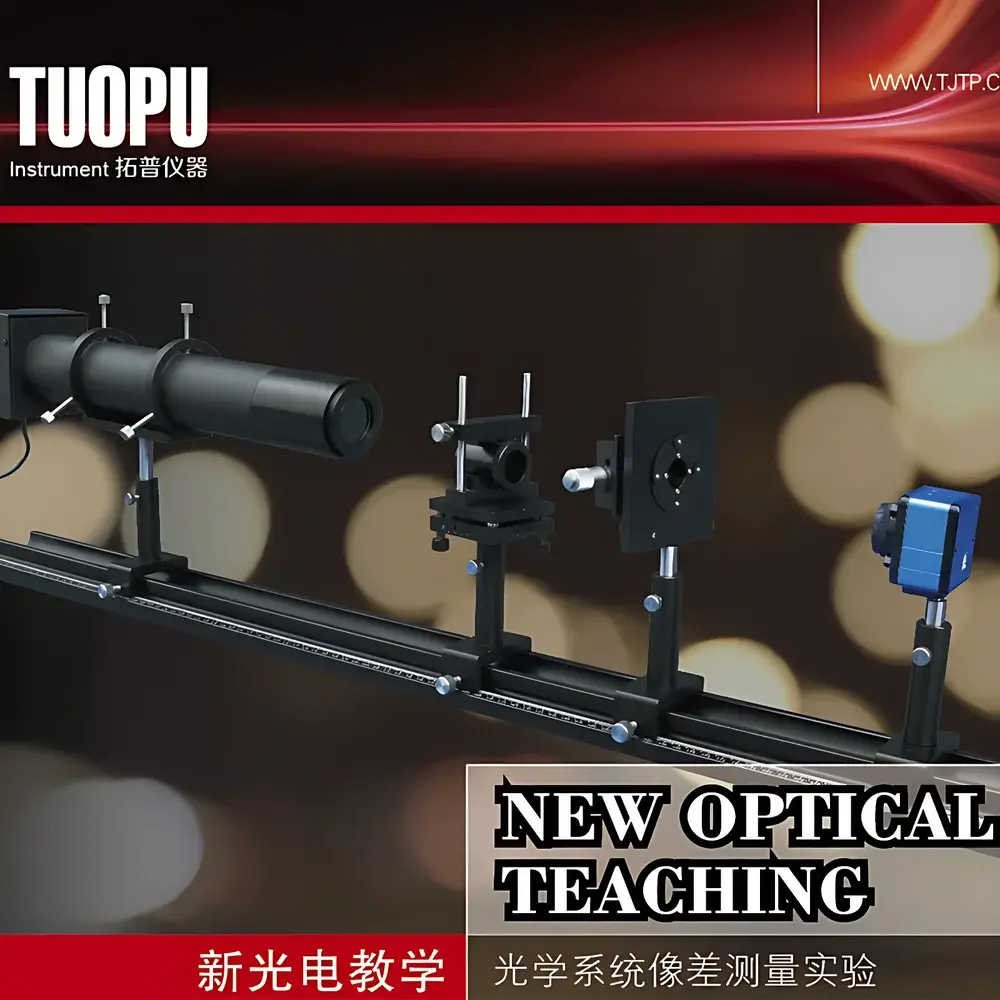
TP-GOS1 Optical Aberration Measurement Experiment System
| Brand | TOP / TP |
|---|---|
| Origin | Tianjin, China |
| Manufacturer Type | Manufacturer |
| Origin Category | Domestic |
| Model | TP-GOS1 |
| Pricing | Upon Request |
Overview
The TP-GOS1 Optical Aberration Measurement Experiment System is an education- and research-oriented optical instrumentation platform engineered for quantitative analysis and visual characterization of monochromatic and chromatic aberrations in real-world imaging systems. It operates on foundational principles of physical optics and geometrical ray tracing, enabling direct observation and measurement of primary Seidel aberrations—including spherical aberration, coma, astigmatism, field curvature, distortion—as well as longitudinal and lateral chromatic aberration. Designed explicitly to bridge the gap between theoretical instruction in engineering optics curricula and hands-on laboratory practice, the system integrates calibrated optical components, standardized test methods (star test, knife-edge shadowgraphy, shear interferometry), and digital image acquisition to deliver reproducible, pedagogically structured experimental outcomes. Its architecture supports both qualitative visualization and semi-quantitative evaluation under controlled illumination and alignment conditions—making it suitable for undergraduate optics laboratories, graduate-level optical design labs, and faculty-led research into aberration compensation techniques.
Key Features
- Modular optical train built on a rigid 1000 mm × 80 mm aluminum optical rail with precision-machined kinematic mounts, micrometer-adjustable translation stages, and angular alignment fixtures.
- Dedicated aberration lens set featuring independently adjustable spherical, comatic, astigmatic, and field-curvature elements—each fabricated to ISO 10110 surface quality standards (scratch-dig 60–40, λ/4 PV wavefront error).
- Integrated He-Ne laser source (λ = 633 nm, TEM00, P > 1.5 mW) with safety-rated high-voltage interlock connectors and beam collimation optics for coherent illumination in shear interferometry mode.
- White-light and trichromatic LED-based parallel beam generator (D/F = 1:10, f = 500 mm, aperture Ø50 mm, effective focal length tolerance ±0.3%) for chromatic aberration characterization.
- High-resolution CMOS imaging module (1280 × 1024 pixels, 5.2 µm pixel pitch, USB 2.0 interface) optimized for low-noise star-test imaging and shadowgram contrast enhancement.
- Calibrated spatial filter assembly incorporating a 40× microscope objective and 15 µm precision pinhole (±0.5 µm tolerance) for diffraction-limited point-source generation.
Sample Compatibility & Compliance
The TP-GOS1 accommodates standard optical components with diameters ranging from Ø25 mm to Ø40 mm, including singlets, doublets, and custom-designed test lenses mounted in adjustable lens holders. All optical surfaces comply with ISO 10110-7 surface imperfection specifications, and mechanical interfaces conform to DIN 3180 mounting standards. The system supports alignment verification per ISO 9022-3 (optical instrument environmental testing) and facilitates experimental documentation traceable to GLP-aligned lab notebook practices. While not certified for regulatory compliance (e.g., FDA 21 CFR Part 11), its measurement protocols align with educational benchmarks referenced in SPIE Field Guide to Optical Design and ANSI Z80.10-2020 (ophthalmic optics testing methodology).
Software & Data Management
The included experiment software provides guided workflow modules for each core procedure: parallel beam collimation validation, star-image centroid analysis, knife-edge scanning profile extraction, and shear fringe contrast quantification. Image capture, annotation, and side-by-side comparison tools support comparative aberration assessment across lens configurations. Raw data export is supported in TIFF and CSV formats; metadata includes timestamp, exposure settings, stage positions, and illumination mode. Software architecture enables integration with MATLAB or Python via documented API endpoints for advanced processing (e.g., Zernike polynomial decomposition, MTF derivation). Audit trails are maintained for all user-initiated calibration steps and parameter changes.
Applications
- Undergraduate laboratory instruction in Engineering Optics, Physical Optics, and Optical Instrumentation courses.
- Validation of ray-tracing simulations (e.g., Zemax OpticStudio, Code V) against empirical measurements.
- Characterization of manufacturing-induced aberrations in prototype lens assemblies.
- Development and testing of adaptive optics correction strategies using deformable mirror feedback loops.
- Training for optical metrology technicians in ISO 10110 interpretation and aberration classification standards.
FAQ
Is the TP-GOS1 compatible with third-party interferometers or wavefront sensors?
Yes—the system’s optical layout follows standard conjugate plane definitions (e.g., pupil and image planes at designated distances), allowing integration with external Shack-Hartmann sensors or commercial Fizeau interferometers via optional adapter kits.
Can the software perform Zernike decomposition automatically?
The base software does not include automated Zernike fitting; however, exported intensity profiles and interferograms are formatted for direct import into standard optical analysis packages supporting Zernike modal analysis.
What safety certifications does the He-Ne laser module meet?
The laser complies with IEC 60825-1:2014 Class IIIB requirements and incorporates redundant key-switch interlocks, emission indicators, and beam-shutter mechanisms meeting EN 60825-1 Annex B guidelines.
Are replacement pinholes or lens elements available as spare parts?
Yes—standardized 15 µm, 25 µm, and 50 µm pinholes, as well as interchangeable aberration lens modules (spherical-only, coma-only, etc.), are stocked and supplied with NIST-traceable calibration certificates.
Does the system support motorized stage control for automated scanning?
Motorized translation and rotation stages are available as optional upgrades, fully integrated with the software’s scripting interface for programmable scan sequences and multi-position data acquisition.



