
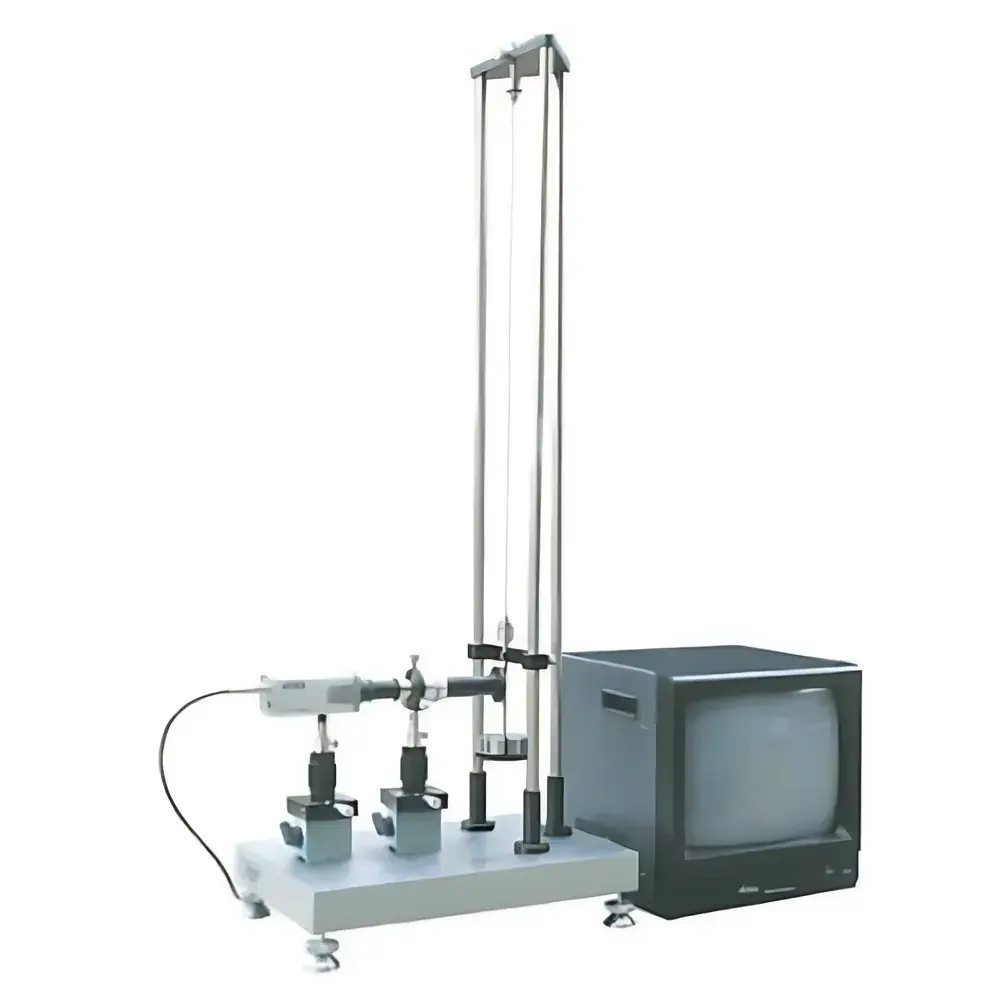
TP WYM-1 CCD-Based Young’s Modulus Measurement System
| Brand | TP |
|---|---|
| Origin | Tianjin, China |
| Manufacturer Type | Manufacturer |
| Country of Origin | China |
| Model | WYM-1 |
| Price | Upon Request |
| Steel Wire | ~90 cm length, Ø 0.25 mm |
| Molybdenum Wire | ~90 cm length, Ø 0.125 mm |
| Reading Microscope | 25× magnification, 0.05 mm graduation |
| CCD Camera | Monochrome, 420 TV lines/mm resolution |
| Vertical Column | Adjustable height, ~100 cm max |
| Monitor | 14-inch monochrome video display |
| Operating Temperature | −5 °C to 40 °C |
| Relative Humidity Range | 10–80 % RH |
| Relative Uncertainty in Young’s Modulus | <5 % |
Overview
The TP WYM-1 CCD-Based Young’s Modulus Measurement System is an educational precision instrument engineered for undergraduate and vocational physics laboratories to quantitatively determine the tensile elastic modulus (Young’s modulus) of metallic wires using the static extension method. It operates on classical Hookean mechanics: a vertically suspended wire—typically stainless steel or molybdenum—is subjected to incremental static loads (standard calibrated masses), inducing measurable axial elongation ΔL. The system replaces manual ocular observation with a high-stability optical path integrating a 25× reading microscope, a monochrome CCD imaging sensor (420 TV lines/mm resolution), and real-time video output to a dedicated 14-inch monochrome monitor. This configuration eliminates observer parallax, reduces visual fatigue during prolonged experiments, and enables consistent frame capture for digital displacement analysis. The apparatus is fundamentally aligned with ASTM E8/E8M and ISO 6892-1 standards for uniaxial tensile testing of metallic materials—adapted here for pedagogical clarity, reproducibility, and hands-on verification of linear elasticity theory.
Key Features
- CCD-assisted real-time imaging system replaces subjective eye-based measurement, improving inter-observer consistency and enabling frame-by-frame review of wire displacement
- Adjustable-height vertical column (~100 cm maximum) accommodates variable wire lengths and facilitates alignment stability under load
- Dual-wire test capability: includes standardized stainless steel (Ø 0.25 mm, ~90 cm) and molybdenum (Ø 0.125 mm, ~90 cm) specimens for comparative modulus analysis
- High-contrast 25× reading microscope with 0.05 mm minimum scale division ensures sub-millimeter positional resolution at the wire marker
- Built-in calibration-ready design: mass loading platform accepts standard slotted weights; all mechanical interfaces are rigidly constrained to minimize torsional or lateral deflection
- Integrated software package supports automated calculation of stress (σ = F/A), strain (ε = ΔL/L₀), and Young’s modulus (E = σ/ε), with uncertainty propagation based on input tolerances (mass, length, diameter, displacement)
Sample Compatibility & Compliance
The WYM-1 is optimized for uniform-diameter cylindrical metallic wires up to 100 cm in length and ≤0.3 mm in diameter. Stainless steel and molybdenum specimens are supplied as reference standards; users may substitute other ductile metals (e.g., copper, brass, aluminum) provided dimensional consistency and surface homogeneity are verified prior to testing. All mechanical components comply with ISO 2768-mK general tolerances for laboratory equipment. The system supports GLP-aligned documentation workflows: raw displacement frames, mass-loading logs, and calculated E-values can be exported in CSV format for audit trail reconstruction. While not certified for industrial QA/QC, its measurement uncertainty (<5% relative) meets typical requirements for academic validation of Hooke’s law and introductory solid mechanics curricula per AAPT (American Association of Physics Teachers) lab guidelines.
Software & Data Management
The bundled Windows-compatible software provides a streamlined interface for experiment setup, data acquisition, and statistical analysis. Users input nominal wire dimensions (length L₀, diameter d), mass increments (M), and gravitational acceleration (g); the software computes cross-sectional area A = π(d/2)² and theoretical stress σ = Mg/A. Displacement values (ΔL) are entered manually from monitor readings—or imported via optional frame-capture timestamping. The program calculates E = (MgL₀)/(A·ΔL) for each load step, performs linear regression on the σ–ε plot, reports slope (E), R² coefficient, and propagates combined standard uncertainty using partial derivatives of all input variables. Export options include PDF lab reports with embedded images and CSV datasets compatible with MATLAB, Python (NumPy/Pandas), or Excel for advanced curve fitting and error modeling.
Applications
- Undergraduate physics labs: direct experimental verification of Hooke’s law, stress–strain linearity, and the definition of Young’s modulus
- Materials science instruction: comparative analysis of elastic behavior across metal classes (e.g., stiffness ratio Mo/SS ≈ 2.3)
- Instrumentation courses: study of optical lever amplification, CCD resolution limits, and analog-to-digital image-based metrology
- Engineering mechanics labs: correlation of macroscopic elastic response with atomic-scale bonding energy models
- Teacher training programs: demonstration of uncertainty budgeting, repeatability assessment, and systematic error identification (e.g., thermal drift, creep, clamp slippage)
FAQ
Is the WYM-1 suitable for research-grade material characterization?
No—it is designed strictly for educational use with controlled boundary conditions and known specimen geometries. Industrial tensile testers (e.g., Instron, Zwick) are required for ASTM-compliant certification.
Can I use custom wire specimens?
Yes, provided diameter uniformity is verified via micrometer (±0.002 mm tolerance) and surface defects (scratches, kinks) are absent. Diameter must be measured at ≥3 positions along the gauge length.
Does the system support USB or HDMI video output?
No—the standard configuration uses composite video (RCA) output to the included 14-inch monochrome monitor. Optional USB-Capture dongles may be integrated for PC-based recording.
What environmental conditions affect measurement accuracy?
Ambient temperature fluctuations >1 °C/min induce thermal expansion artifacts; humidity >80 % RH risks condensation on optical surfaces. Lab HVAC stabilization is recommended.
Is software source code or API access available for customization?
No—the application is closed-source but permits batch export of raw inputs and results for external processing. No SDK or command-line interface is provided.





