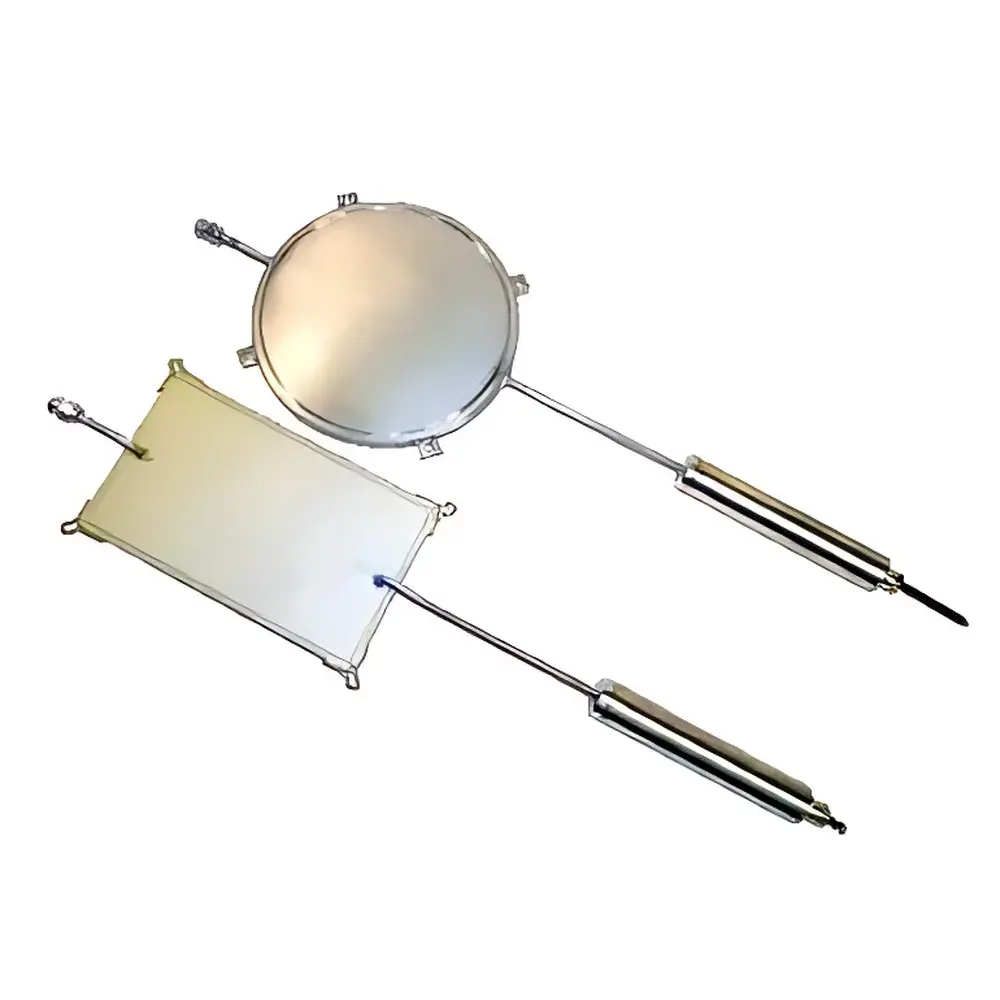
TPC Earth Pressure Cell by Roctest
| Brand | Roctest |
|---|---|
| Origin | Canada |
| Model | TPC |
| Output Options | Vibrating Wire (VW), 4–20 mA, 0–5 Vdc, Pneumatic, Fiber Optic |
| Construction | Hermetically sealed stainless steel housing filled with de-aired oil |
| Shape Options | Circular or Rectangular (for tangential/radial stress in shotcrete tunnel linings) |
| Mounting | Four integrated metal mounting rings |
| Temperature Sensing | Built-in thermistor |
| Environmental Rating | IP68 (VW version), Surge-protected (VW) |
| Compliance | ISRM Recommended Methods for Rock Stress Measurements |
| Stiffness | High (enabling embedment in soil/concrete), with peripheral grooves to reduce off-axis sensitivity |
Overview
The TPC Earth Pressure Cell, engineered by Roctest (Canada), is a high-stability geotechnical transducer designed for long-term in-situ measurement of normal earth pressure and concrete contact stress in civil and mining infrastructure. Operating on the principle of hydraulic force transmission, the sensor consists of a rigid, hermetically sealed stainless steel pressure cell—either circular or rectangular—filled with de-aired, low-compressibility oil. External load applied to the active face induces proportional hydrostatic pressure within the oil volume, which is transmitted via a rigid steel conduit to a remotely mounted secondary transducer (e.g., vibrating wire, analog voltage/current, pneumatic, or fiber optic). This mechanical-hydraulic coupling decouples the sensing element from harsh installation environments while preserving signal integrity and minimizing thermal drift. The TPC’s high structural stiffness ensures minimal deformation under load, enabling reliable embedment in compacted soils, roller-compacted concrete, shotcrete linings, and foundation rock masses. Its design adheres strictly to ISRM (International Society for Rock Mechanics) guidelines for stress cell calibration, installation geometry, and data interpretation—making it suitable for critical applications where traceability, repeatability, and regulatory defensibility are required.
Key Features
- Robust dual-plate stainless steel construction with full perimeter welding and IP68-rated sealing (VW variant)
- Integrated thermistor for simultaneous temperature monitoring—essential for thermal compensation analysis in long-term monitoring programs
- Four symmetrically positioned stainless steel mounting rings simplify alignment and secure anchoring during backfilling or concrete placement
- Peripherally machined grooves reduce lateral constraint effects, enhancing directional selectivity toward normal (axial) stress while suppressing sensitivity to shear or bending moments
- Vibrating wire output includes built-in surge protection and supports ASTM D4767-compliant data logging protocols
- Rectangular variant enables orthogonal stress resolution in sprayed concrete tunnel linings—supporting both radial and tangential stress vector analysis per ITA-AITES recommendations
- Compatible with industry-standard data acquisition systems including Campbell Scientific CR-series, Geokon GKS, and Roctest’s own GeoMON software platform
Sample Compatibility & Compliance
The TPC is validated for direct embedment in granular soils (sand, gravel), cohesive fills (clay, silt), mass concrete, roller-compacted concrete (RCC), and wet-mix shotcrete. Its high stiffness prevents significant local disturbance during installation, satisfying ASTM D7392 and ISO 18674-2 requirements for minimally invasive stress measurement. All variants comply with ISRM’s “Suggested Methods for Rock Stress Measurements Using Hydraulic Fracturing and Stress Cells” for calibration traceability and field verification procedures. VW-equipped units meet IEC 61000-4-5 (surge immunity) and support GLP-compliant audit trails when used with calibrated, time-stamped DAQ systems. The device carries no CE marking but conforms to CSA C22.2 No. 1010.1 for industrial electrical safety when interfaced with certified signal conditioners.
Software & Data Management
Raw outputs (frequency shift for VW, mV/V for strain-gauge variants, or digital pulse counts) are processed using Roctest’s GeoMON v5.2 or third-party platforms compliant with IEEE 1451.2 smart transducer interface standards. Calibration coefficients—including temperature-dependent zero drift and sensitivity factors—are stored in non-volatile memory and auto-loaded during initialization. Data files adhere to ASTM E2234-compliant CSV structure with embedded metadata (sensor ID, installation depth, orientation, thermistor reading, timestamp, and QA/QC flags). For regulated environments (e.g., dam safety monitoring per ICOLD Bulletin 135), optional 21 CFR Part 11 modules provide electronic signature, role-based access control, and immutable audit logs.
Applications
- Monitoring interfacial contact pressure between concrete dam foundations and bedrock
- Quantifying active/passive lateral earth pressures behind retaining walls and diaphragm piles
- Measuring consolidation-induced stress redistribution in hydraulic fill embankments
- Assessing shotcrete-to-rock bond stress and circumferential load transfer in NATM tunnels
- Validating numerical models (e.g., PLAXIS 2D/3D, FLAC) through back-analysis of measured stress histories
- Long-term performance evaluation of landfill liner systems and MSE wall reinforcement zones
FAQ
What is the typical calibration uncertainty for the TPC Earth Pressure Cell?
Calibration uncertainty is ±0.5% FS (full scale) at 20 °C, traceable to NRC Canada primary standards.
Can the TPC be used in submerged or high-pH concrete environments?
Yes—the 316L stainless steel housing and de-aired silicone oil filling ensure compatibility with pH 4–12 and continuous submersion up to 200 m water head.
How is thermal drift compensated in long-term deployments?
Compensation requires concurrent thermistor readings and site-specific empirical correction curves derived from controlled thermal cycling tests per ASTM D4767 Annex A4.
Is grouting required around the TPC during embedment?
No—grouting is discouraged; the TPC is designed for direct contact with host material. For concrete applications, an optional pressurization tube allows post-cure re-contact adjustment.
What is the maximum recommended burial depth for the TPC in cohesionless soils?
Up to 50 m depth is supported, provided conduit routing avoids sharp bends (>10× pipe diameter radius) and differential settlement zones.