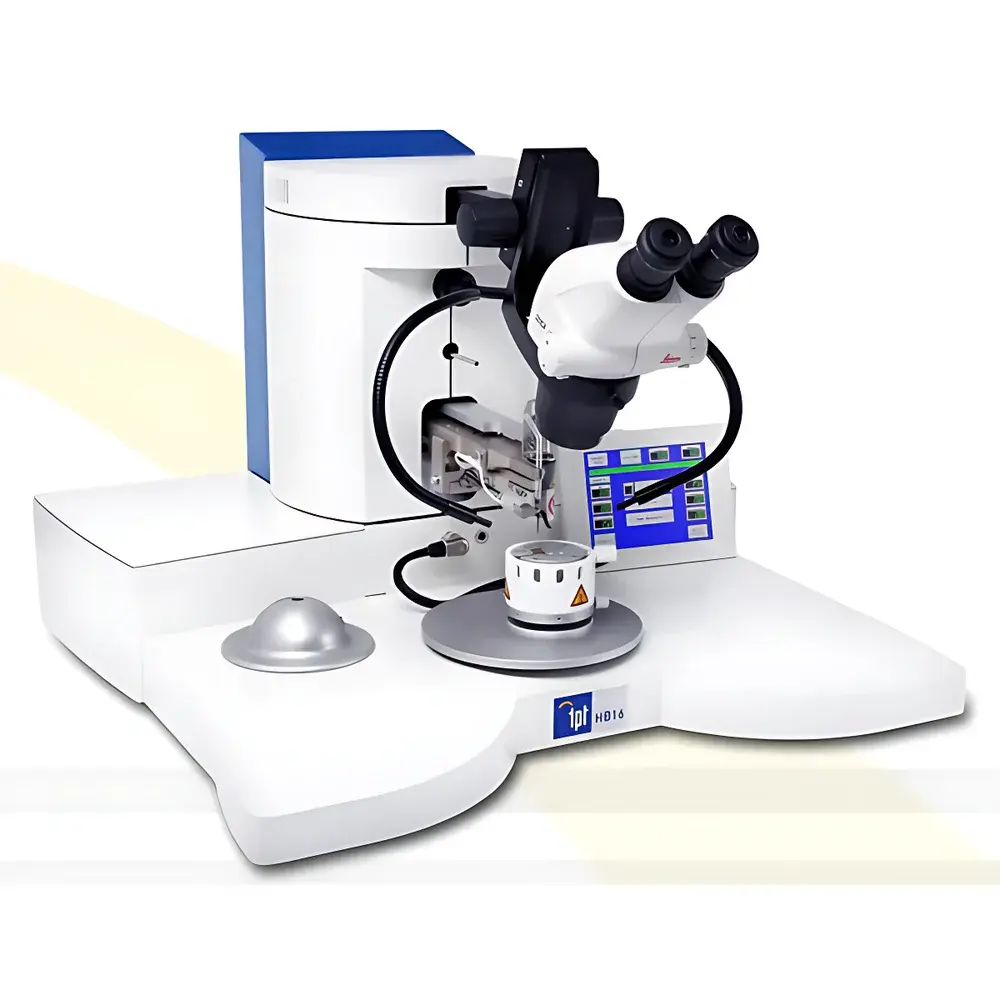
TPT HB10 Semi-Automatic Thermosonic Wire Bonder
| Brand | TPT |
|---|---|
| Origin | Germany |
| Model | HB10 |
| Bonding Methods | Wedge-Wedge, Ball-Wedge, Ribbon & Bump Bonding |
| Wire Diameter Range | 17–75 µm (gold/aluminum) |
| Ribbon Size | up to 25 × 250 µm |
| Ultrasonic Frequency | 62 kHz, PLL-controlled |
| Ultrasonic Power Output | 0–5 W |
| Bond Time | 0–10 s |
| Bond Force | 5–150 cNm (350 cNm optional) |
| Motorized Z-Axis Stroke | 17 mm |
| Deep-Cavity Bond Head Clearance | 16 mm |
| Bond Arm Length | 165 mm |
| Touchscreen Interface | 6.5" LCD |
| Program Storage Capacity | 100 recipes |
| Temperature Control Range | up to 250 °C (±1 °C) |
| Power Supply | 100–240 V AC, ±10%, 50/60 Hz, max. 10 A |
| Dimensions (W×D×H) | 680 × 640 × 490 mm |
| Net Weight | 42 kg |
Overview
The TPT HB10 Semi-Automatic Thermosonic Wire Bonder is a precision-engineered benchtop bonding platform designed for R&D laboratories, pilot-line validation, and low-volume production environments in semiconductor packaging, MEMS, power electronics, and advanced sensor manufacturing. It implements thermosonic bonding—a hybrid process combining controlled heat, ultrasonic energy, and mechanical force—to form reliable metallurgical interconnections between wire or ribbon and bond pads on die or substrates. The system supports multiple bonding modalities—including ball-wedge, wedge-wedge, ribbon, and bump bonding—within a single modular head architecture, enabling rapid reconfiguration via tooling exchange (e.g., capillary vs. wedge tool). Its motorized Z-axis, electronically regulated ball diameter control, and programmable thermal profile ensure high reproducibility across diverse wire materials (Au, Al, Cu) and geometries (17–75 µm round wire; 25 × 250 µm ribbon), making it suitable for qualification of next-generation interconnects under GLP-aligned development workflows.
Key Features
- Multi-mode bonding head compatible with ball, wedge, ribbon, and bump configurations—switching requires only tool change, no hardware retrofitting
- Motor-driven Z-axis with 17 mm stroke and 6:1 mechanical reduction ratio for precise, repeatable force application and depth control
- 62 kHz PLL-synchronized ultrasonic generator delivering stable 0–5 W output with real-time feedback for consistent energy coupling
- 6.5-inch capacitive touchscreen HMI with intuitive parameter entry, recipe navigation, and live status monitoring
- Electronic ball diameter control integrated with arc height and tail length calibration routines for Au ball formation repeatability
- Deep-cavity bond head design accommodating up to 16 mm substrate clearance—ideal for stacked-die, cavity-down packages, and thick substrates
- Motorized wire feed and clamp-cut severing mechanism ensuring clean break termination and minimal wire slack
- Optional pull-test module compliant with ASTM F459 and MIL-STD-883 Method 2011.9 for post-bond mechanical verification
- USB-based recipe backup and firmware update capability supporting version-controlled process documentation
Sample Compatibility & Compliance
The HB10 accommodates standard semiconductor substrates including silicon wafers (up to 8″), ceramic DIPs, leadframes, and organic laminates. It supports gold (17–75 µm), aluminum (17–75 µm), and copper (optional upgrade) wire types, as well as flat ribbon (max. 25 × 250 µm) for high-current applications. All thermal profiles are traceable to NIST-traceable reference standards, and temperature stability is maintained at ±1 °C over the full 25–250 °C operating range. The system meets CE marking requirements per EN 61000-6-2 (immunity) and EN 61000-6-4 (emissions), and its software architecture supports audit-ready operation under ISO 9001 and IATF 16949 quality management frameworks. Optional 21 CFR Part 11-compliant electronic signature and audit trail modules are available for regulated medical device packaging development.
Software & Data Management
The HB10 runs on embedded real-time OS with deterministic cycle timing and non-volatile recipe storage for up to 100 distinct processes. Each recipe includes independent settings for ultrasonic power ramp, bond time, force profile, temperature ramp/soak, and loop geometry parameters. Parameter changes are logged with timestamp, operator ID (via optional LDAP integration), and reason code. USB export enables CSV-formatted logs for SPC analysis in JMP or Minitab. Firmware updates preserve user-defined calibration offsets and do not reset factory defaults. Remote diagnostics via Ethernet (optional) allow OEM-level support without physical access.
Applications
- Qualification of Cu wire bonding processes for automotive-grade power modules
- Development of fine-pitch ball-wedge interconnects in RF SiP assemblies
- Prototyping ribbon bonds for GaN HEMT packaging requiring low-inductance, high-current paths
- Reliability testing of thermosonic bonds under accelerated temperature-humidity bias (THB) conditions
- Process window optimization for low-k dielectric pad metallization (Al/NiV/Cu stacks)
- Failure analysis correlation using synchronized bond parameter logging and post-process SEM/X-ray inspection
FAQ
Is copper wire bonding supported out-of-the-box?
Copper wire bonding requires optional hardware upgrades—including inert gas purge interface, enhanced oxidation mitigation firmware, and specialized capillary coatings—and is validated separately per customer process requirements.
Can the HB10 be integrated into a semi-automated line?
Yes—the system provides TTL and RS-232 I/O for external start/stop signaling, vacuum status feedback, and recipe selection triggers; custom PLC interface kits are available upon request.
What calibration standards does the force sensor comply with?
The load cell is factory-calibrated against ISO/IEC 17025-accredited deadweight standards, with annual recalibration recommended using traceable torque wrenches per ASTM E2502.
Does the touchscreen support multi-language UI?
English and German language packs are included; additional languages (Japanese, Chinese, Korean) may be deployed via firmware update subject to localization validation.
Is remote software support available outside business hours?
TPT offers 24/5 remote assistance via secure VPN tunneling for critical troubleshooting, with SLA-backed response times defined in service contracts.