
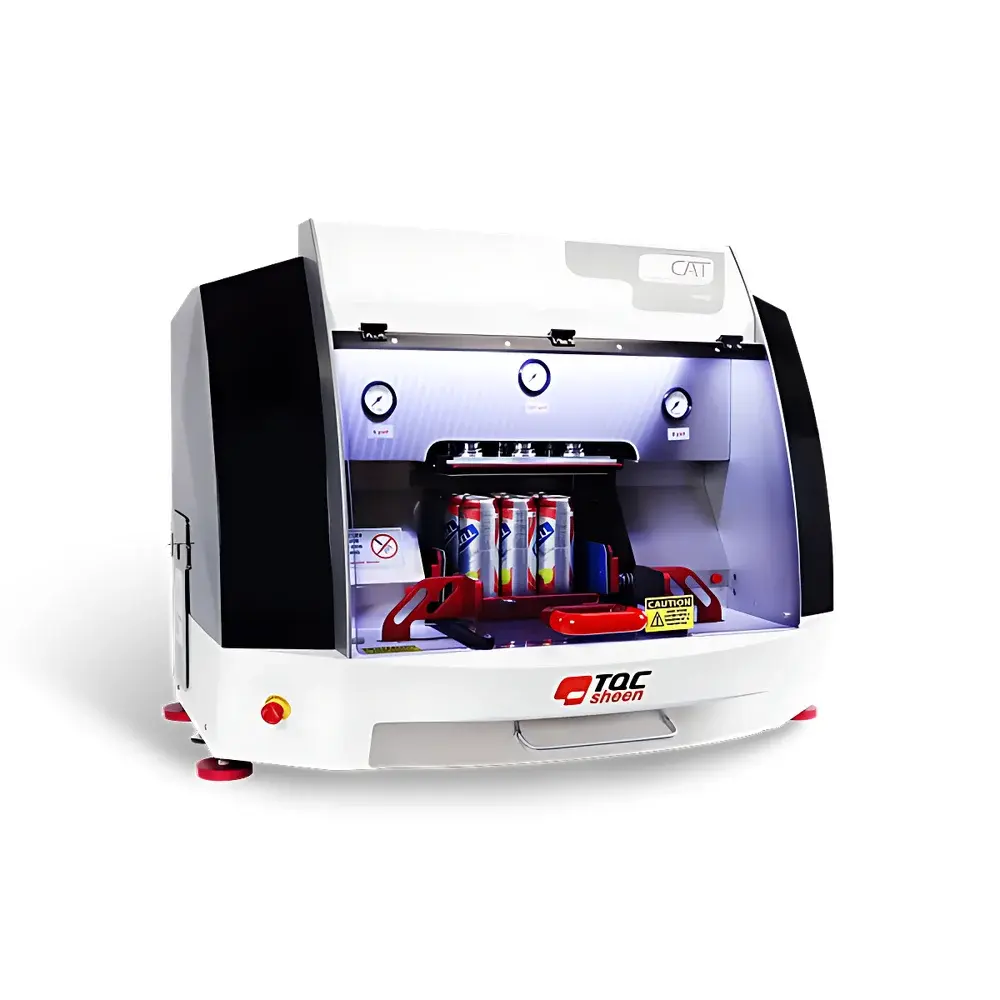
TQC Sheen CAT Can Abrasion Tester
| Brand | TQC Sheen |
|---|---|
| Origin | Netherlands |
| Model | CAT |
| Stroke Length | 12.7–50.8 mm (0.5–2 in) |
| Frequency Range | 0–2.5 Hz |
| Top Cylinder Pressure | 0–6 bar (0–87 psi) |
| Side Cylinder Pressure | 0–6 bar (0–87 psi) |
| Compatible Can Volume | 150–1000 mL |
| Minimum/Maximum Can Diameter | 53–84 mm |
| Minimum/Maximum Can Height | 88–205 mm |
| Operating Temperature | 0–50 °C (32–122 °F) |
| Operating Humidity | 0–90 % RH (non-condensing) |
| Power Supply | 100–240 VAC, 50–60 Hz |
| Air Supply | 8 bar ±20 % |
| Sound Level | <70 dB(A) |
| Weight | 125 kg (276 lb) |
| Dimensions | 1050 × 790 × 760 mm (41.3 × 31.1 × 29.9 in) |
Overview
The TQC Sheen CAT Can Abrasion Tester is a precision-engineered tribological testing system designed to replicate the mechanical wear mechanisms experienced by metal beverage cans during road and rail transport. Based on reciprocating linear motion under controlled pneumatic loading, the CAT employs dual-axis actuation—vertical compression via top cylinder and lateral oscillation via side cylinder—to simulate real-world abrasion conditions including vibration, sliding contact, and intermittent impact between adjacent cans or between cans and corrugated packaging. Its core measurement principle relies on standardized mechanical stress application rather than optical or electrical signal detection; wear severity is quantified post-test through visual inspection, gloss loss assessment, coating thickness profiling (with optional profilometry), or leakage verification per ASTM D4332 and ISO 2234. The instrument is not a generic abrasion tester but a purpose-built solution aligned with industry-specific failure modes—particularly aluminum can lacquer integrity, ink adhesion on printed substrates, and barrier layer durability under dynamic load.
Key Features
- Dual-pneumatic actuation system: independent control of top cylinder pressure (0–6 bar) and side cylinder pressure (0–6 bar) enables precise simulation of stacking load and lateral shear forces encountered in palletized freight.
- Adjustable stroke length (12.7–50.8 mm) and frequency (0–2.5 Hz) allow replication of diverse transportation profiles—from smooth highway transit to rough rural road conditions—per EN 15147-1 and ISTA 3A protocols.
- Modular sample holder accommodates cylindrical containers from 150 mL to 1000 mL, with diameter (53–84 mm) and height (88–205 mm) ranges covering standard beverage, food, and aerosol can formats.
- Robust steel frame and vibration-damped base ensure mechanical stability during extended test cycles, minimizing extraneous resonance that could compromise repeatability.
- Integrated safety interlocks, emergency stop circuitry, and pressure relief valves comply with CE machinery directive 2006/42/EC and ISO 13857 requirements for operator protection.
- Low-noise operation (<70 dB(A)) permits integration into shared laboratory environments without acoustic isolation infrastructure.
Sample Compatibility & Compliance
The CAT supports evaluation of coated aluminum cans, laminated paperboard cartons, metallized PET containers, and printed polymer sleeves. It accepts both filled and empty cans—though empty cans are recommended for standardized QC testing to eliminate fluid damping effects. Test specimens must meet dimensional tolerances specified in ISO 9001:2015 Annex A.2 for measurement system analysis (MSA). The instrument itself conforms to IEC 61000-6-2 (immunity) and IEC 61000-6-4 (emissions), and its pneumatic control architecture meets ISO 8573-1 Class 4 air quality standards. While the CAT does not carry FDA 21 CFR Part 11 certification out-of-the-box, audit-ready test logs—including timestamped parameter sets, operator ID, and cycle count—can be exported in CSV format for GLP/GMP traceability when paired with validated LIMS integration.
Software & Data Management
The CAT operates via front-panel membrane keypad with LED status indicators—no proprietary software is required for basic operation. However, optional RS-232 or USB-to-serial interface enables connection to external PCs running custom Python- or LabVIEW-based automation scripts for unattended multi-cycle sequencing and parameter logging. All user-defined test programs (stroke, frequency, duration, pressure setpoints) are stored in non-volatile memory with battery-backed retention (>10 years). Raw operational data—including real-time pressure feedback, cycle counter, and elapsed time—is accessible via ASCII command protocol (AT-style syntax). For regulated environments, users may implement third-party electronic lab notebook (ELN) systems to capture digital signatures, version-controlled SOPs, and audit trails compliant with 21 CFR Part 11 Annex 11 requirements.
Applications
- Coating qualification for beverage can interior/exterior lacquers (e.g., epoxy-phenolic, PVDC, acrylic) per ASTM D3359 cross-hatch adhesion and ISO 20567-1 erosion resistance standards.
- Validation of UV-curable inks and overprint varnishes on aluminum substrates subjected to high-speed filling and palletizing lines.
- Comparative wear ranking of alternative can materials (e.g., steel vs. aluminum vs. biopolymer-coated variants) under identical transport stress profiles.
- Root cause analysis of field failures involving pinhole corrosion, delamination, or label scuffing—correlating lab-generated wear patterns with customer complaint samples.
- Supplier qualification testing for coil coaters, can makers, and ink formulators operating under joint QSR (Quality System Requirements) agreements with global CPG brands.
FAQ
What standards does the CAT directly support?
The CAT is engineered to enable execution of test methods referenced in ASTM D4332 (conditioning containers), ISO 2234 (packaging vibration testing), and EN 15147-1 (metal packaging abrasion resistance), though it does not perform automated pass/fail judgments.
Can the CAT test non-cylindrical packages?
Yes—using optional flat-sample adapters and rectangular wear blocks, the system accommodates printed cardboard panels, flexible pouches, and book covers per ISO 12947-2 Martindale abrasion methodology.
Is calibration traceable to national standards?
Pressure transducers are factory-calibrated against NIST-traceable references; users receive a calibration certificate valid for 12 months. Annual recalibration is recommended and supported by TQC Sheen’s EU-accredited service centers.
Does the CAT require compressed air drying or filtration?
Yes—supply air must meet ISO 8573-1 Class 4 (solid particle size ≤5 µm, dew point ≤3 °C) to prevent cylinder seal degradation and ensure consistent actuation force.
How is wear severity quantified?
Quantification is method-dependent: visual rating per ISO 4628-2 (blistering), gloss reduction measured with a 60° glossmeter (ASTM D523), or coating thickness loss assessed using eddy-current or XRF techniques pre- and post-test.



