
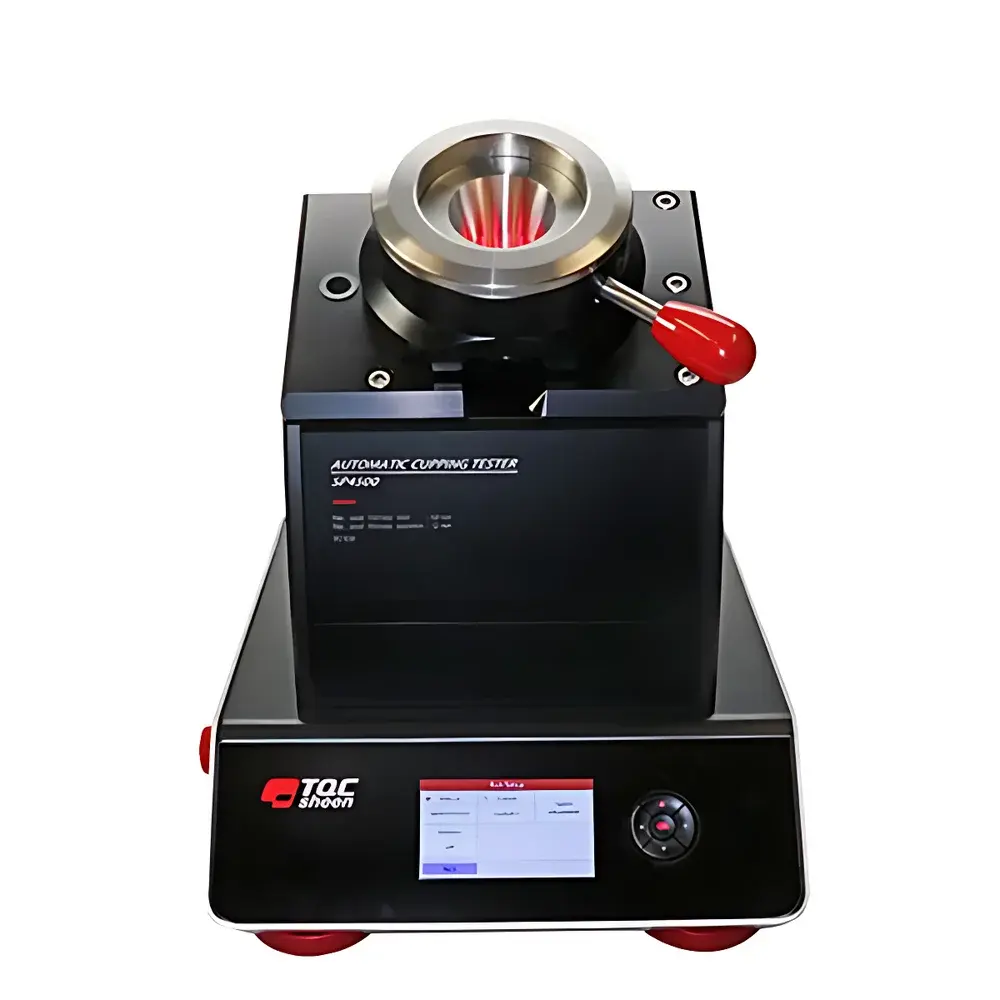
TQC Sheen Erichsen Cupping Tester
| Brand | TQC Sheen |
|---|---|
| Origin | Netherlands |
| Manufacturer Type | Authorized Distributor |
| Origin Category | Imported |
| Model | Erichsen Cupping Tester |
| Pricing | Upon Request |
| Maximum Specimen Thickness | 1.2 mm (steel or aluminum) |
| Maximum Specimen Width | 95 mm |
| Punch Diameter | 20 mm (hardened steel) |
| Die Diameter | 27 mm (hardened steel) |
| Depth Resolution | 0.01 mm |
| Maximum Indentation Depth | 15 mm |
| Displacement per Handle Rotation | 0.48 mm/rev |
| Dimensions (L×W×H) | 313 × 340 (including handle) × 370 mm |
| Construction Materials | Anodized aluminum, stainless steel, tungsten carbide components |
| Net Weight | 16 kg |
Overview
The TQC Sheen Erichsen Cupping Tester is a precision-engineered mechanical testing instrument designed to evaluate the cold-forming behavior and ductility of metallic sheet materials—particularly coated steel, aluminum, and other thin-gauge substrates used in automotive, appliance, and packaging industries. Based on the standardized Erichsen cupping test principle (ISO 20482, ASTM E643, EN ISO 8496), the device applies controlled, quasi-static biaxial strain via a spherical punch driven vertically into a clamped specimen until localized fracture or critical deformation occurs. The resulting cup depth—measured with micrometer-grade resolution—is directly correlated to material formability, coating adhesion integrity, and resistance to cracking under complex stress states. Unlike automated hydraulic systems, this manually operated tester delivers high reproducibility through calibrated mechanical displacement and rigid kinematic architecture, making it ideal for routine QC labs where traceability, operator independence, and minimal maintenance are prioritized.
Key Features
- High-precision mechanical drive system with 0.48 mm linear displacement per full handle rotation, enabling fine-grained control over punch advancement and repeatable test execution.
- Digital depth measurement module with 0.01 mm resolution and integrated zero-reset function, compliant with ISO 20482 calibration requirements for cup depth reporting.
- Adjustable specimen clamping mechanism with angular positioning capability, accommodating non-orthogonal sample alignment and ensuring uniform radial constraint during deformation.
- Multi-LED illumination system with selectable color modes (white, blue, red) enhances visual contrast for detecting micro-cracks, coating delamination, or edge splitting—critical for post-test failure analysis.
- Bilingual (English/Spanish/French/German) user interface with intuitive soft-key navigation; supports firmware-upgradable language packs for global laboratory deployment.
- Modular construction using anodized aluminum housing, stainless-steel structural components, and tungsten carbide punch/die inserts ensures long-term dimensional stability and wear resistance under repeated loading cycles.
Sample Compatibility & Compliance
The tester accommodates flat specimens up to 95 mm wide and 1.2 mm thick—including cold-rolled steel, galvanized steel, aluminum alloys (e.g., AA1050, AA3003), and pre-painted or coil-coated sheets. Clamping force is mechanically optimized to prevent slippage without inducing edge buckling. All test parameters adhere to internationally recognized standards: ISO 20482 (Erichsen cupping test), ASTM E643 (tensile strain hardening exponent and plastic strain ratio), EN ISO 8496 (metallic materials—cupping test), and DIN 53156 (coating adhesion assessment). The instrument’s mechanical design and calibration methodology support GLP-compliant documentation workflows when paired with certified traceable depth gauges and logbook-based audit trails.
Software & Data Management
While the base unit operates as a stand-alone mechanical tester, optional USB-connected digital readout modules enable direct data capture into Excel-compatible CSV files or LIMS-integrated platforms. Firmware supports timestamped test records, operator ID tagging, and configurable pass/fail thresholds based on predefined cup depth limits (e.g., ≥8.0 mm for Class A automotive panels). Audit trail functionality meets FDA 21 CFR Part 11 requirements when deployed with validated software extensions, including electronic signature prompts and immutable record archiving. Calibration certificates include NIST-traceable verification of punch geometry, die concentricity, and depth transducer linearity.
Applications
- Quality control of coil-coated and pre-painted metal substrates in roll-to-roll production environments.
- Evaluation of coating flexibility and interfacial adhesion in architectural cladding and roofing materials.
- Formability screening of lightweight alloys for EV battery enclosures and structural stampings.
- Supplier qualification testing per OEM specifications (e.g., Ford WSS-M2P177-A2, GM GMW14872).
- R&D investigations into strain localization behavior, necking onset, and fracture initiation mechanisms in advanced high-strength steels (AHSS).
- Training and proficiency testing in metallurgical laboratories and technical colleges.
FAQ
What standards does the TQC Sheen Erichsen Cupping Tester comply with?
It conforms to ISO 20482, ASTM E643, EN ISO 8496, and DIN 53156 for cupping testing of metallic sheets and coated products.
Can the instrument be calibrated in-house?
Yes—the device supports user-performed verification using certified depth gauges and reference punches; full recalibration requires authorized service centers with traceable metrology equipment.
Is the tester suitable for non-metallic substrates such as composites or polymer films?
No—it is specifically engineered for metallic sheets with yield strengths up to 500 MPa; alternative test methods (e.g., mandrel bend, conical cupping) are recommended for polymeric or laminated materials.
How is specimen thickness variation accommodated?
The adjustable clamping system includes height-compensating spacers and spring-loaded pressure plates to maintain consistent clamping force across thicknesses from 0.15 mm to 1.2 mm.
Does the unit require external power or compressed air?
No—all functions are manually actuated via ergonomic handle rotation; no electrical supply, pneumatic source, or vacuum system is needed.



