
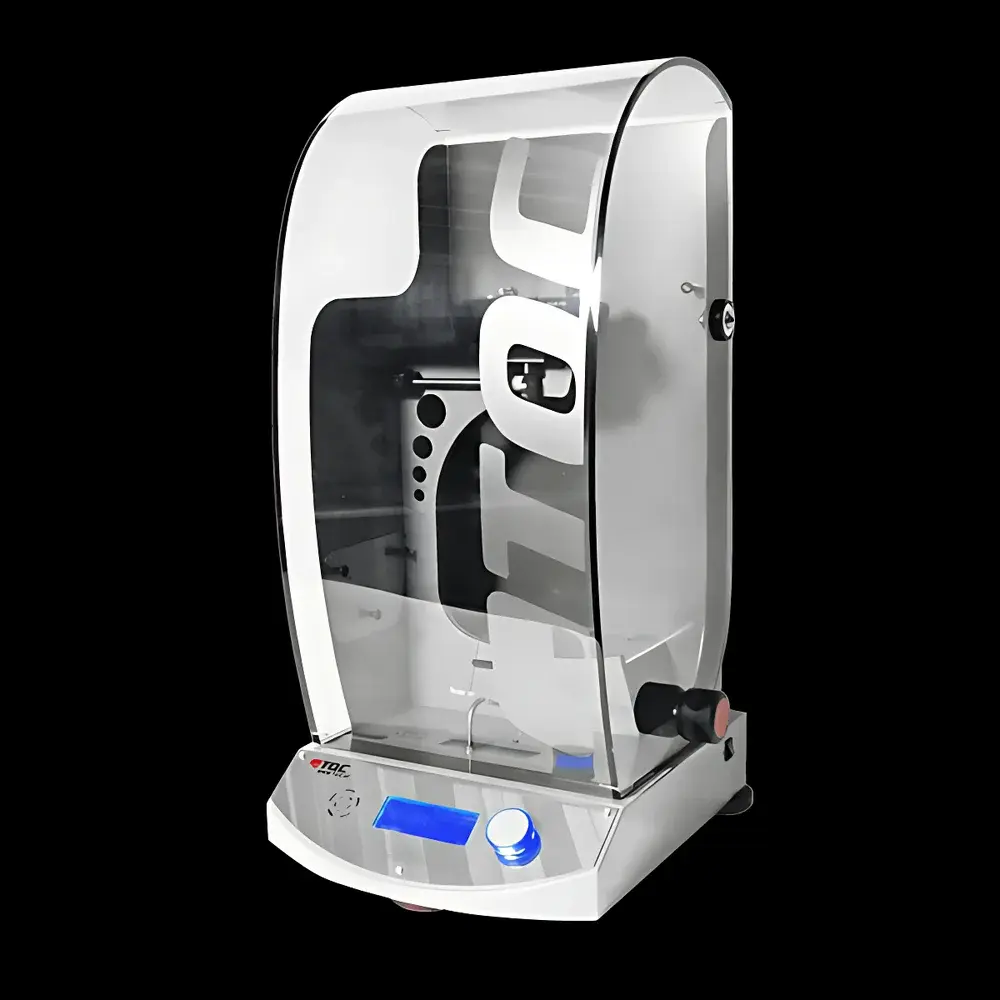
TQC Sheen Persoz & König Pendulum Hardness Tester
| Brand | TQC Sheen |
|---|---|
| Origin | Netherlands |
| Model | Pendulum Hardness Tester |
| Compliance | ISO 1522:2005, NBN T22-105, BS 3900-E5 |
| Dimensions (closed) | 740 × 430 × 430 mm |
| Dimensions (open) | 960 × 430 × 650 mm |
| Weight | 26 kg |
| Housing | Powder-coated steel |
| Front panel & small components | Stainless steel |
| Left side panel | Anodized aluminum |
| Lid | Perspex acrylic (6 mm thick) |
| Power supply | 110 VAC, 50/60 Hz |
| Pendulum types supported | Persoz (SP0510), König (SP0505) |
| Pivot ball material | Tungsten carbide |
| Pivot ball diameters | 8 mm (Persoz), 5 mm (König) |
| Pivot spacing | 50 mm (Persoz), 30 mm (König) |
| Oscillation period | 1.0 s (Persoz), 1.4 s (König) |
| Initial deflection angle | 12° → 4° (Persoz), 6° → 3° (König) |
| Damping time on glass reference | 430 ± 15 s (Persoz), 250 ± 10 s (König) |
| Max sample size | 105 × 200 × 11 mm (Persoz), 105 × 200 × 8.3 mm (König) |
| Counting method | Time-based oscillation decay (vibration = time) |
| Total oscillations at endpoint | 179 ± 7 |
| Adjustable pendulum mass | 500 g / 200 g |
Overview
The TQC Sheen Persoz & König Pendulum Hardness Tester is a precision-engineered instrument designed for non-destructive, quantitative evaluation of the hardness development of organic coatings—particularly paints, varnishes, lacquers, and ink films—on rigid substrates. It operates on the fundamental principle of damped torsional oscillation: a calibrated pendulum, suspended via tungsten carbide pivot points, swings across the coated surface; the rate of amplitude decay (measured as time or number of oscillations until defined angular attenuation) correlates directly with the viscoelastic resistance of the film. This physical damping behavior reflects crosslink density, polymer network rigidity, and solvent evaporation kinetics—parameters critical to coating performance and process validation. The instrument conforms strictly to ISO 1522:2005, which defines two standardized test configurations—Persoz (higher sensitivity, longer damping time) and König (shorter period, higher frequency response)—enabling comparative assessment across formulation batches, curing conditions, and substrate interactions.
Key Features
- Automated dual-mode operation: One-touch selection between Persoz (SP0510) and König (SP0505) pendulum configurations—no manual recalibration required.
- Integrated electronic timing and counting system with microprocessor-controlled release mechanism ensures repeatability independent of operator technique or ambient vibration.
- On-sample bubble level: A precision spirit level mounted directly adjacent to the test area eliminates uncertainty from base-level misalignment; horizontal verification occurs at the measurement plane, not the chassis.
- Transparent Perspex lid with pneumatic gas spring support enables unobstructed visual monitoring and rapid access for pendulum exchange or maintenance.
- Modular pendulum design: Stainless steel arms with precisely adjustable mass (200 g / 500 g options) and interchangeable tungsten carbide pivot inserts (5 mm or 8 mm diameter) guarantee long-term dimensional stability and wear resistance.
- Rugged hybrid construction: Powder-coated steel enclosure, stainless steel front panel and hardware, anodized aluminum side panels, and 6 mm optical-grade acrylic lid ensure corrosion resistance, mechanical integrity, and optical clarity.
Sample Compatibility & Compliance
The tester accommodates flat, rigid specimens up to 105 × 200 mm in plan view and 11 mm (Persoz) or 8.3 mm (König) in thickness—compatible with standard glass slides, metal panels, and plastic plaques used in ASTM D4366, ISO 1522, and BS 3900-E5 qualification protocols. All measurements are traceable to certified reference glass plates (supplied separately), with damping time tolerances rigorously maintained per ISO 1522:2005 Annex A (±15 s for Persoz, ±10 s for König on 6 mm soda-lime glass). The instrument meets requirements for GLP-compliant laboratories: audit-ready test logs (when paired with optional data export), defined operational limits, and documented calibration intervals aligned with NBN T22-105 and ISO/IEC 17025–recommended practices.
Software & Data Management
While the base unit operates as a stand-alone analog-digital hybrid system, optional USB interface modules enable direct acquisition of raw decay curves, endpoint timestamps, and oscillation counts into validated laboratory information management systems (LIMS). Exported datasets include instrument ID, pendulum type, sample ID, ambient temperature/humidity (via external probe input), operator ID, and timestamped result—structured to satisfy FDA 21 CFR Part 11 requirements when deployed with appropriate electronic signature controls. Firmware updates maintain alignment with evolving ISO standards and support configurable pass/fail thresholds for automated QC gatekeeping.
Applications
- Quality control of industrial coatings during production line release testing.
- Formulation R&D: Correlating resin chemistry, catalyst loading, and cure schedule with hardness evolution profiles.
- Accelerated aging studies: Tracking hardness gain over time under controlled UV, thermal, or humidity exposure.
- Substrate adhesion influence assessment: Comparing damping behavior on aluminum, steel, and composite panels.
- Regulatory submission support: Generating ISO 1522–compliant data packages for automotive OEM specifications (e.g., GMW14872, Ford CETP).
- Third-party certification labs performing EN ISO 2813, ISO 2409, and ISO 4624 alongside hardness validation.
FAQ
Is the pendulum included with the base unit?
No—the Persoz (SP0510) and König (SP0505) pendulums are sold separately to allow users to select the appropriate configuration for their application and compliance requirements.
Can the instrument be used for flexible substrates?
ISO 1522 specifies rigid supports only; testing on elastomeric or thin-film substrates introduces uncontrolled energy dissipation and violates standard test conditions. Substrate rigidity must exceed 1 GPa modulus and remain dimensionally stable under pendulum load.
How often does the instrument require calibration verification?
Daily verification using certified reference glass is recommended before first use; full metrological calibration against NIST-traceable standards is advised every 12 months or after any mechanical impact or environmental shock.
Does the tester support automatic report generation?
Yes—when connected to TQC Sheen’s optional LabLink software suite, it generates PDF reports compliant with ISO/IEC 17025 documentation requirements, including uncertainty budgets and instrument calibration status.
What safety certifications does the unit hold?
Certified to IEC 61010-1:2010 for electrical safety and EMC compliance per EN 61326-1:2013, suitable for Class I laboratory environments.



