
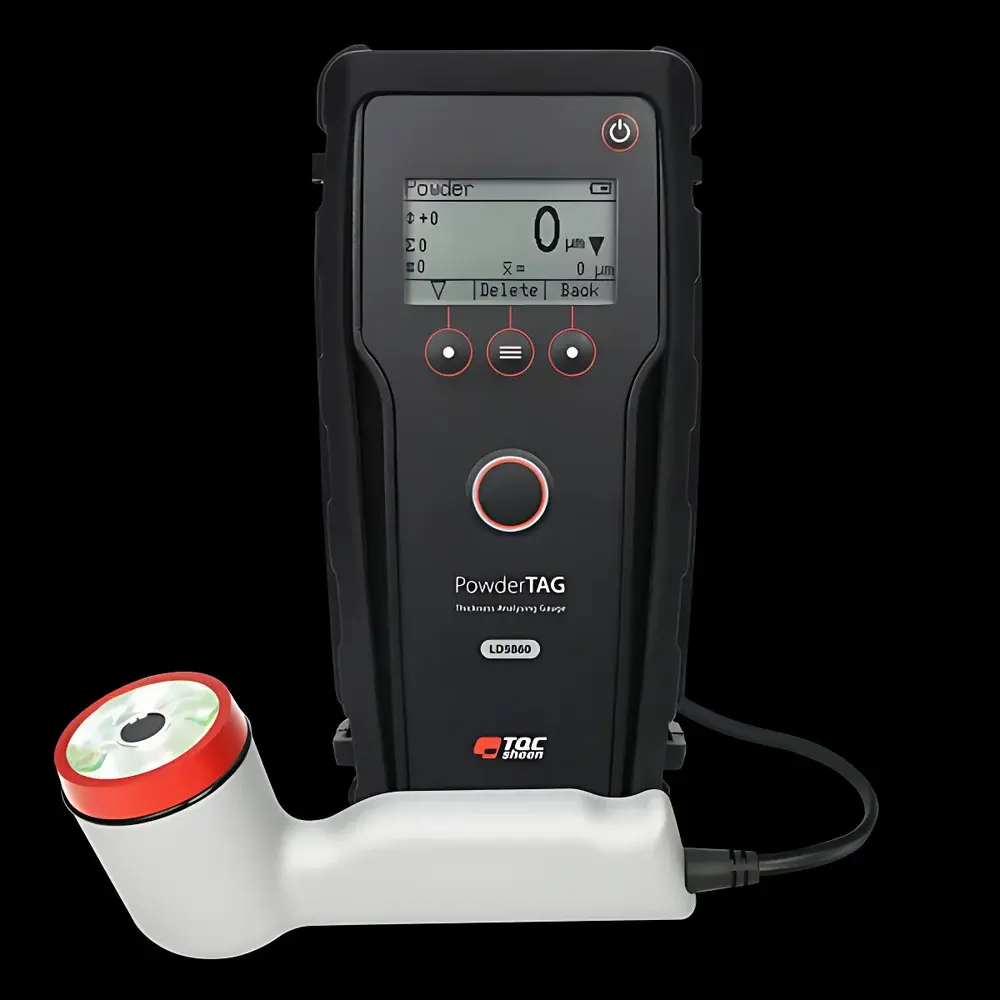
TQC Sheen Powder Coating Thickness Gauge
| Brand | TQC Sheen |
|---|---|
| Origin | Netherlands |
| Model | Powder Coating Thickness Gauge |
| Measurement Range | 0–300 µm |
| Accuracy | ±3% of reading |
| Resolution | ±1% of reading |
| Standoff Distance | ~35 mm |
| Spot Size | 2 × 2 mm |
| Measurement Speed | 1024–2048 measurements/sec |
| Dimensions | 80 × 180 × 43 mm |
| Weight | 700 g |
| Interface | USB |
| Power Supply | 4 × AA Li-ion batteries (3.7 V each), up to 10 hours continuous operation |
| Substrate Compatibility | Ferrous & non-ferrous metals (e.g., steel, aluminum), MDF |
| Operating Humidity | ≤80% RH at 32°C |
| Storage Temperature | 0–55°C |
Overview
The TQC Sheen Powder Coating Thickness Gauge is a non-contact, high-speed electromagnetic induction and eddy current-based instrument engineered for precise, real-time measurement of uncured and cured powder coating thickness on conductive and non-conductive substrates. Unlike traditional destructive cross-sectioning or contact-based magnetic induction gauges, this device employs dual-sensor physics—combining low-frequency eddy current response for non-ferrous metals (e.g., aluminum) and magnetic induction for ferrous substrates (e.g., steel)—while maintaining calibrated sensitivity for MDF via dielectric compensation algorithms. Its fixed standoff distance of 35 mm enables consistent probe-to-surface geometry without mechanical pressure, eliminating substrate deformation risk and operator-induced variability. Designed for inline process validation and laboratory QA/QC workflows, the gauge delivers repeatable results across complex geometries—including edges, corners, recessed profiles, and curved surfaces—without requiring surface preparation or calibration on reference standards for each substrate type.
Key Features
- Non-contact measurement eliminates physical interference with uncured powder layers, preserving film integrity prior to curing.
- Single-button operation with immediate digital readout supports rapid throughput in production environments (up to 2048 measurements per second).
- Dual-mode sensor architecture automatically detects substrate type (ferrous, non-ferrous, or MDF) and selects optimal excitation frequency and signal processing parameters.
- Compact ergonomic design (80 × 180 × 43 mm, 700 g) facilitates handheld use in confined spaces and overhead applications.
- USB interface enables direct data streaming to Windows-based QA software for traceable reporting and statistical process control (SPC) charting.
- Battery-powered operation (4 × AA Li-ion, 3.7 V) ensures uninterrupted field use for up to 10 hours, with low-battery warning and hot-swappable capability.
Sample Compatibility & Compliance
The gauge is validated for use on industrial-grade powder coatings applied to ASTM A653 galvanized steel, ISO 209 aluminum alloys, and EN 622-2 MDF panels. It meets IEC 61000-4-2 (ESD immunity) and IEC 60529 IP54 ingress protection requirements for dust and water resistance during shop-floor deployment. While not certified to ISO 2178 or ISO 2360 as a standalone metrology standard, its measurement methodology aligns with the physical principles defined therein for non-magnetic and non-conductive coating thickness assessment. Data acquisition complies with GLP documentation requirements when used with TQC Sheen’s optional audit-trail-enabled software (v3.2+), supporting 21 CFR Part 11–compliant electronic records where configured with user authentication and change logging.
Software & Data Management
The included PC software (Windows 10/11 compatible) provides real-time graphing, batch export to CSV/Excel, and configurable pass/fail thresholds based on customer-defined specification limits (e.g., ISO 12944 C3–C5 corrosion categories). Each measurement record stores timestamp, GPS coordinates (when connected to external module), substrate ID, operator code, and environmental metadata (ambient temperature/humidity if logged externally). Raw signal waveforms are retained for retrospective analysis, enabling root-cause investigation of outlier readings related to powder charge variation, film bridging, or electrostatic shielding effects. Firmware updates are delivered via secure HTTPS channel with SHA-256 signature verification.
Applications
- Pre-cure thickness verification to prevent under-film defects (e.g., pinholes) or over-application waste.
- Post-cure quality release testing in automotive trim, appliance housings, and architectural aluminum extrusions.
- In-process monitoring during automatic powder spray booths using portable handheld or fixture-mounted configurations.
- R&D evaluation of new powder formulations’ flow behavior and leveling characteristics under varying deposition voltages.
- Supplier qualification audits where third-party labs require traceable, non-destructive thickness verification per OEM technical specifications (e.g., Ford WSS-M2P175-B1, BMW GS 90010).
FAQ
Can this gauge measure thickness on zinc-coated steel?
Yes—the instrument distinguishes between the magnetic permeability of the zinc layer and underlying steel substrate, delivering accurate net organic coating thickness when calibrated per ASTM D7091 Annex A2.
Is calibration required before each use?
No routine recalibration is needed; factory calibration remains stable for ≥12 months under normal operating conditions. Optional annual verification against NIST-traceable shims is recommended for ISO 9001-certified facilities.
Does it work on textured or orange-peel powder finishes?
Yes—the 2 × 2 mm spot size and adaptive signal averaging compensate for micro-topography, provided surface roughness Ra does not exceed 15 µm.
Can data be integrated into MES or SAP QM modules?
Yes—via ODBC-compliant database export or REST API integration (available in Enterprise License edition).
What is the minimum measurable coating thickness on aluminum?
The practical lower limit is 12 µm, constrained by signal-to-noise ratio and natural oxide layer interference, consistent with ISO 2360 Clause 6.3.



