
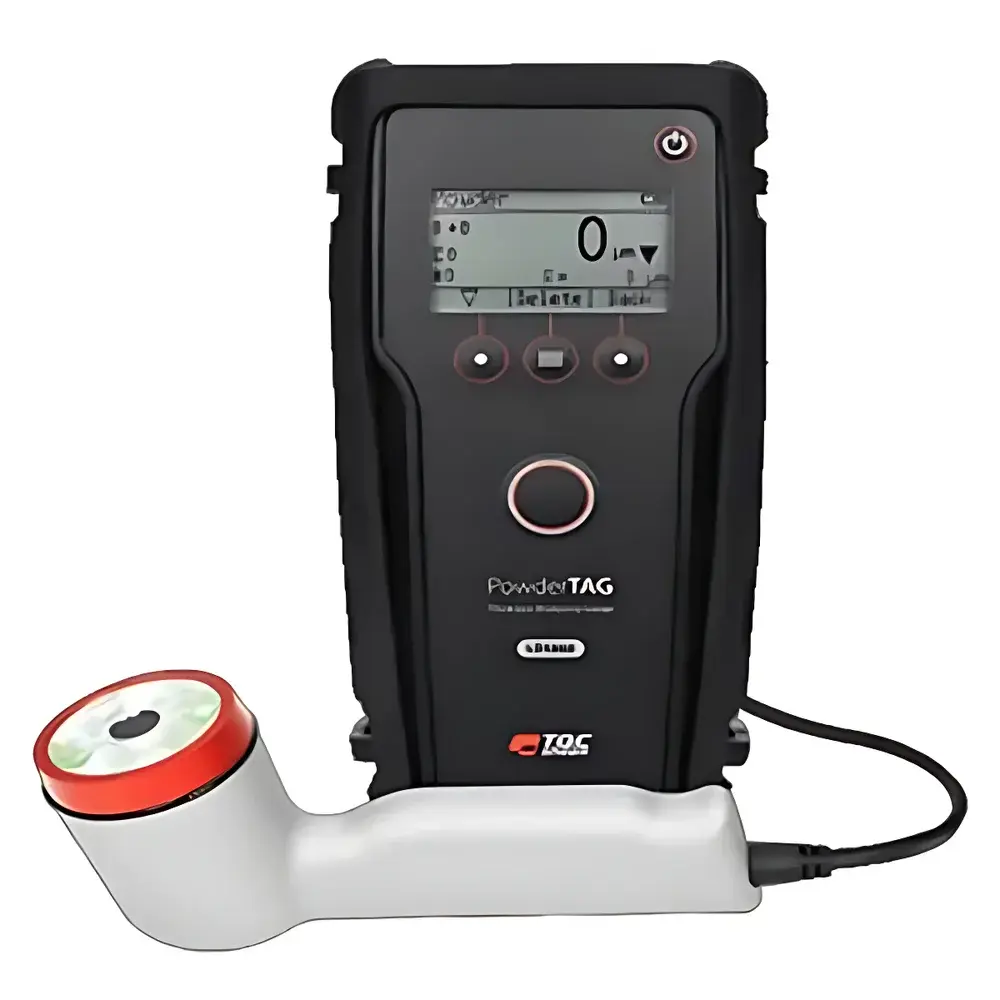
TQC Sheen PowderTAG Non-Contact Powder Coating Thickness Gauge
| Brand | TQC Sheen |
|---|---|
| Origin | Netherlands |
| Model | PowderTAG |
| Measurement Range | 0–300 µm |
| Accuracy | ±3% of reading |
| Resolution | ±1% of reading |
| Standoff Distance | ~35 mm |
| Spot Size | 2 × 2 mm |
| Measurement Speed | 1024–2048 measurements/s |
| Dimensions | 80 × 180 × 43 mm |
| Weight | 700 g |
| Interface | USB |
| Power Supply | 4 × AA Li-ion batteries (3.7 V each), 10 h continuous operation |
| Substrate Compatibility | Ferrous & non-ferrous metals (e.g., steel, aluminum), MDF |
| Relative Humidity Limit | ≤80% at 32°C |
| Storage Temperature | 0–55°C |
| Measurement Principle | Eddy current + capacitance dual-sensor non-contact technology |
Overview
The TQC Sheen PowderTAG is a handheld, dual-technology non-contact thickness gauge engineered specifically for real-time, in-line measurement of uncured and cured powder coatings on conductive and non-conductive substrates. Unlike conventional magnetic induction or eddy current gauges limited to metallic bases, the PowderTAG integrates synchronized eddy current and capacitance sensing to deliver reliable thickness data across a broad substrate spectrum—including steel, aluminum, and medium-density fiberboard (MDF). Its operational principle relies on high-frequency electromagnetic field perturbation (eddy current mode) for metal substrates and dielectric permittivity response (capacitance mode) for non-metals, enabling consistent calibration-free measurement without physical contact or surface preparation. Designed for integration into powder coating production lines, R&D labs, and quality control checkpoints, the PowderTAG supports rapid process validation prior to thermal curing—reducing scrap, minimizing rework, and improving first-pass yield.
Key Features
- Dual-sensor architecture: Simultaneous eddy current and capacitance detection ensures accurate readings on both metallic and non-metallic substrates without manual mode switching.
- Non-contact operation: Maintains a stable 35 mm standoff distance, eliminating risk of surface damage, contamination, or measurement drift caused by probe pressure.
- High-speed acquisition: Captures 1024–2048 thickness values per second, enabling statistical evaluation of coating uniformity across complex geometries—including edges, corners, and recessed profiles.
- Compact ergonomic design: Weighing only 700 g with dimensions of 80 × 180 × 43 mm, it facilitates extended use during line audits or mobile lab assessments.
- Field-deployable power system: Four rechargeable AA lithium-ion cells (3.7 V each) provide up to 10 hours of continuous operation—ideal for shift-based QC workflows without tethering to mains power.
- USB interface for direct data export: Enables seamless transfer of timestamped measurement logs to Windows-based analysis software for traceability and reporting compliance.
Sample Compatibility & Compliance
The PowderTAG is validated for use on industrial-grade powder coatings applied to ferrous substrates (e.g., carbon steel, galvanized steel), non-ferrous metals (e.g., anodized or bare aluminum), and engineered wood composites such as MDF. It accommodates curved surfaces, sharp edges, and irregular contours without requiring fixture jigs or reference standards. The device operates within environmental limits defined by ISO 2819 (metallic coating thickness measurement) and aligns with ASTM D7091 practice for non-destructive measurement of dry film thickness on non-magnetic substrates. While not certified under FDA 21 CFR Part 11, its USB data export supports GLP/GMP-aligned documentation when paired with controlled laboratory information management systems (LIMS).
Software & Data Management
The PowderTAG interfaces natively with TQC Sheen’s proprietary PowderTAG PC Software (Windows 10/11 compatible), which provides real-time waveform visualization, statistical summary (mean, SD, min/max), histogram generation, and pass/fail threshold mapping. All measurements are time-stamped and stored with instrument serial number, operator ID (user-defined), and substrate type metadata. Export formats include CSV and PDF reports compliant with internal audit requirements. Audit trails—though not cryptographically signed—are structured to support retrospective review in regulated environments where raw data integrity is maintained via file-level access controls.
Applications
- Pre-cure verification of electrostatically applied powder layers to prevent under- or over-film conditions before oven entry.
- In-process monitoring of transfer efficiency and spray gun performance across conveyorized coating lines.
- Batch release testing of finished parts per automotive OEM specifications (e.g., Ford WSS-M2P146-B2, GMW14872).
- R&D formulation development—correlating powder chemistry, particle size distribution, and applied voltage with final film build.
- Supplier qualification audits where objective, repeatable thickness data replaces subjective visual inspection.
- Maintenance of coating process capability indices (Cp/Cpk) aligned with IATF 16949 and ISO 9001 quality management frameworks.
FAQ
Can the PowderTAG measure powder thickness on plastic substrates?
No—the device is calibrated and validated only for conductive metals and MDF. It does not support thermoplastic, thermoset, or composite polymer substrates due to insufficient dielectric contrast and lack of standardized calibration references.
Is surface roughness compensation available?
The PowderTAG does not perform automatic roughness correction; however, its 2 × 2 mm spot size averages local topography, yielding representative thickness values for Ra < 3.2 µm surfaces typical of pretreated metal or sanded MDF.
Does it require annual recalibration?
TQC Sheen recommends functional verification using certified reference standards (e.g., NIST-traceable foil sets) prior to each shift or daily—full recalibration is performed by authorized service centers every 12 months or after impact exposure.
Can multiple operators share one device with individual traceability?
Yes—operator IDs are manually entered per session in the PC software; no biometric or login authentication is embedded in the hardware unit itself.
What happens if ambient humidity exceeds 50% at 35°C?
Capacitive signal stability degrades above specified RH limits; users should relocate measurement to climate-controlled zones or suspend use until conditions comply with the stated storage/operating envelope.



