
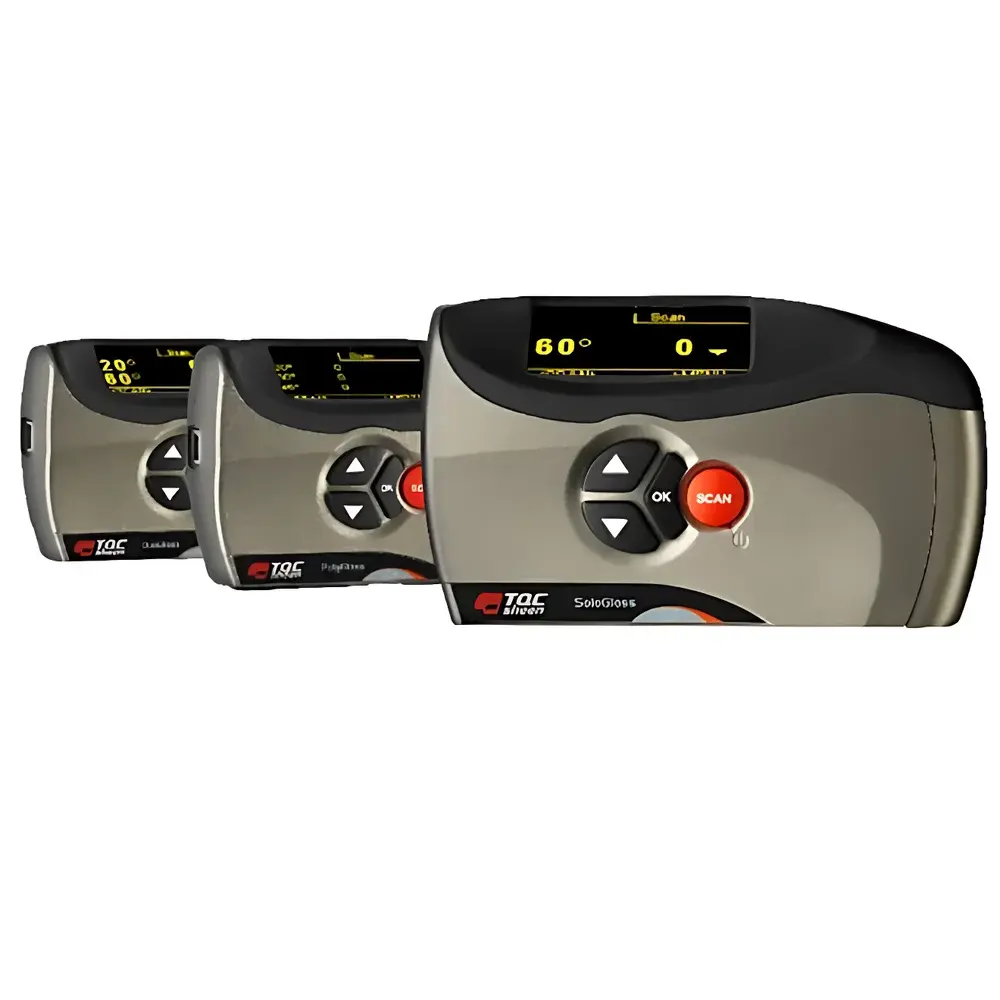
TQC Sheen SoloGloss® and PolyGloss® Portable Gloss Meters
| Brand | TQC Sheen |
|---|---|
| Country of Origin | Netherlands |
| Model | SoloGloss® (single-angle) / PolyGloss® (triple-angle) |
| Measurement Angles | 20°, 60°, 85° |
| Gloss Range | 0–2000 GU |
| Resolution | 0.1 GU (0–100 GU), 1 GU (>100 GU) |
| Repeatability | 20°: ±0.4 GU |
| 60° | ±0.2 GU |
| 85° | ±0.2 GU |
| Reproducibility | 20°: ±1.69 GU |
| 60° | ±1.58 GU |
| 85° | ±1.88 GU |
| Accuracy Deviation | 20°: ±1.2 GU |
| 60° | ±0.6 GU |
| 85° | ±1.6 GU |
| Spot Size | 20°: 5 × 5 mm |
| 60° | 20 × 9 mm |
| 85° | 40 × 9 mm |
| Compliance | ISO 2813, ASTM D523, DIN 67530, JIS Z8741 |
Overview
The TQC Sheen SoloGloss® and PolyGloss® are precision portable gloss meters engineered for reliable, traceable surface reflectance quantification in industrial quality control, R&D, and production environments. Based on the principle of specular reflectance measurement—defined as the ratio of reflected to incident light flux under controlled geometric conditions—these instruments comply with internationally recognized standards including ISO 2813, ASTM D523, DIN 67530, and JIS Z8741. The SoloGloss® operates at a fixed 60° geometry, optimized for mid-gloss surfaces (e.g., automotive clear coats, architectural paints, and plastic housings), while the PolyGloss® integrates three calibrated optical paths (20°, 60°, and 85°) to span the full gloss spectrum—from mirror-like finishes (>70 GU at 60°) to matte or textured substrates (<10 GU at 60°). Both models employ stabilized LED sources, temperature-compensated silicon photodiodes, and factory-traceable calibration against certified ceramic standards to ensure long-term measurement integrity.
Key Features
- Triple-angle optical architecture (PolyGloss®): Independent 20°, 60°, and 85° measurement channels with dedicated apertures and collimation optics to minimize stray light and angular crosstalk
- Dual-material hybrid frame construction: Combines anodized aluminum housing with elastomeric shock-absorbing inserts to maintain optical alignment under mechanical stress and thermal cycling
- High-stability LED illumination: Constant-current-driven 550 nm source with <±0.2% intensity drift over 8 hours, eliminating lamp aging effects common in tungsten-based systems
- Real-time statistical validation: On-device calculation of mean, standard deviation, min/max, and pass/fail thresholds per measurement sequence
- Calibration traceability: Supplied with NIST-traceable calibration certificate and reference standard (certified gloss tile, 100 GU ±0.2 GU at 60°)
- IP54-rated enclosure: Dust- and splash-resistant design suitable for shop-floor deployment without protective enclosures
Sample Compatibility & Compliance
These gloss meters accommodate flat, curved, and textured surfaces with radii ≥25 mm (60°/85°) or ≥10 mm (20°), provided surface roughness (Ra) remains below 1.6 µm to avoid diffuse scattering interference. Measurements conform to GLP/GMP documentation requirements when paired with TQC Sheen Ideal Finish software, supporting audit-ready reports with embedded metadata (operator ID, timestamp, instrument serial number, calibration status). Data export formats include CSV, XML, and PDF with digital signature options compliant with FDA 21 CFR Part 11 for regulated industries. All units undergo 10,000+ cycle durability testing on certified reference tiles prior to shipment, verifying repeatability stability across temperature ranges of 10–40°C and relative humidity up to 80% non-condensing.
Software & Data Management
TQC Sheen Ideal Finish software provides comprehensive post-acquisition analysis for both SoloGloss® and PolyGloss® datasets. It enables multi-sample trend visualization (time-series, batch-wise, location-mapped), Gaussian distribution fitting for process capability assessment (Cp/Cpk), outlier detection via Grubbs’ test, and comparative reporting across angles or substrates. The software supports role-based user access control, electronic signatures, and automatic backup to network drives or cloud storage (AWS S3, Microsoft Azure). Audit trails log all data modifications—including recalibration events, parameter changes, and report exports—with immutable timestamps and user attribution, satisfying ISO/IEC 17025 clause 7.7 and EU Annex 11 requirements for analytical instrument qualification.
Applications
- Automotive OEMs and Tier-1 suppliers: In-line verification of paint gloss uniformity across body panels, bumpers, and interior trims
- Coatings manufacturers: Formulation development and batch release testing per ASTM D523 protocols
- Plastics processors: Monitoring extrusion and injection molding parameters affecting surface finish
- Printing and packaging: Quantifying varnish and laminating film reflectance on flexible and rigid substrates
- Architectural coatings labs: Correlating gloss values with weathering exposure (QUV, Xenon arc) per ISO 11341
- Medical device OEMs: Validating matte-finish polymer housings for ergonomic and anti-glare compliance
FAQ
Why does ISO 2813 specify multiple measurement angles?
Because surface microstructure and coating formulation significantly affect angular reflectance distribution. A single 60° reading may saturate on high-gloss surfaces or lack sensitivity on low-gloss substrates. 20° enhances resolution above 70 GU; 85° improves discrimination below 10 GU.
Can these gloss meters measure curved surfaces?
Yes—within defined radius limits (≥25 mm for 60°/85°, ≥10 mm for 20°). Curvature-induced beam divergence is compensated by aperture sizing and detector field-of-view optimization.
How often should calibration be verified?
Daily verification using the included reference tile is recommended before critical measurements. Full recalibration by an accredited service lab is advised every 12 months or after physical impact.
Is Ideal Finish software validated for regulated environments?
Yes—the software includes IQ/OQ documentation templates, configurable electronic signature workflows, and 21 CFR Part 11-compliant audit trail generation.
What environmental conditions affect measurement accuracy?
Ambient light contamination, surface contamination (dust, fingerprints), and temperature gradients >2°C/min can induce drift. The instruments feature ambient light rejection algorithms and auto-zero compensation during startup.



