
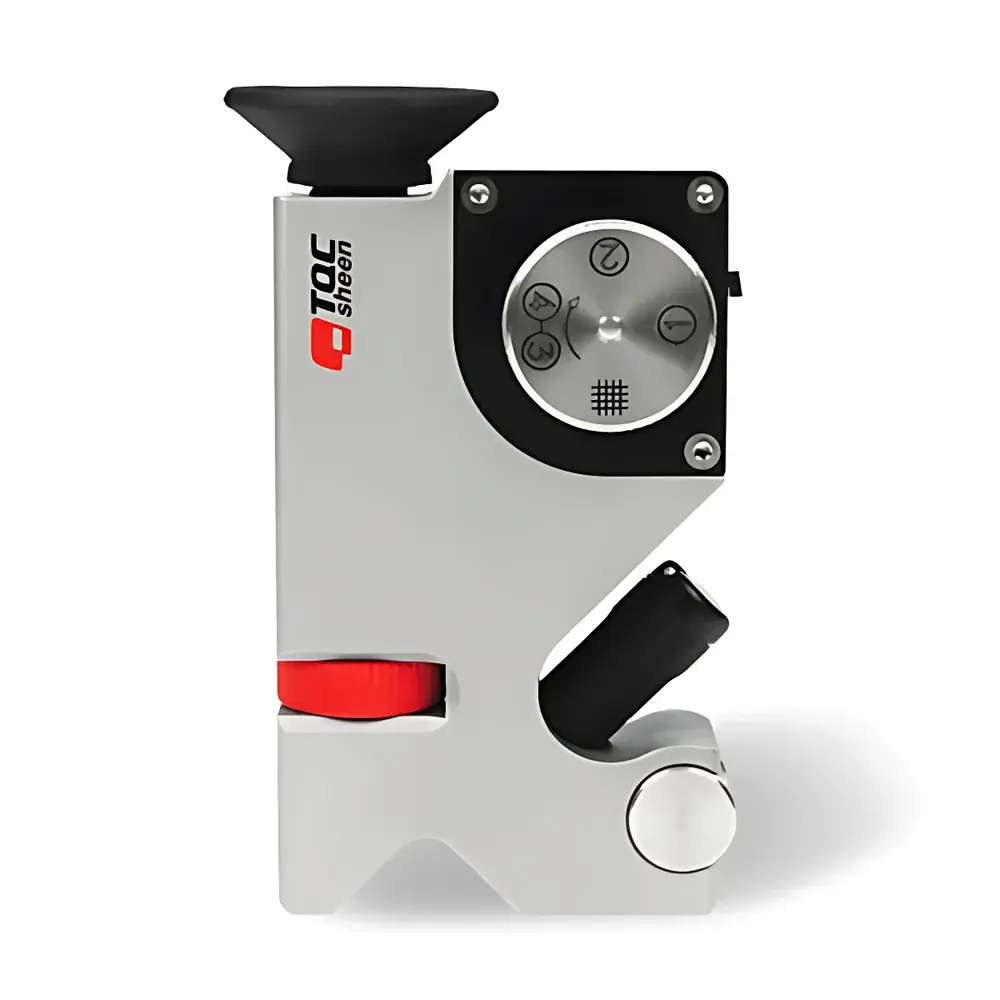
TQC Sheen SuperPIG III Dry Film Thickness Gauge
| Brand | TQC Sheen |
|---|---|
| Origin | Netherlands |
| Manufacturer Type | Authorized Distributor |
| Origin Category | Imported |
| Model | SuperPIG III |
| Pricing | Available Upon Request |
| Measurement Range | 2–1800 µm / 0.1–70 mils |
| Microscope Magnification | 50× (calibrated reticle) |
| Scale Range | 0.00–1.80 mm / 0.00–0.07 in |
| Scale Graduation | 0.02 mm / 0.001 in |
| Accuracy | Dependent on blade geometry and operator reading proficiency |
| Power Supply | 4 × AG13/LR44 batteries |
| Housing Material | Titanium-anodized aluminum |
| Dimensions (W × D × L) | 25 × 110 × 65 mm |
Overview
The TQC Sheen SuperPIG III Dry Film Thickness Gauge is a precision mechanical cross-section measurement instrument engineered for quantitative assessment of cured organic coatings—such as paints, varnishes, epoxies, and polymer-based finishes—on rigid substrates including metal, plastic, and wood. Unlike electromagnetic or eddy-current gauges, the SuperPIG III employs a destructive microtome-based methodology: a calibrated scalpel blade cuts a perpendicular cross-section through the dry film, exposing the interface between coating and substrate. This exposed profile is then visually evaluated under an integrated 50× optical microscope with an engraved dual-scale reticle (metric and imperial), enabling direct thickness readout in micrometers (µm) or mils (thousandths of an inch). The method conforms to internationally recognized standards for destructive thickness verification—including ISO 2808 (Paints and varnishes — Determination of film thickness), ASTM D4138 (Standard Practice for Measurement of Dry Film Thickness of Protective Coating Systems by Destructive, Cross-Sectioning Means), and SSPC-PA 2 Annex B—where high spatial resolution and traceable visual metrology are required for quality assurance, failure analysis, or regulatory documentation.
Key Features
- Integrated 50× precision optical microscope with dual-scale calibrated reticle (0.02 mm / 0.001 in graduation), optimized for parallax-free viewing of cut cross-sections
- Titanium-anodized aluminum housing ensures long-term dimensional stability, corrosion resistance, and ergonomic handling in industrial lab or field environments
- Three interchangeable precision-ground cutting blades (standard, fine-cut, and ultra-fine variants) mounted on a quick-release rotating turret for rapid tool selection without disassembly
- Dual-unit scale (µm/mils) eliminates manual unit conversion during reporting and supports global compliance workflows
- High-intensity white LED illumination system with diffused coaxial lighting minimizes glare and enhances edge contrast at the coating–substrate interface
- Compact footprint (25 × 110 × 65 mm) and low center-of-gravity design enable stable operation on uneven surfaces or within confined test areas
Sample Compatibility & Compliance
The SuperPIG III is validated for use on non-porous and semi-porous substrates where mechanical sectioning yields clean, representative cross-sections. It is routinely applied to automotive OEM coatings, marine antifouling systems, aerospace primer/topcoat stacks, and industrial powder-coated components. Blade selection is determined by film hardness and substrate rigidity: softer films (e.g., acrylics) require finer blades to prevent smearing; harder systems (e.g., polyurethane or ceramic hybrids) necessitate carbide-tipped variants (sold separately). The instrument meets mechanical calibration traceability requirements per ISO/IEC 17025 when used in conjunction with certified reference standards. Its operation supports GLP-compliant documentation protocols when paired with controlled laboratory procedures and operator qualification records.
Software & Data Management
The SuperPIG III operates as a standalone mechanical-optical instrument with no embedded firmware or digital connectivity. All measurements are manually recorded via observer interpretation of the reticle scale. For integration into digital QA/QC workflows, users commonly pair the device with calibrated digital imaging systems (e.g., USB microscopes with measurement software) to capture annotated cross-section images. When used in regulated environments (e.g., ISO 9001-certified production lines or FDA-regulated medical device coating validation), documented operator training, periodic verification using NIST-traceable step-height standards, and audit-ready logbooks constitute standard data management practice. The absence of electronic storage aligns with environments requiring air-gapped instrumentation or adherence to 21 CFR Part 11 principles via procedural controls rather than software-based audit trails.
Applications
- Verification of compliance with contractual film thickness specifications (e.g., minimum DFT for corrosion protection on structural steel)
- Root-cause analysis of coating delamination, blistering, or interfacial adhesion failure
- Validation of spray application parameters during process qualification (e.g., transfer efficiency, gun distance, fluid pressure)
- Third-party inspection for ISO 12944 C5-I/C5-M corrosion protection systems
- Research and development of multi-layer functional coatings (e.g., UV-curable topcoats over conductive primers)
- Forensic evaluation of coating degradation mechanisms in accelerated weathering studies
FAQ
Is the SuperPIG III suitable for measuring soft or elastomeric coatings?
Yes—provided appropriate blade geometry and cutting speed are selected to minimize deformation. Use of the fine-cut blade and slow, steady advancement is recommended for thermoplastic or rubber-modified systems.
Does the instrument require annual recalibration?
While the optical reticle and mechanical frame do not drift, TQC Sheen recommends biannual verification against certified step-height standards (e.g., NIST SRM 2100 series) to maintain measurement confidence in accredited labs.
Can it measure coatings on curved surfaces?
It is designed for flat or gently contoured substrates (radius > 50 mm). For highly curved geometries, alternative methods such as ultrasonic DFT gauges or replica tape may be more appropriate.
What maintenance is required for long-term accuracy?
Routine cleaning of the microscope optics with lens-grade tissue and ethanol; periodic inspection of blade edges for nicks or dulling; replacement of AG13 batteries every 12–18 months under typical usage.
Is operator training necessary for ISO/IEC 17025 compliance?
Yes—ISO/IEC 17025:2017 Clause 6.2.5 mandates documented competence assessment. TQC Sheen provides application-specific training modules and competency checklists aligned with ISO 2808 Annex A.



