
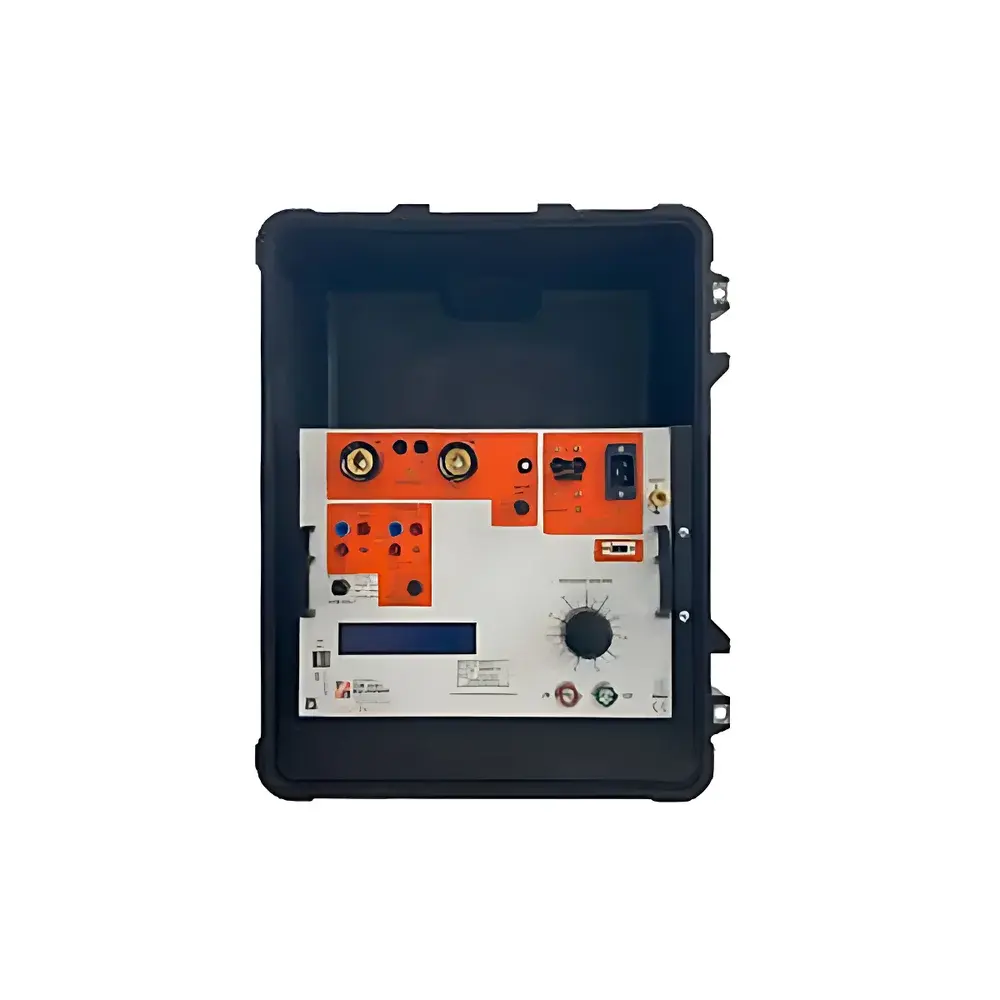
T&R 750ADM MK4 Primary Current Injection Test Set
| Brand | T&R |
|---|---|
| Origin | United Kingdom |
| Model | 750ADM MK4 |
| Output Capacity | 750 A (primary), 40 A / 16 V (secondary) |
| Open-Circuit Voltage | 5.0 V (230 V supply) |
| Continuous Current Rating | 125 A |
| Short-Term Current Rating | 750 A for 20 s (230 V) |
| True RMS Measurement Accuracy | ±0.5% rdg + 2–5 digits |
| Timing Resolution | 1 ms |
| Timing Accuracy | ±0.01% rdg + 2d (conventional mode) |
| Storage | USB-based CSV logging with real-time clock timestamping |
| Safety Compliance | BS EN 61010-1, UKCA certified |
| Dimensions (metal enclosure) | 560 × 456 × 265 mm |
| Weight | 27.4 kg |
| Power Input | Auto-ranging 115 V / 230 V ±10%, 50/60 Hz, single-phase |
Overview
The T&R 750ADM MK4 Primary Current Injection Test Set is a precision-engineered, portable test instrument designed for primary injection testing of low-voltage and medium-voltage protection systems in compliance with international electrical safety and commissioning standards. Operating on the principle of controlled high-current DC or quasi-AC (single-cycle or sustained) injection into primary windings or conductors, the 750ADM MK4 delivers calibrated, repeatable current outputs up to 750 A at ≤5 V open-circuit voltage—optimized for rapid thermal and magnetic trip verification of circuit breakers, reclosers, and overcurrent relays without secondary CT isolation. Its dual-output architecture supports both primary injection (up to 750 A) and secondary injection (up to 40 A at 16 V), enabling comprehensive testing across device classes—from miniature circuit breakers (MCBs) to molded-case and air-break breakers—while maintaining full galvanic isolation between output stages and measurement circuits.
Key Features
- Dual independent output ports: Primary injection (0–750 A, ≤5 V OC) and secondary injection (0–40 A, ≤16 V OC), each with dedicated current regulation and protection.
- True RMS digital current measurement with four selectable ranges (20.00 A, 50.00 A, 200.0 A, 750 A), resolution down to 0.01 A, and accuracy of ±0.5% rdg + 2–5 digits depending on range.
- High-speed capture capability: Single-cycle RMS measurement completed within ≤20 ms, ensuring accurate representation of transient trip currents.
- Flexible timing system with auto-ranging resolution (1 ms / 10 ms / 100 ms), supporting trip time, reset time, and reclosing interval measurements under conventional or current-triggered modes.
- Two isolated contact inputs with automatic NO/NC detection, 24 VDC open-circuit voltage, and compatibility with external DC trigger sources (24–240 VDC).
- Integrated thermal and electronic overcurrent protection on all output paths, plus input-side circuit breaker and dedicated grounding terminal for substation-grade safety.
- USB-host interface supporting real-time data logging to removable storage: All test parameters—including timestamped current waveforms, harmonic content, trip times, and user annotations—are saved as ISO-compliant CSV files, organized by date-stamped folders.
- Auto-sensing dual-voltage power supply (115 V / 230 V ±10%, 50/60 Hz), rated up to 3900 VA at 230 V, with built-in line filtering and surge suppression.
Sample Compatibility & Compliance
The 750ADM MK4 is validated for testing a broad spectrum of power system protection devices, including but not limited to: low-voltage MCBs and MCCBs; electromechanical and electronic overcurrent relays (IEC 60255-3, IEEE C37.90); automatic reclosers; residual current circuit breakers (RCCBs) with integrated overcurrent elements; and primary-side current transformer ratio verification (when paired with an external secondary current meter). All test procedures align with functional safety requirements outlined in IEC 61850-10 (conformance testing), IEEE C37.118.2 (synchrophasor-enabled relay validation), and EN 61000-4-5 (surge immunity during field operation). The unit conforms fully to BS EN 61010-1:2010+A1:2019 for safety of electrical equipment for measurement, control, and laboratory use, and carries UKCA marking for deployment in Great Britain. It is routinely deployed in environments requiring GLP-compliant audit trails—its USB logging system supports traceable, tamper-evident record retention suitable for third-party certification audits.
Software & Data Management
No proprietary software installation is required. The 750ADM MK4 operates as a standalone embedded system with a real-time operating system (RTOS) managing all measurement, timing, and storage functions. Test results—including current magnitude, waveform snapshots (sampled at ≥10 kS/s), harmonic distortion indices (THD, individual harmonics up to 25th order), trip timestamps, and user-entered annotations—are written directly to FAT32-formatted USB drives in plain-text CSV format. Each file includes header metadata (device ID, firmware version, test date/time, operator ID if entered via optional USB keyboard), ensuring full chain-of-custody integrity. Files are named sequentially with millisecond-precision timestamps and stored in daily folders (e.g., “2024-06-15/14-22-08-342.csv”). This architecture eliminates dependency on host PC software, satisfies FDA 21 CFR Part 11 requirements for electronic records when combined with organizational SOPs, and enables seamless integration into existing CMMS or asset management platforms via automated script ingestion.
Applications
- Commissioning verification of new switchgear installations per IEC 61439 and ANSI C37.58.
- Periodic maintenance testing of overcurrent protection schemes in utility substations and industrial distribution panels.
- Functional validation of trip curves (B, C, D, K, Z types) against manufacturer datasheets and IEC 60898-1 tolerances.
- Primary-side CT ratio and polarity checks—when used with a calibrated secondary current clamp meter and appropriate test leads.
- Thermal-magnetic coordination studies between upstream and downstream protective devices.
- Field calibration support for relay test sets where primary injection serves as reference-level stimulus.
- Training and competency assessment for protection engineers and technicians under simulated fault conditions.
FAQ
What is the difference between primary and secondary injection testing?
Primary injection applies current directly to the main conductor or breaker pole—verifying the entire trip path including contacts, bimetallic elements, and solenoids—whereas secondary injection injects current into the relay’s current input terminals, isolating the relay electronics from mechanical components.
Can the 750ADM MK4 perform harmonic analysis during trip events?
Yes. The internal sampling engine captures full-cycle waveforms at ≥10 kS/s and computes THD and individual harmonic magnitudes up to the 25th order, logged alongside RMS values and timestamps.
Is the device compatible with 115 V power supplies in North America?
Yes. The auto-ranging power supply accepts 115 V ±10% at 50/60 Hz, though maximum output current is reduced to 500 A for 10 s under this condition.
Does the unit support automated test sequences?
No. The 750ADM MK4 is a manually operated, single-step test set. Automated multi-step sequences require external programmable logic controllers or relay test software interfacing via contact inputs.
How is measurement traceability maintained?
All current measurement ranges are factory-calibrated against NPL-traceable shunts. Calibration certificates (including uncertainty budgets) are supplied with each unit and remain valid for 12 months under normal operating conditions.






