
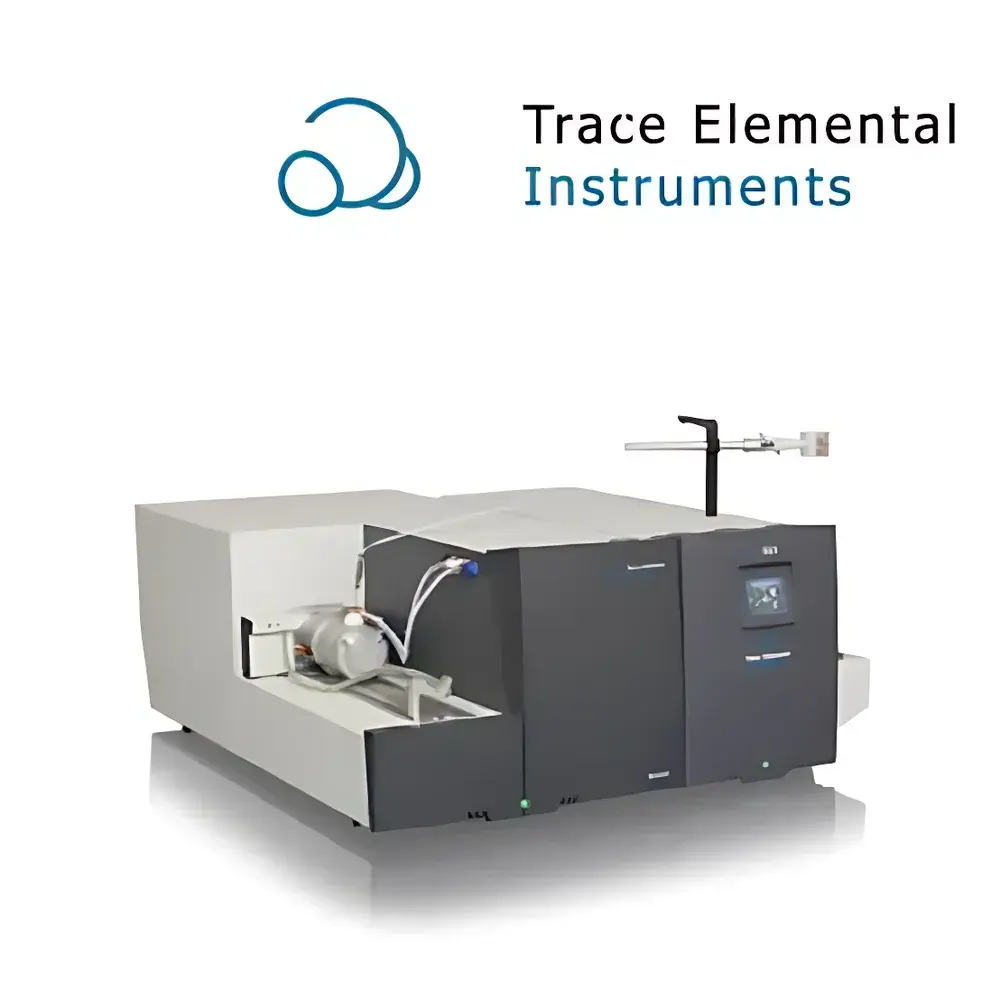
Trace Elemental Instruments XPLORER TX Total Chlorine Analyzer
| Brand | TE/Trace Elemental Instruments |
|---|---|
| Origin | Netherlands |
| Model | XPLORER TX |
| Detection Principle | Combustion Microcoulometry |
| Sample Types | Liquids, Gases, Liquefied Petroleum Gas (LPG), Solids |
| Measurement Range | 0.0025–1000 mg absolute chlorine |
| LOD | 0.025 mg/L |
| Combustion Furnace Temperature | 1050 °C |
| Software | TEIS 2 Professional Software |
| Compliance | ASTM D5808, ASTM D7042, ISO 16939, IP 566, UOP 390, EN ISO 16939, SH/T 0689 |
| Optional Autosamplers | 105-position 2 mL vial XYZ autosampler (with auto-dilution & auto-calibration), Gas/LPG autosampler, 20-position solid autosampler |
| Detector | Temperature-controlled microcoulometric cell with closed-loop feedback control |
Overview
The Trace Elemental Instruments XPLORER TX Total Chlorine Analyzer is a high-performance combustion microcoulometric system engineered for precise, trace-level quantification of total chlorine in diverse sample matrices—including liquid hydrocarbons, gaseous fuels, liquefied petroleum gas (LPG), and solid materials. Based on the fundamental principle of high-temperature oxidative combustion followed by electrochemical detection via a microcoulometric titration cell, the XPLORER TX delivers exceptional sensitivity, linearity, and reproducibility across an extended dynamic range from sub-ppb to ppm levels. Its robust architecture integrates a stabilized 1050 °C quartz furnace, optimized gas flow management, and a temperature-regulated detector with real-time feedback control—ensuring minimal baseline drift and long-term signal stability essential for regulatory-compliant analysis in quality control and R&D laboratories.
Key Features
- Combustion microcoulometric detection with 0.025 mg/L limit of detection, validated per ASTM D5808 and ISO 16939 protocols
- Modular, field-upgradable autosampling options: 105-position XYZ autosampler for 2 mL vials (supporting automated dilution and calibration), dedicated gas/LPG introduction module, and 20-position solid sample carousel
- Fully integrated TEIS 2 Professional Software enabling method-driven workflow automation—from sequence generation and instrument parameter control to real-time data acquisition, peak integration, and report export
- Temperature-stabilized microcoulometric cell with active thermal feedback loop, minimizing environmental influence and enhancing measurement repeatability
- Compact, benchtop footprint with tool-free module interchange—enabling rapid reconfiguration between liquid, gas, and solid analysis modes without hardware recalibration
- Automated combustion condition management, including oxygen flow optimization, carrier gas regulation, and post-combustion scrubbing—reducing operator intervention and extending consumable lifetime
Sample Compatibility & Compliance
The XPLORER TX accommodates heterogeneous sample types without requiring matrix-specific hardware modifications. Liquid samples (e.g., jet fuel, diesel, naphtha) are introduced via syringe or autosampler; gaseous and LPG samples utilize pressure-regulated injection with integrated moisture and sulfur removal; solids (e.g., catalysts, polymers, ash residues) undergo controlled pyrolysis prior to oxidation. All operational parameters align with internationally recognized standard methods, including ASTM D5808 (microcoulometric determination of chlorine in aromatic hydrocarbons), ASTM D7042 (chlorine in middle distillates), ISO 16939 (petroleum products — determination of total chlorine), IP 566, UOP 390, EN ISO 16939, and SH/T 0689 (Chinese national standard for chlorine in gasoline). The system supports full audit trail functionality, electronic signatures, and secure user access levels—facilitating compliance with GLP, GMP, and FDA 21 CFR Part 11 requirements where applicable.
Software & Data Management
TEIS 2 Professional Software serves as the central analytical interface, providing intuitive graphical workflow design, customizable method templates, and integrated calibration management. It enables batch processing of up to 999 samples per sequence, automatic application of correction factors (e.g., recovery, dilution), and real-time validation against user-defined acceptance criteria. Raw data—including current-time chromatograms, integrated charge values, and calculated chlorine mass—are stored in a structured SQLite database with immutable timestamps and operator metadata. Export formats include CSV, PDF analytical reports, and XML for LIMS integration. Audit logs record all critical events: method edits, calibration updates, result overrides, and user logins—ensuring full traceability for internal QA reviews and external regulatory inspections.
Applications
- Refinery QC: Monitoring chlorine contamination in feedstocks, intermediates, and finished fuels to prevent catalyst poisoning and corrosion
- Petrochemical R&D: Quantifying residual chlorine in polymer additives, solvents, and specialty chemicals
- Environmental testing labs: Analyzing chlorine content in soil extracts, waste oils, and incineration residues per EPA Method 5050 equivalents
- Pharmaceutical excipient screening: Verifying low-level halogen impurities in APIs and formulation components
- Aviation fuel certification: Ensuring compliance with ASTM D1655 Annex A4 and DEF STAN 91-91 specifications
- Research on dechlorination kinetics: Supporting kinetic modeling through high-frequency, low-LOD time-series measurements
FAQ
What sample volume is required for liquid analysis?
Typical injection volumes range from 1–100 µL depending on expected concentration; the 105-position autosampler supports programmable dilution for high-concentration samples.
Can the XPLORER TX analyze chlorinated solvents such as chloroform or carbon tetrachloride?
Yes—provided appropriate safety interlocks and scrubbing modules are installed; method validation per ASTM D5808 is recommended for halogen-rich matrices.
Is the microcoulometric cell replaceable in-house?
Yes—the detector assembly is designed for user-level replacement with factory calibration verification; no alignment tools or service engineer intervention are required.
Does TEIS 2 support multi-instrument network deployment?
Yes—TEIS 2 Server Edition allows centralized method distribution, remote monitoring, and aggregated reporting across multiple XPLORER TX units within a single domain.
How frequently must the combustion tube be cleaned or replaced?
Under typical operation (≤500 injections/week), quartz combustion tubes require cleaning every 2–3 months; lifetime exceeds 12 months with proper sample preparation and oxygen purity control.




