
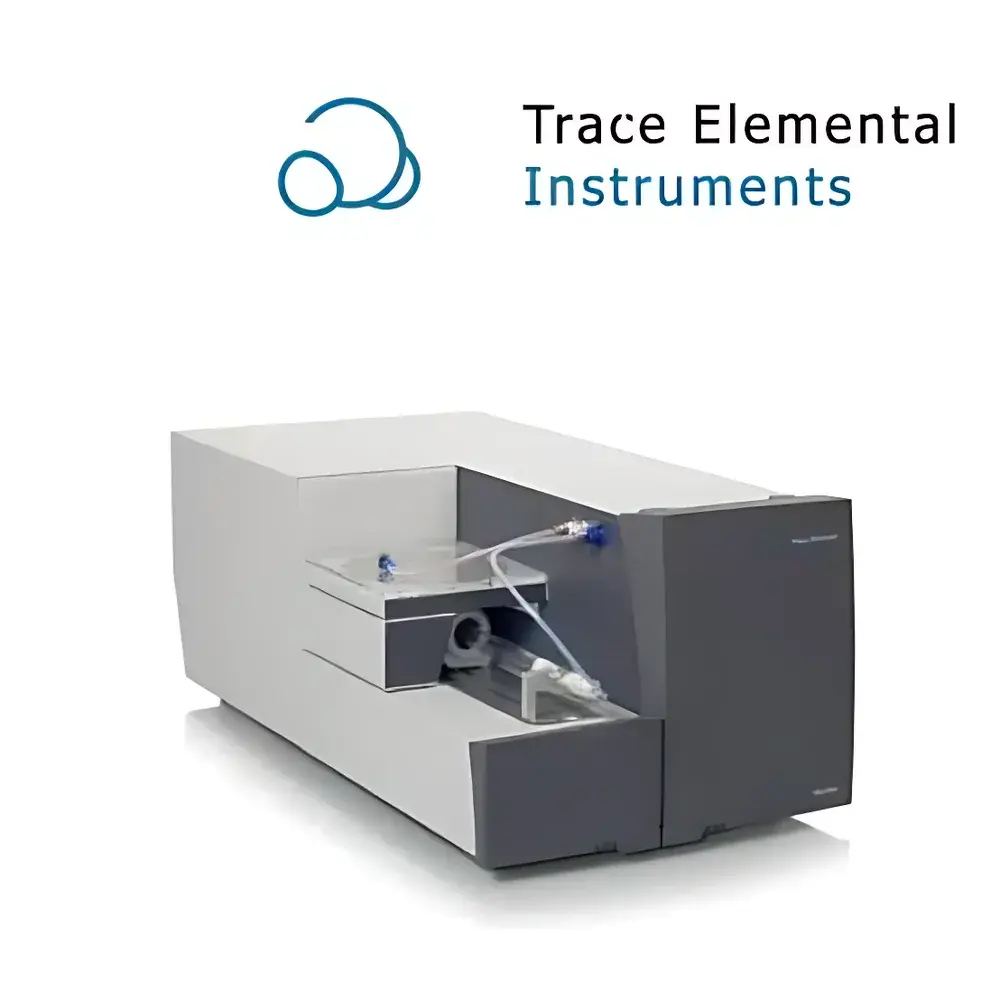
Trace Elemental Instruments XPLORER TX/TS Total Chlorine and Total Sulfur Analyzer
| Brand | Trace Elemental Instruments |
|---|---|
| Origin | Netherlands |
| Model | XPLORER TX/TS |
| Detection Principle | Combustion Microcoulometry |
| Sample Types | Solids, Liquids, Gases, LPG |
| Measurement Range (S) | 0.0020–500 mg |
| Measurement Range (Cl) | 0.0025–1000 mg |
| LOD (S) | 0.020 mg/L |
| LOD (Cl) | 0.025 mg |
| Combustion Furnace Temperature | 1050 °C |
| Software | TEIS 2 Professional |
Overview
The Trace Elemental Instruments XPLORER TX/TS is a high-performance, dual-mode elemental analyzer engineered for the precise quantification of total sulfur (TX) and total chlorine (TS) in diverse sample matrices—including petroleum products, coal derivatives, lubricants, catalysts, polymers, and environmental solids—using combustion microcoulometric detection. This instrument operates on the principle of high-temperature oxidative combustion (1050 °C), followed by selective electrochemical titration of evolved SO₂ or HCl in a microcoulometric cell. The resulting charge integration yields absolute mass-based quantitation with trace-level sensitivity and metrological traceability. Designed specifically for laboratories requiring regulatory-grade data integrity in coal, refinery, and petrochemical QA/QC workflows, the XPLORER TX/TS delivers reproducible results across ppb-to-ppm concentration ranges without matrix-dependent calibration drift.
Key Features
- Combustion microcoulometric detection system with temperature-stabilized coulometric cells and closed-loop feedback control, ensuring long-term baseline stability and sub-ppb detection capability for both sulfur and chlorine.
- Modular, field-upgradable architecture supporting interchangeable sample introduction modules: liquid autosampler (105-position, 2 mL vials), XYZ robotic liquid handler with integrated dilution and calibration functions, gas/LPG pressurized injection module, and 20-position solid sampler with programmable pyrolysis ramping.
- Integrated 1050 °C high-efficiency quartz combustion furnace with ceramic insulation and real-time thermal monitoring to guarantee complete oxidation of refractory organosulfur and organochlorine compounds.
- Intuitive touchscreen interface coupled with TEIS 2 Professional software—designed for multi-user environments under GLP/GMP compliance requirements—including full audit trail, electronic signatures, and 21 CFR Part 11–ready configuration options.
- Compact footprint (≤0.8 m²) optimized for benchtop deployment in space-constrained analytical labs while maintaining full automation capacity for unattended overnight operation.
- Automated method sequencing, dynamic range adaptation, and real-time signal diagnostics reduce operator dependency and minimize risk of procedural error during high-throughput screening.
Sample Compatibility & Compliance
The XPLORER TX/TS accommodates heterogeneous sample forms per ASTM D3120, D5453, D7039, ISO 20846, ISO 20884, IP 287, UOP 97, EN ISO 13032, and SH/T 0689 standards. Liquid samples (e.g., diesel, jet fuel, crude oil) are introduced via calibrated syringe or pressurized loop; gaseous and LPG samples are metered using mass flow controllers with back-pressure regulation; solid samples (coal, coke, ash, catalysts) undergo controlled pyrolysis prior to combustion. All hardware and software components are validated against ISO/IEC 17025 requirements for testing laboratories, with documented uncertainty budgets available upon request. Instrument qualification packages support IQ/OQ/PQ execution aligned with pharmaceutical and energy-sector validation protocols.
Software & Data Management
TEIS 2 Professional provides end-to-end workflow orchestration—from method creation and sequence definition to raw signal processing, calibration curve fitting (linear, quadratic, or multipoint nonlinearity correction), and report generation. Data files are stored in encrypted SQLite databases with immutable timestamps and user-action logging. Export formats include CSV, PDF, XML, and ASTM E1394-compliant structured data for LIMS integration. Audit trail functionality records all parameter modifications, calibration events, and result approvals with user ID, timestamp, and reason-for-change fields. Optional server-based deployment enables centralized instrument fleet management and remote diagnostic access under ITAR- and GDPR-compliant infrastructure.
Applications
- Coal and coke analysis per ASTM D4294 and ISO 19732 for total sulfur content determination in thermal and metallurgical grade feedstocks.
- Refinery process stream monitoring—gasoline, naphtha, kerosene—to ensure compliance with ultra-low-sulfur diesel (ULSD) and Euro 6/China VI specifications.
- Chlorine speciation screening in polymer feedstocks and PVC stabilizers where residual chloride catalyzes degradation.
- Environmental testing of fly ash, scrubber sludge, and landfill leachates for regulatory reporting under EPA Method 5050 and ISO 17294-2.
- R&D applications in catalyst development, where sulfur poisoning thresholds and chlorine-induced sintering mechanisms require sub-ppm quantitation fidelity.
FAQ
What detection principle does the XPLORER TX/TS employ?
Combustion microcoulometry—samples are combusted at 1050 °C, and evolved SO₂ or HCl is quantified via electrochemical titration in a microcoulometric cell.
Can the same instrument analyze both sulfur and chlorine without hardware modification?
Yes—the TX/TS designation indicates dual-mode capability; switching between analytes requires only method selection and detector conditioning, not physical reconfiguration.
Is the system compliant with 21 CFR Part 11 for regulated laboratories?
TEIS 2 Professional supports full Part 11 implementation including role-based access control, electronic signatures, and audit-trail retention when deployed in validated configurations.
What sample throughput can be achieved with the 105-position liquid autosampler?
Up to 90 samples per 24-hour cycle with automated dilution, calibration, and QC checks—dependent on sample matrix complexity and required detection limits.
How is calibration traceability maintained across instrument lifetime?
Certified reference materials (CRMs) traceable to NIST SRMs or equivalent national metrology institutes are used for initial calibration and periodic verification; TEIS 2 logs all CRM lot numbers and expiration dates automatically.




