
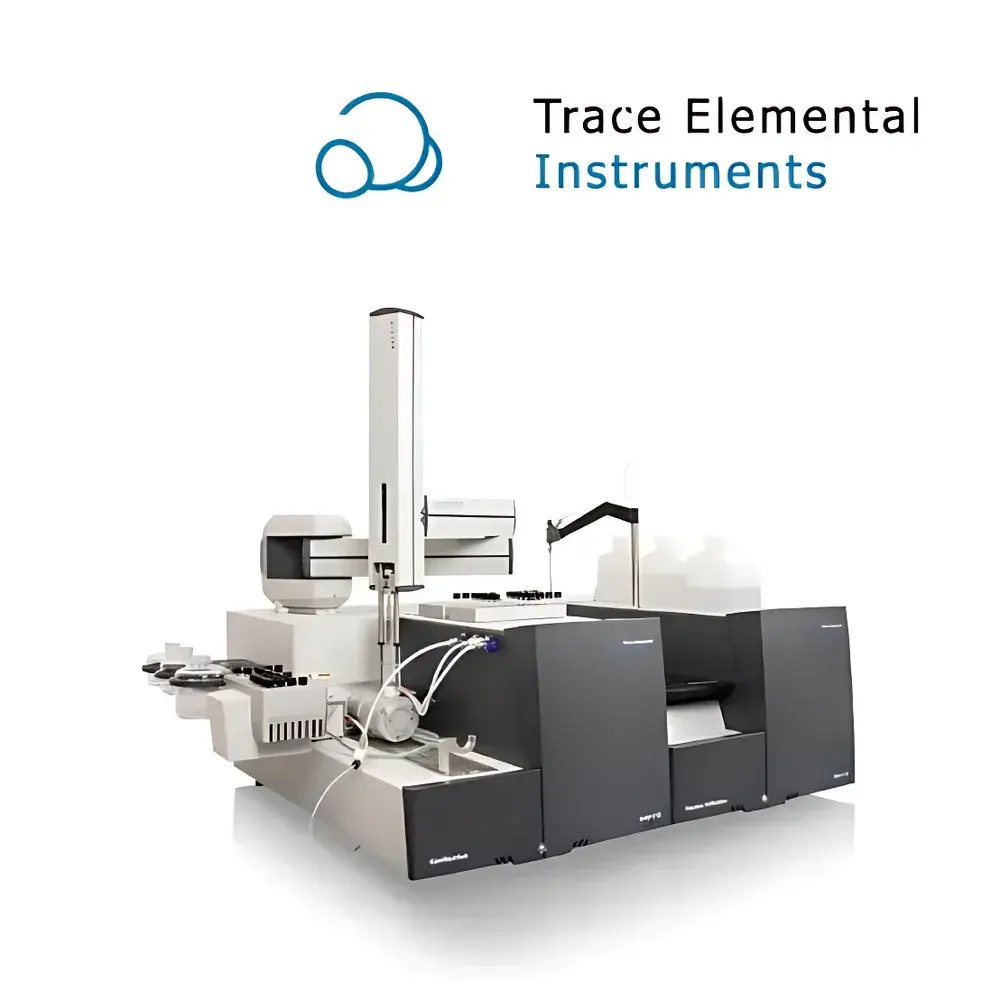
Trace Elemental Instruments Xprep C-IC Combustion-Based Sample Preparation System for Ion Chromatography
| Brand | TE/Trace Elemental Instruments |
|---|---|
| Origin | Netherlands |
| Model | Xprep C-IC |
| Instrument Type | Laboratory |
| Category | Ion Chromatography Sample Prep System |
| Sample Introduction Modes | Liquid direct injection & Quartz boat solid injection |
| Fraction Collector Capacity | 65 positions |
| Compatibility | Universal IC interface (vendor-neutral) |
| Combustion Capability | Solids, liquids, gases, and LPG |
| Reagent Dispensing | Integrated precision metering system |
| Compliance Context | Designed for ASTM D7359, ISO 14912, USP <643>, and EPA Method 1694-compliant workflows |
Overview
The Trace Elemental Instruments Xprep C-IC is a fully automated, compact combustion-based sample preparation system engineered specifically for high-integrity ion chromatographic (IC) analysis of halogens (F⁻, Cl⁻, Br⁻, I⁻) and sulfur species (SO₄²⁻, SO₃²⁻, S₂O₃²⁻) in complex matrices. It operates on the principle of high-temperature oxidative combustion (900–1100 °C) in a horizontal quartz furnace under controlled oxygen-rich atmosphere, followed by quantitative absorption of evolved acidic gases (e.g., HX, SO₂, SO₃) into an alkaline trapping solution. The resulting ionic analytes are then transferred—without manual intervention—to any commercially available ion chromatograph via a precisely timed, pressure-controlled liquid transfer module. This closed-loop architecture eliminates exposure to corrosive vapors, minimizes analyst handling error, and ensures stoichiometric recovery of thermally labile and strongly adsorbing species that are frequently lost or degraded in open-vessel digestion or conventional microcoulometric methods.
Key Features
- Compact benchtop footprint (< 0.8 m²), optimized for integration into regulated QC laboratories and research facilities with space constraints
- Dual-mode sample introduction: programmable liquid syringe injection (0.1–100 µL) and automated quartz boat handling for solids (up to 1 g) and viscous liquids
- Horizontally oriented combustion tube enabling uniform thermal profile, reproducible oxidation kinetics, and reduced soot formation across heterogeneous samples
- 65-position fraction collector with PTFE-coated vials, supporting multi-step sequential trapping (e.g., separate absorption for halogen vs. sulfur fractions)
- Integrated peristaltic reagent delivery system with gravimetric calibration traceability; supports precise addition of NaOH, H₂O₂, or catalytic additives during absorption
- Vendor-agnostic IC interface: TTL-triggered autosampler synchronization and pressure-driven liquid transfer compatible with Thermo Fisher, Metrohm, Shimadzu, and Dionex IC platforms
- Full process automation via embedded PLC controller with audit-trail-enabled software (IEC 62443-compliant firmware architecture)
Sample Compatibility & Compliance
The Xprep C-IC accommodates a broad range of sample types without matrix-specific method redevelopment: petroleum distillates (gasoline, diesel, jet fuel), biofuels (FAME, HVO), LPG and natural gas condensates, polymer pellets and films, electronic components (PCBs, solder masks), soil/sediment extracts, food-grade solvents, and industrial polishing agents. Its design aligns with critical regulatory frameworks including ASTM D7359 (total halogens in aromatic hydrocarbons), ISO 14912 (sulfur in fuels), USP (halogen content in pharmaceutical excipients), and EPA Method 1694 (pharmaceuticals and personal care products in wastewater). All fluidic pathways contacting analytes are constructed from inert materials (quartz, PFA, PTFE), ensuring minimal memory effect and compliance with GLP/GMP documentation requirements for 21 CFR Part 11–enabled data systems.
Software & Data Management
Control and monitoring are managed through TE’s Xprep Control Suite—a Windows-based application featuring role-based user access, method parameter locking, electronic signature support, and real-time combustion temperature/pressure logging. Each run generates a timestamped, digitally signed .CSV report containing furnace ramp profiles, trap solution volume, transfer timing, and system diagnostic flags. Raw data files are structured for seamless import into LIMS environments and support automated calculation of absolute mass recovery (µg X/g sample) using internal standard correction (e.g., ¹³C-labeled surrogate spikes). Audit trails record all parameter changes, user logins, and instrument state transitions—fully compliant with FDA 21 CFR Part 11 Annex 11 and EU GMP Annex 11 validation protocols.
Applications
- Petrochemical QA/QC: Quantification of organochlorides in reformate streams and sulfur species in hydrotreated naphthas
- RoHS/WEEE compliance testing: Total bromine and chlorine screening in plastic housings and flame-retardant additives
- Environmental forensics: Speciation of sulfate vs. sulfite in atmospheric particulate matter and coal combustion residues
- Pharmaceutical impurity profiling: Detection of residual halogenated solvents (e.g., chloroform, dichloromethane) in active pharmaceutical ingredients
- Electroplating bath monitoring: Real-time tracking of chloride drift and sulfate accumulation in nickel strike solutions
- Food contact material safety: Migration testing of fluorinated polymers under simulated gastric conditions
FAQ
Can the Xprep C-IC be validated for GMP-regulated environments?
Yes—its deterministic transfer logic, hardware-enforced method locking, and full electronic audit trail meet ALCOA+ data integrity principles and support IQ/OQ/PQ protocol execution.
Does it require dedicated carrier gases or consumables beyond standard IC eluents?
Only ultra-high-purity oxygen (≥99.999%) and certified grade NaOH solution are required; no proprietary cartridges, membranes, or catalysts are used.
How is carryover minimized between high-concentration and trace-level samples?
Automated post-run furnace purging (5 min O₂ flush), dual-stage trap rinsing, and dynamic flow-path selection ensure <0.05% carryover for Cl⁻ at 1000 µg/g level.
Is method transfer possible from existing oxygen bomb or pyrohydrolysis workflows?
Yes—TE provides documented equivalency studies against ASTM D129, D1266, and ISO 4290 showing <±3% bias for total Cl/S determination across 15+ matrix types.
What maintenance intervals are recommended for routine operation?
Quartz furnace inspection every 500 runs; trap line replacement every 1000 runs; full system calibration verification semiannually per ISO/IEC 17025 guidelines.





