
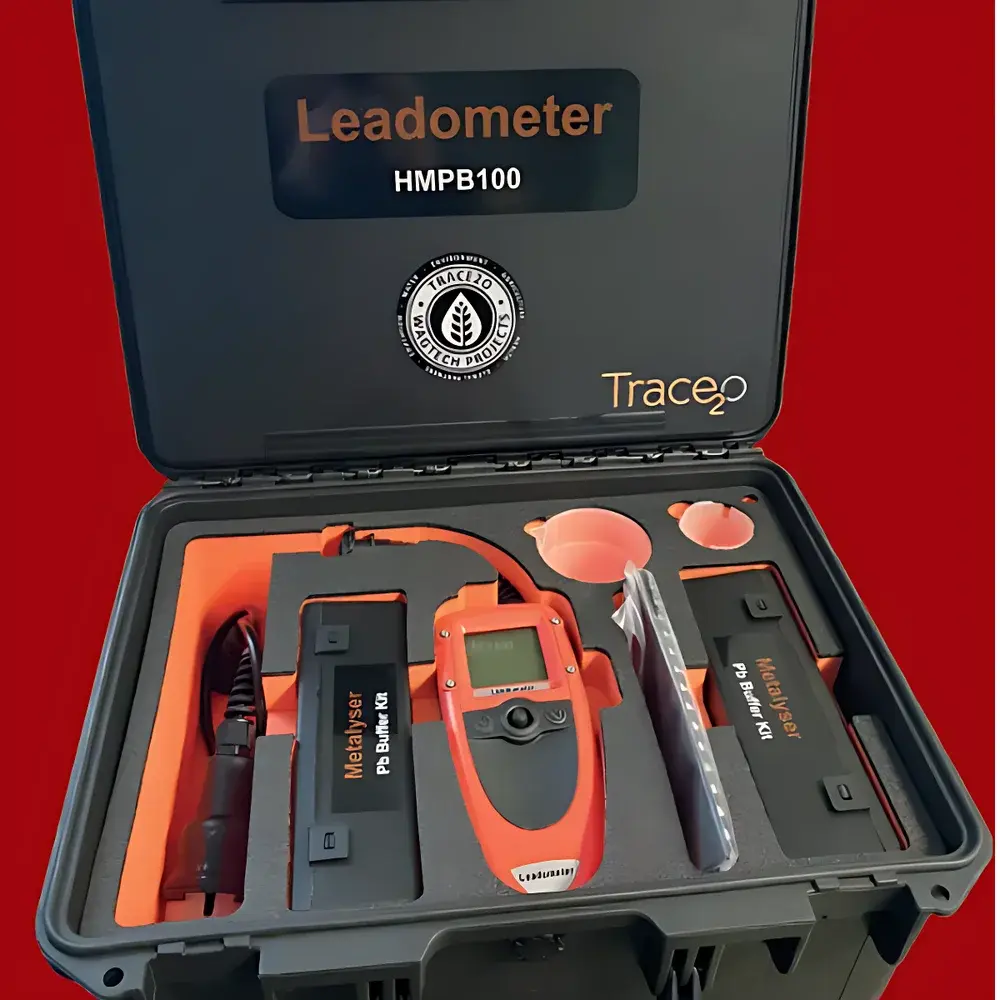
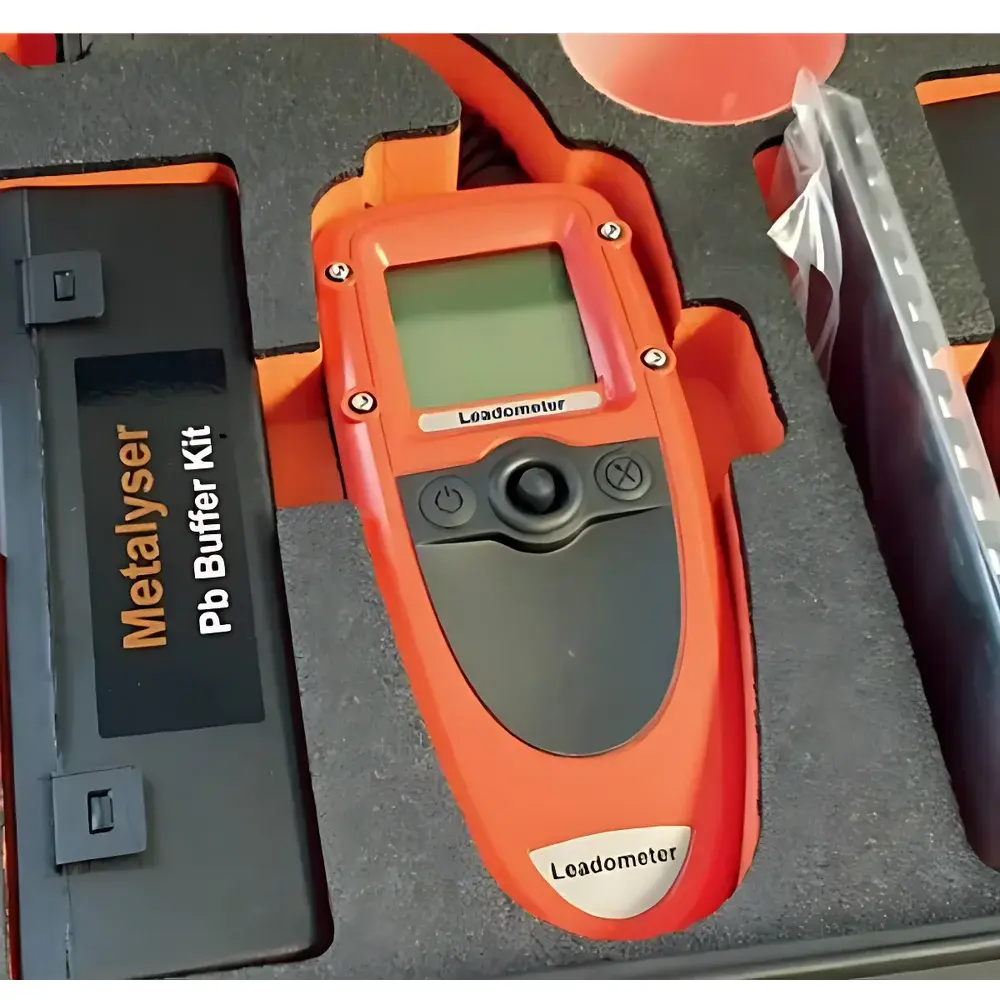
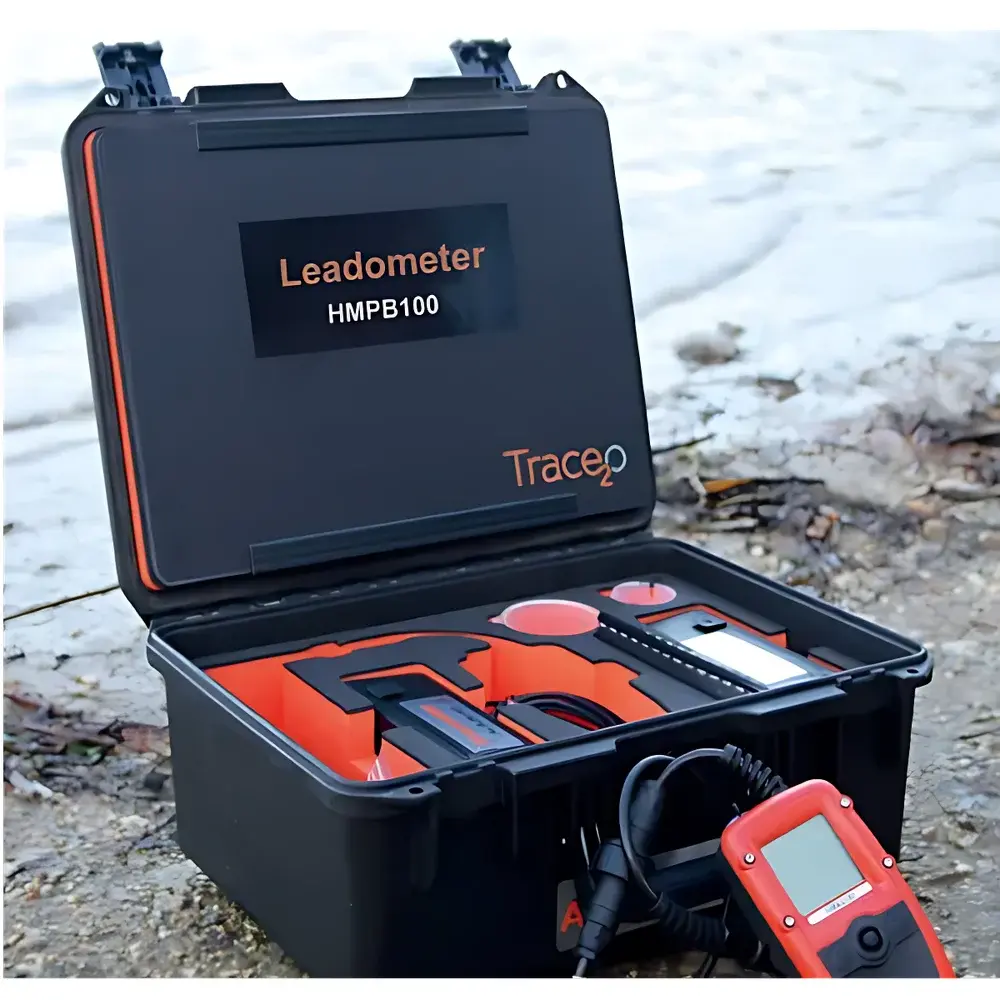
Trace2o HMPB100 Portable Lead Analyzer for On-Site Water Testing
| Brand | Trace2o |
|---|---|
| Origin | United Kingdom |
| Model | HMPB100 |
| Detection Limit | 5 ppb (µg/L) |
| IP Rating | IP68 |
| Display | Backlit LCD |
| Data Storage Capacity | 1,000 measurements |
| Power | Rechargeable long-life battery (included) |
| Weight | <10 kg |
| Test Time | 5–10 minutes per sample |
| Kit Includes | Reagents for 200 tests |
| Waste Profile | Non-hazardous residual waste |
| Compliance | EPA Method 200.7 / ASTM D3559-18 |
| PC Connectivity | Required for data export and report generation |
Overview
The Trace2o HMPB100 Portable Lead Analyzer is an electrochemical field instrument engineered for rapid, on-site quantification of dissolved lead (Pb²⁺) in drinking water, surface water, groundwater, and wastewater. It employs anodic stripping voltammetry (ASV)—a highly sensitive trace metal detection technique—coupled with a disposable, pre-calibrated solid-state mercury-film electrode. This principle enables reliable detection at sub-ppb levels without laboratory-grade infrastructure. Designed to meet the operational demands of environmental field technicians, public health responders, and municipal water quality teams, the HMPB100 delivers USEPA Method 200.7–equivalent performance in under 10 minutes per analysis. Its portability, ruggedized construction, and low environmental footprint make it suitable for deployment in remote sampling locations, disaster response zones, or routine compliance monitoring programs where immediate decision support is critical.
Key Features
- Sub-ppb detection limit of 5 µg/L (ppb) for Pb²⁺ in aqueous matrices, validated against certified reference materials (CRMs)
- IP68-rated waterproof and dustproof enclosure for operation in rain, high humidity, or submerged conditions up to 1 m for 30 minutes
- Integrated backlit LCD display with intuitive menu navigation—no external screen required during measurement
- Onboard data logger storing up to 1,000 complete test records, including timestamp, sample ID, calibration status, and raw ASV scan data
- Rechargeable lithium-ion battery providing ≥12 hours of continuous operation (typical usage: 80–100 tests per charge)
- Push-to-fit mercury-film electrode system requiring no manual polishing or film deposition—minimizing operator variability and maintenance downtime
- Pre-packaged reagent kit containing all consumables for 200 analyses, formulated to generate non-hazardous post-test residues compliant with EU Directive 2008/98/EC on waste classification
Sample Compatibility & Compliance
The HMPB100 is optimized for use with filtered, low-turbidity aqueous samples (0–40°C, pH 2–8). It accommodates grab samples collected in standard HDPE or borosilicate glass containers. Interference from common ions—including Cu²⁺, Cd²⁺, Zn²⁺, and Fe³⁺—is mitigated via built-in matrix correction algorithms and optional standard addition protocols. The analyzer conforms to key regulatory frameworks: its methodology aligns with USEPA Method 200.7 (Inductively Coupled Plasma-Mass Spectrometry and Anodic Stripping Voltammetry for Metals) and ASTM D3559-18 (Standard Test Methods for Lead in Water). While not a GLP-certified lab instrument, its audit-ready data export functionality supports ISO/IEC 17025-aligned field testing workflows and satisfies reporting requirements for US Safe Drinking Water Act (SDWA) Tier 1 screening and WHO provisional guideline values.
Software & Data Management
Data retrieval and reporting are managed via Trace2o’s proprietary PC-based software suite (Windows 10/11 compatible), which connects to the HMPB100 through USB-C or Bluetooth 5.0. The software provides calibrated concentration output, ASV peak identification overlays, QC flagging (e.g., electrode fouling, insufficient deposition time), and customizable report templates compliant with EPA Form 3320-1. All measurement sessions include immutable metadata: operator ID, GPS coordinates (if enabled via paired smartphone), ambient temperature, and battery voltage. Audit trails log every calibration event, firmware update, and data export action—supporting FDA 21 CFR Part 11 readiness when deployed within regulated utility QA/QC programs.
Applications
- Routine screening of lead service lines and premise plumbing in municipal distribution systems
- Post-remediation verification following lead pipe replacement or corrosion control adjustments
- Field validation of point-of-use (POU) filter performance under real-world flow conditions
- Emergency response monitoring during lead contamination incidents (e.g., Flint-style events or industrial spills)
- Educational field labs and environmental science outreach programs requiring hands-on trace metal analysis
- Contractor-led compliance audits for schools, childcare facilities, and healthcare institutions subject to EPA Lead and Copper Rule Revisions (LCRR)
FAQ
Is the HMPB100 approved for regulatory compliance reporting?
It is validated for field screening and preliminary compliance assessment per USEPA and ASTM methods; final certification-level reporting may require confirmatory ICP-MS analysis per local jurisdictional requirements.
Does the instrument require annual recalibration by the manufacturer?
No—field recalibration is performed using NIST-traceable Pb standard solutions (provided in kit); factory recalibration is recommended every 24 months or after 5,000 measurements.
Can the electrode be reused across multiple samples?
Each mercury-film electrode is designed for single-use per analysis to ensure reproducibility; cross-contamination risk is eliminated without cleaning or regeneration steps.
What happens if a sample exceeds the upper detection limit of 100 µg/L?
The software automatically flags saturation events and recommends dilution with certified lead-free water; dilution factors are applied in real time during result calculation.
Is training provided with purchase?
Yes—Trace2o includes remote instructor-led training (2 hours), digital SOPs, and a field troubleshooting guide aligned with ISO 22000 and WHO Field Manual for Environmental Health Risk Assessment.
Related Products






