
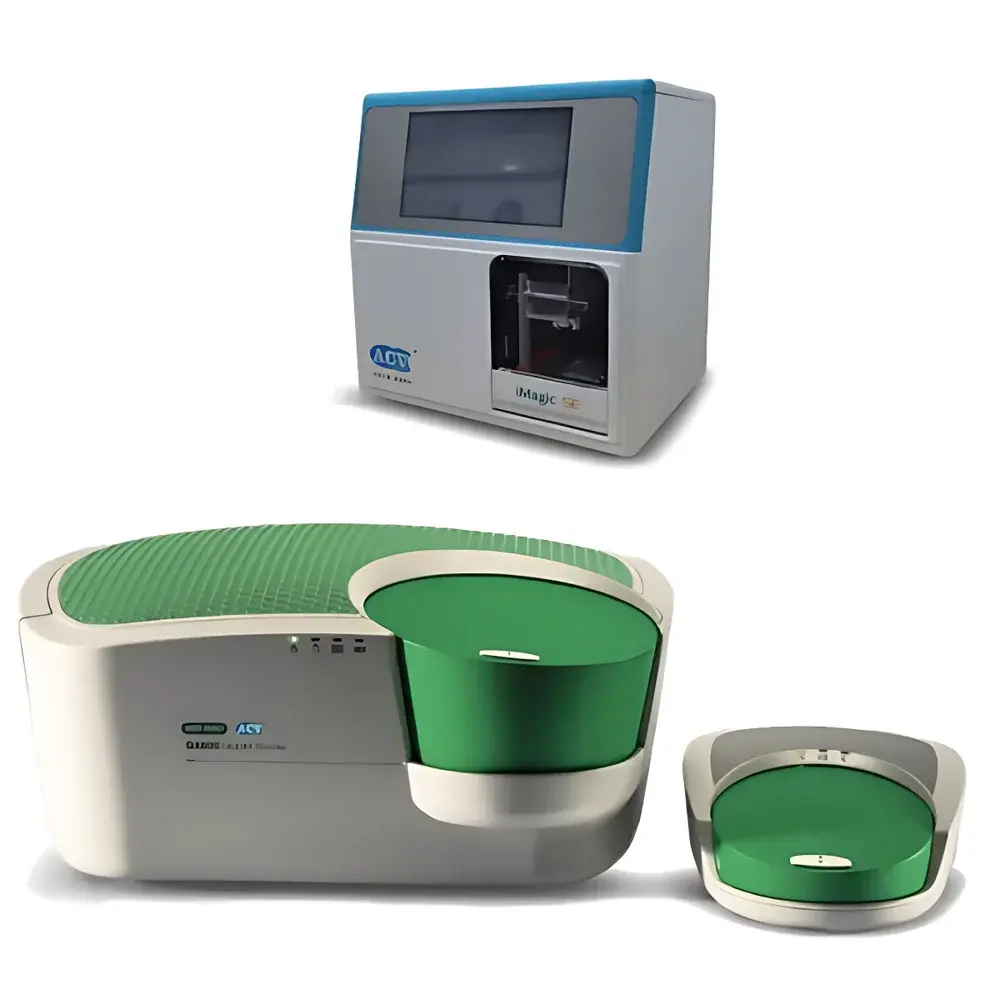
TraceNac Series Ultra-Micro Nucleic Acid Quantification System by ACV
| Brand | ACV |
|---|---|
| Origin | Shandong, China |
| Model | TraceNac Series |
| Sample Throughput | 96-well format |
| Detection Principle | Digital PCR (dPCR) with Magnetic Bead-Based Nucleic Acid Extraction |
| DNA Detection Limit | Absolute quantification of target nucleic acid at ≤0.1% mutant allele frequency |
| Instrument Category | Ultra-micro Nucleic Acid and Protein Analyzer |
| Compliance | Designed for GLP-compliant workflows |
Overview
The TraceNac Series Ultra-Micro Nucleic Acid Quantification System is an integrated benchtop platform engineered for absolute nucleic acid quantification at trace levels without reliance on reference standards or calibration curves. It combines automated magnetic bead-based nucleic acid extraction with digital PCR (dPCR) detection in a single workflow—enabling precise, reproducible measurement of low-abundance targets such as rare mutations, circulating tumor DNA (ctDNA), viral load variants, and gene-edited alleles. Unlike conventional qPCR, which infers concentration from cycle threshold (Ct) values and requires serial dilutions of reference standards, the TraceNac system partitions sample DNA into thousands of nanoliter-scale reaction droplets, performs endpoint PCR amplification in each compartment, and applies Poisson statistical modeling to calculate target copy number directly from binary (positive/negative) fluorescence readouts. This principle ensures high precision across wide dynamic ranges (typically 1–10⁶ copies/μL), minimal inter-run variability, and robust resistance to PCR inhibition from complex biological matrices.
Key Features
- Integrated sample-to-answer workflow: Fully automated magnetic bead-based nucleic acid purification (1–96 samples per run) followed by dPCR partitioning, thermal cycling, and fluorescence imaging.
- High-sensitivity detection: Capable of detecting and absolutely quantifying nucleic acid targets at ≤0.1% mutant allele frequency—critical for liquid biopsy, minimal residual disease (MRD) monitoring, and low-input FFPE applications.
- Optimized reagent cartridges: Pre-filled, lyophilized dPCR master mix and magnetic bead extraction reagents minimize pipetting errors and reduce hands-on time.
- Robust thermal control: Precision Peltier-based thermocycling module with ±0.1 °C uniformity across all wells ensures consistent amplification efficiency and inter-well reproducibility.
- On-instrument imaging: High-resolution CMOS detector with dual-channel (FAM/HEX) excitation and emission filters enables simultaneous detection of multiple targets within a single run.
- Modular design: Compatible with optional barcode scanning, ambient temperature sensors, and external networked storage for traceability in regulated environments.
Sample Compatibility & Compliance
The TraceNac Series accepts diverse input materials including plasma, serum, CSF, urine, saliva, whole blood (with optional lysis), FFPE-derived DNA/RNA, and cultured cell lysates. Its magnetic bead chemistry is optimized for recovery of fragmented nucleic acids (<100 bp), making it suitable for degraded clinical specimens. The system supports ISO/IEC 17025-aligned validation protocols and includes built-in instrument qualification tools (IQ/OQ/PQ templates). When deployed with validated software configurations, it meets requirements for data integrity under FDA 21 CFR Part 11—including electronic signatures, audit trail logging, and user access controls. All extraction and dPCR protocols are compatible with CLSI EP17-A2 guidelines for limit-of-detection verification and USP recommendations for molecular assay validation.
Software & Data Management
The TraceNac Control Suite provides intuitive, role-based interface navigation with configurable user permissions (administrator, analyst, reviewer). Raw dPCR data files (.trc) are stored with embedded metadata (run parameters, reagent lot numbers, operator ID, timestamp). Quantification algorithms apply Poisson correction and include confidence interval estimation (95% CI) for every reported concentration. Export options include CSV, PDF analytical reports, and XML-compatible formats for integration with enterprise LIMS or ELN systems. Software versioning follows ICH GCP Annex 11 principles, with change logs, regression testing records, and patch deployment history maintained internally.
Applications
- Quantitative detection of somatic mutations (e.g., EGFR T790M, BRAF V600E) in plasma-derived ctDNA.
- Monitoring of minimal residual disease (MRD) post-chemotherapy or hematopoietic stem cell transplantation.
- Validation of CRISPR/Cas9 editing efficiency and off-target assessment in preclinical models.
- Standard-free quantification of reference materials for NIST-traceable calibration of qPCR assays.
- Viral load measurement in latent infections (e.g., HIV proviral DNA, HBV cccDNA) where low-copy-number detection is essential.
- Quality control of mRNA vaccine intermediates and final drug substance batches.
FAQ
Does the TraceNac system require external calibration standards for absolute quantification?
No. Absolute quantification is achieved through digital partitioning and Poisson statistics—no standard curve or reference material is required.
Can the system process partially degraded RNA samples?
Yes. The magnetic bead chemistry is optimized for short fragments (down to 30 nt), and the dPCR workflow tolerates moderate RNA degradation better than reverse transcription-qPCR.
Is the software compliant with 21 CFR Part 11 for regulated laboratories?
Yes—when configured with audit trail activation, electronic signature enforcement, and secure user authentication, the system supports full Part 11 compliance for GxP environments.
What is the typical hands-on time per 96-sample run?
Approximately 25 minutes, including loading of sample plates and consumables; total run time (extraction + dPCR) is ~3.5 hours.
Are third-party reagents supported?
The system is validated exclusively with ACV-branded magnetic bead kits and dPCR master mixes; use of non-validated reagents voids performance specifications and regulatory compliance claims.
Related Products



