
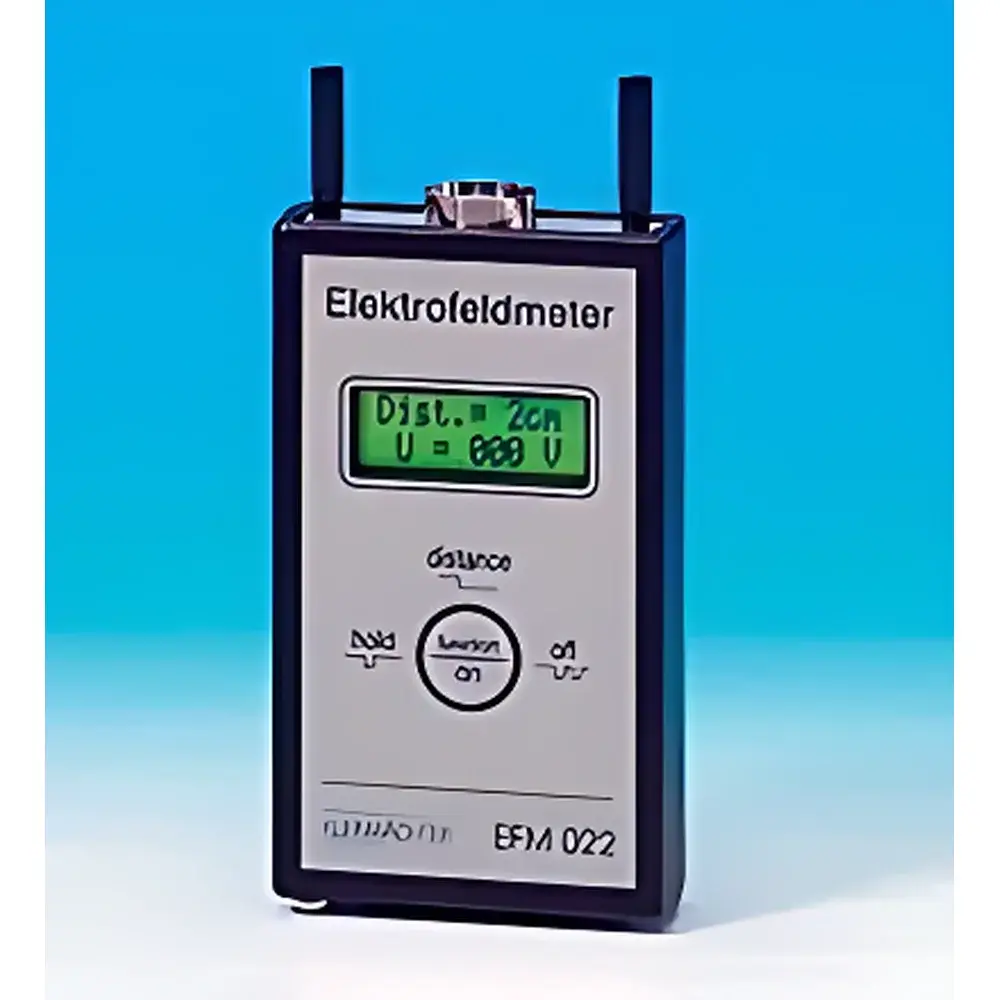
TREO EFM 022 Portable Electrostatic Field Meter
| Origin | Germany |
|---|---|
| Type | Imported Instrument |
| Model | EFM 022 |
| Measurement Distance Ranges | 1 cm (0–8 kV), 2 cm (0–16 kV), 5 cm (0–40 kV), 10 cm (0–80 kV), 20 cm (0–160 kV) |
| Display | Dual-line LCD with backlight (top line: distance in cm |
| bottom line | field voltage in V) |
| Power Supply | 9 V alkaline battery (IEC 6LR61) |
| Dimensions | 122 × 70 × 26 mm |
| Weight | 130 g |
| Operating Mode | CPS (Charged Plate Sensor) compatible (optional external high-voltage converter and flat-plate charger required) |
Overview
The TREO EFM 022 Portable Electrostatic Field Meter is a precision-engineered, non-contact electrostatic field measurement instrument designed for rapid, repeatable assessment of surface voltage on insulating and semi-conductive materials. Based on the principle of capacitive coupling and electrostatic induction, the EFM 022 measures the electric field strength generated by static charge accumulation without physical contact—minimizing disturbance to the charged surface and eliminating risk of discharge or contamination. Its calibrated sensor head responds linearly across five predefined probe-to-surface distances (1, 2, 5, 10, and 20 cm), enabling traceable voltage estimation from 0 to ±160 kV depending on standoff distance. This capability makes it especially suitable for evaluating triboelectric charging behavior in textile manufacturing, cleanroom garment validation, roll-to-roll web processing, and packaging material qualification—where uncontrolled static poses risks to product integrity, operator safety, and process reliability.
Key Features
- Single-button operation with intuitive menu-driven configuration—no calibration tools or software required for routine use.
- Five preset measurement distances (1/2/5/10/20 cm) automatically scale voltage readout to maintain consistent field sensitivity per ISO 18527-1 and IEC 61340-4-1 test methodologies.
- Real-time dual-line LCD display with integrated backlight: top line indicates selected distance (cm); bottom line shows measured voltage (V or kV) with polarity indication (+/−).
- Hold function for instantaneous value capture and memory retention of last reading—enabling comparison across multiple sample points without manual note-taking.
- No zero-adjustment needed between measurements: factory-calibrated offset compensation ensures immediate readiness after power-on.
- CPS (Charged Plate Sensor) mode support—when used with optional TREO flat-plate charger (e.g., FPC-100) and external high-voltage converter, the EFM 022 can serve as part of a full ASTM D257-compliant surface resistivity and charge decay evaluation system.
Sample Compatibility & Compliance
The EFM 022 is optimized for non-conductive and low-conductivity substrates typical in textile production—including synthetic fibers (polyester, nylon), blended fabrics, nonwovens, coated films, and laminated composites. Its non-invasive measurement avoids surface perturbation, preserving sample condition during QC checks. The instrument conforms to key international standards governing electrostatic measurement practices, including IEC 61340-2-1 (Electrostatics — Part 2-1: Measurement methods — Ability of materials to dissipate static electricity), ISO 18527-1 (Electrostatics — Test methods for evaluating electrostatic propensity of materials — Part 1: Triboelectric charging), and EN 1149-1 (Protective clothing — Electrostatic properties — Part 1: Test method for measurement of surface resistivity). While not a medical device or safety-critical control instrument, its design supports GLP-aligned documentation workflows when paired with external logging accessories.
Software & Data Management
The EFM 022 operates as a standalone field meter with no embedded data logging or USB connectivity. However, its stable analog output signal (available via optional analog interface module) permits integration into third-party SCADA or LabVIEW-based acquisition systems for time-series recording. For audit-ready reporting, users may manually record readings alongside contextual metadata (sample ID, location, humidity/temperature conditions, distance setting) in accordance with internal SOPs or ISO/IEC 17025 documentation requirements. Optional TREO PC software (sold separately) enables batch export of manually entered measurement logs into CSV format for statistical process control (SPC) analysis and trend visualization.
Applications
- Quantitative verification of antistatic treatment efficacy on woven and knitted fabrics during finishing processes.
- Pre-shipment validation of ESD-safe workwear and cleanroom garments per ANSI/ESD S20.20 and IEC 61340-5-1.
- Troubleshooting static-related defects in textile printing, dyeing, and cutting operations—such as fiber repulsion, dust attraction, or misalignment in automated layup.
- Charge decay profiling of technical textiles used in aerospace or automotive interiors under controlled environmental chambers.
- Baseline electrostatic characterization of raw fiber bales or spun yarn prior to weaving or knitting—supporting root-cause analysis of downstream static events.
FAQ
Is the EFM 022 calibrated to NIST-traceable standards?
Yes—each unit ships with a manufacturer’s certificate of calibration referencing traceable reference field generators compliant with ISO/IEC 17025-accredited laboratories.
Can the EFM 022 measure charge decay time?
Not autonomously; however, when combined with the optional TREO FPC-100 flat-plate charger and external timer, it supports manual implementation of ASTM D257 Section 12.3 decay testing protocols.
What environmental conditions affect measurement accuracy?
Relative humidity below 30 % RH may increase surface charge retention and reduce repeatability; measurements are most reliable between 30–65 % RH and 15–30 °C ambient temperature.
Does the instrument require periodic recalibration?
Annual recalibration is recommended for quality-critical applications; intervals may be extended per internal metrology policy if stability checks (using certified reference plates) confirm drift < ±2 % over six months.
Is the EFM 022 suitable for measuring static on moving webs?
Yes—its fast response time (< 100 ms) and wide dynamic range allow real-time monitoring at line speeds up to 100 m/min when mounted on fixed-position brackets with appropriate standoff distance control.





