
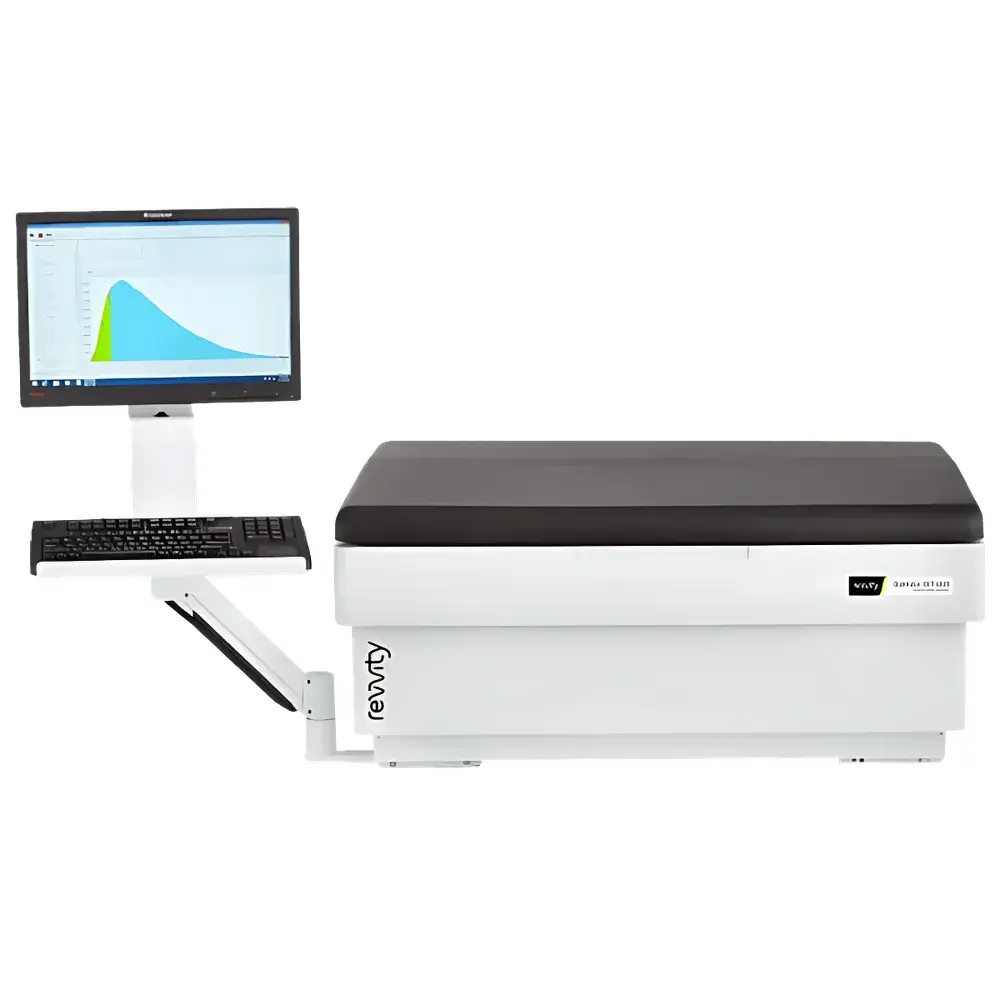
Tri-Carb 4810 Liquid Scintillation Spectrometer
| Brand | Revvity |
|---|---|
| Origin | USA |
| Model | Tri-Carb 4810 |
| Detection Principle | Coincidence Counting + Time-Resolved Liquid Scintillation Counting (TR-LSC) |
| Background Reduction | Optimized via Pulse-Shape Discrimination and Dual-Photomultiplier Coincidence Logic |
| Quench Correction Method | tSIE (transformed Spectral Index of the External standard) |
| Multichannel Analyzer (MCA) Resolution | 4096 channels |
| Detection Efficiency | ≥63% for ³H, ≥95% for ¹⁴C |
| Sample Volumes Supported | 4 mL, 7 mL, 20 mL |
| Sample Capacity | 408 × 20 mL vials or 720 × 4/7 mL vials |
| Compliance | Meets ASTM D7282, ISO 9001–certified manufacturing environment, fully compatible with GLP/GMP data integrity requirements including 21 CFR Part 11–compliant audit trail and electronic signature support |
Overview
The Tri-Carb 4810 Liquid Scintillation Spectrometer is a high-performance, dual-PMT benchtop instrument engineered for quantitative detection of low-energy beta emitters—including ³H, ¹⁴C, ³²P, ³⁵S, and ⁸⁹Sr—in aqueous, organic, and heterogeneous biological matrices. It employs true coincidence counting logic to reject uncorrelated photomultiplier tube (PMT) noise events, combined with patented Time-Resolved Liquid Scintillation Counting (TR-LSC) technology that discriminates between prompt scintillation photons and delayed afterglow or chemiluminescence artifacts. This architecture delivers exceptionally low background counts—typically < 0.5 CPM in ³H windows—and enables reliable quantification at sub-disintegration-per-minute (dpm) activity levels. The system is calibrated traceably to NIST-traceable ¹⁴C and ³H standards and operates under stable temperature-controlled conditions to minimize PMT gain drift and spectral migration.
Key Features
- Dual independent high-quantum-efficiency photomultiplier tubes with active voltage stabilization and real-time gain matching
- Integrated tSIE (transformed Spectral Index of the External standard) algorithm for automated, matrix-independent quench correction across single- and dual-label experiments
- 4096-channel multichannel analyzer with adjustable window settings, enabling simultaneous multi-isotope analysis without hardware reconfiguration
- Programmable sample carousel accommodating up to 408 × 20 mL low-diffusion glass vials or 720 × 4/7 mL polyethylene vials—compatible with standard scintillation cocktail formulations (e.g., Ultima Gold™, EcoLite+, MicroScint™)
- Onboard spectral deconvolution engine supporting up to three isotopes per sample using region-of-interest (ROI) integration and chi-square minimization fitting
- Embedded Windows-based OS with deterministic I/O timing, ensuring reproducible count acquisition cycles and precise dead-time correction
Sample Compatibility & Compliance
The Tri-Carb 4810 accepts standard 4 mL, 7 mL, and 20 mL screw-cap or push-top vials, including borosilicate glass and low-potassium plastic variants optimized for ultra-low-background applications. It supports both aqueous-compatible cocktails (e.g., for cell lysates or urine) and high-flashpoint organic solvents (e.g., toluene-based cocktails for tissue homogenates). All firmware and software modules are validated per IQ/OQ protocols aligned with ISO/IEC 17025 and FDA 21 CFR Part 11 requirements. Audit trails record user identity, timestamp, parameter changes, and raw count file generation—fully admissible during regulatory inspections. Instrument performance verification includes daily background checks, efficiency calibration with certified reference sources, and linearity assessment across five decades of activity (1–10⁵ dpm).
Software & Data Management
Acquisition and analysis are managed through the Tri-Carb Software Suite v5.x—a validated, installable desktop application supporting method templates, batch processing, and LIMS integration via ASTM E1384-compliant HL7 messaging. Raw spectral data (.spc) and processed results (.csv, .pdf) are stored with immutable metadata: vial ID, cocktail type, quench parameter (tSIE), counting time, background subtraction mode, and detector voltage history. Electronic signatures comply with ALCOA+ principles (Attributable, Legible, Contemporaneous, Original, Accurate, Complete, Consistent, Enduring, Available). Export formats include ANSI/NISO Z39.18–compliant XML for long-term archival and cross-platform interoperability.
Applications
- Cellular & Molecular Biology: Quantitative tracking of nucleic acid synthesis (³H-thymidine), protein turnover (¹⁴C-leucine), post-translational modifications (³²P-ATP kinase assays), and receptor-ligand binding kinetics under physiological conditions
- Nutritional Physiology: In vivo absorption studies using ⁶⁵Zn, ⁵⁹Fe, or ⁷⁵Se tracers in animal models; plant nutrient uptake profiling via hydroponic ³²P or ¹⁵N labeling; mineral bioavailability assessment in fortified foods
- Environmental Radioecology: Low-level ³H monitoring in groundwater following nuclear facility releases; ¹⁴C dating preparation validation; radionuclide speciation in sediment pore water using solvent extraction followed by LSC
- Pharmaceutical ADME: Mass balance studies in preclinical species using ¹⁴C-labeled drug candidates; metabolite identification via HPLC-LSC hyphenation with fraction collector synchronization
FAQ
What quench correction methods does the Tri-Carb 4810 support?
It implements tSIE (transformed Spectral Index of the External standard) as the primary method, with optional support for SQP(E) and DPM-based internal standardization for specific QC workflows.
Is the system compliant with 21 CFR Part 11 for regulated laboratories?
Yes—full electronic signature capability, role-based access control, immutable audit trails, and configurable retention policies are embedded and validated.
Can it distinguish between ³H and ¹⁴C in dual-label experiments without chemical separation?
Yes—using spectral deconvolution on 4096-channel MCA data and tSIE-driven efficiency interpolation, with typical cross-talk < 2.5% under optimal cocktail conditions.
What maintenance is required to sustain optimal PMT stability?
Annual gain calibration using ¹⁴C check sources and quarterly dark-current verification are recommended; no routine PMT replacement is needed within the first 8 years of operation under standard lab conditions.
Does the instrument support remote monitoring or integration with laboratory information management systems (LIMS)?
Yes—via TCP/IP-enabled instrument server with RESTful API endpoints and native drivers for Thermo Fisher SampleManager, LabWare LIMS, and custom SQL-based platforms.
Related Products







