
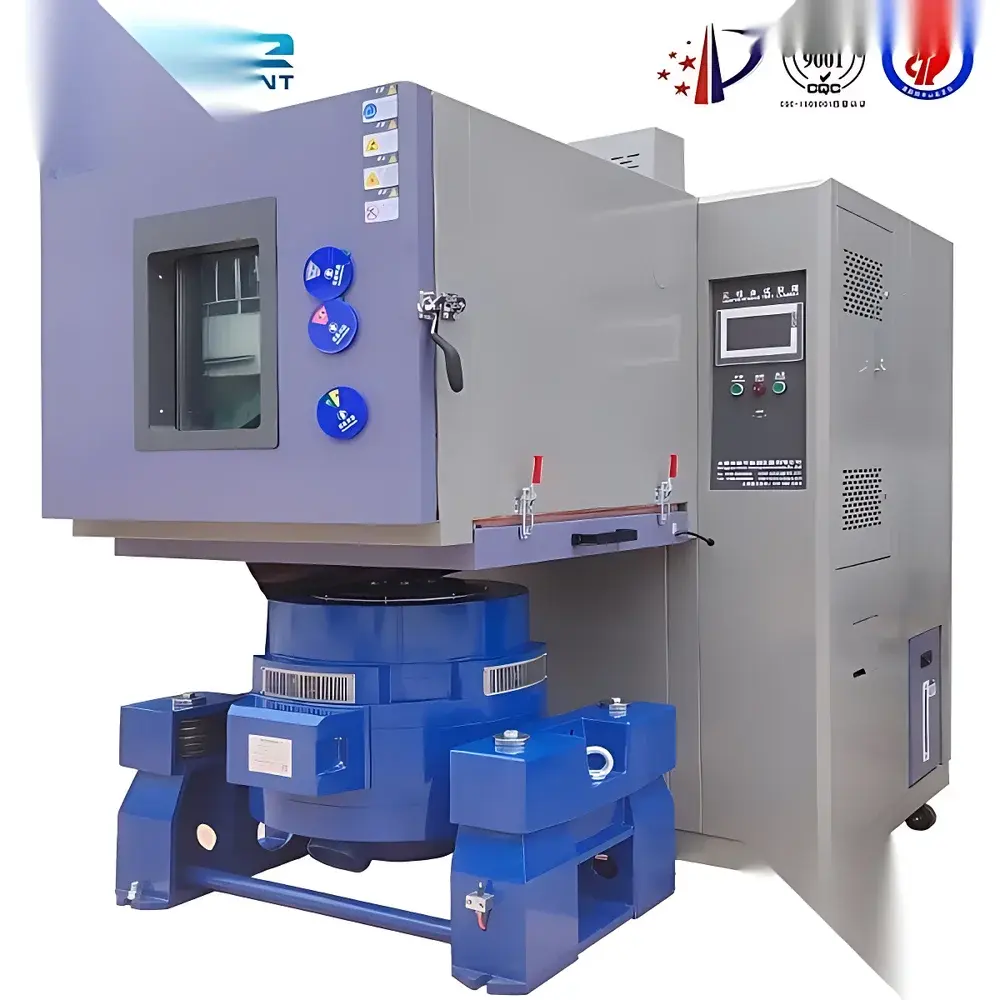
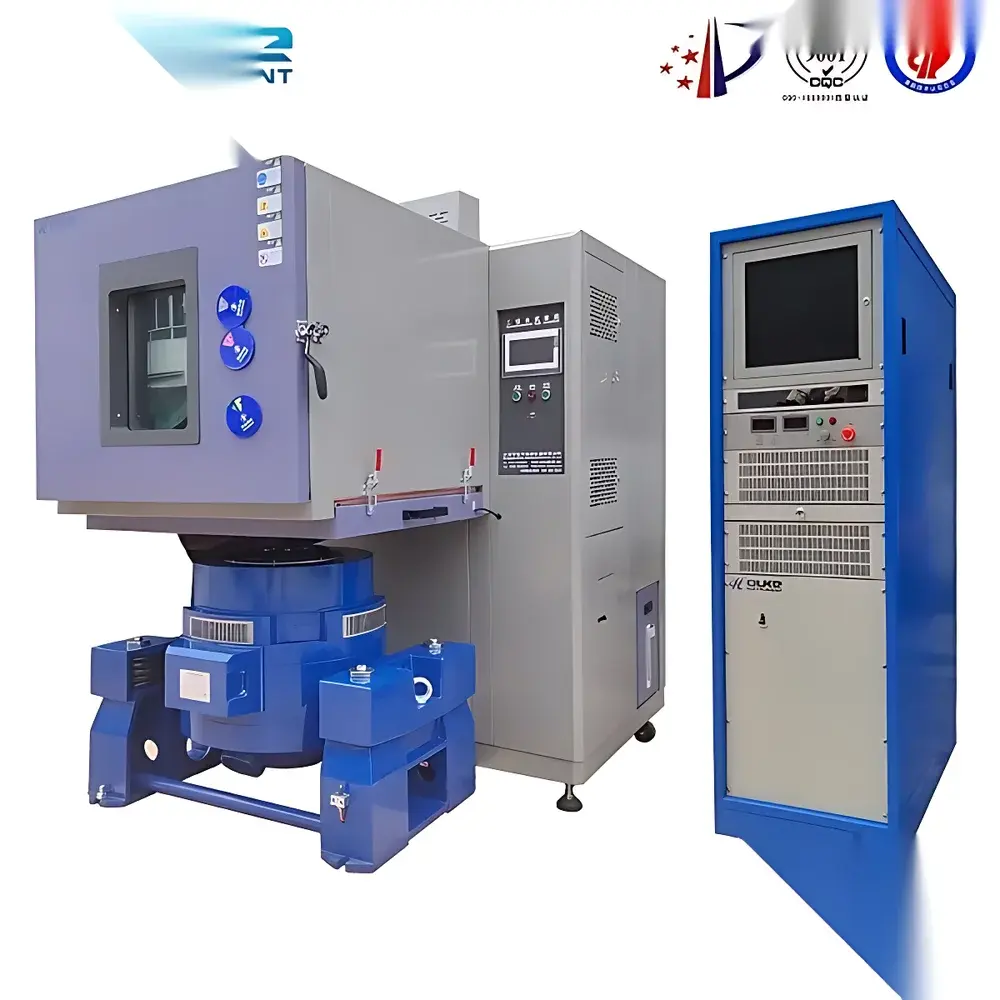
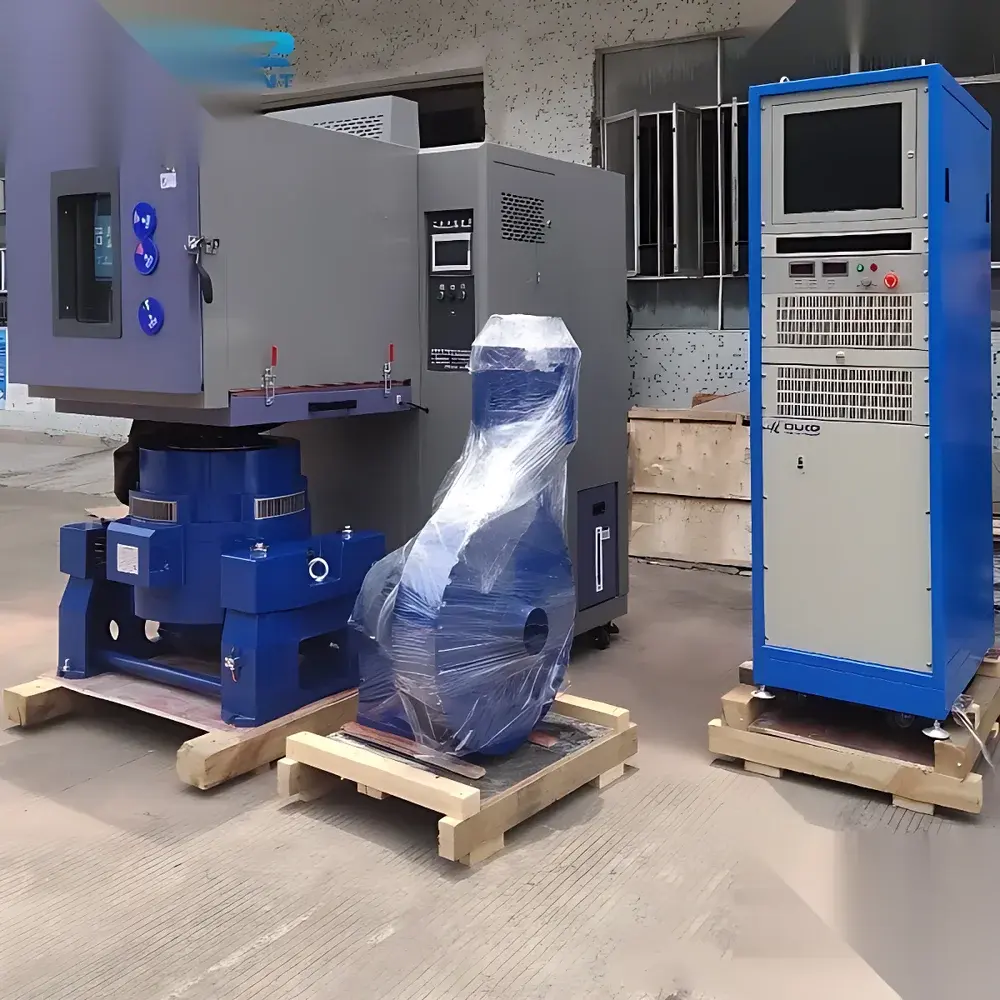
Tri-Combined Environmental Vibration Test System
| Brand | Other Brands |
|---|---|
| Origin | Imported |
| Manufacturer Type | General Distributor |
| Price | USD 21,000 (approx.) |
| Power | 1.5 kW |
| Speed Range | 100–300 rpm (continuously adjustable) |
| Speed Accuracy | ±3 rpm |
| Amplitude | 25.4 mm ±15% |
| Max Load Capacity | 100 kg |
| Time Setting Range | 0–99.99 h |
| Supply Voltage | 220 V, 50 Hz |
| Net Weight | ~250 kg |
| Drive Type | DC Motor with Synchronous Silent Belt Transmission |
| Vibration Mode | Orbital (Reciprocating Rotational) |
| Mounting | Linear Rail-Based Fixture System |
| Base Construction | Heavy-Duty Channel Steel Frame with Vibration-Damping Rubber Pads |
| Compliance | Configurable for IEC 60068-2-6, IEC 60068-2-64, MIL-STD-810H, GB/T 2423.10, GB/T 2423.34 |
Overview
The Tri-Combined Environmental Vibration Test System is an integrated reliability validation platform engineered to replicate concurrent thermal, humidity, and mechanical vibration stresses during product qualification and endurance testing. Unlike sequential environmental chambers or standalone shakers, this system implements synchronized multi-stress exposure—enabling accelerated life-cycle simulation of real-world operational conditions encountered during manufacturing, logistics, installation, and field deployment. Its core vibration mechanism operates on a precisely controlled orbital (reciprocating rotational) principle—commonly referred to in industry as “galloping” or “horse-gallop” motion—generated via a robust DC motor coupled with a synchronous silent belt transmission. This architecture ensures low acoustic emission (<65 dB(A) at 1 m), high torque delivery across the full speed range (100–300 rpm), and exceptional load stability under dynamic conditions up to 100 kg. The system’s modular design supports integration with optional temperature-humidity chambers (not included), allowing users to configure fully compliant tri-combined test environments per IEC, MIL-STD, and GB/T standards.
Key Features
- Orbital vibration mode with continuous speed adjustability from 100 to 300 rpm, calibrated to ±3 rpm accuracy for repeatable spectral energy distribution.
- Digital frequency display with programmable timer (0–99.99 hours) enabling precise dwell-time control for fatigue and resonance screening protocols.
- Linear rail-based sample mounting system—designed for rapid, tool-free fixture attachment and secure retention during high-amplitude excitation (25.4 mm ±15%).
- Heavy-duty channel steel base frame integrated with high-damping rubber isolation pads; eliminates requirement for anchoring or reinforced flooring.
- DC motor-driven actuation ensures smooth torque response, minimal speed droop under load, and compatibility with long-duration cyclic tests (>1,000 hours).
- Low-noise synchronous belt drive reduces mechanical harmonics and extends maintenance intervals compared to direct-coupled or gear-driven alternatives.
- Scalable configuration: Supports non-standard payload dimensions and mass distributions upon engineering review—ideal for aerospace subassemblies, automotive ECUs, and industrial control cabinets.
Sample Compatibility & Compliance
The system accommodates rigid and semi-rigid specimens up to 100 kg and 600 × 600 × 600 mm (L×W×H), with fixture adaptability for PCBs, enclosures, sensors, and assembled modules. It meets essential requirements of IEC 60068-2-6 (sinusoidal vibration), IEC 60068-2-64 (broadband random vibration), and MIL-STD-810H Method 514.8 (vibration testing). When paired with certified climate chambers, full tri-combined testing aligns with GB/T 2423.34 (combined temp/humidity/vibration) and ISO 16750-3 (road vehicle environmental conditions). All mechanical interfaces comply with ISO 5344 mounting standards, and vibration profiles are exportable for traceability in GLP/GMP-regulated environments.
Software & Data Management
While the base unit operates via embedded digital controller with local parameter programming, optional PC-based software (sold separately) enables waveform generation, real-time amplitude/speed logging, pass/fail threshold definition, and CSV data export. Audit trails—including operator ID, timestamp, test parameters, and runtime events—are retained locally for compliance with FDA 21 CFR Part 11 when used in regulated medical device validation. Calibration certificates (traceable to NIST or equivalent national metrology institutes) are available upon request for ISO/IEC 17025-accredited laboratories.
Applications
- Electronics: Solder joint integrity assessment, connector retention verification, and BGA crack propagation analysis under combined thermal cycling and vibration stress.
- Automotive: ECU housing durability, sensor mounting reliability, and infotainment module survivability in simulated chassis vibration envelopes.
- Aerospace: Avionics box shock/vibration screening prior to DO-160G Section 8 qualification.
- Industrial Equipment: Structural fatigue evaluation of motor controllers, PLC housings, and HMI panels exposed to factory-floor vibrational spectra.
- Consumer Goods: Drop-and-vibration correlation studies for power tools, home appliances, and wearable devices.
FAQ
Is the system capable of performing simultaneous temperature, humidity, and vibration testing?
Yes—when integrated with a compatible climatic chamber (e.g., temperature range –70°C to +180°C, humidity 10–98% RH), the system achieves true tri-combined operation per GB/T 2423.34 and IEC 60068-2-52.
What is the maximum allowable specimen height above the vibration table surface?
Standard clearance is 300 mm; extended-height configurations (up to 600 mm) are available via custom base risers and support column reinforcement.
Does the system include calibration documentation?
A factory calibration report covering speed linearity, amplitude repeatability, and timer accuracy is supplied standard; ISO/IEC 17025-certified calibration is available as an add-on service.
Can vibration profiles be imported from external sources (e.g., field data files)?
With optional software, users may import .wav or .tdms files for time-domain playback or generate PSD spectra per MIL-STD-810H Annex G requirements.
Is technical support available for test method development?
Yes—application engineers provide protocol guidance for ASTM D999, IEC 60068-2-64, and customer-specific test plans, including fixture design consultation and failure mode interpretation.



