
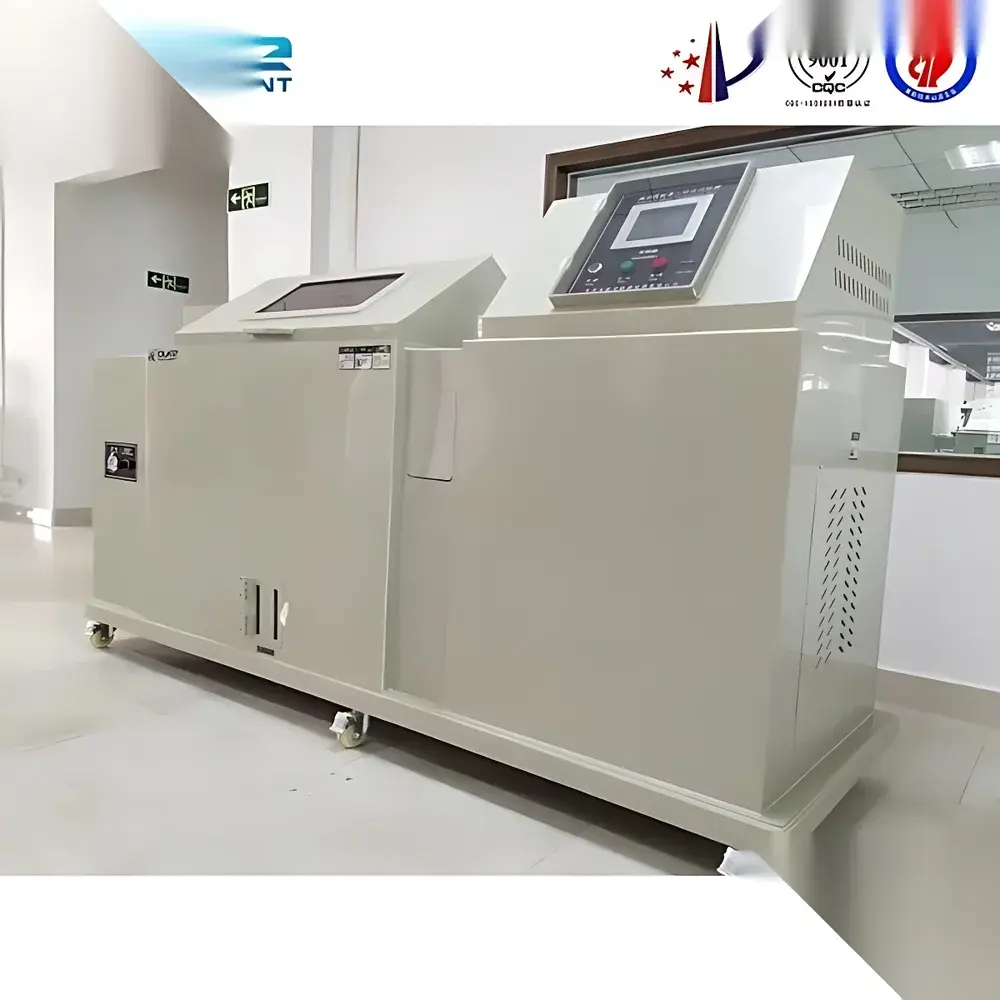
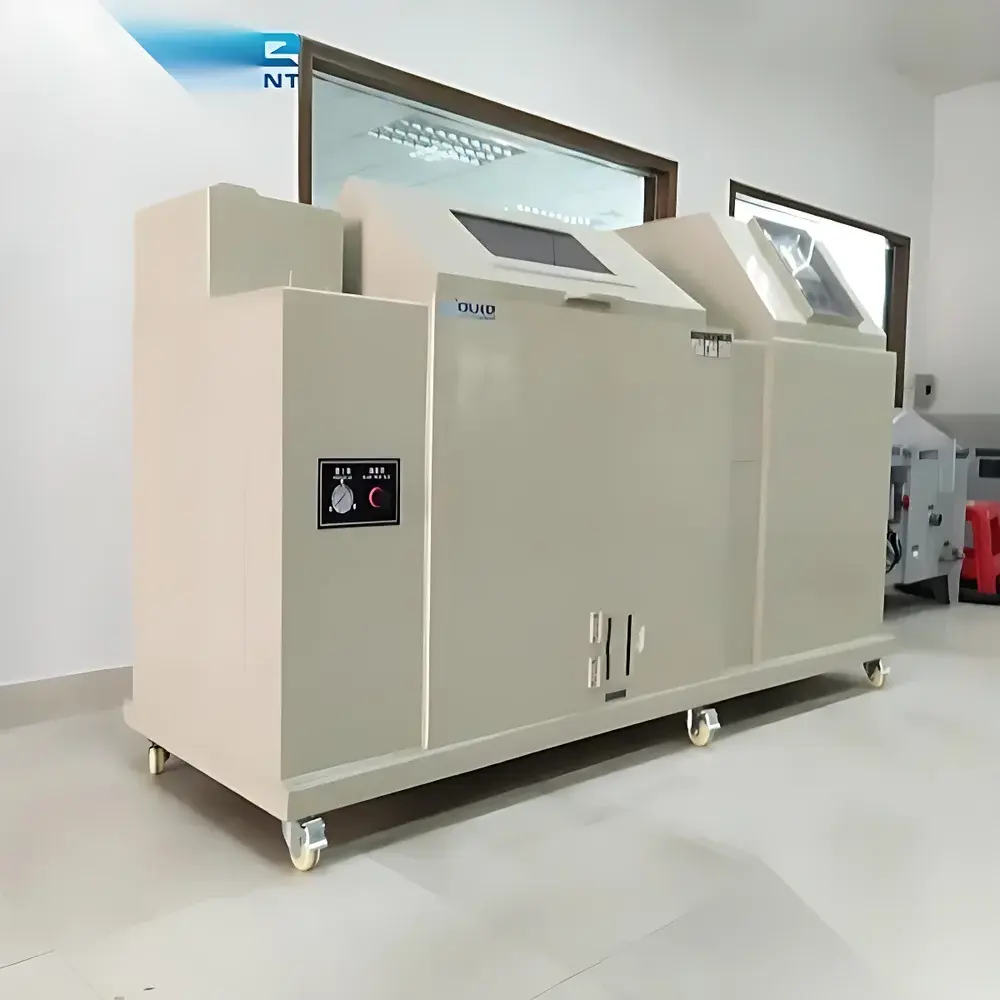
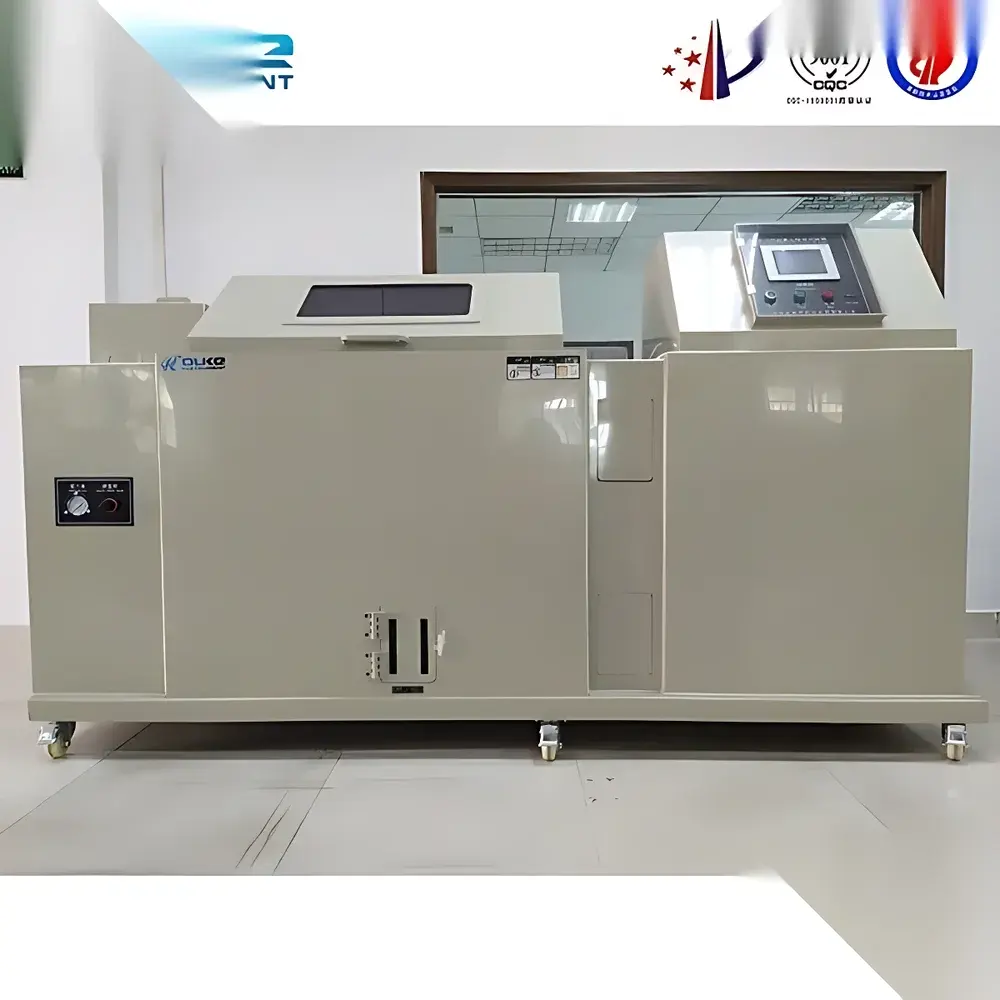
Tri-Environmental Test Chamber for Temperature, Humidity, and Salt Spray (Salt Fog) Corrosion Testing
| Brand | Other Brands |
|---|---|
| Origin | Imported |
| Manufacturer Type | Authorized Distributor |
| Price | USD 12,500 (FOB) |
| Compliance | GB/T 2423.17, GB/T 5170.8, GB/T 10587, IEC 60068-2-11, ASTM B117, DIN 50021, MIL-STD-810G Method 509.6 |
| Operating Ambient | 0–35 °C, ≤85% RH, 86–106 kPa |
| Sample Orientation | 15°–30° from vertical (flat specimens), horizontal (components/equipment) |
Overview
The Tri-Environmental Test Chamber for Temperature, Humidity, and Salt Spray Corrosion Testing is an engineered environmental simulation system designed to replicate the synergistic degradation mechanisms encountered in real-world “three-protection” (moisture, heat, salt fog) service conditions. It integrates precise control of temperature (typically 15–55 °C), relative humidity (up to 98% RH), and continuous or cyclic salt fog generation using a compressed-air atomized NaCl solution (5.0 ± 1.0 % w/w). Unlike single-stress chambers, this tri-combined chamber enables accelerated corrosion testing under controlled, repeatable, and standardized climatic profiles—critical for evaluating the long-term integrity of metallic substrates, electroplated layers, organic coatings, conversion films, and passivated surfaces. The chamber operates on the principle of controlled aerosol dispersion via pneumatic nozzles, ensuring uniform fog distribution across the test volume per ISO 9227 and ASTM B117 specifications. Its architecture supports both neutral salt spray (NSS) and acetic acid salt spray (AASS) test modes, enabling comparative assessment of coating performance under varying chemical aggressiveness.
Key Features
- Triple-stress integration: Simultaneous or sequential control of temperature, humidity, and salt fog concentration within a single test volume
- Corrosion-resistant stainless-steel interior (SUS316L) with sealed viewing window and corrosion-inhibiting gasketing
- Precision-machined salt solution reservoir with level sensor, automatic top-up capability, and pH monitoring (range: 6.5–7.2 for NSS)
- Dual-stage air filtration system (pre-filter + HEPA) to prevent nozzle clogging and ensure consistent droplet size distribution (median diameter: 1–3 µm)
- Programmable controller with Ethernet interface supporting up to 99 test cycles, ramp/soak profiles, and user-defined pause points
- Integrated temperature/humidity calibration ports compliant with ISO/IEC 17025 traceability requirements
- Self-diagnostic fault logging with timestamped event history and alarm relay outputs for external SCADA integration
Sample Compatibility & Compliance
The chamber accommodates flat panels, machined components, PCB assemblies, fasteners, and finished subassemblies. Sample mounting follows internationally recognized orientation guidelines: flat specimens are positioned at 15°–30° from vertical to optimize salt deposition uniformity and minimize pooling; cylindrical or irregular parts are secured using non-reactive PTFE or titanium fixtures; electronic units are placed horizontally with ventilation openings unobstructed. All support structures must be inert and non-shielding—stainless steel (316 grade) or PVC-coated racks are recommended. The system meets mandatory compliance requirements for product qualification in automotive (VW 80101, GMW 14872), aerospace (SAE AMS 2700), and electronics (IEC 60068-2-52) sectors. Full documentation includes factory calibration certificates, installation qualification (IQ), operational qualification (OQ), and test reports aligned with GLP principles and FDA 21 CFR Part 11 audit-trail readiness.
Software & Data Management
Equipped with Windows-based chamber management software (v5.2+), the system provides real-time graphing of chamber parameters, automated report generation (PDF/CSV), and secure role-based access control. Data logging resolution is configurable down to 1-second intervals, with local storage (16 GB internal SSD) and optional cloud backup. Software modules support statistical process control (SPC) charting, deviation alerts, and export to LIMS platforms via OPC UA or Modbus TCP. All test records include digital signatures, electronic timestamps, and immutable audit trails—fully compliant with ISO/IEC 17025 Clause 7.11 and GMP Annex 11 requirements for data integrity.
Applications
This tri-environmental chamber serves as a core qualification tool in R&D labs, quality assurance departments, and third-party testing laboratories. Primary applications include: evaluation of zinc-nickel and trivalent chromium coatings on automotive chassis components; lifetime prediction of conformal coatings on military-grade circuit boards; validation of marine-grade aluminum alloy anodizing; comparative analysis of anti-corrosion primers for offshore wind turbine towers; and accelerated aging of medical device housings exposed to coastal environments. It is routinely deployed for supplier audits, PPAP submissions, and regulatory filings requiring evidence of corrosion resistance per ISO 12944, ASTM D1654, or MIL-DTL-16232.
FAQ
Must temporary protective coatings (e.g., VCI films or rust inhibitors) be removed prior to testing?
Yes—per ASTM B117 and IEC 60068-2-11, all non-permanent protective layers must be removed unless explicitly specified in the test plan, as they interfere with fundamental corrosion mechanism assessment.
What is the recommended sample orientation for electronic enclosures?
Enclosures and functional assemblies shall be mounted horizontally with ventilation apertures unobstructed; tilt angles are prohibited unless justified by field-use orientation and documented in the test protocol.
Does the chamber support cyclic corrosion testing (CCT) protocols?
Yes—the controller supports multi-step sequences including dry-off, humidity soak, salt spray, and condensation phases per ISO 14993 and SAE J2334.
Is third-party calibration certification included with delivery?
A full IQ/OQ package with NIST-traceable calibration certificates for temperature, humidity, and fog deposition rate is provided upon commissioning.
Can the system be integrated into an existing laboratory MES or QMS platform?
Yes—native Modbus TCP and OPC UA drivers enable seamless integration with Siemens Desigo, Rockwell FactoryTalk, or ETQ Reliance QMS environments.



