
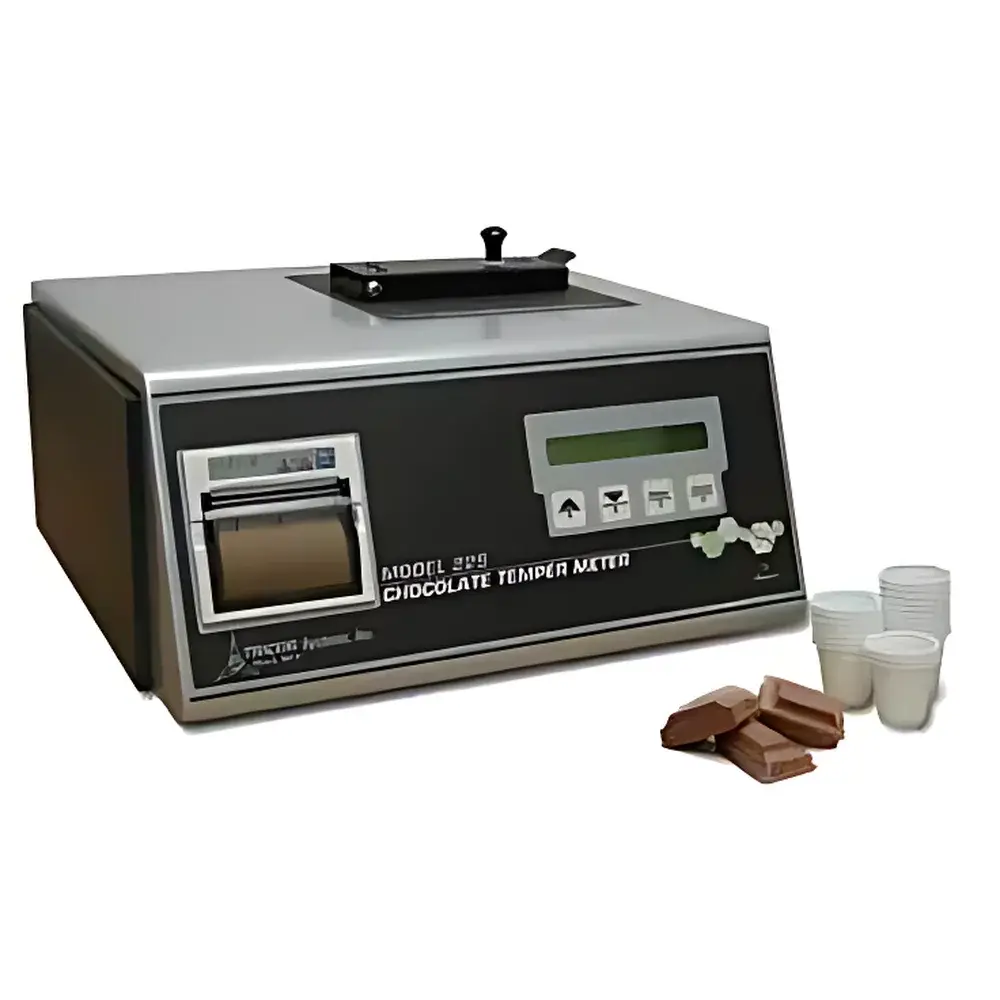
TRICOR Model 225 Portable Chocolate Tempering Analyzer
| Brand | TRICOR |
|---|---|
| Origin | USA |
| Manufacturer Type | Authorized Distributor |
| Import Status | Imported |
| Model | 225 |
| Price Range | USD 13,500–27,000 |
| Dimensions | 20.3 H × 34.3 W × 33 D cm (8 × 13.5 × 13 in) |
| Weight | 6.4 kg (14 lbs) |
| Power Supply | 115/220 V AC, 50/60 Hz, 1.7/0.85 A |
| Sample Volume | 11.0 mL |
| Standard Test Duration | 5 min |
| Sample Stabilization Time | 30 s |
| CTU Repeatability | ±1.0 CTU |
| Cooler Temperature Stability | ±0.06 °C |
| Probe Heating Accuracy | ±0.6 °C |
| Temperature Resolution | ±0.006 °C |
| Temperature Measurement Range | 15–29 °C (standard) |
| Tempering Curve Range | 15–29 °C (standard) |
| Operating Ambient Temperature | 10–38 °C |
| Display | 2-line × 24-character LCD |
| Self-Test | Automatic at Power-On |
| Optional | Remote Plotting Printer, Adjustable Test Duration (3–9.55 min), Extended Temperature Range (15–46 °C / 58–116 °F), TMDAS© Windows Software for Data Acquisition & Analysis |
Overview
The TRICOR Model 225 Portable Chocolate Tempering Analyzer is a purpose-built thermal kinetic instrument engineered to quantify the crystallization behavior of cocoa butter during chocolate tempering—a critical phase governing final product quality. It operates on the principle of controlled isothermal cooling and real-time temperature monitoring of molten chocolate in a standardized geometry, measuring the rate and extent of polymorphic crystal formation (primarily Form V) via precise thermistor-based detection. The device calculates the Chocolate Temper Unit (CTU), a proprietary but industry-validated metric derived from the slope of the temperature vs. time curve during the critical nucleation and growth phase. Unlike generic differential scanning calorimeters or manual seeding methods, the Model 225 replicates the thermal history experienced by chocolate in industrial enrobing or molding processes—enabling objective, operator-independent assessment of temper stability prior to production release.
Key Features
- Integrated Peltier-based thermoelectric cooling/heating system—eliminates dependence on external ice baths or chilled water, ensuring stable thermal boundary conditions and consistent probe immersion depth.
- Single-use, dimensionally calibrated polypropylene sample cups (11.0 mL volume) prevent cross-contamination and preserve geometric reproducibility across batches and operators.
- Onboard 2-line LCD interface with step-by-step operational prompts—no external computer required for routine QA/QC testing.
- Built-in thermal printer provides immediate hard-copy output of CTU value, tempering curve slope, timestamp, and date—supporting traceability per ISO 22000 and FDA 21 CFR Part 11-compliant documentation practices when paired with audit-trail-enabled software.
- ±0.06 °C cooler temperature stability and ±0.006 °C temperature resolution ensure high inter-instrument reproducibility—critical for multi-site consistency in global confectionery supply chains.
- Compact footprint (34.3 cm wide) and 6.4 kg mass enable deployment directly on production lines, in QC labs, or mobile inspection carts without dedicated bench space.
Sample Compatibility & Compliance
The Model 225 is validated for dark, milk, and white chocolate formulations containing standard cocoa butter equivalents (CBEs) and common emulsifiers (e.g., lecithin, PGPR). It accommodates viscosity ranges typical of tempered chocolate (3,500–12,000 cP at 45 °C) without requiring dilution or pre-shearing. All materials contacting chocolate—including the sample cup, probe sheath, and thermal block—are food-grade compliant (FDA 21 CFR §177.1520, EU Regulation EC No. 1935/2004) and non-reactive with cocoa butter triglycerides. The instrument meets IEC 61010-1 safety standards for laboratory electrical equipment and carries CE marking for use in EEA markets. Its CTU methodology aligns with internal specifications adopted by major global confectioners and has been referenced in ASTM E2913-22 (Standard Guide for Sensory Evaluation of Confectionery Products) as an objective correlate to gloss, snap, and bloom resistance.
Software & Data Management
The optional TRICOR Tempering Measurement Data Acquisition Software (TMDAS©) is a Windows-based application enabling full remote control, automated test sequencing, and long-term data archival. TMDAS© supports configurable pass/fail thresholds, statistical process control (SPC) charting (X-bar/R charts), and export to CSV, Excel (.xlsx), and SQL-compatible formats—facilitating integration into enterprise LIMS or MES platforms. Audit trails record user ID, timestamp, parameter settings, raw temperature-time arrays, and final CTU calculation—meeting GLP/GMP requirements for regulated food manufacturing environments. Data files retain embedded metadata (instrument serial number, calibration status, ambient conditions), ensuring full analytical traceability per ISO/IEC 17025 Clause 7.7.
Applications
- Real-time verification of temper status post-tempering machine (e.g., Selmi, Buhler, Sollich units) before mold filling or enrobing.
- Root-cause analysis of bloom, poor snap, or delayed set times through correlation of CTU deviation with storage conditions and ingredient lot variability.
- Validation of new chocolate formulations or alternative fat systems (e.g., cocoa butter replacers) against baseline tempering kinetics.
- Training tool for production staff—visualizing the impact of minor tempering parameter adjustments (cooling rate, seed addition timing) on CTU outcomes.
- Supplier qualification—quantitative assessment of incoming couverture or compound chocolate lots prior to blending.
FAQ
What does CTU (Chocolate Temper Unit) actually measure?
CTU quantifies the normalized slope of the temperature plateau during isothermal crystallization, reflecting the density and uniformity of Form V crystal nuclei. Higher CTU values (typically 12–22 for well-tempered dark chocolate) indicate rapid, homogeneous nucleation—correlating strongly with gloss, contraction, and resistance to fat bloom.
Can the Model 225 be used for compound chocolate or low-cocoa products?
Yes—the instrument detects crystallization onset and kinetics in any cocoa butter-containing system. However, CTU interpretation thresholds must be established per formulation via correlation studies with sensory and physical testing (e.g., ASTM D523 gloss, ISO 8986-2 snap force).
Is calibration traceable to NIST standards?
The thermistor probe is factory-calibrated against NIST-traceable dry-block calibrators (±0.01 °C uncertainty at 20 °C); users receive a certificate of calibration with each unit and may perform field verification using certified reference materials (e.g., pure stearic acid, mp 69.3 °C).
How often does the instrument require recalibration?
Annual recalibration is recommended under routine use; however, daily self-test and quarterly verification using reference chocolate samples (supplied by TRICOR) maintain measurement integrity between formal calibrations.
Does TMDAS© support 21 CFR Part 11 compliance?
Yes—when deployed on validated Windows OS environments with enforced user authentication, electronic signatures, and immutable audit logs, TMDAS© satisfies Part 11 requirements for electronic records and signatures in FDA-regulated facilities.





