
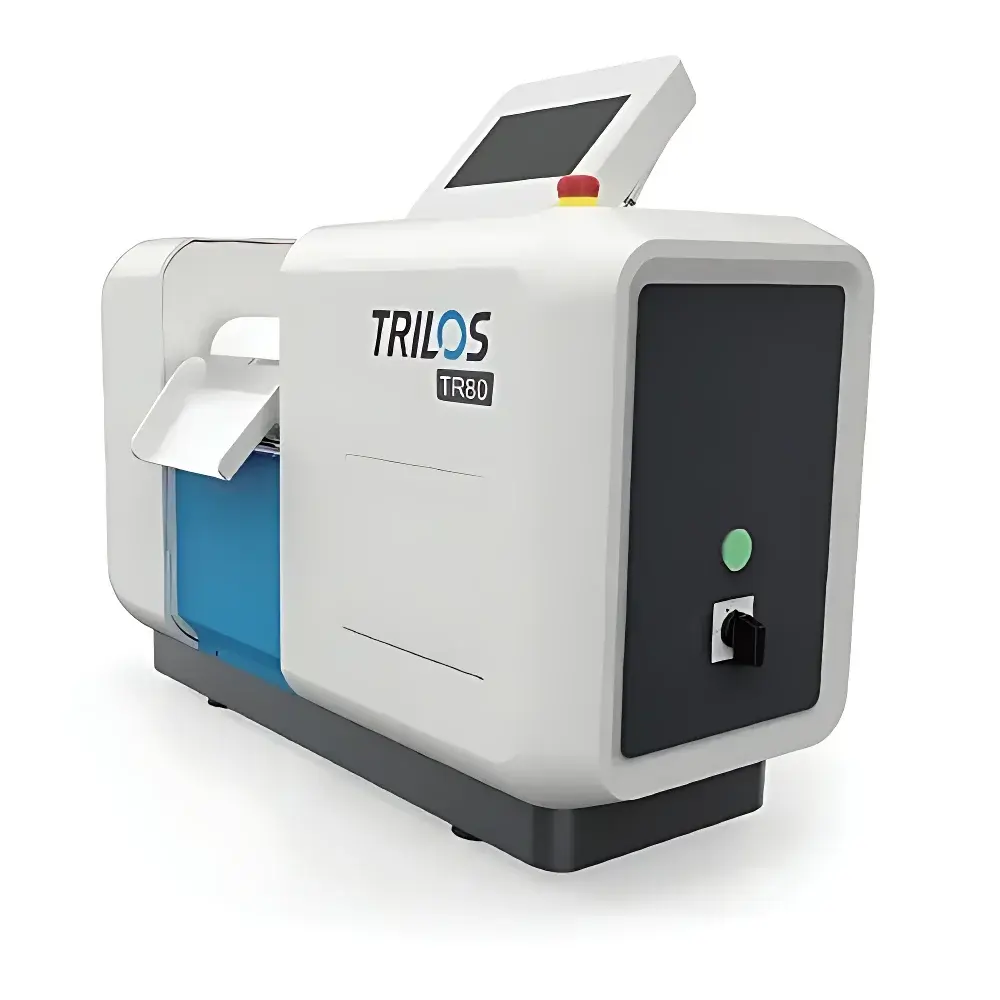
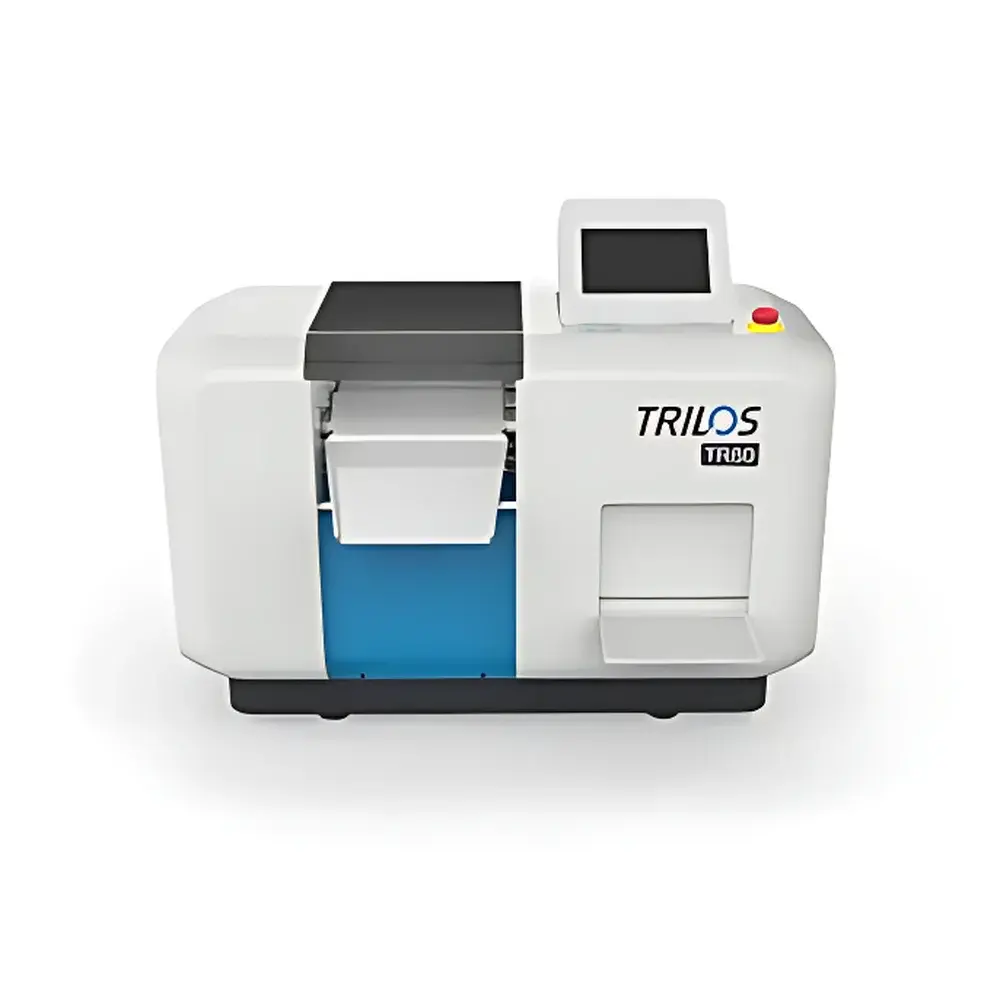
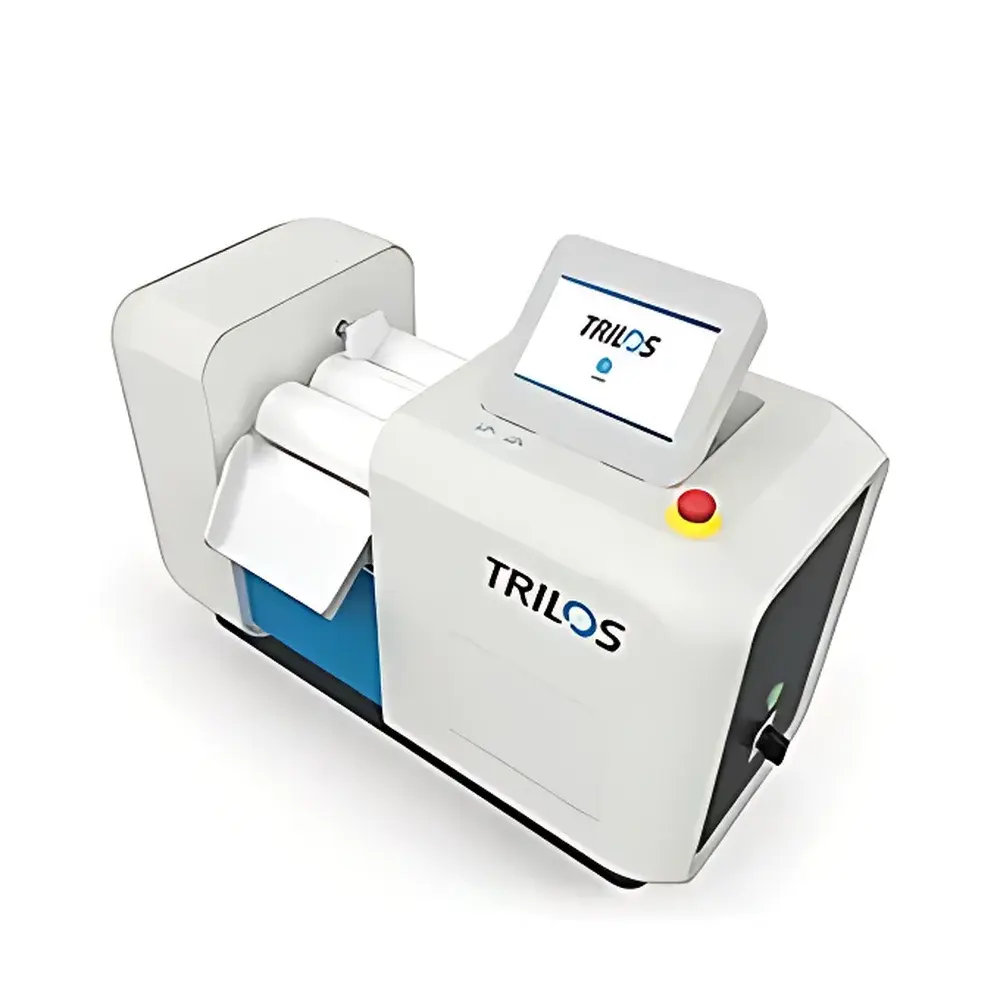
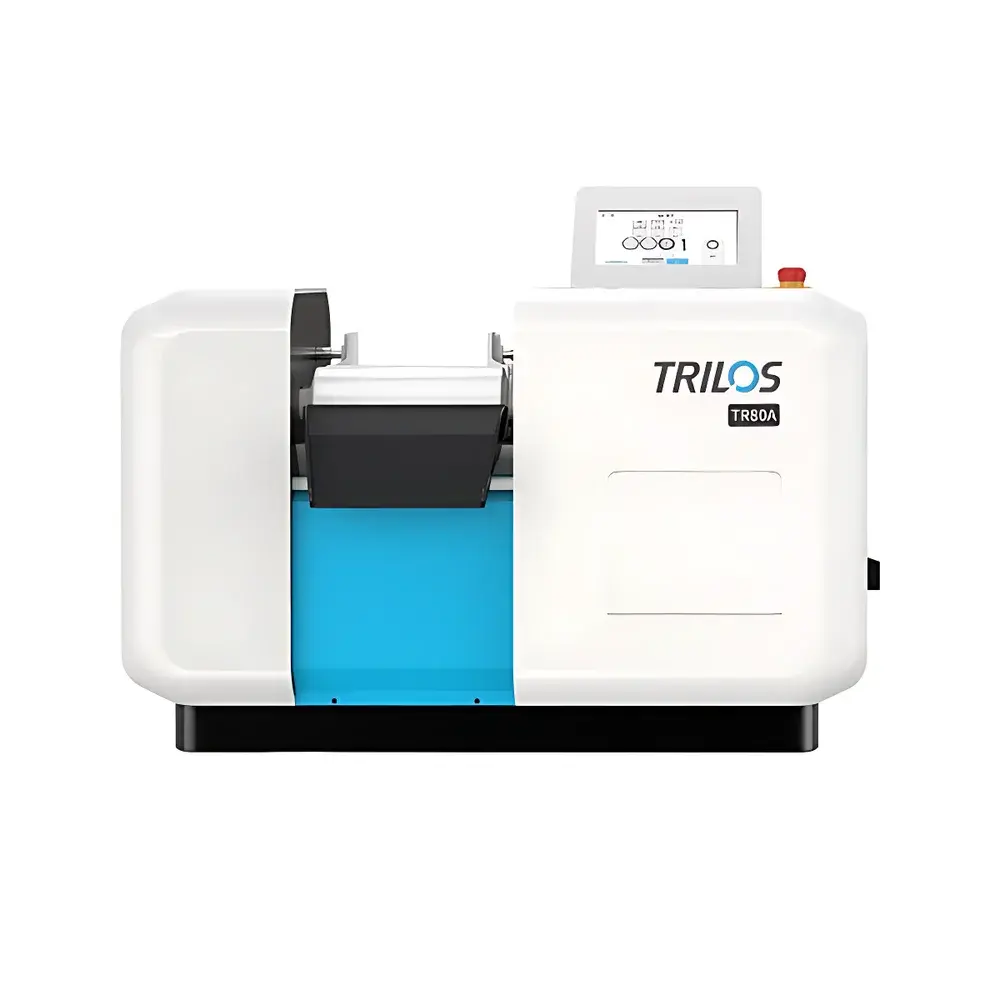
TRILOS TR80A Laboratory Three-Roll Mill
| Brand | TRILOS |
|---|---|
| Origin | USA |
| Model | TR80A |
| Roller Diameter | 80 mm |
| Roller Length | 200 mm |
| Speed Ratio | 1:3:9 |
| Throughput Capacity | 0.02–20 L/h |
| Final Particle Size | ≤1 µm (material-dependent) |
| Feed Particle Size | >1 µm |
| Roller Material Options | SiC, Al₂O₃, ZrO₂, Stainless Steel |
| Doctor Blade Material Options | Al₂O₃, ZrO₂, Stainless Steel, PVC |
| Motor Power | 1.5 kW |
| Dimensions (L×W×H) | 750 × 340 × 490 mm |
| Integrated Cooling Circuit | Yes |
| Control Interface | Full-touch industrial HMI |
| Gap Adjustment | Real-time online correction |
| Compliance | Designed for GLP-compliant lab environments |
| Software Features | Recipe-based operation with audit-trail-capable parameter logging |
Overview
The TRILOS TR80A Laboratory Three-Roll Mill is an engineered solution for high-shear, precision dispersion and particle size reduction of viscous pastes, slurries, and semi-solid materials. Based on the classical three-roll mill principle—where material is subjected to progressive shear deformation across three horizontally aligned, counter-rotating rollers with precisely controlled speed ratios (1:3:9)—the TR80A delivers reproducible sub-micron dispersion performance in a compact footprint suitable for benchtop deployment. Unlike conventional ball or bead mills, this system operates without grinding media, eliminating contamination risk and enabling direct control over shear history, residence time, and thermal management via integrated roller cooling. Its design targets applications requiring narrow particle size distribution (PSD), deagglomeration of nanoscale fillers, and homogenization of high-viscosity formulations—particularly where batch integrity, traceability, and operator safety are critical.
Key Features
- Sub-micron dispersion capability: Achieves final particle sizes down to ≤1 µm, dependent on feedstock rheology and inherent agglomerate strength.
- Benchtop-integrated architecture: Compact dimensions (750 × 340 × 490 mm) allow installation on standard laboratory workbenches without dedicated floor space.
- Real-time online gap adjustment: Motorized, digitally calibrated roller gap control enables precise shear rate modulation during operation—critical for process development and scale-up correlation.
- Modular roller and blade materials: Interchangeable rollers fabricated from silicon carbide (SiC), alumina (Al₂O₃), zirconia (ZrO₂), or stainless steel; doctor blades available in ceramic or polymer variants to match chemical compatibility requirements.
- Dual-mode operation: Supports both manual parameter override and recipe-driven automated runs—facilitating method transfer between R&D and pilot-scale production.
- Integrated closed-loop cooling system: Maintains stable roller surface temperature (<40 °C typical under continuous operation), minimizing thermal degradation of heat-sensitive actives (e.g., polymers, APIs, conductive nanomaterials).
- Full-touch industrial HMI: IP65-rated control panel with intuitive graphical interface, real-time torque monitoring, and password-protected user levels for SOP enforcement.
Sample Compatibility & Compliance
The TR80A accommodates a broad spectrum of soft-to-pasty materials—including polymer dispersions, conductive pastes, pharmaceutical ointments, cosmetic emulsions, battery electrode slurries, solder pastes, and functional coatings—with feed particle sizes >1 µm and viscosities up to 10⁶ mPa·s. Its sealed mechanical design and optional dust cover meet OSHA and EU Machinery Directive (2006/42/EC) requirements for operator protection. The system supports GLP-compliant documentation workflows: all operational parameters (gap setting, roller speeds, run duration, cooling setpoint) are timestamped and stored locally with export capability (CSV/Excel). When configured with audit-trail-enabled firmware, it aligns with FDA 21 CFR Part 11 data integrity expectations for regulated laboratories.
Software & Data Management
The embedded control software provides recipe-based operation with up to 99 programmable methods, each storing roller speed ratios, gap profiles, cooling setpoints, and dwell times. All parameter changes are logged with user ID, timestamp, and reason-for-change fields—enabling full traceability per ISO/IEC 17025 and ASTM E2500-18 guidelines. Data export supports USB flash drive or Ethernet transmission to LIMS or ELN platforms. Optional OPC UA integration allows seamless connection to MES systems for centralized batch record generation in GMP pilot environments.
Applications
- Nanomaterial dispersion: Exfoliation and stabilization of graphene, MXenes, and metal oxide nanoparticles in polymer matrices.
- Electrode slurry preparation: Homogenization of Li-ion cathode/anode slurries with carbon black, NMC, or silicon composites—ensuring uniform coating thickness and reduced calendering defects.
- Conductive adhesive formulation: Dispersion of silver, copper, or nickel flakes in epoxy or silicone carriers for flexible electronics assembly.
- Pharmaceutical semi-solids: Particle size refinement of topical gels and ointments containing micronized APIs under low-thermal-stress conditions.
- Functional coatings: Production of UV-curable inks, anti-reflective suspensions, and dielectric pastes with <5% PSD width (D90/D10).
- High-performance sealants: Deagglomeration of fumed silica thickeners in RTV silicones without gelation or viscosity drift.
FAQ
What is the minimum batch volume the TR80A can process reliably?
The system is validated for consistent dispersion performance across 0.02–20 L/h throughput, with stable operation demonstrated at 50 mL total batch volume using the standard configuration.
Can the TR80A be integrated into an automated lab workflow?
Yes—via Ethernet (TCP/IP) or optional RS-485 Modbus RTU, the unit supports remote start/stop, parameter upload/download, and real-time status polling for integration with robotic liquid handlers or central process controllers.
Is roller surface finish standardized or customizable?
All rollers undergo precision lapping to Ra ≤0.02 µm and are optionally available with super-polished (Ra ≤0.008 µm) or electropolished finishes for ultra-low-adhesion applications such as lithium metal anode slurries.
Does the system comply with electrical safety standards for North American labs?
The TR80A carries UL 61010-1 and CSA C22.2 No. 61010-1 certification, including grounding continuity, insulation resistance, and enclosure ingress protection (IP54 base rating, IP65 HMI).
How is maintenance access designed for routine cleaning and inspection?
Roller assemblies slide laterally on linear guides with quick-release clamps; the front guard and scraper housing disassemble without tools—enabling full visual inspection and wipe-down within 8 minutes.



