
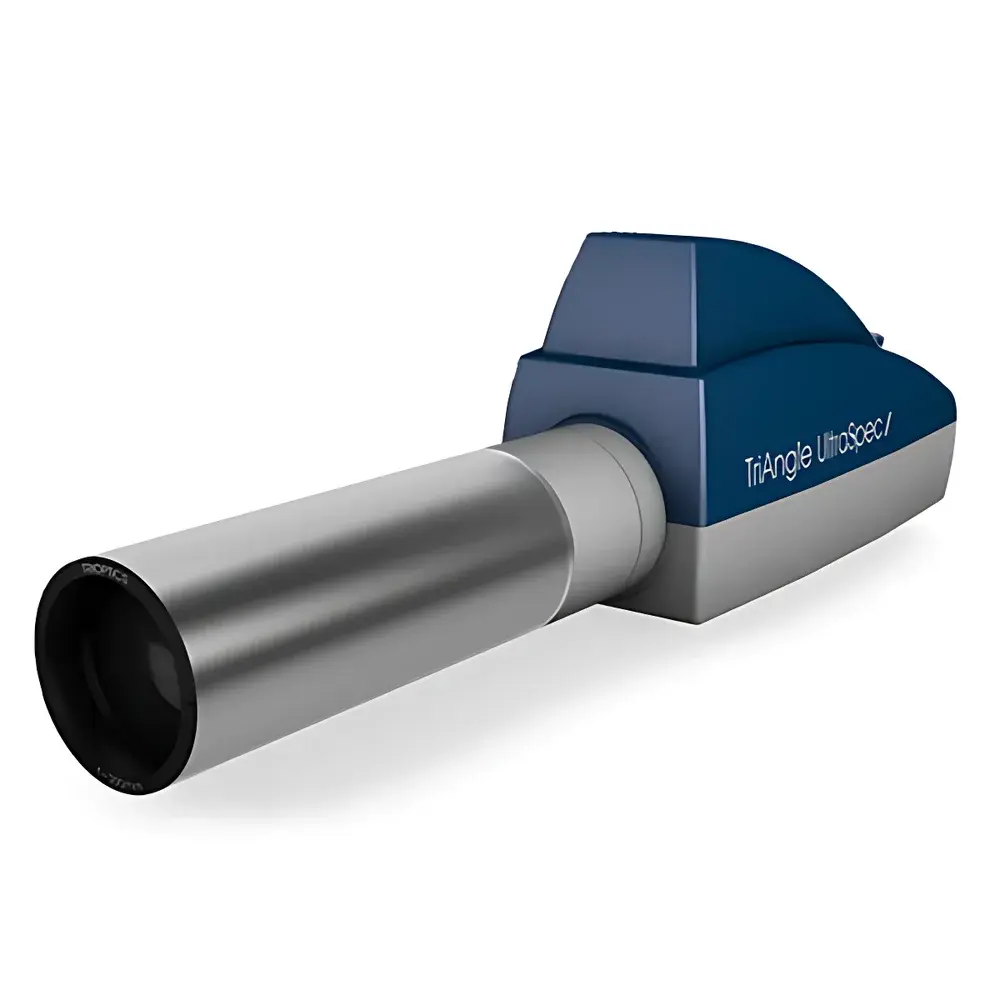
TRIOPTICS TriAngle® Electronic Autocollimator
| Brand | TRIOPTICS |
|---|---|
| Origin | Germany |
| Model | TriAngle® Electronic Autocollimator |
| Sensor Type | High-Resolution CMOS or PSD |
| Spectral Range Options | UV, Visible, NIR |
| Measurement Modes | Absolute and Relative |
| Max. Simultaneous Targets | ≤12 reflections |
| Multi-Instrument Support | Up to 12 units per PC |
| Trigger Interface | External TTL trigger supported |
| Data Export Format | CSV |
| Software | TriAngle® Control Suite v5.x (FDA 21 CFR Part 11 compliant audit trail optional) |
Overview
The TRIOPTICS TriAngle® Electronic Autocollimator is a precision optical metrology instrument engineered for non-contact, high-resolution angular measurement based on the principle of autocollimation. It operates by projecting a collimated beam onto a reflective surface and analyzing the position shift of the retro-reflected image using either a high-resolution CMOS sensor or a Position-Sensitive Detector (PSD). This fundamental optical configuration enables sub-arcsecond angular resolution—typically down to 0.01 arcsec depending on focal length and sensor configuration—making it suitable for demanding alignment, calibration, and stability verification tasks in optical, mechanical, and aerospace engineering environments. Unlike classical visual autocollimators, the TriAngle® series integrates digital imaging, real-time centroid calculation, and deterministic geometric modeling to deliver traceable, repeatable angular data without operator interpretation bias.
Key Features
- Two operational modes: absolute angle measurement (referenced to internal zero) and relative change tracking (ideal for dynamic tilt monitoring)
- Simultaneous detection and centroid computation of up to twelve discrete reflection spots—enabling multi-axis alignment or parallelism analysis in a single acquisition
- Modular optical design with interchangeable collimating objectives (focal lengths from 100 mm to 1000 mm), allowing optimization of angular range (±10° to ±0.5°) versus resolution trade-offs
- Native spectral variants available: UV-enhanced (200–400 nm), visible-optimized (400–700 nm), and NIR-compatible (700–1100 nm) configurations, each calibrated with wavelength-specific reference standards
- Real-time video streaming and numerical readout with configurable update rates up to 500 Hz (TriAngle® HiSpeed variant); supports external TTL triggering for synchronization with motion stages, interferometers, or environmental chambers
- Multi-unit network architecture: one host PC can control, acquire, and time-synchronize data from up to twelve independent TriAngle® units—critical for large-aperture telescope alignment or multi-degree-of-freedom platform characterization
Sample Compatibility & Compliance
The TriAngle® is compatible with any optically flat or near-flat reflective surface—including polished metal mirrors, coated optical windows, silicon wafers, and precision-ground mechanical reference planes. Surface roughness should be < λ/10 (RMS) at the operating wavelength to ensure diffraction-limited spot formation. The system complies with ISO 10110-7 (optical element surface quality), ISO 1101 (geometrical tolerancing), and ASTM E284 (standard terminology for optics). Optional GLP/GMP-compliant software modules provide full 21 CFR Part 11 audit trails, electronic signatures, and secure user role management—validated for use in regulated pharmaceutical, defense, and aerospace QA/QC laboratories.
Software & Data Management
The TriAngle® Control Suite (v5.x) provides an intuitive, application-driven GUI with dedicated workspaces for alignment, vibration analysis, wedge angle mapping, and prism angle deviation testing. All measurements are computed in real time using calibrated pixel-to-angle conversion matrices; no post-processing or manual interpolation is required. Raw image frames, centroid coordinates, angular deviations, and statistical summaries (mean, std dev, min/max over time) are logged synchronously. Data export supports CSV (comma-separated values) for direct import into MATLAB, Python (NumPy/Pandas), or statistical process control (SPC) platforms. Batch reporting templates can be customized to meet internal SOPs or customer deliverable requirements.
Applications
- Optical system alignment: collimation verification of laser cavities, beam steering assemblies, and interferometric test benches
- Mechanical metrology: straightness and flatness evaluation of granite tables, air-bearing stages, and precision spindles via reversal techniques
- Prism and wedge characterization: quantitative assessment of 45° and 90° deviation errors in right-angle prisms, as well as wedge angles of optical substrates per ISO 10110-3
- Dynamic performance analysis: high-frequency angular vibration monitoring (up to 200 Hz bandwidth with HiSpeed model) for mirror mounts, adaptive optics systems, and inertial sensor qualification
- Rotary stage calibration: axis-of-rotation tilt error mapping using multi-position autocollimation (e.g., reversal method per ISO 230-2 Annex C)
- Manufacturing process feedback: closed-loop integration with CNC centering machines (e.g., TRIOPTICS ATS series) for real-time tilt correction during lens assembly
FAQ
What is the smallest resolvable angle for the standard TriAngle® configuration?
Typical angular resolution is 0.01–0.05 arcsec depending on objective focal length and sensor mode; certified calibration reports are provided per unit.
Can the TriAngle® measure through protective windows or vacuum viewports?
Yes—provided the window exhibits minimal wavefront distortion (< λ/20 PV) and is anti-reflection coated at the operating wavelength to suppress ghost reflections.
Is temperature compensation built into the measurement algorithm?
The system includes optional integrated temperature sensors and a linear thermal drift model; users may apply custom coefficients based on material CTE and mechanical layout.
How is traceability maintained across different TriAngle® units and labs?
Each instrument ships with NIST-traceable calibration certificates (DAkkS-accredited where applicable); inter-unit consistency is verified using standardized mirror artifacts and round-robin intercomparisons.
Does the software support automated pass/fail decision logic for production line use?
Yes—threshold-based go/no-go flags, histogram-based capability analysis (Cpk), and PLC-ready digital I/O signals are configurable via the TriAngle® Automation API (TCP/IP and DLL interfaces).




