
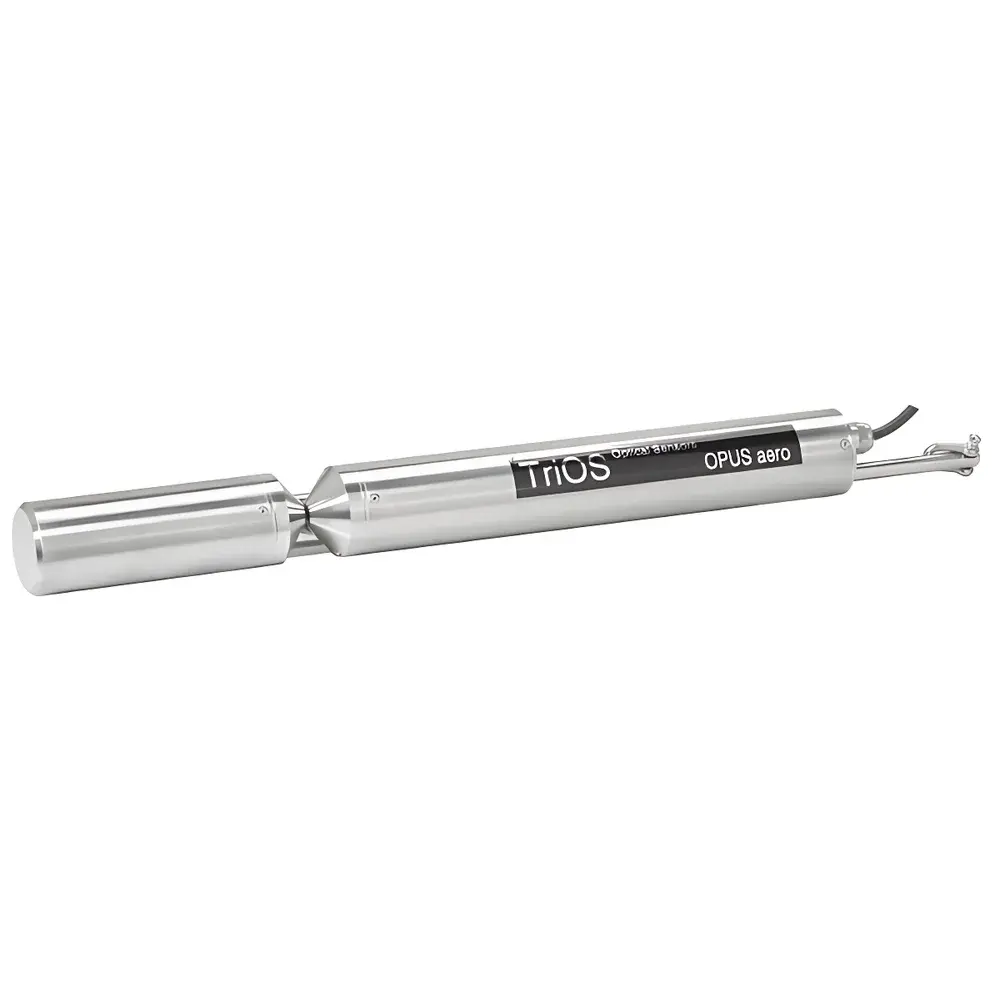
TriOS OPUS aero High-Concentration Nitrate & Nitrite Spectrophotometer
| Brand | TriOS |
|---|---|
| Origin | Germany |
| Model | OPUS aero |
| Optical Path Lengths | 0.3 mm, 1 mm, 2 mm |
| Nitrate-N (NO₃-N) Range | 2.4–120 mg/L (0.3 mm), 0.7–36 mg/L (1 mm), 0.35–18 mg/L (2 mm) |
| Nitrite-N (NO₂-N) Range | 4.4–220 mg/L (0.3 mm), 1.3–67 mg/L (1 mm), 0.65–33.5 mg/L (2 mm) |
| Wavelength Range | 200–360 nm |
| Resolution | 0.8 nm/pixel |
| Detector | 256-channel Miniature Spectrometer |
| Light Source | Xenon Flash Lamp |
| Turbidity Compensation | Yes |
| Accuracy | ±(5% + 0.1 mg/L) |
| Response Time | 2 min |
| Minimum Measurement Interval | 1 min |
| Housing Material | Stainless Steel 1.4571 / 1.4404 |
| Dimensions | 470 × 48 mm |
| Weight | ~3 kg |
| Digital Interfaces | Ethernet (TCP/IP), RS-232/RS-485 (Modbus RTU) |
| Power Supply | 12–24 VDC (±10%) |
| Max. Power Consumption | ≤8 W |
| Pressure Rating | 3 bar (fixed cable), 1 bar (flow cell, 2–4 LPM) |
| IP Rating | IP68 |
| Operating Temperature | +2 to +40 °C (sample & ambient), -20 to +80 °C (storage) |
| Flow Velocity | 0.1–10 m/s |
| Calibration Interval | 24 months |
| Data Storage | 2 GB internal |
Overview
The TriOS OPUS aero is a high-performance, submersible UV-VIS spectrophotometric sensor engineered for continuous, reagent-free quantification of nitrate-nitrogen (NO₃-N) and nitrite-nitrogen (NO₂-N) in wastewater aeration basins and other demanding aquatic environments. Operating on the principle of multi-wavelength absorption spectroscopy—specifically, spectral attenuation analysis across the 200–360 nm range—the OPUS aero leverages high-resolution optical detection (0.8 nm/pixel) and xenon flash illumination to resolve overlapping absorbance signatures of NO₃⁻ and NO₂⁻ ions with minimal interference from organic matter or turbidity. Its dual-pathlength design (0.3 mm, 1 mm, and 2 mm optical cells) enables dynamic range adaptation: shorter pathlengths support high-concentration monitoring in nitrification/denitrification zones, while longer pathlengths enhance sensitivity for low-level detection during process transitions. Unlike wet-chemistry analyzers, the OPUS aero delivers true in-situ measurement without sample extraction, filtration, or chemical reagents—reducing maintenance burden and eliminating analytical delay.
Key Features
- Real-time, in-situ measurement of NO₃-N and/or NO₂-N without sampling, digestion, or reagents
- TriOS G2 intelligent interface with embedded 2 GB data storage and browser-based configuration (no proprietary software required)
- Integrated turbidity compensation algorithm validated against ASTM D5907 and ISO 7027 principles
- Nanocoated sapphire optical window ensuring long-term fouling resistance and stable transmission in biologically active wastewater
- Three selectable optical path lengths (0.3 mm, 1 mm, 2 mm) for optimized dynamic range across varying concentration regimes
- Wireless operational access via built-in Wi-Fi: configure, calibrate, and retrieve data using any standard web browser on laptop, tablet, or smartphone
- Robust stainless-steel housing (grades 1.4571 and 1.4404) rated IP68 and pressure-resistant up to 3 bar (fixed installation) or 1 bar (flow-cell mode)
- Compliant with Modbus RTU protocol for seamless integration into SCADA, DCS, or PLC-based process control systems
Sample Compatibility & Compliance
The OPUS aero is designed for direct immersion or flow-through deployment in municipal and industrial wastewater streams, including activated sludge aeration tanks, anoxic zones, and tertiary treatment effluents. Its spectral analysis engine inherently corrects for scattering effects from suspended solids (up to 500 NTU), enabling reliable quantification under high-turbidity conditions typical of biological treatment processes. The sensor meets mechanical and environmental requirements per IEC 60529 (IP68), EN 61000-6-2/-6-4 (EMC immunity/emission), and conforms to the functional safety expectations of wastewater automation per IEC 61508 SIL 2 for sensor layer integrity. While not a standalone regulatory analyzer, its output supports compliance reporting aligned with EU Urban Wastewater Treatment Directive (91/271/EEC) and US EPA Method 353.2-equivalent monitoring protocols when deployed within a validated system architecture.
Software & Data Management
Configuration, diagnostics, and data retrieval are performed exclusively through an embedded HTTP server accessible via standard web browsers—eliminating dependency on vendor-specific applications. The G2 interface logs timestamped spectra and derived concentration values internally (2 GB capacity, supporting >12 months of 1-minute interval data at default settings). Export formats include CSV and JSON; raw spectral data (256-channel intensity arrays) is retained alongside processed results for retrospective recalibration or method validation. Audit trails—including parameter changes, calibration events, and firmware updates—are automatically recorded with UTC timestamps. For regulated environments, the system supports time-synchronized NTP clients and can be integrated with external historians compliant with ISA-95 or OPC UA frameworks. Though not certified for FDA 21 CFR Part 11 out-of-the-box, its immutable logging structure and user-access controls facilitate qualification under GLP/GMP-aligned QA procedures when deployed with appropriate procedural controls.
Applications
- Real-time feedback control of dissolved oxygen and carbon dosing in denitrification basins
- Monitoring nitrate/nitrite accumulation during nitrification inhibition or process upsets
- Performance verification of membrane bioreactors (MBRs) and moving bed biofilm reactors (MBBRs)
- Effluent compliance tracking prior to discharge—particularly where NO₂-N thresholds apply
- Research-grade kinetic studies of nitrogen transformation pathways in pilot-scale reactors
- Integration into digital twin platforms for predictive modeling of nitrogen removal efficiency
FAQ
Does the OPUS aero require periodic re-calibration in the field?
Yes—triennial factory calibration is recommended, but field verification using traceable nitrate/nitrite standard solutions (e.g., NIST-traceable KNO₃ and NaNO₂) is advised every 12 months. The 24-month maintenance interval assumes stable installation, nominal fouling, and adherence to specified flow and temperature ranges.
Can the sensor distinguish between NO₃⁻ and NO₂⁻ simultaneously in a single measurement?
Yes—when calibrated for dual-analyte mode, the multivariate spectral deconvolution algorithm resolves both NO₃-N and NO₂-N concentrations independently from the same absorption spectrum, provided their combined absorbance remains within the linear response range of the selected optical path length.
Is the OPUS aero compatible with existing SCADA systems using Modbus TCP?
It supports Modbus RTU over RS-485 natively; Modbus TCP requires an external protocol converter or gateway. Ethernet (TCP/IP) connectivity is reserved for configuration and data export—not real-time register polling.
What flow velocity range ensures optimal measurement stability?
For fixed-cable immersion, flow velocities between 0.1 and 10 m/s are acceptable; however, stable readings below 0.3 m/s may require mechanical cleaning cycles or supplemental flow conditioning to prevent boundary-layer stagnation.
How does the nanocoated optical window perform under sulfide-rich or fatty wastewater conditions?
The DLC (diamond-like carbon) nanocoating resists biofilm adhesion and chemical etching from H₂S and lipids, extending cleaning intervals by ≥3× versus uncoated quartz. Field data from WWTPs in Northern Europe confirm >18 months of uninterrupted operation without manual wiping in primary clarifier effluents.
Related Products







