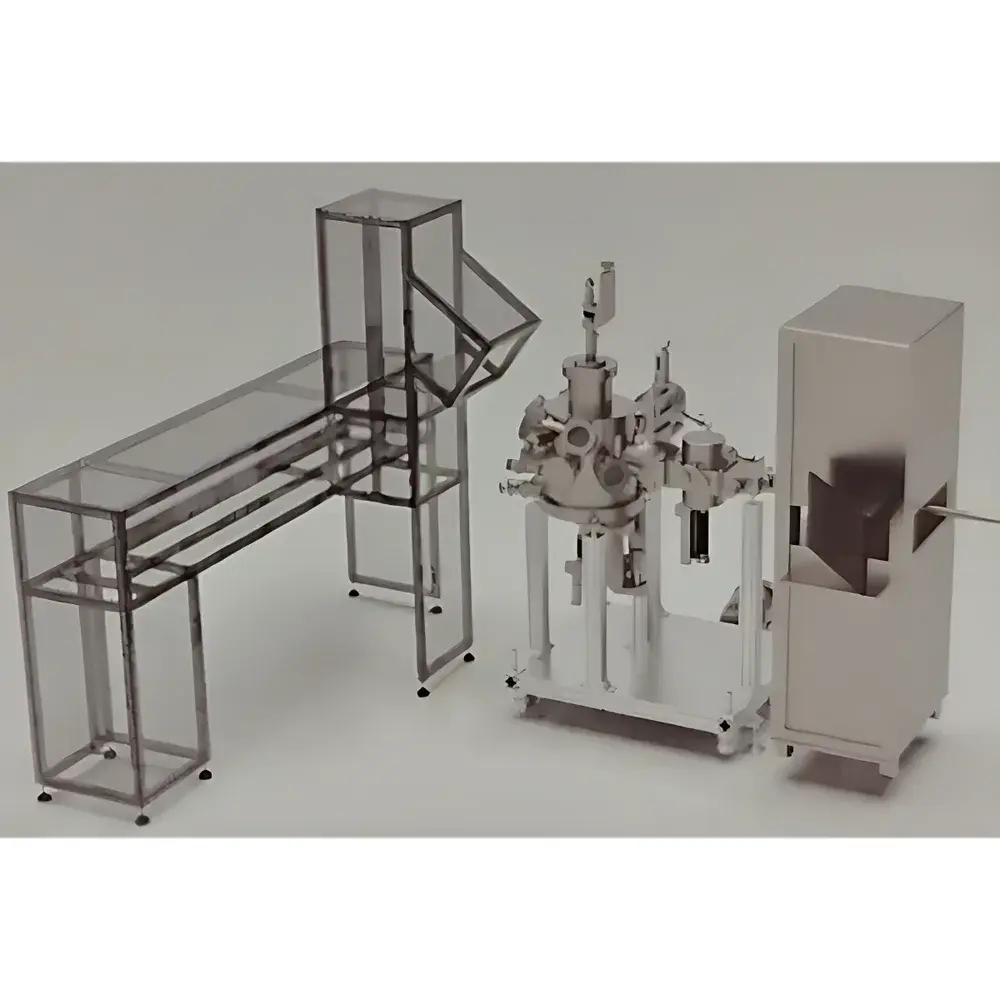
Truth Instruments PLD-400 Pulsed Laser Deposition System
| Brand | Truth Instruments Company Limited |
|---|---|
| Origin | Anhui, China |
| Manufacturer Type | Authorized Distributor |
| Country of Origin | China |
| Model | PLD-400 |
| Base Pressure | 5×10⁻⁹ mbar |
| Substrate Heating Range | Room Temperature to 1200 °C |
| Target Configuration | Six 1-inch or Three 2-inch targets (motorized rotation and revolution) |
| Substrate Size | Up to 2-inch wafers |
| Optional Add-ons | Liquid Nitrogen Cryo-Cooling Stage, Load-Lock Transfer Module, Reactive Gas Inlet System (O₂, N₂, Ar), In-situ Quartz Crystal Microbalance (QCM), Predefined Process Recipe Management, High-Pressure RHEED (up to 1×10⁻⁵ mbar), Electron Gun for LEED |
Overview
The Truth Instruments PLD-400 Pulsed Laser Deposition System is a high-vacuum, ultra-high-purity thin-film growth platform engineered for research-grade epitaxial synthesis of complex oxides, multiferroics, high-temperature superconductors, and wide-bandgap semiconductors. It operates on the fundamental principle of pulsed laser ablation: a high-energy UV laser beam (typically KrF excimer, 248 nm, or optionally Nd:YAG harmonics) is focused onto a solid target material inside an ultra-high-vacuum (UHV) chamber, generating a transient, highly energetic plasma plume. This plume expands directionally toward a heated single-crystal substrate, where atoms and clusters condense with preserved stoichiometry—enabling atomically precise, layer-by-layer growth under controlled background gas environments (e.g., O₂ partial pressure up to 1×10⁻¹ mbar). The PLD-400’s UHV architecture—base pressure ≤5×10⁻⁹ mbar—minimizes hydrocarbon and water vapor contamination, ensuring reproducible surface chemistry and interface sharpness critical for heterostructure studies and quantum materials engineering.
Key Features
- UHV-compatible stainless-steel main chamber with all-metal sealing (no elastomers), baked to ≤5×10⁻⁹ mbar base pressure using dual-stage turbomolecular pumping and optional cryogenic trapping.
- Motorized six-position target manipulator with independent rotation and revolution motion—enabling uniform ablation, cross-contamination suppression, and in-situ target exchange without venting.
- High-precision substrate stage with resistive heating, thermocouple feedback, and PID-controlled temperature regulation from room temperature to 1200 °C (±1 °C stability over 24 h).
- Integrated RHEED (Reflection High-Energy Electron Diffraction) port with differential pumping, compatible with both standard (≤1×10⁻⁸ mbar) and high-pressure (≤1×10⁻⁵ mbar) operation for real-time monitoring of surface reconstruction and growth mode.
- Modular optical access: Four 6-inch CF flanges (two at 45°, two axial) for laser coupling, viewport alignment, and auxiliary diagnostics (e.g., PL imaging, laser-induced fluorescence).
- Full vacuum interlock logic, pressure ramp rate control, and emergency venting protocol compliant with ISO 27462 and IEC 61000-6-2 electromagnetic compatibility standards.
Sample Compatibility & Compliance
The PLD-400 accommodates substrates up to 2-inch diameter—including SrTiO₃, LaAlO₃, MgO, Si (with buffer layers), and flexible metallic foils—mounted via spring-loaded molybdenum clamps to ensure thermal uniformity and mechanical stability during high-temperature deposition. All wetted components are electropolished 316L stainless steel or oxygen-free high-conductivity copper; gasket materials conform to ASTM F2299 for low-outgassing performance. The system meets GLP (Good Laboratory Practice) documentation requirements for traceable calibration logs (temperature, pressure, laser energy), and supports audit-ready electronic records when integrated with optional FDA 21 CFR Part 11-compliant software modules.
Software & Data Management
Control is executed via a deterministic real-time Linux-based platform (PREEMPT_RT kernel) with deterministic I/O latency (<100 µs). The GUI provides synchronized logging of laser pulse count, substrate temperature, chamber pressure, RHEED intensity profiles, and QCM deposition rate (if installed). Process recipes—including laser fluence, repetition rate, substrate rotation speed, gas flow setpoints, and thermal ramp profiles—are stored with version control and user-access permissions. Raw data exports to HDF5 format ensure interoperability with Python-based analysis pipelines (e.g., SciPy, Matplotlib, PyFAI) and institutional LIMS systems.
Applications
- Growth of epitaxial perovskite oxide heterostructures (e.g., La₀.₇Sr₀.₃MnO₃/SrTiO₃) for spintronics and resistive switching memory prototypes.
- Stoichiometric transfer of multi-cation targets (e.g., BiFeO₃, YMnO₃) without phase segregation—validated by XRD θ–2θ scans and STEM-EDS line profiling.
- In-situ investigation of surface kinetics via time-resolved RHEED oscillations during oxide film nucleation.
- Integration with ozone-assisted oxidation for low-temperature crystallization of IGZO channel layers in TFT fabrication workflows.
- Deposition of nitride-based templates (e.g., AlN on sapphire) for subsequent MBE or MOVPE of GaN devices.
FAQ
What laser specifications are supported natively?
The PLD-400 is configured for KrF excimer lasers (248 nm, 10–30 Hz, 0.5–2 J/cm² fluence); Nd:YAG (266/355 nm) and Ti:Sapphire (800 nm) systems can be integrated via custom beam path alignment kits.
Can the system operate under reactive oxygen atmosphere?
Yes—integrated mass flow controllers support O₂ partial pressures from 1×10⁻⁷ to 1×10⁻¹ mbar, with leak-tight stainless-steel gas lines and inline ozone scrubbers for stable oxidizing conditions.
Is remote operation and monitoring possible?
Standard Ethernet (TCP/IP) and optional VPN-enabled VNC access allow full parameter control and live RHEED image streaming from off-site locations, subject to institutional firewall policies.
How is target degradation monitored during long runs?
RHEED intensity drift and ablation crater depth profiling (via integrated white-light interferometry option) provide quantitative metrics for target lifetime estimation and scheduled replacement planning.
Does the system comply with CE or UL safety directives?
The PLD-400 carries CE marking per Machinery Directive 2006/42/EC, Low Voltage Directive 2014/35/EU, and EMC Directive 2014/30/EU; UL 61010-1 certification is available upon request for North American installations.