
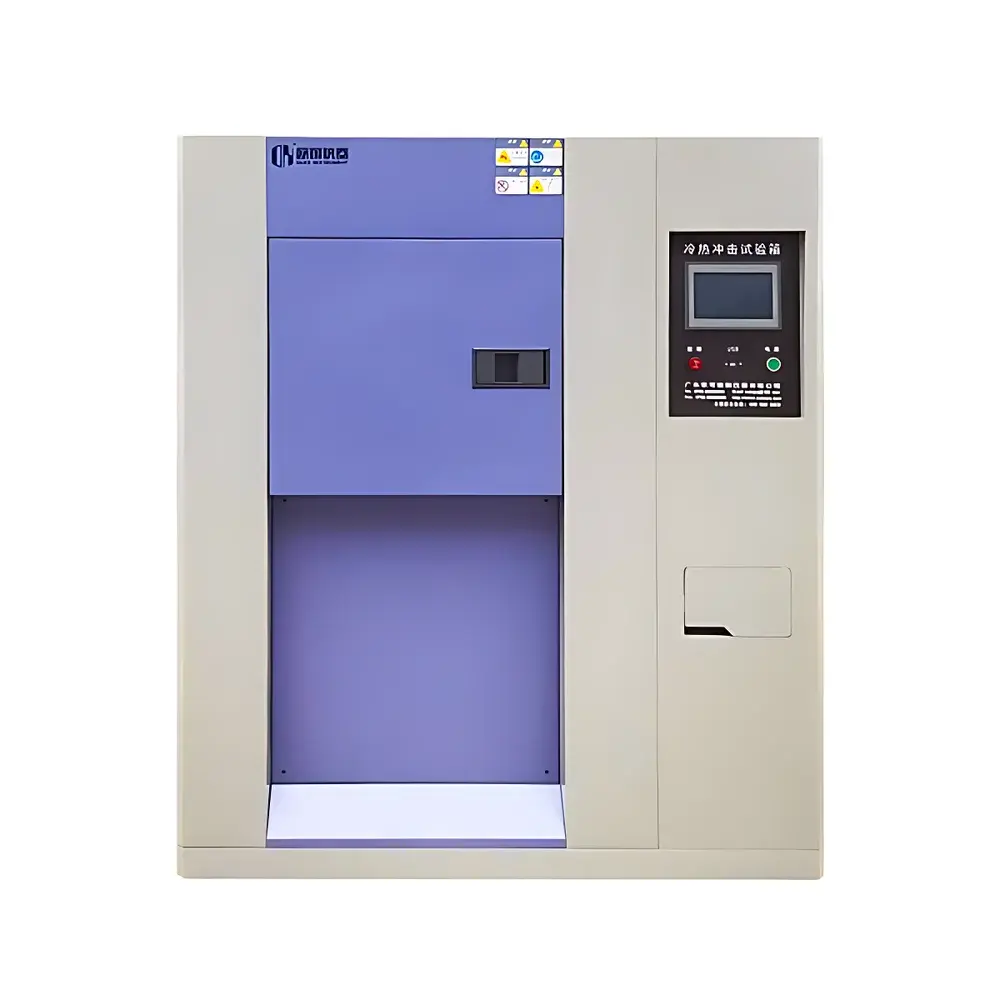
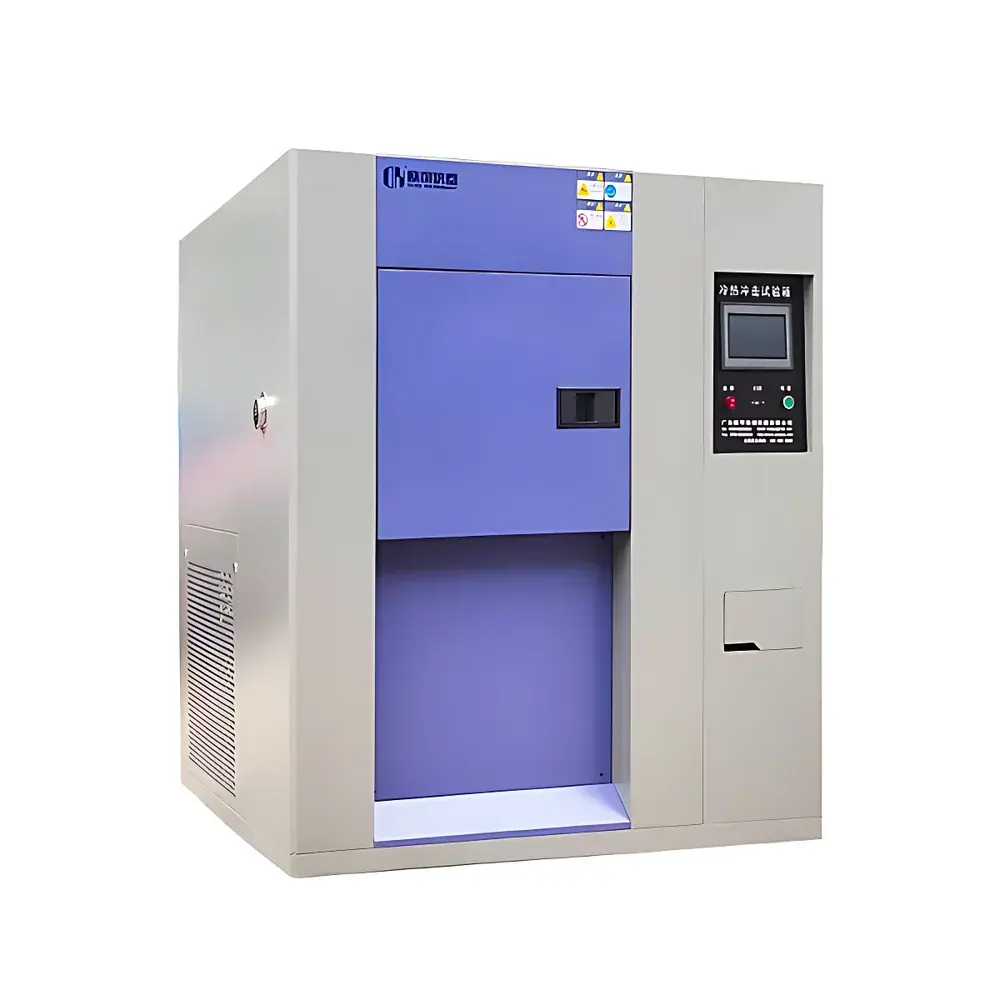
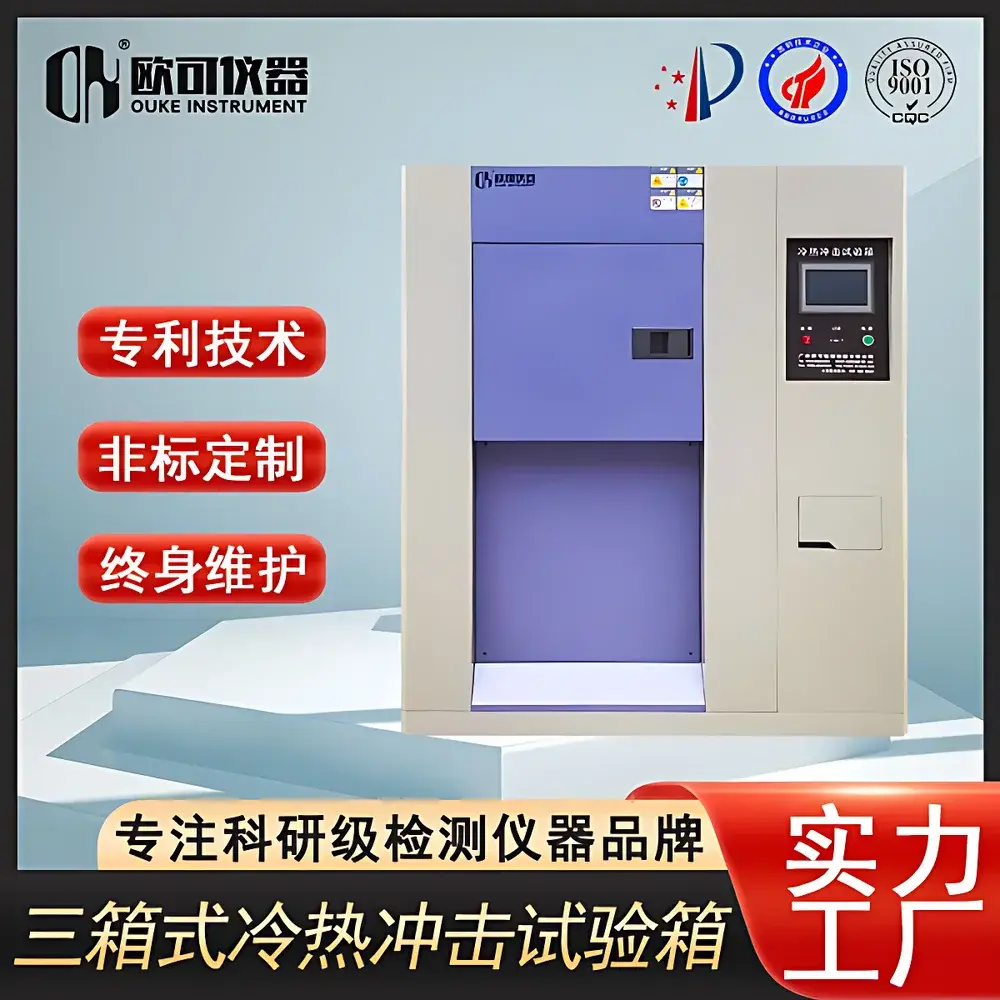
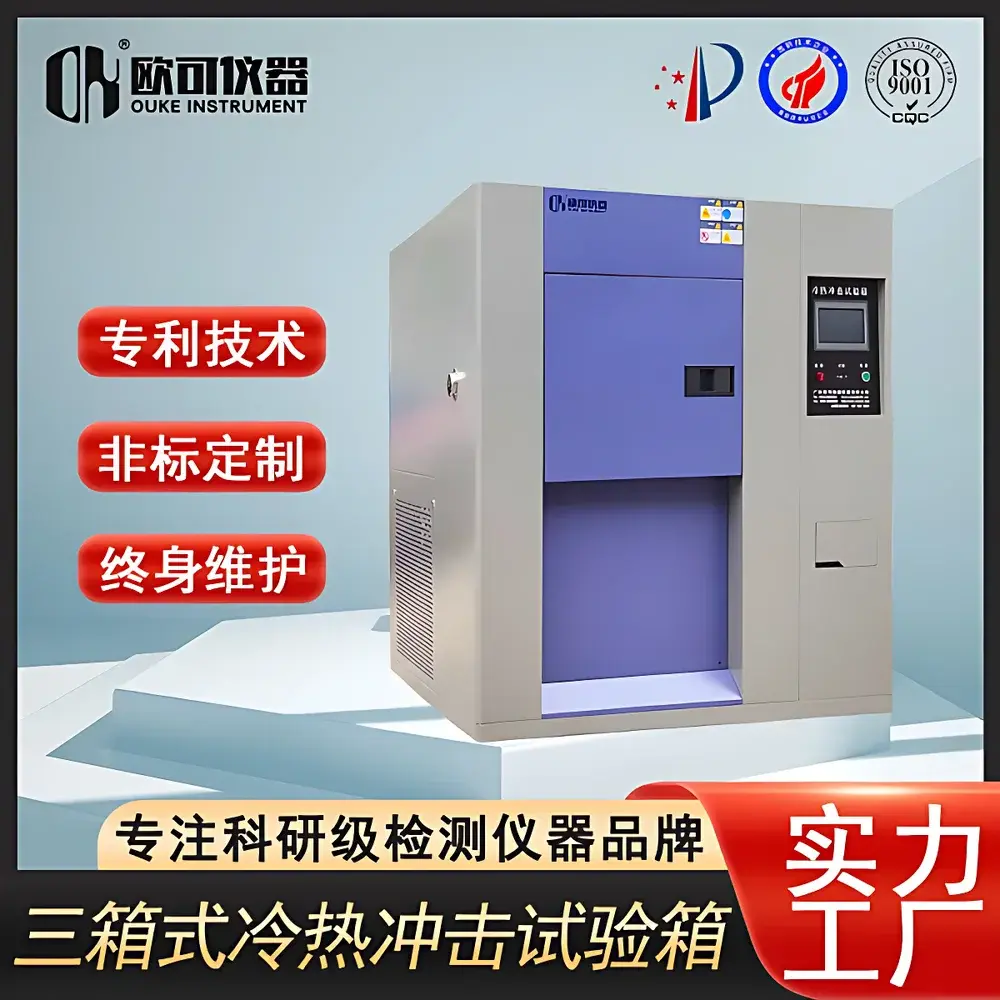
OK-TS-3 Three-Chamber Thermal Shock Test Chamber
| Brand | OK Instruments |
|---|---|
| Origin | Guangdong, China |
| Manufacturer Type | Direct Manufacturer |
| Product Origin | Domestic (China) |
| Model | OK-TS-3 |
| Price | ¥80,000 |
| High-Temperature Range | 200 °C |
| Low-Temperature Range | −40 °C |
| Thermal Shock Range | −40 °C to 200 °C |
| Temperature Stability | ±2 °C |
| Heating Rate | 15 °C/min |
| Cooling Rate | 15 °C/min |
Overview
The OK-TS-3 Three-Chamber Thermal Shock Test Chamber is an engineered environmental reliability testing system designed to evaluate material and component resilience under rapid, repetitive thermal transitions. Unlike two-chamber basket-type systems, it employs a three-zone architecture—comprising independent high-temperature, low-temperature, and test chambers—enabling precise, non-mechanical thermal shock delivery via controlled air mass transfer. The test specimen remains stationary throughout the entire cycle, eliminating mechanical stress induced by physical movement. This design adheres to fundamental principles of transient heat transfer in forced-convection environments and supports deterministic evaluation of thermal fatigue, interfacial delamination, solder joint integrity, and coefficient-of-thermal-expansion (CTE) mismatch failure modes. It is widely deployed in qualification protocols for mission-critical electronics where operational continuity during thermal cycling is mandatory.
Key Features
- Three physically isolated chambers: dedicated high-temperature zone (up to +200 °C), low-temperature zone (down to −40 °C), and static test chamber—ensuring zero sample displacement.
- High-speed pneumatic damper system with sealed actuation, enabling sub-second valve switching between thermal reservoirs.
- High-capacity centrifugal blower assembly delivering uniform airflow distribution across the test volume, minimizing thermal gradients during transition phases.
- Real-time temperature stabilization control with ±2 °C stability in steady-state conditions and programmable ramp profiles up to 15 °C/min for both heating and cooling.
- Integrated thermal energy recovery logic reduces cumulative compressor load and improves long-term system repeatability across extended test sequences.
- Robust stainless-steel internal construction with insulated double-wall panels and silicone-sealed access ports for EMI-shielded or powered-in-situ testing configurations.
Sample Compatibility & Compliance
The OK-TS-3 accommodates large-format, high-mass, or electrically active assemblies—including live PCBA units, automotive ECUs, avionics modules, and battery management systems—without requiring disconnection or repositioning. Its static-test architecture meets stringent requirements for vibration-sensitive and thermally constrained applications. The chamber complies with key international test standards including IEC 60068-2-14 (Test N: Change of temperature), MIL-STD-883 Method 1010.8 (Thermal Shock), JESD22-A104D (Temperature Cycling), and GJB 150.5A-2009 (Environmental Test Methods for Military Equipment). Optional validation packages support IQ/OQ documentation aligned with GLP and GMP audit frameworks.
Software & Data Management
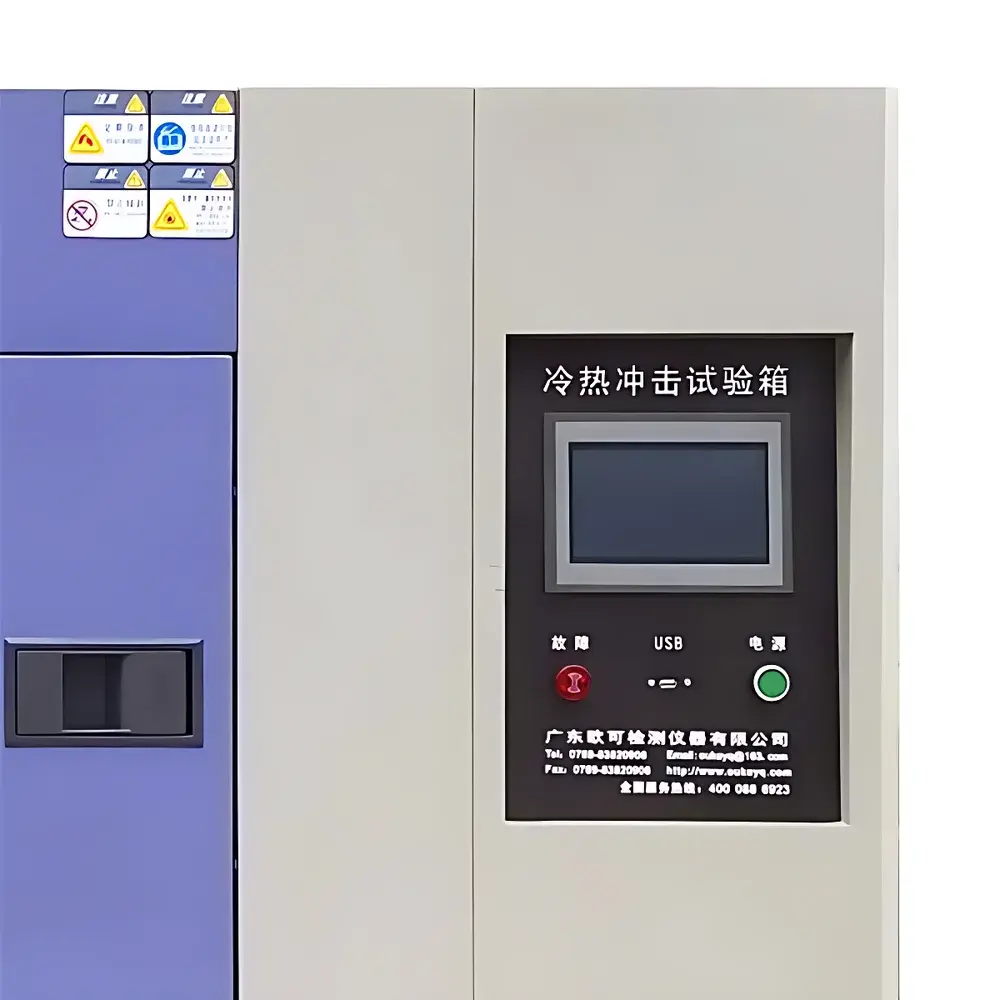
Equipped with a 7-inch color touchscreen HMI controller supporting multi-segment programmable cycles, real-time graphing, and event-triggered data logging. All temperature readings, valve status, fan speed, and alarm events are timestamped with millisecond resolution. Export formats include CSV and PDF reports compatible with LIMS integration. Optional Ethernet/IP interface enables remote monitoring, centralized fleet management, and compliance with FDA 21 CFR Part 11 requirements through configurable user authentication, electronic signatures, and audit trail functionality.
Applications
- Automotive electronics: ECU, ADAS sensors, powertrain inverters, and onboard chargers subjected to under-hood thermal extremes.
- Aerospace & defense: Flight-critical avionics, radar transceivers, and satellite payload components validated per DO-160 Section 4.9 and MIL-STD-810H.
- Semiconductor packaging: Wafer-level CSP, flip-chip BGA, and SiC power modules undergoing JEDEC J-STD-020 moisture sensitivity level (MSL) preconditioning.
- Consumer electronics: Foldable display hinges, MEMS microphones, and high-power LED arrays exposed to ambient-to-operational thermal transients.
- Energy infrastructure: Fuel cell stack controllers, EV DC fast-charging modules, and grid-scale power converters operating across wide climatic envelopes.
FAQ
How does the three-chamber design improve test fidelity compared to two-chamber systems?
It eliminates mechanical motion-induced artifacts—such as micro-vibration, positional misalignment, or contact resistance variation—thereby isolating thermal stress as the sole variable. This yields higher measurement reproducibility for solder joint and adhesive bond failure analysis.
Can the OK-TS-3 perform powered-in-situ testing during thermal transitions?
Yes. The stationary test chamber allows uninterrupted electrical connectivity, enabling real-time functional monitoring of DUTs under thermal shock—critical for validating thermal shutdown logic or sensor drift behavior.
What is the typical time required to transition from −40 °C to +200 °C?
Within standard configuration, the chamber achieves full transition in ≤5 minutes, consistent with JESD22-A104D Class X2 requirements for severe thermal shock profiling.
Is calibration traceability available for this model?
Yes. Factory calibration certificates are provided with NIST-traceable references for all PT100 sensors and controller inputs, with optional annual recalibration services and ISO/IEC 17025-compliant documentation.
Does the system support custom test profiles beyond standard specifications?
Absolutely. The controller supports up to 99 programmable segments per cycle, including dwell times, ramp rates, and conditional branching based on real-time sensor feedback or external TTL triggers.



