
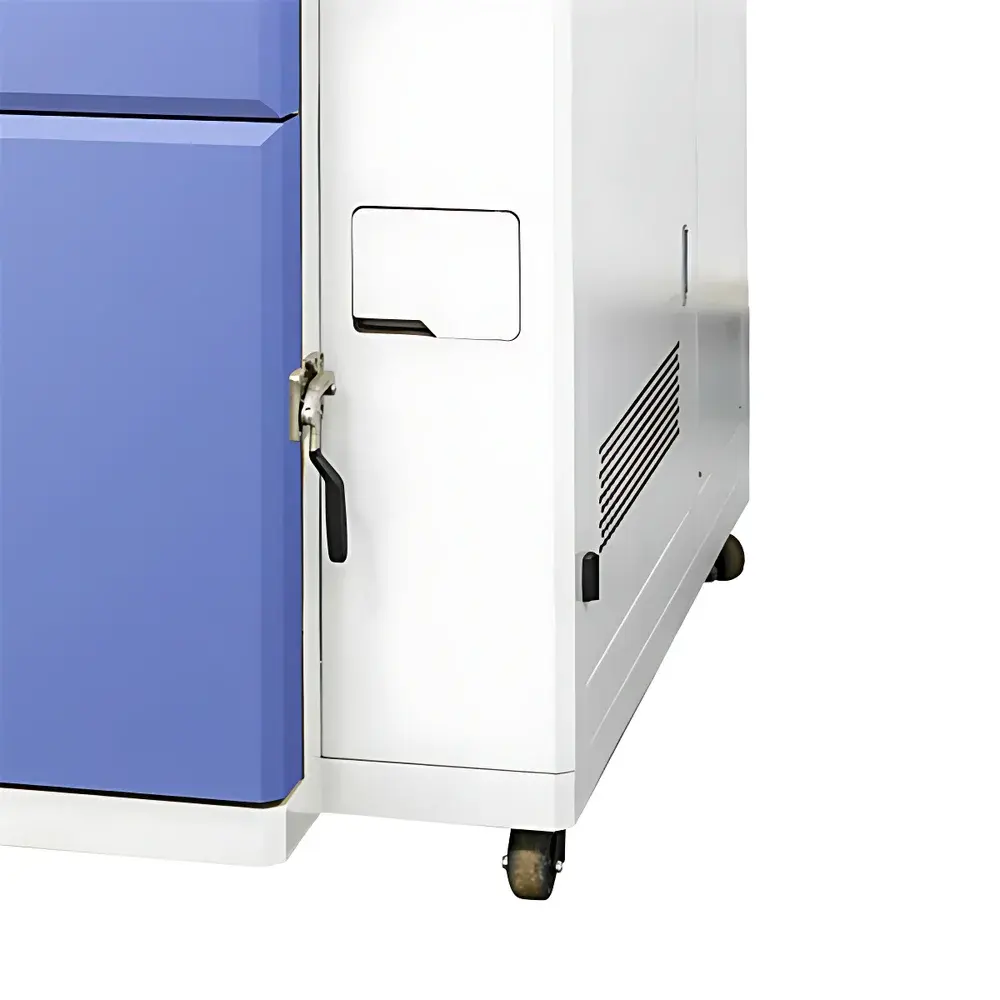
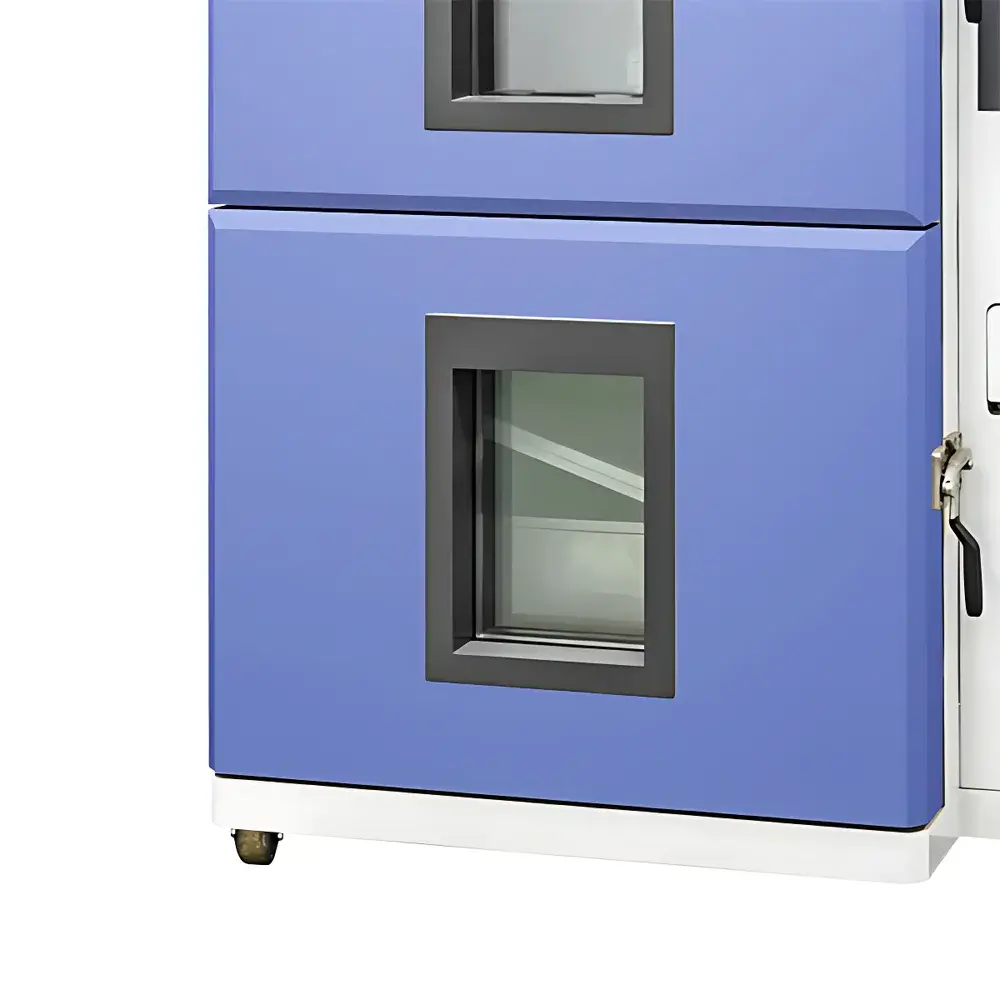
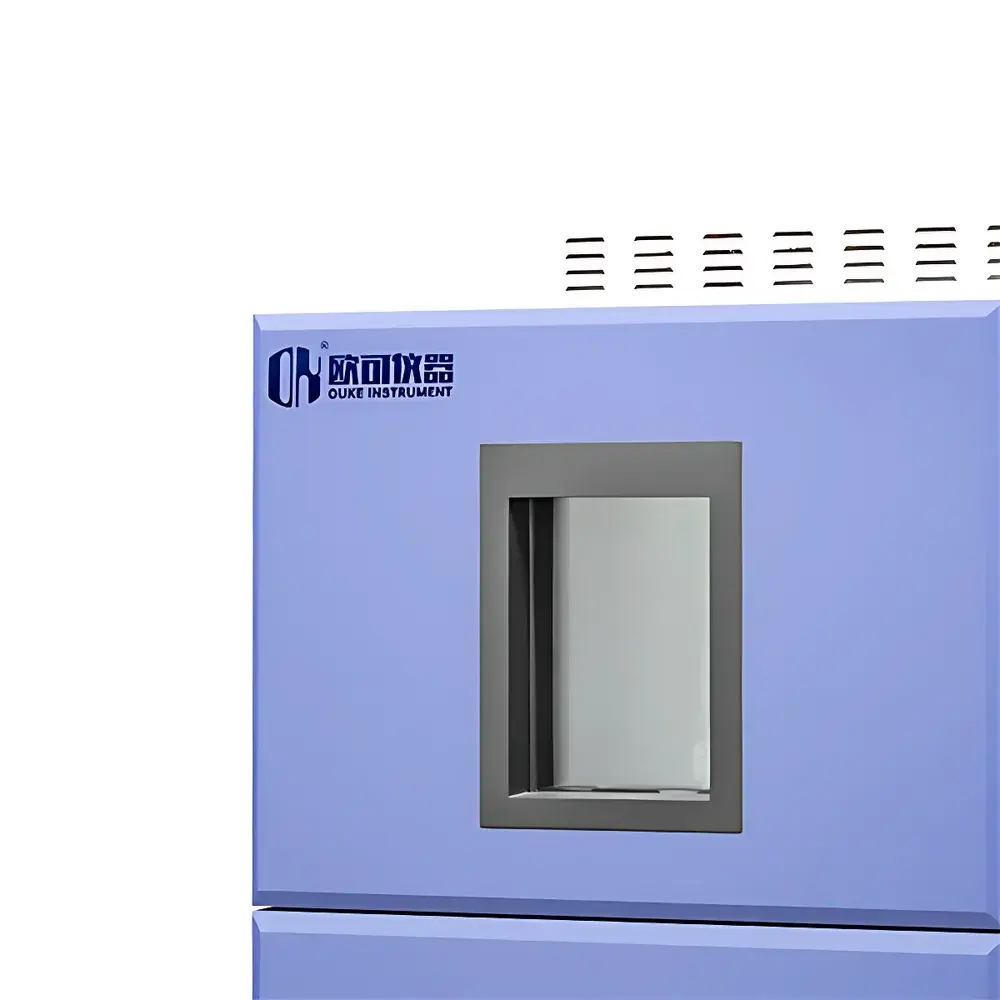
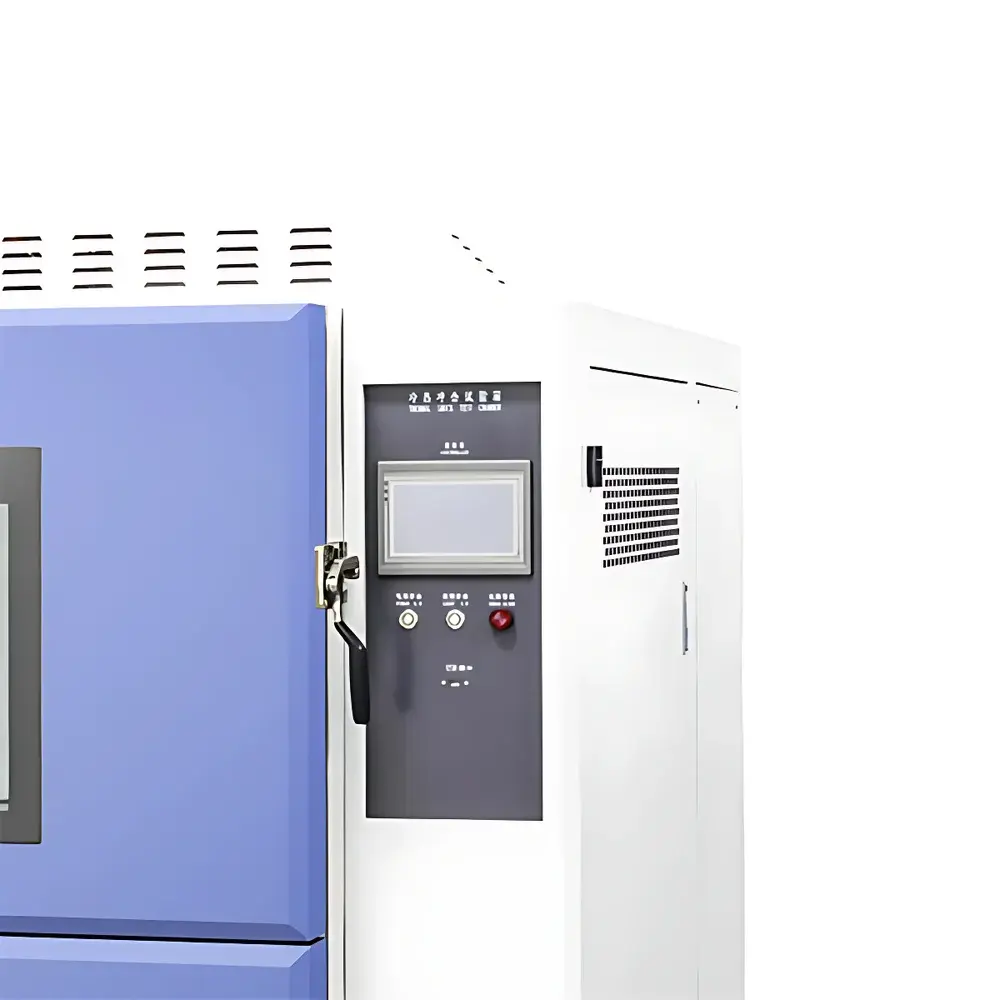
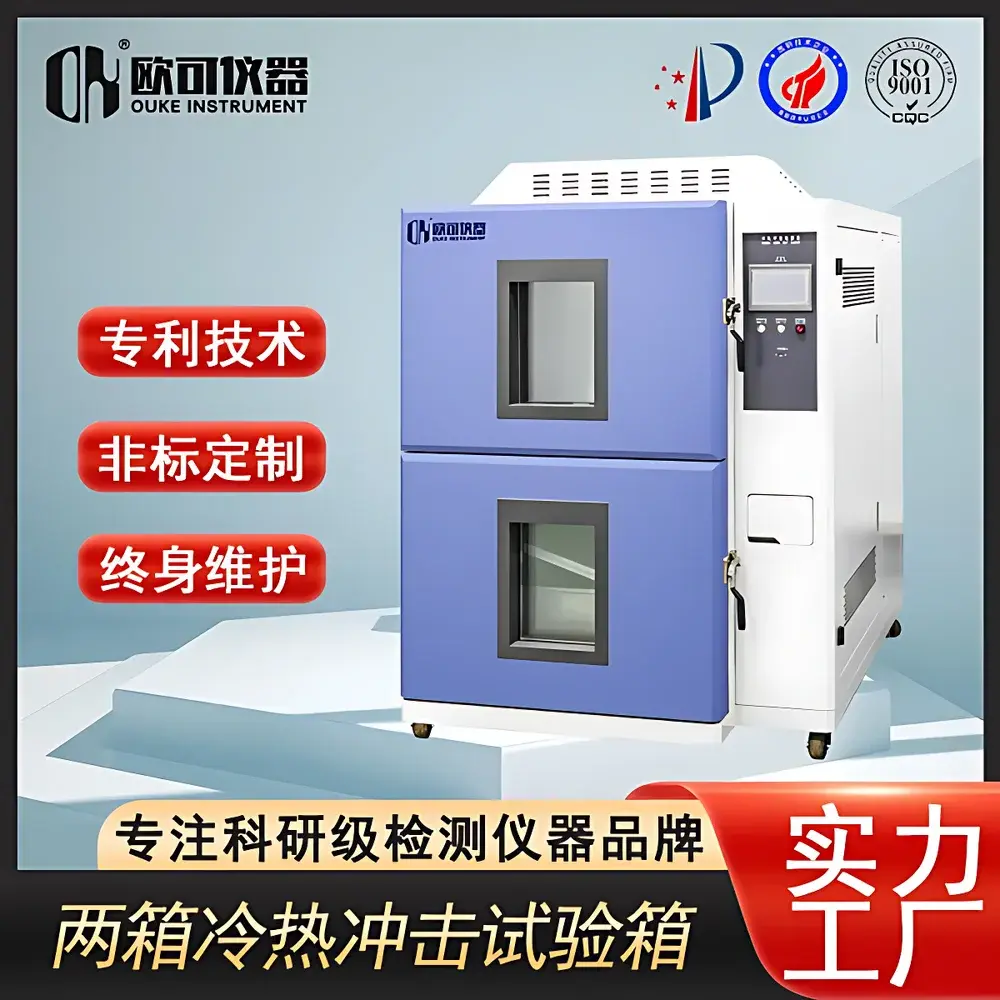
OK-TS-49.01 Dual-Chamber Thermal Shock Test Chamber
| Brand | OK Instruments |
|---|---|
| Origin | Guangdong, China |
| Manufacturer Type | Direct Manufacturer |
| Model | OK-TS-49.01 |
| Price | USD 12,500 (FOB Guangdong) |
| High-Temperature Range | +150 °C |
| Low-Temperature Range | −50 °C |
| Thermal Shock Range | −50 °C to +150 °C |
| Temperature Stability | ±2 °C |
| Heating Rate | 10 °C/min |
| Cooling Rate | 10 °C/min |
Overview
The OK-TS-49.01 Dual-Chamber Thermal Shock Test Chamber is an engineered solution for evaluating material and component reliability under rapid, repetitive thermal transitions between extreme temperature extremes. Unlike single-chamber thermal cycling systems, this dual-zone architecture employs two physically isolated chambers—one maintained at high temperature (+150 °C) and the other at low temperature (−50 °C)—with a pneumatically actuated sample transfer basket that moves specimens between zones in controlled, repeatable cycles. The system operates on the principle of accelerated thermal stress induction: by subjecting test items to abrupt temperature differentials exceeding 200 °C within seconds, it simulates real-world operational stresses encountered during power-up/down, environmental exposure, or mission-critical deployment. This methodology aligns with standardized thermal shock protocols defined in JEDEC JESD22-A104, MIL-STD-810 Method 503, and GJB 150.5A, enabling quantifiable assessment of solder joint integrity, interfacial delamination, seal failure, and coefficient-of-thermal-expansion (CTE) mismatch effects.
Key Features
- Dual independent chamber design with fully segregated high- and low-temperature zones—eliminates thermal cross-contamination and enables simultaneous stabilization at opposing setpoints.
- Pneumatic basket transfer mechanism achieving ≤10-second transition time between chamber centers (measured per IEC 60068-2-14), ensuring reproducible shock intensity across test cycles.
- High-fidelity PID-controlled heating and refrigeration subsystems, each equipped with redundant safety cut-offs, over-temperature/over-pressure monitoring, and auto-diagnostic logging.
- Stainless-steel inner chamber construction (SUS304) with multi-layer vacuum-insulated walls and fluorosilicone door gaskets rated for continuous operation from −50 °C to +150 °C.
- Programmable controller supporting up to 999 cycles, customizable dwell times (1 min–999 min per zone), ramp profiles, and user-defined sequence branching.
- Integrated RS485 interface and optional Ethernet module compliant with Modbus TCP, enabling remote supervision, alarm forwarding, and integration into centralized lab management platforms.
Sample Compatibility & Compliance
The OK-TS-49.01 accommodates standard test specimens up to 400 × 400 × 400 mm (W×D×H) within its basket assembly, with a maximum load capacity of 20 kg. It supports rigid and semi-rigid samples including printed circuit boards (PCBs), automotive ECUs, MEMS sensors, ceramic substrates, and metallic fasteners. The chamber meets structural and operational requirements of ISO 16750-4 (road vehicles), AEC-Q200 (passive components), and IPC-9701 (solder joint reliability). All thermal profiles are traceable via internal calibrated Class A PT100 sensors (±0.15 °C accuracy), with data logs timestamped to UTC and exportable in CSV or XML format. Optional validation packages include IQ/OQ documentation aligned with GLP and GMP Annex 11 expectations for regulated environments.
Software & Data Management
The embedded controller firmware includes built-in data acquisition with 1-second sampling resolution for all critical parameters: chamber temperatures, basket position status, compressor discharge pressure, and heater current draw. Raw datasets are stored onboard for ≥30 days and can be exported via USB or network transfer. An optional PC-based software suite (OK-DataLink v3.2) provides graphical profile editing, real-time multi-channel trending, statistical process control (SPC) charting (X̄-R, Cpk), and automated report generation compliant with ASTM E29 and ISO/IEC 17025 reporting conventions. Audit trails record all user actions—including parameter changes, manual overrides, and calibration events—with immutable timestamps and operator ID tagging, satisfying FDA 21 CFR Part 11 electronic record requirements when configured with user authentication and digital signature modules.
Applications
- Electronics reliability engineering: qualification testing of BGA packages, wafer-level CSPs, and flex-rigid hybrids per JEDEC JESD22-A104D.
- Automotive Tier-1 suppliers: validation of ADAS camera modules, battery management systems (BMS), and power inverters under ISO 16750-4 Clause 6.2 (thermal shock).
- Aerospace component screening: thermal fatigue assessment of avionics housings, optical sensor mounts, and composite airframe brackets.
- Materials science research: investigation of phase transformation kinetics in shape-memory alloys and cryogenic embrittlement thresholds in high-strength steels.
- Quality assurance laboratories: incoming inspection of supplier-submitted components against enterprise-specific thermal shock acceptance criteria (e.g., zero electrical opens after 500 cycles).
FAQ
What standards does the OK-TS-49.01 support out of the box?
It natively implements test sequences conforming to JEDEC JESD22-A104, MIL-STD-810G Method 503.5, and GJB 150.5A. Custom profiles can be loaded for proprietary or industry-specific specifications.
Is the temperature stability specification ±2 °C applicable during active transfer?
No—the ±2 °C tolerance applies only during dwell phases, after thermal equilibrium is confirmed (per internal sensor averaging over 60 seconds). Transient overshoot during recovery is limited to ±3.5 °C per IEC 60068-2-14 Annex B.
Can humidity be introduced into either chamber?
Not without modification. The standard configuration is dry thermal shock only. For combined temperature/humidity shock, a three-chamber variant (OK-TSH-49.01) with integrated steam humidification and desiccant drying is available.
What maintenance intervals are recommended?
Compressor oil and refrigerant filter replacement every 24 months; door gasket inspection and torque verification quarterly; full system calibration with NIST-traceable reference sensors annually.
Does the system include factory calibration documentation?
Yes—each unit ships with a Certificate of Conformance and a Calibration Report signed by an ISO/IEC 17025-accredited metrology lab, covering all installed temperature sensors and timing actuators.
Related Products



