
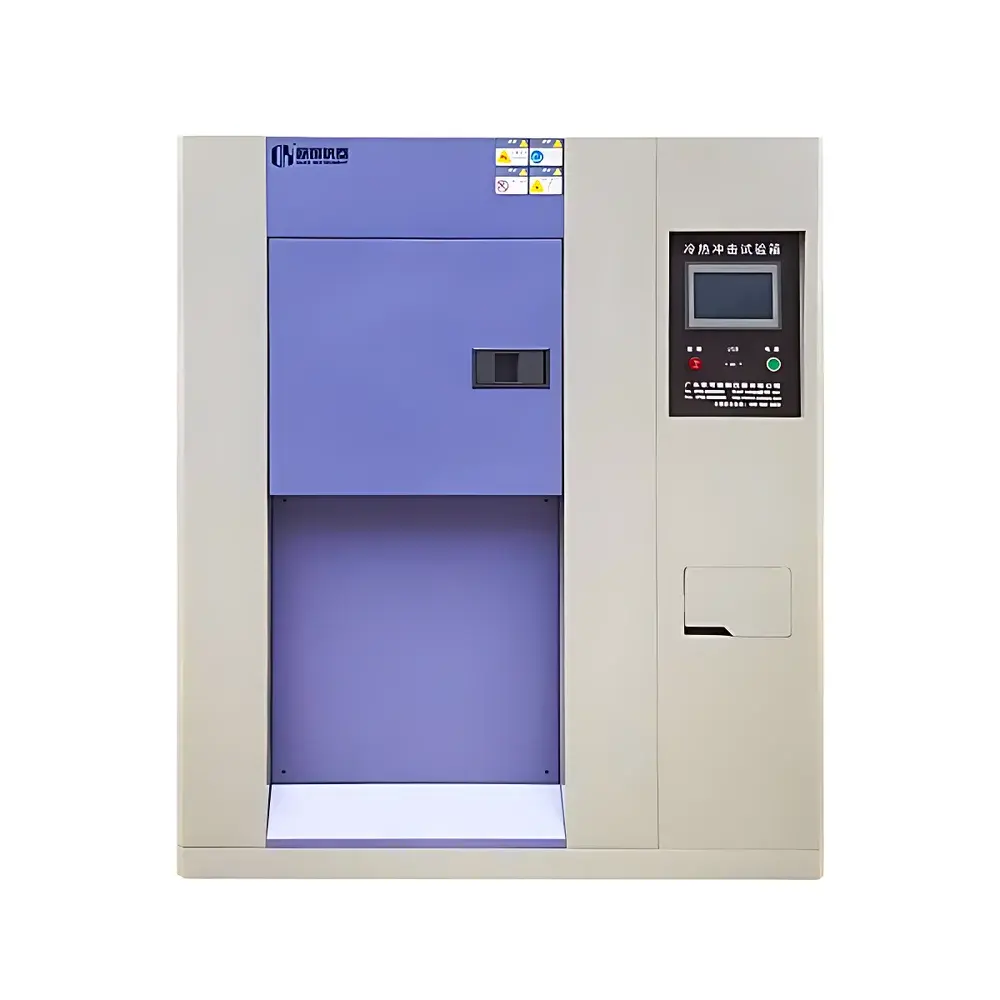
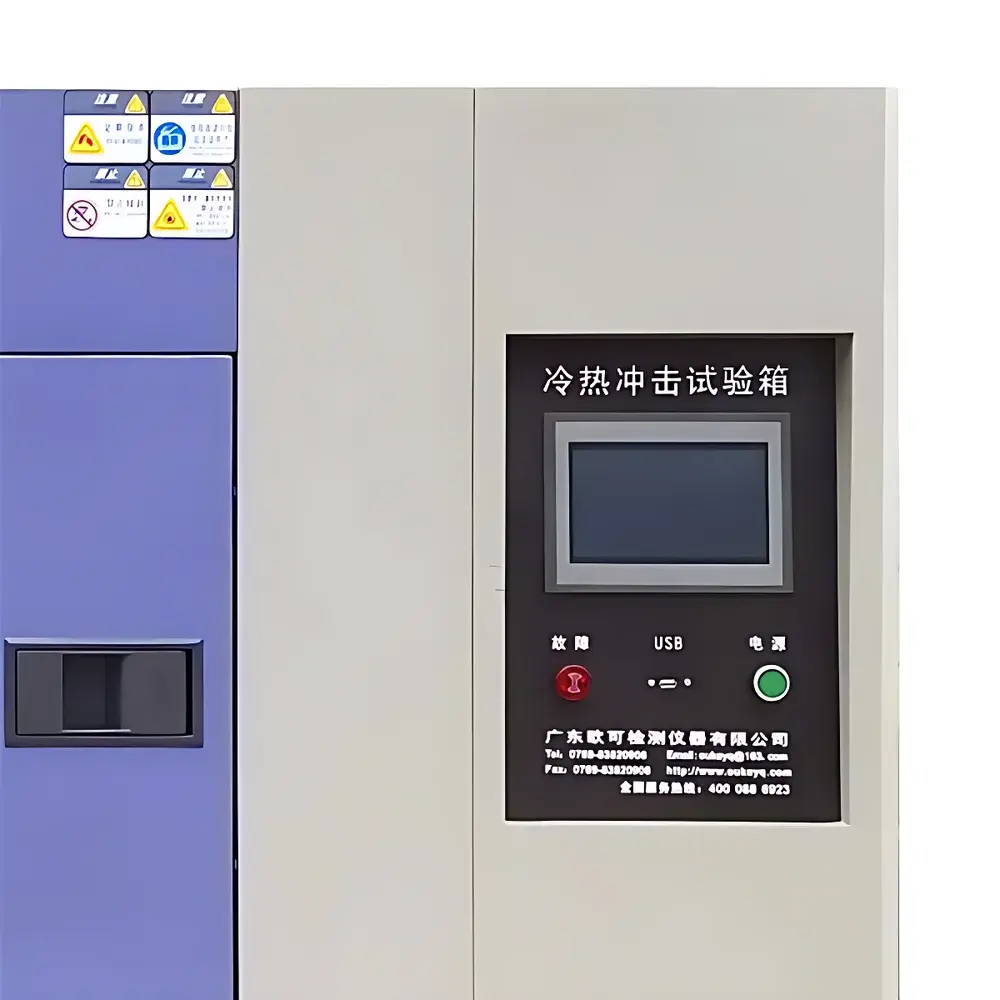
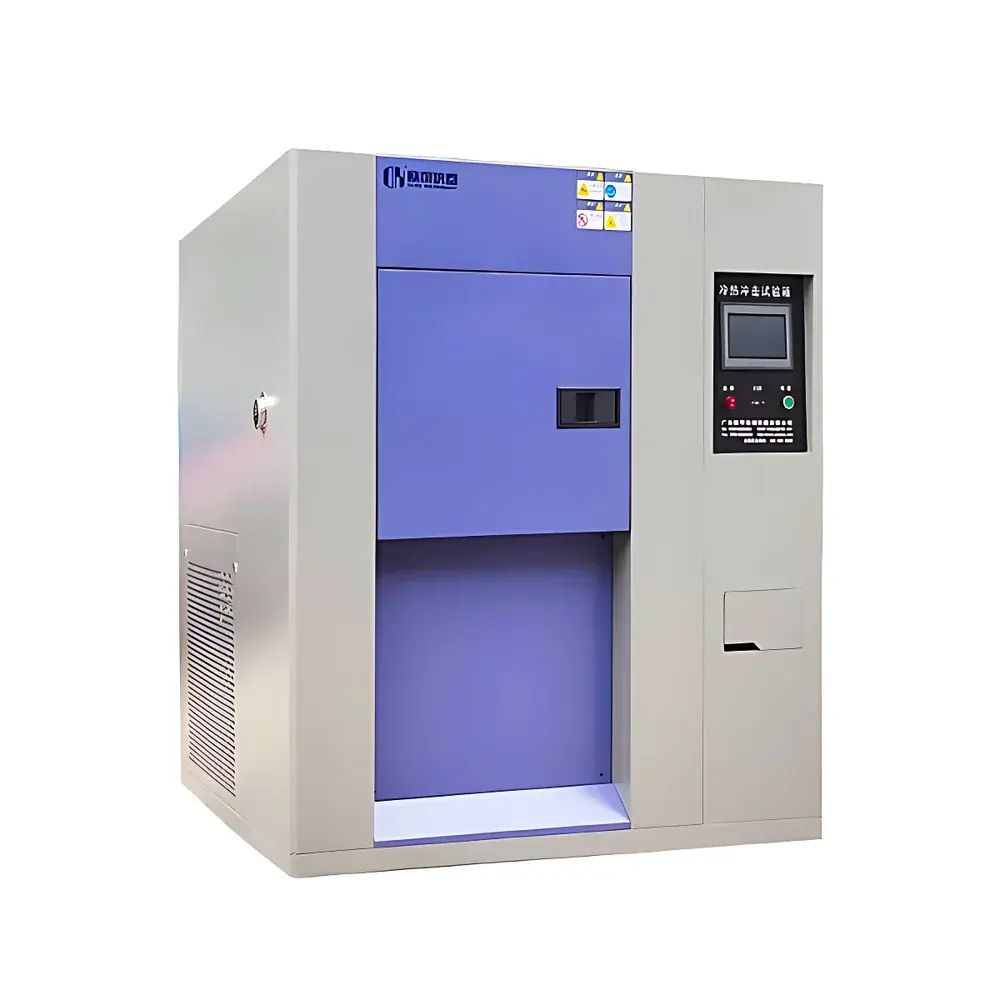
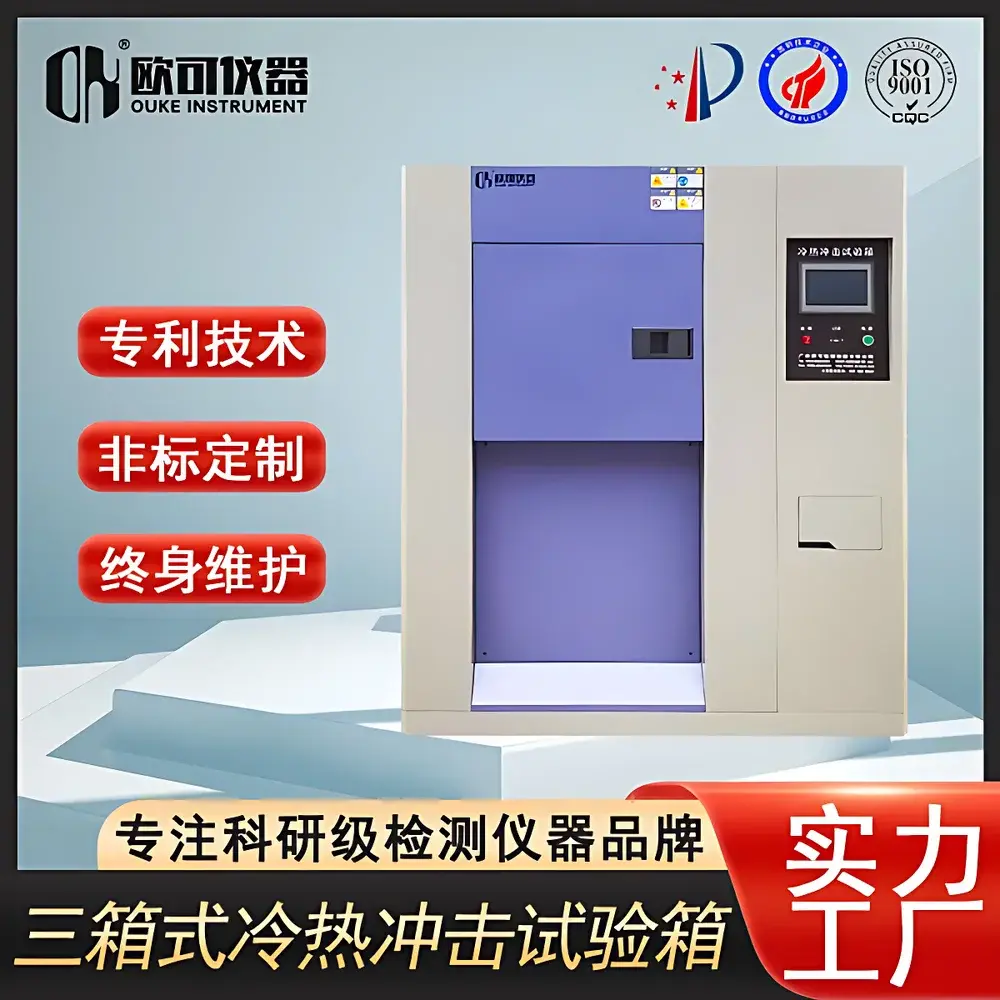
OK-TS-49.3 Two-Zone Thermal Shock Test Chamber
| Brand | OK Instruments |
|---|---|
| Origin | Guangdong, China |
| Manufacturer Type | OEM/ODM Producer |
| Country of Origin | China |
| Model | OK-TS-49.3 |
| High-Temperature Range | +150 °C |
| Low-Temperature Range | −50 °C |
| Thermal Shock Range | −50 °C to +150 °C |
| Temperature Stability | ±2 °C |
| Heating Rate | 10 °C/min |
| Cooling Rate | 10 °C/min |
Overview
The OK-TS-49.3 Two-Zone Thermal Shock Test Chamber is an engineered environmental reliability system designed to evaluate material and component integrity under rapid, repetitive temperature transitions. It operates on the Couette-style dual-chamber principle: two physically isolated thermal reservoirs — one maintained at high temperature (up to +150 °C), the other at low temperature (down to −50 °C) — with a motorized transfer basket that moves test specimens between them in less than 10 seconds. This architecture ensures direct immersion of samples into extreme thermal environments, generating high-magnitude thermal gradients (>200 °C step change) and inducing thermo-mechanical stress via differential expansion/contraction. Unlike three-zone systems that rely on air redirection, the OK-TS-49.3 delivers higher thermal shock severity per cycle due to minimal thermal mass interference and absence of intermediate ambient staging. Its design complies with the fundamental operational logic defined in IEC 60068-2-14 (Test N: Change of Temperature) and aligns with test protocols specified in JESD22-A104 (Temperature Cycling) and GB/T 2423.22 (Environmental Testing – Part 2: Tests – Test N: Change of Temperature).
Key Features
- Two independent, thermally sealed chambers: high-temperature zone (electric heating + forced-air circulation) and low-temperature zone (cascade refrigeration system with hermetic compressors, evaporators, and electronic expansion valves)
- High-speed horizontal basket transfer mechanism with servo-driven positioning, achieving ≤8 s transition time between chambers (measured from basket departure to full immersion in target chamber)
- Precision temperature control via PID-regulated PLC-based controller with 0.1 °C resolution and real-time logging of chamber setpoints, actual temperatures, and basket position status
- Thermal stability maintained at ±2 °C across both zones during dwell phases; heating and cooling rates independently verified at 10 °C/min under no-load conditions per ASTM E1545
- Stainless-steel interior construction (SUS304), insulated with 150 mm thick polyurethane foam (thermal conductivity <0.022 W/m·K), minimizing external heat leakage and energy consumption
- Integrated safety interlocks: over-temperature cutoff (dual-stage), low-refrigerant pressure alarm, door-open inhibition, and emergency stop circuit compliant with EN 60204-1
Sample Compatibility & Compliance
The OK-TS-49.3 accommodates samples up to 400 × 400 × 400 mm (W × D × H) and 30 kg maximum load. It is suitable for rigid and semi-rigid specimens including printed circuit assemblies (PCBAs), automotive ECUs, aerospace avionics modules, metal housings, and molded polymer components. Due to its direct immersion methodology, it is not recommended for high-thermal-mass items (e.g., fully assembled power converters >5 kW) or hygroscopic materials requiring humidity control. The chamber meets structural and operational requirements for GLP-compliant testing environments when paired with audit-trail-enabled software (see Software section). Calibration traceability follows ISO/IEC 17025 guidelines using NIST-traceable PT100 sensors (Class A tolerance). All thermal profiles are reproducible within ±1.5 °C deviation across 100 consecutive cycles under identical loading conditions.
Software & Data Management
The embedded controller supports USB export of CSV-formatted test logs (time-stamped temperature readings, basket position events, alarm history). Optional OK-DataLink software enables remote monitoring via Ethernet (TCP/IP), scheduled test execution, and automated report generation in PDF/Excel formats. When configured with digital signature and user-role management, the system satisfies FDA 21 CFR Part 11 requirements for electronic records and signatures — including immutable audit trails for parameter changes, start/stop commands, and calibration events. Data retention is configurable up to 12 months onboard; external NAS or cloud sync is supported via SFTP protocol. All exported datasets include metadata required for ISO 17025 accreditation submissions: instrument ID, sensor serial numbers, calibration dates, and environmental lab conditions.
Applications
- Failure mode analysis of solder joints and wire bonds under repeated thermal cycling (IPC-9701 validation)
- Qualification testing of automotive ADAS sensors per AEC-Q200 Rev D, particularly for cold-start hot-soak scenarios
- Evaluation of coating adhesion and substrate delamination in aerospace composites (per MIL-STD-810H Method 503.5)
- Reliability screening of lithium-ion battery modules subjected to field-relevant thermal transients
- Material characterization of thermoplastics and elastomers — quantifying embrittlement onset, hysteresis loss, and dimensional stability shifts
- Accelerated life testing of optoelectronic packages (e.g., VCSEL arrays, photodiodes) where thermal mismatch induces lens misalignment or fiber coupling drift
FAQ
What standards does the OK-TS-49.3 support out-of-the-box?
It natively executes test profiles aligned with IEC 60068-2-14, JESD22-A104, and GB/T 2423.22. Custom profile import (via CSV) allows adaptation to proprietary OEM specifications.
Is the 10 °C/min heating/cooling rate guaranteed under load?
No — the rated rate applies to no-load conditions per ASTM E1545. Actual performance depends on sample mass, thermal conductivity, and surface area-to-volume ratio. A derating curve is provided in the technical manual for loads >15 kg.
Can the chamber be integrated into a factory MES or SCADA system?
Yes — Modbus TCP and OPC UA interfaces are available as optional hardware modules for real-time data streaming and centralized test orchestration.
How often does the refrigeration system require maintenance?
Compressor oil and filter-drier replacement is recommended every 24 months or 8,000 operating hours; evaporator coil cleaning every 6 months in non-cleanroom environments.
Does the OK-TS-49.3 support ramp-soak-ramp (RSR) profiles?
Yes — the controller supports multi-segment RSR sequences with programmable dwell times, slope limits, and conditional branching based on temperature thresholds or elapsed cycle count.



