
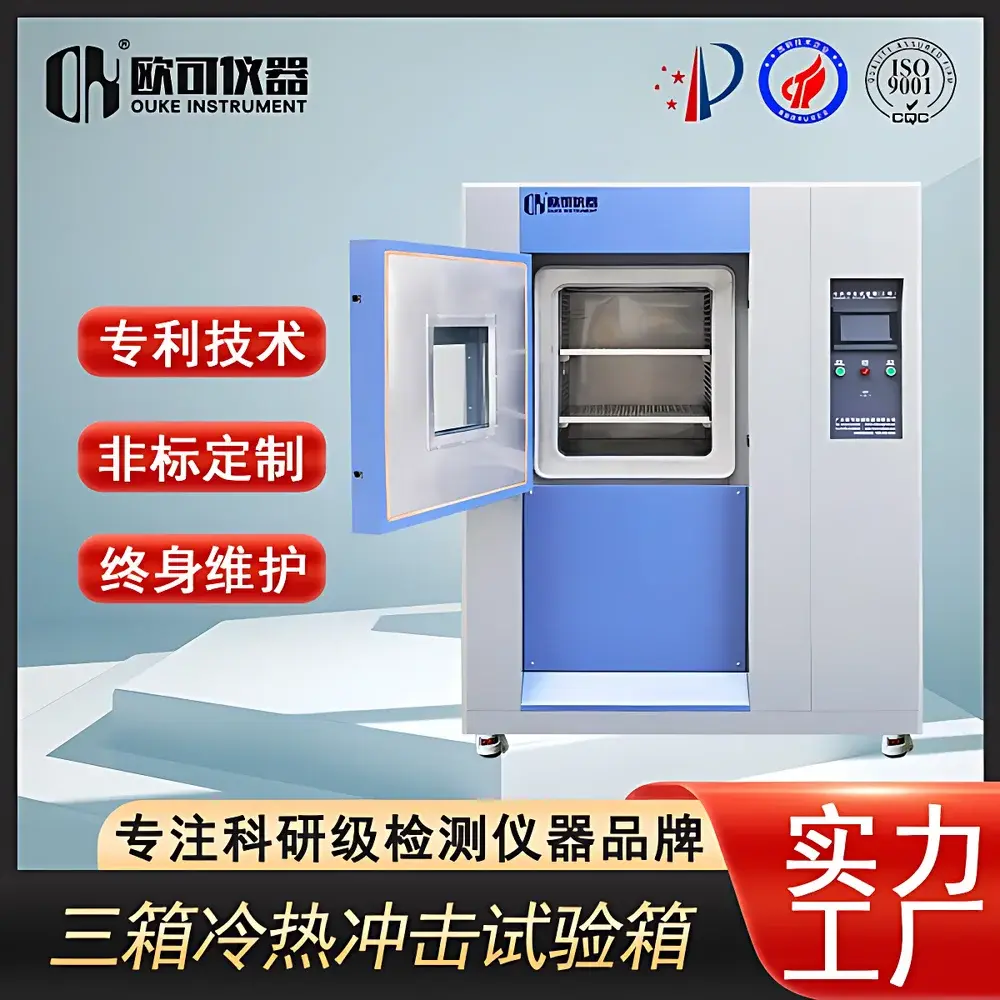
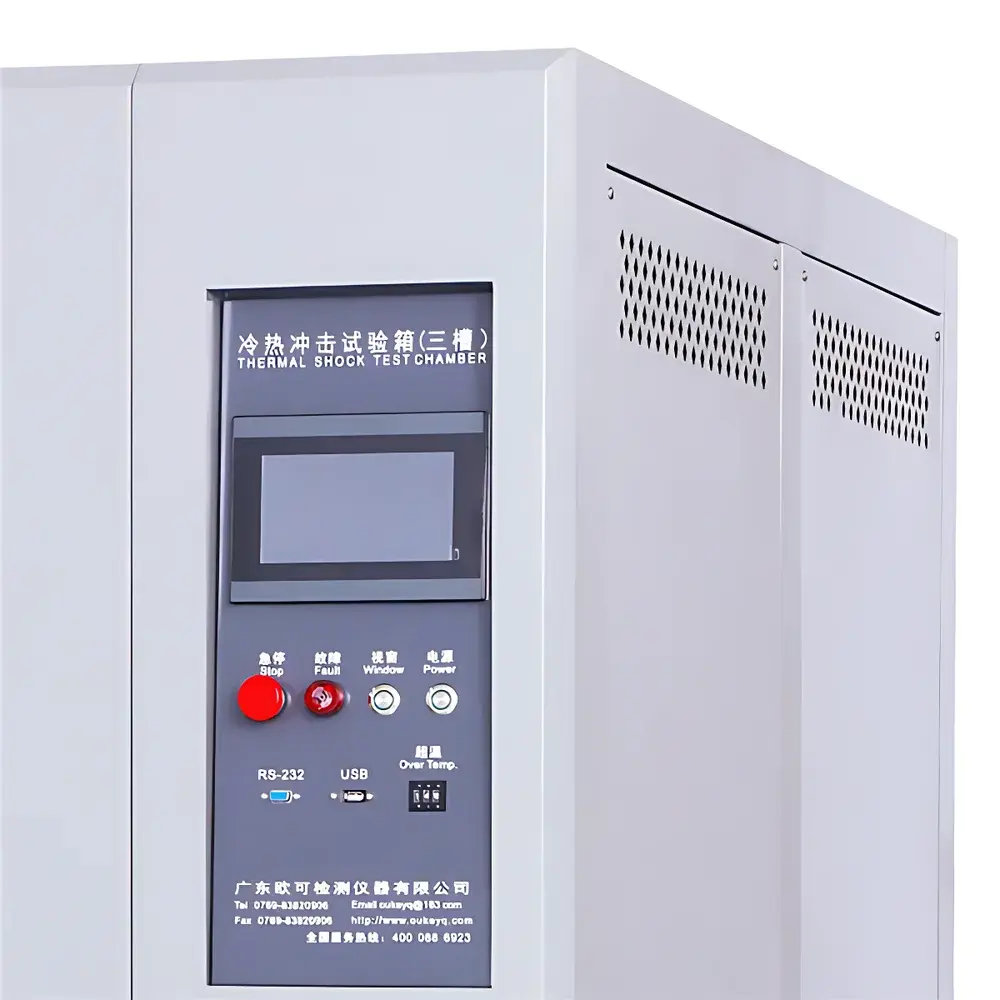
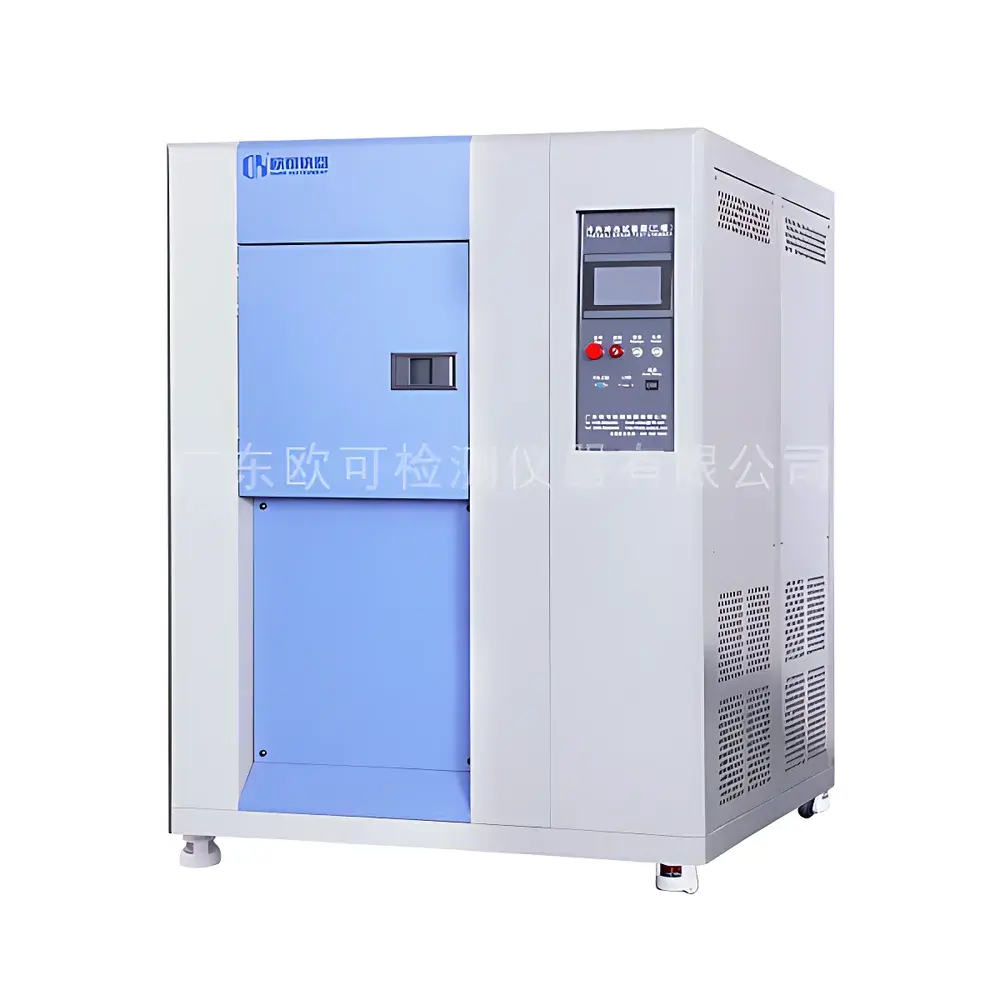
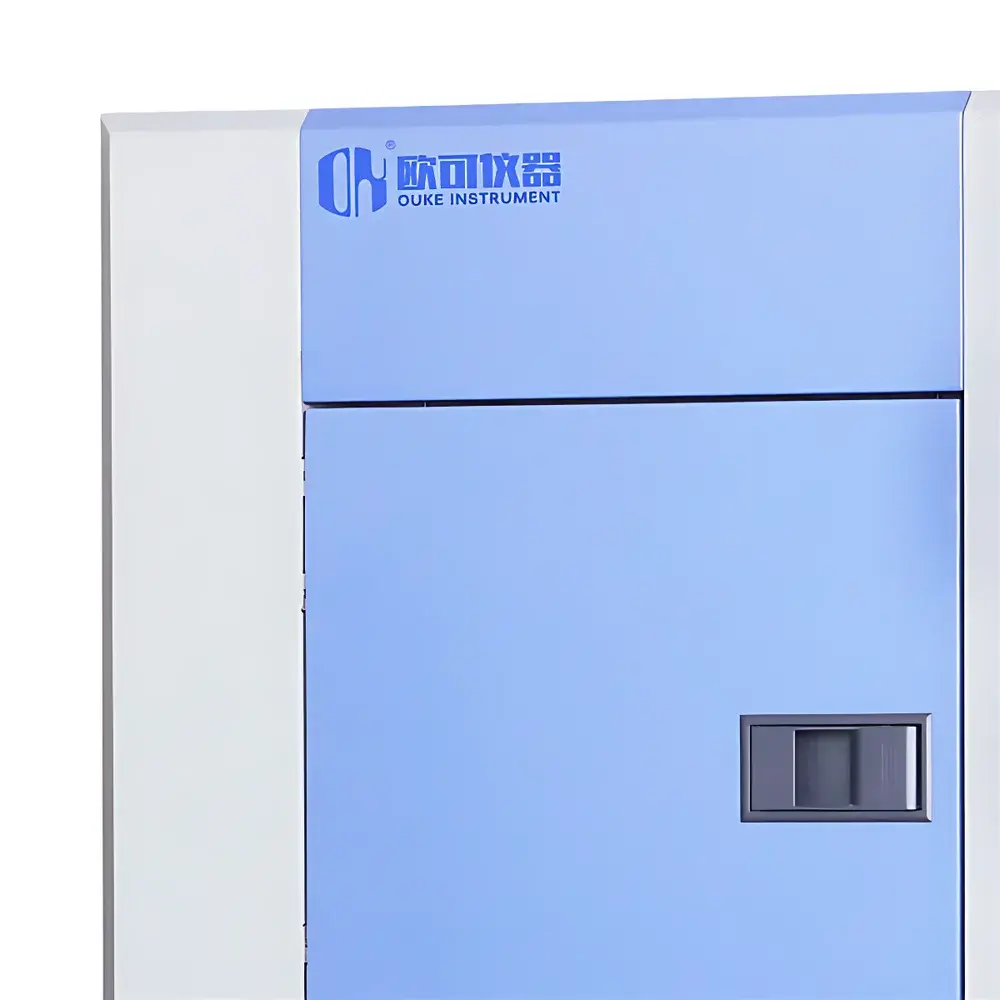
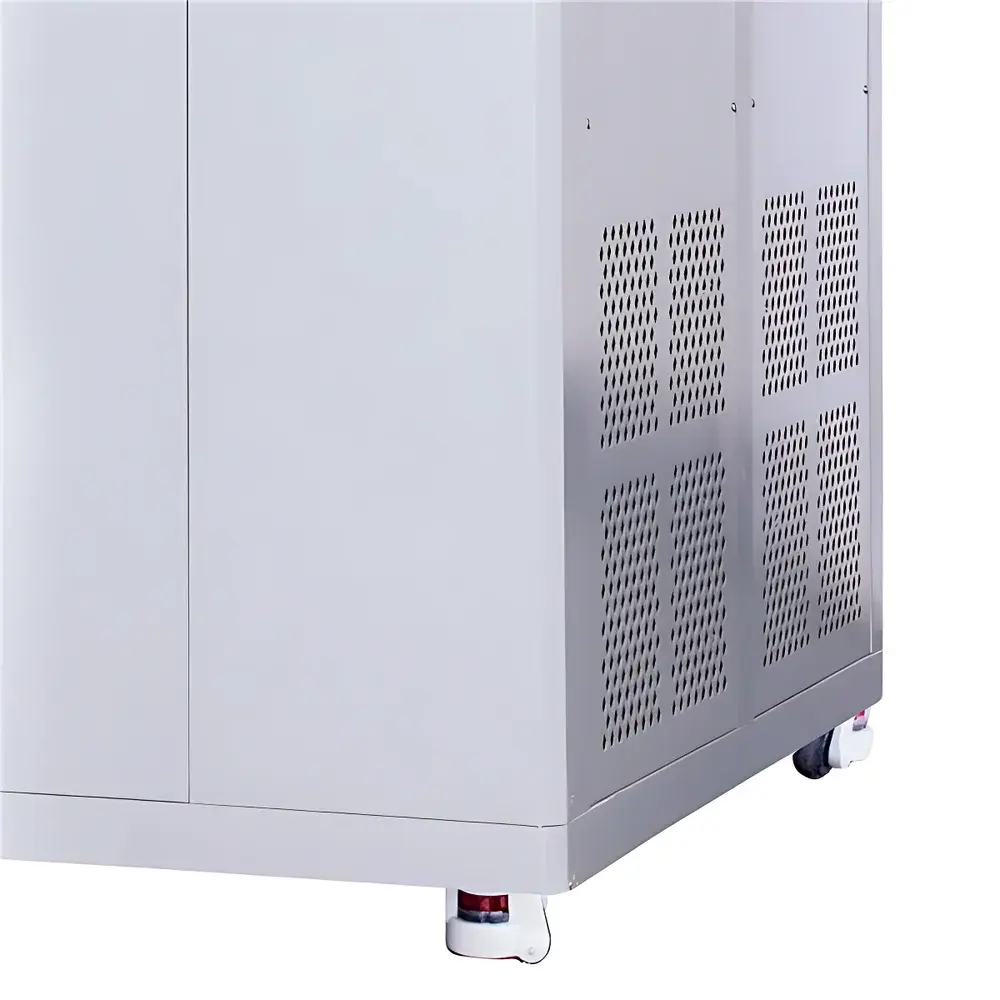
OK-TS-49.45 Three-Chamber Thermal Shock Test Chamber
| Brand | OK Instruments |
|---|---|
| Origin | Guangdong, China |
| Manufacturer Type | Direct Manufacturer |
| Model | OK-TS-49.45 |
| High-Temperature Range | +150 °C |
| Low-Temperature Range | −55 °C |
| Thermal Shock Range | −55 °C to +150 °C |
| Temperature Stability | ±2 °C |
| Temperature Transition Time | ≤10 s (hot-to-cold / cold-to-hot) |
Overview
The OK-TS-49.45 Three-Chamber Thermal Shock Test Chamber is an engineered solution for accelerated reliability assessment under extreme thermal transients. Unlike conventional temperature cycling or rapid temperature change chambers—which apply gradual, linear thermal profiles—this system implements true thermal shock via a three-zone architecture: separate high-temperature and low-temperature蓄热 (storage) zones, plus a stationary test chamber where the specimen remains fixed throughout testing. During operation, high-velocity air streams—preconditioned in dedicated thermal reservoirs—are directed into the test zone through pneumatically actuated isolation dampers. This design eliminates mechanical displacement of samples, thereby removing vibration-induced artifacts and enabling real-time functional monitoring (e.g., powered-in situ electrical continuity checks, optical alignment verification, or sensor output logging) during transitions. The chamber complies with the fundamental timing requirements of MIL-STD-883 Method 1010.8, IEC 60068-2-14 (equivalent to GB/T 2423.22), and JESD22-A104, all of which mandate transition times ≤10 seconds between specified temperature extremes.
Key Features
- Three-chamber configuration with independent high-temperature (+150 °C) and low-temperature (−55 °C) thermal reservoirs, ensuring stable preconditioning and minimal thermal inertia during switching.
- Stationary sample placement in the central test chamber—ideal for large, heavy, or vibration-sensitive assemblies including automotive ECUs, avionics modules, and optoelectronic packages.
- Fast-acting pneumatic damper system enabling hot-to-cold or cold-to-hot transitions in ≤10 seconds, meeting stringent military and semiconductor qualification timelines.
- Temperature stability maintained within ±2 °C across the full operating range, verified per ISO/IEC 17025-compliant calibration protocols.
- Robust stainless-steel construction with double-wall insulation and forced-air circulation, minimizing thermal leakage and ensuring uniformity in the test zone (±1.5 °C at center point).
- Integrated safety interlocks, over-temperature protection, and refrigerant leak detection aligned with UL 61010-1 and CE machinery directive requirements.
Sample Compatibility & Compliance
The OK-TS-49.45 accommodates specimens up to 49.45 L in volume (internal dimensions: 450 × 450 × 245 mm W×D×H), with a maximum static load capacity of 30 kg. Its stationary-test-zone architecture supports continuous power supply, signal cabling, and fiber-optic feedthroughs—enabling live diagnostics during thermal transients. The system satisfies test condition definitions in key international standards: MIL-STD-883 (Method 1010.8), IEC 60068-2-14 (Test Nb), and JESD22-A104 (Temperature Cycling). It is routinely deployed in GLP-compliant laboratories for qualification of Class III medical devices and AEC-Q200-graded automotive components. All control logic and data acquisition paths are designed to support audit-ready documentation under FDA 21 CFR Part 11 when paired with validated software configurations.
Software & Data Management
Equipped with OK-TCM v3.2 thermal control software, the chamber delivers programmable multi-step shock profiles—including dwell time, number of cycles, ramp direction sequencing, and conditional branching based on real-time thermocouple feedback. Data logging records temperature at ≥1 Hz resolution from six calibrated PT100 sensors (three in each reservoir, one in test zone, one ambient reference), stored in CSV and PDF report formats with embedded digital signatures. Audit trails capture user actions, parameter changes, and alarm events with timestamped metadata. Optional integration with LabArchives ELN or Siemens Opcenter Quality enables traceable linkage to broader quality management systems (QMS) and supports automated generation of test certificates compliant with ISO 9001:2015 clause 8.5.2.
Applications
- Failure mode identification in solder joints, die attach layers, and wire bonds due to coefficient-of-thermal-expansion (CTE) mismatch under abrupt thermal loading.
- Qualification of encapsulated MEMS devices, LED arrays, and RF front-end modules subjected to field-relevant thermal shock scenarios (e.g., aircraft cabin pressurization cycles, automotive under-hood thermal excursions).
- Reliability screening of printed circuit board assemblies (PCBAs) prior to burn-in or final shipment—particularly for aerospace and defense contractors requiring compliance with AS9100 Rev D.
- Material interface integrity assessment in hybrid packaging (e.g., ceramic-to-metal seals, glass-frit bonded substrates) where microcrack initiation is time- and rate-dependent.
- Validation of thermal interface materials (TIMs) under repeated shock conditions to quantify degradation in interfacial contact resistance.
FAQ
What distinguishes a three-chamber thermal shock chamber from a two-chamber (basket-transfer) system?
A three-chamber system keeps the sample stationary while routing pre-conditioned air via dampers; a two-chamber system physically moves the sample between hot and cold zones. The former avoids mechanical shock and supports powered-in-test applications.
Does this chamber meet MIL-STD-883 requirements for transition time?
Yes—verified transition times are ≤10 seconds between −55 °C and +150 °C at the specimen location, per Method 1010.8, Clause 4.2.2.
Can I perform real-time electrical measurements during thermal transitions?
Yes—the stationary test zone includes standardized cable ports and EMI-shielded feedthroughs compatible with oscilloscopes, SMUs, and boundary-scan controllers.
Is liquid nitrogen required to achieve −55 °C?
No—this model uses a cascade dual-refrigeration system with environmentally compliant R-404A/R-23 blends, eliminating reliance on cryogenic consumables.
How is temperature uniformity validated across the test zone?
Uniformity is confirmed using a 9-point NIST-traceable thermocouple mapping procedure per IEC 60068-3-5, with results documented in the factory acceptance test (FAT) report supplied with each unit.



