
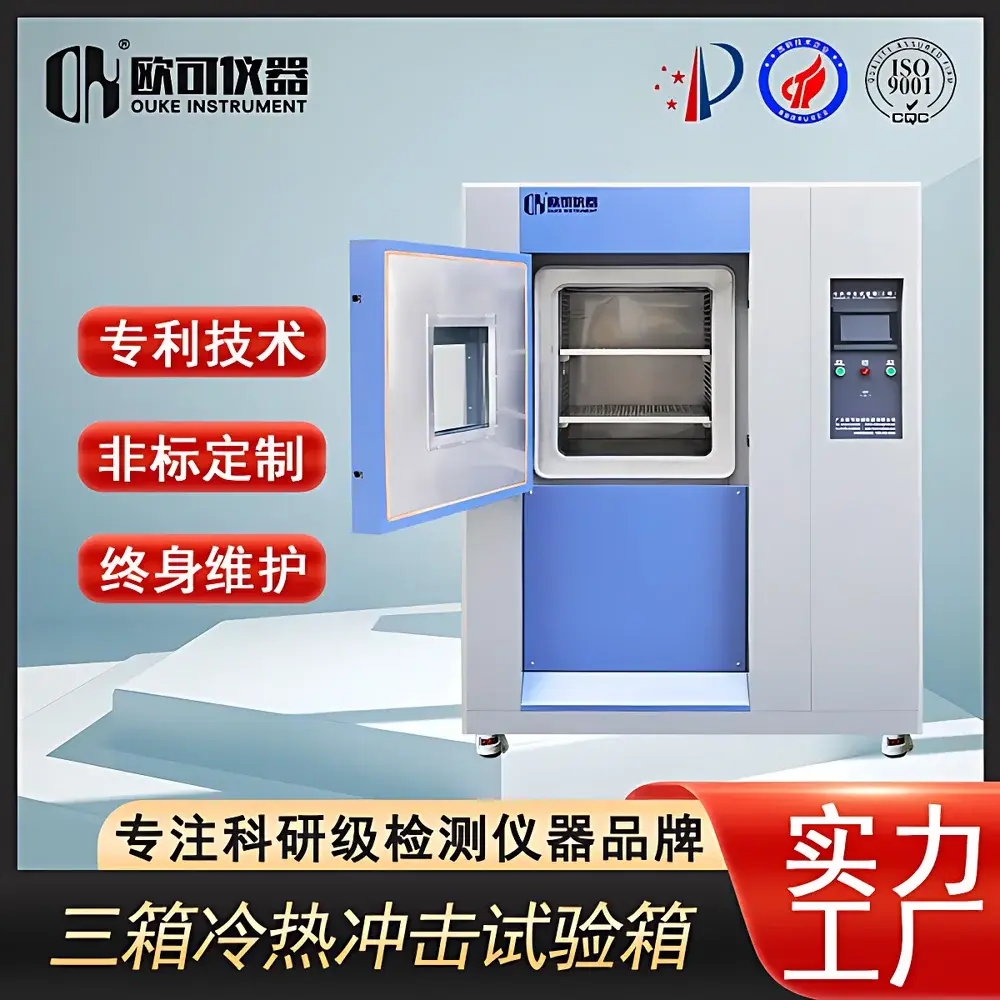
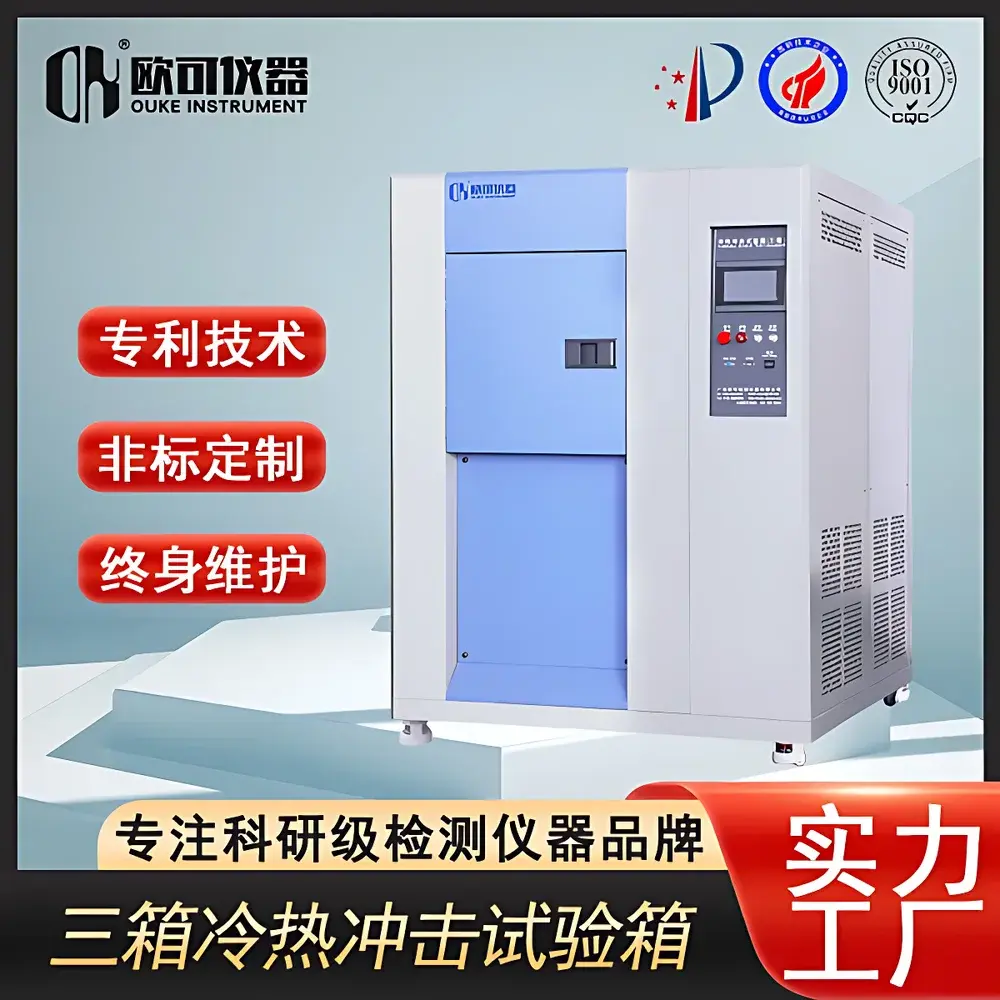
OK-TS-49 Two-Zone Thermal Shock Test Chamber
| Brand | OK Instruments |
|---|---|
| Origin | Guangdong, China |
| Manufacturer Type | Direct Manufacturer |
| Model | OK-TS-49 |
| Price | ¥89,000 |
| High-Temperature Range | +150 °C |
| Low-Temperature Range | −50 °C |
| Thermal Shock Range | −50 °C to +150 °C |
| Temperature Stability | ±2 °C |
| Heating Rate | 10 °C/min |
| Cooling Rate | 10 °C/min |
Overview
The OK-TS-49 Two-Zone Thermal Shock Test Chamber is an engineered environmental reliability test system designed to evaluate material and component resilience under rapid, repetitive transitions between extreme high and low temperatures. It operates on the dual-chamber (two-box) principle: two thermally isolated compartments—one maintained at a stable high temperature (+150 °C), the other at a stable low temperature (−50 °C)—with a motor-driven transfer basket that physically shuttles test specimens between them. This architecture enables direct air-to-sample thermal exchange during transfer, delivering high-magnitude thermal transients with minimal thermal inertia. Unlike single- or three-zone configurations, the two-zone design eliminates airflow redirection delays and ensures maximum thermal gradient exposure per cycle—critical for accelerated stress testing in qualification protocols aligned with IEC 60068-2-14, MIL-STD-883 Method 1010.8, JESD22-A104, and GB/T 2423.22.
Key Features
- Independent dual-compartment architecture with dedicated high-temperature (+150 °C) and low-temperature (−50 °C) zones, each equipped with precision PID-controlled heating and refrigeration systems
- High-speed mechanical transfer basket with repeatable positioning accuracy and ≤10-second transition time between chambers (typical −50 °C → +150 °C specimen zone temperature crossover)
- Thermal stability of ±2 °C across both chambers during dwell phases, verified per ISO/IEC 17025-compliant calibration procedures
- Uniform heating and cooling rates of 10 °C/min, sustained across full operational load conditions (up to rated basket capacity)
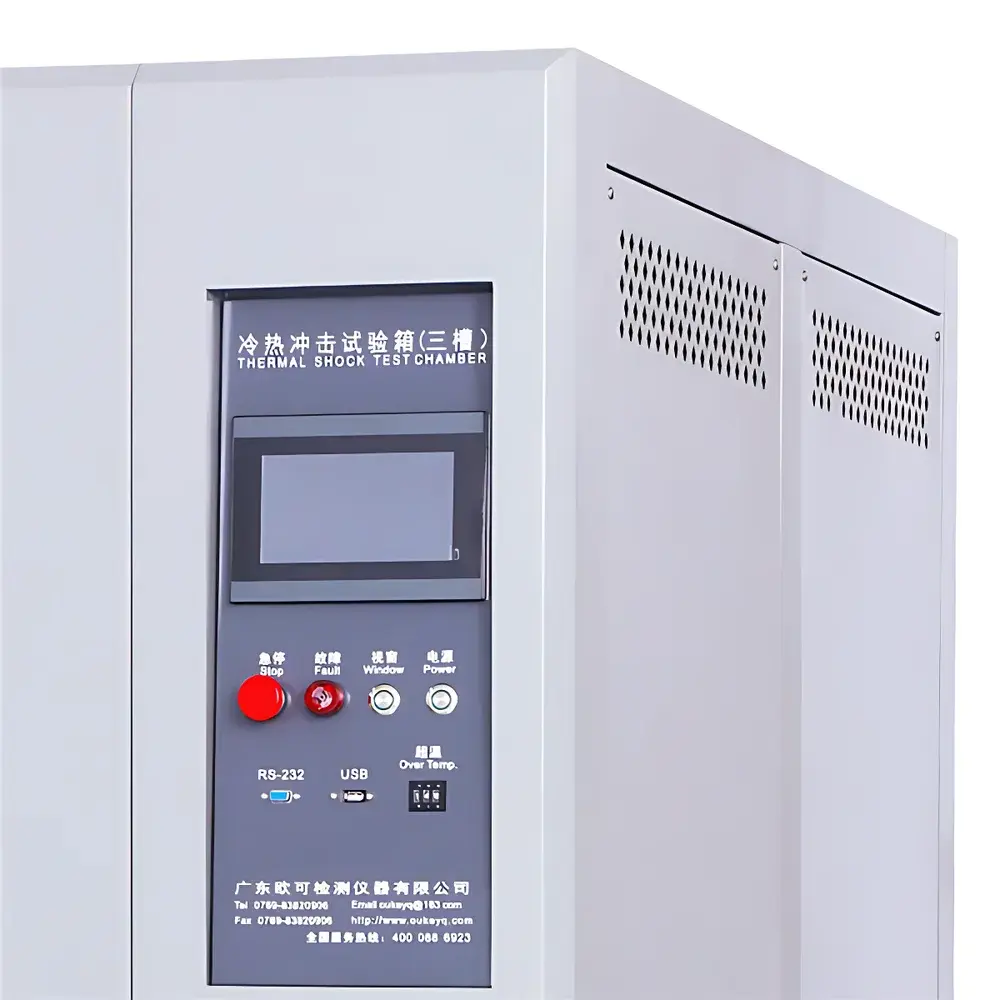
- Industrial-grade PLC-based controller with 7-inch color touchscreen interface, supporting multi-segment programmable cycles, real-time curve plotting, and event-triggered logging
- Comprehensive safety suite including over-temperature cut-off, compressor phase protection, motor overload detection, and specimen over-temperature alarm with automatic shutdown
Sample Compatibility & Compliance
The OK-TS-49 accommodates rigid and semi-rigid specimens up to standard basket dimensions (W × D × H: 400 × 400 × 400 mm), with a maximum load capacity of 25 kg. Its open-basket transfer mechanism supports non-instrumented samples only; integration with powered or signal-connected devices requires external slip-ring assemblies or extended flexible cabling—users must validate electromagnetic compatibility and thermal loading effects prior to deployment. The chamber complies with structural and performance requirements of IEC 60068-2-14 (Change of Temperature), GB/T 2423.22 (Temperature Change Test N), and JESD22-A104. While not certified to UL or CE as a complete system, its electrical subsystems meet IEC 61000-6-2 (immunity) and IEC 61000-6-4 (emission) standards. For GLP/GMP-regulated environments, optional audit-trail-enabled firmware and 21 CFR Part 11–compliant electronic signature modules are available upon request.
Software & Data Management
Embedded control firmware supports local data logging at user-selectable intervals (1–60 seconds), storing temperature readings from dual chamber sensors and basket position status. Logged data exports directly to CSV via USB flash drive. Optional Ethernet connectivity enables remote monitoring through HTTP-based API endpoints compatible with LabVIEW, Python (requests library), or enterprise MES platforms. All logged events—including door openings, power interruptions, and safety triggers—are timestamped with millisecond resolution and retained in non-volatile memory. Calibration history, operator login logs, and parameter change records are preserved for traceability, fulfilling basic documentation requirements for internal quality audits and ISO 9001 process validation.
Applications
- Electronics reliability assessment: solder joint integrity, die attach delamination, and CTE mismatch-induced microcracking in PCBAs and discrete semiconductors
- Automotive electronics qualification: infotainment units, ADAS sensors, and powertrain control modules subjected to simulated under-hood and cold-soak cycling
- Aerospace component screening: thermal fatigue resistance of composite airframe fasteners, optical sensor housings, and avionics enclosures exposed to stratospheric-to-ground thermal gradients
- Photovoltaic module validation: encapsulant adhesion loss and interconnect ribbon fatigue under diurnal thermal cycling representative of desert installations
- New material development: quantification of thermal shock tolerance in ceramic matrix composites, metal foams, and polymer nanocomposites used in high-gradient thermal management systems
FAQ
What is the typical specimen temperature transition time between chambers?
Measured at the geometric center of the basket, the time required for specimen zone temperature to cross from −40 °C to +140 °C (or vice versa) is ≤10 seconds under no-load conditions, per IEC 60068-2-14 Annex B verification protocol.
Does the system support automated test sequencing across multiple thermal shock profiles?
Yes—the controller supports up to 99 programmable segments per profile, with dwell times, transfer triggers, and cycle counts fully configurable. Up to 100 profiles can be stored internally.
How often is calibration recommended?
Annual calibration of chamber temperature sensors against NIST-traceable references is recommended. Internal verification using Class A PT100 reference probes is supported via built-in calibration mode.
Can the chamber operate continuously for extended qualification runs?
Designed for unattended operation, the OK-TS-49 includes redundant refrigeration safeguards and continuous compressor monitoring. Maximum recommended continuous runtime is 72 hours; longer tests require scheduled maintenance intervals per OEM service manual.
Is frost accumulation in the cold chamber addressed automatically?
No auto-defrost function is included. Manual defrosting is required when frost thickness exceeds 3 mm on evaporator surfaces—typically every 100–200 thermal cycles depending on ambient humidity and door-opening frequency.



