
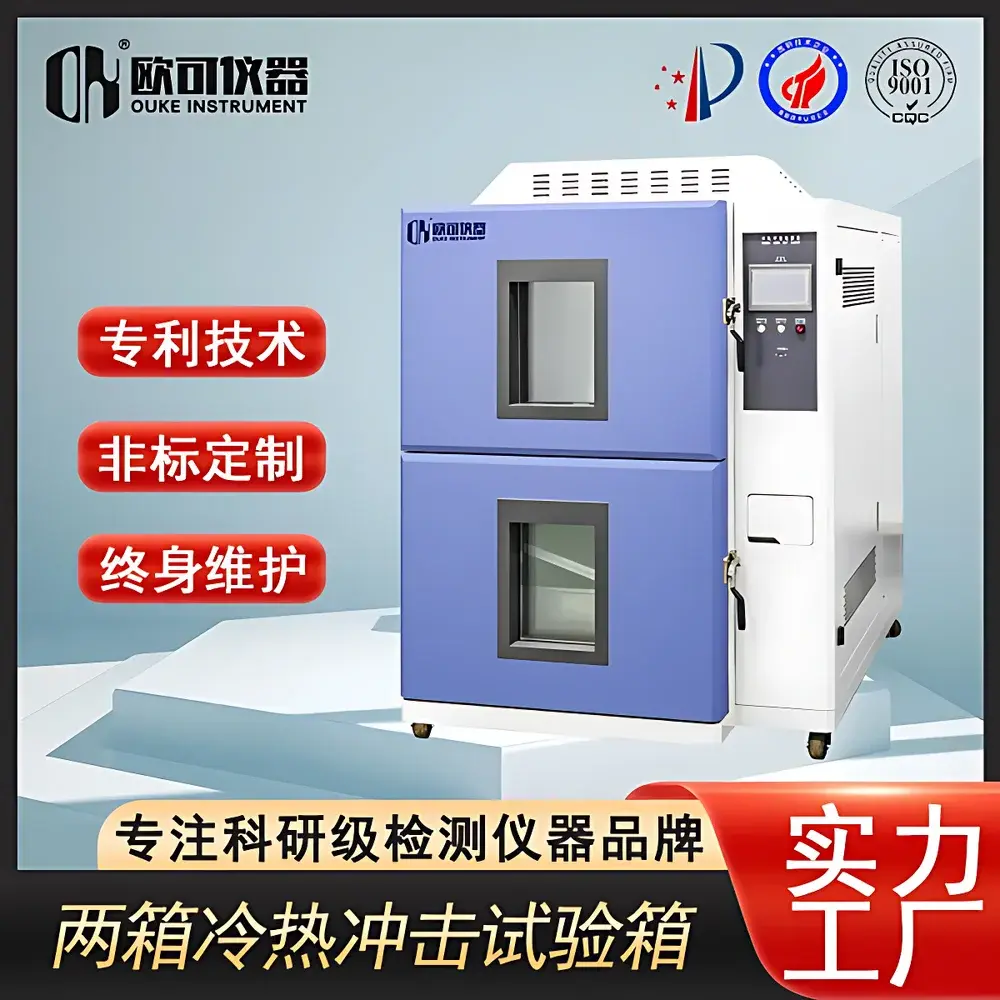
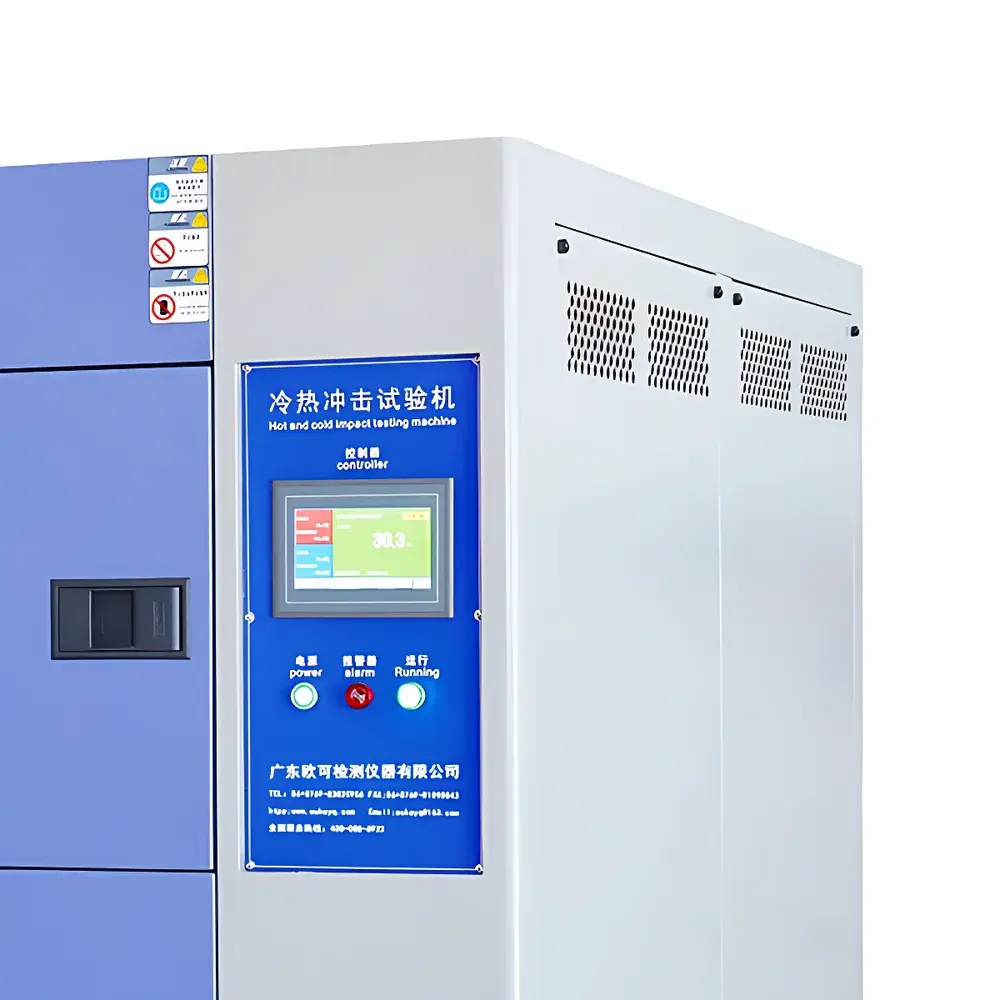
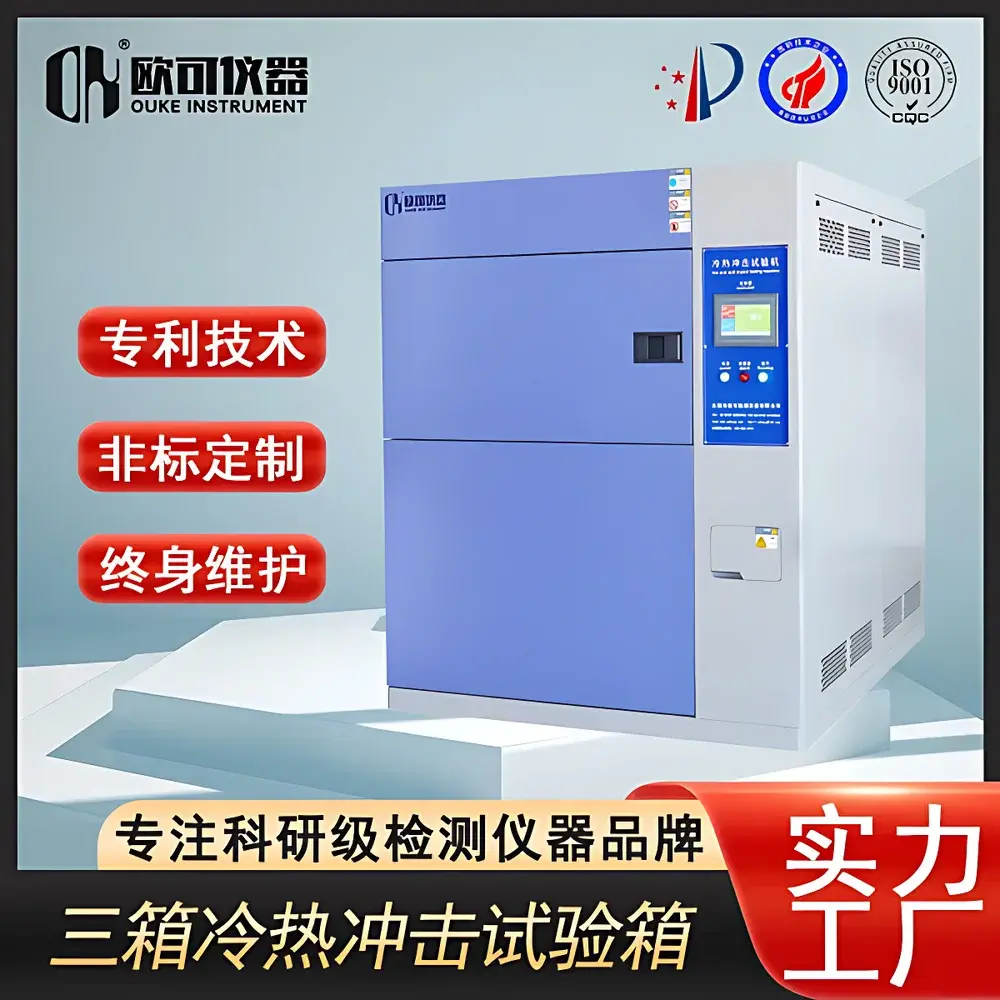
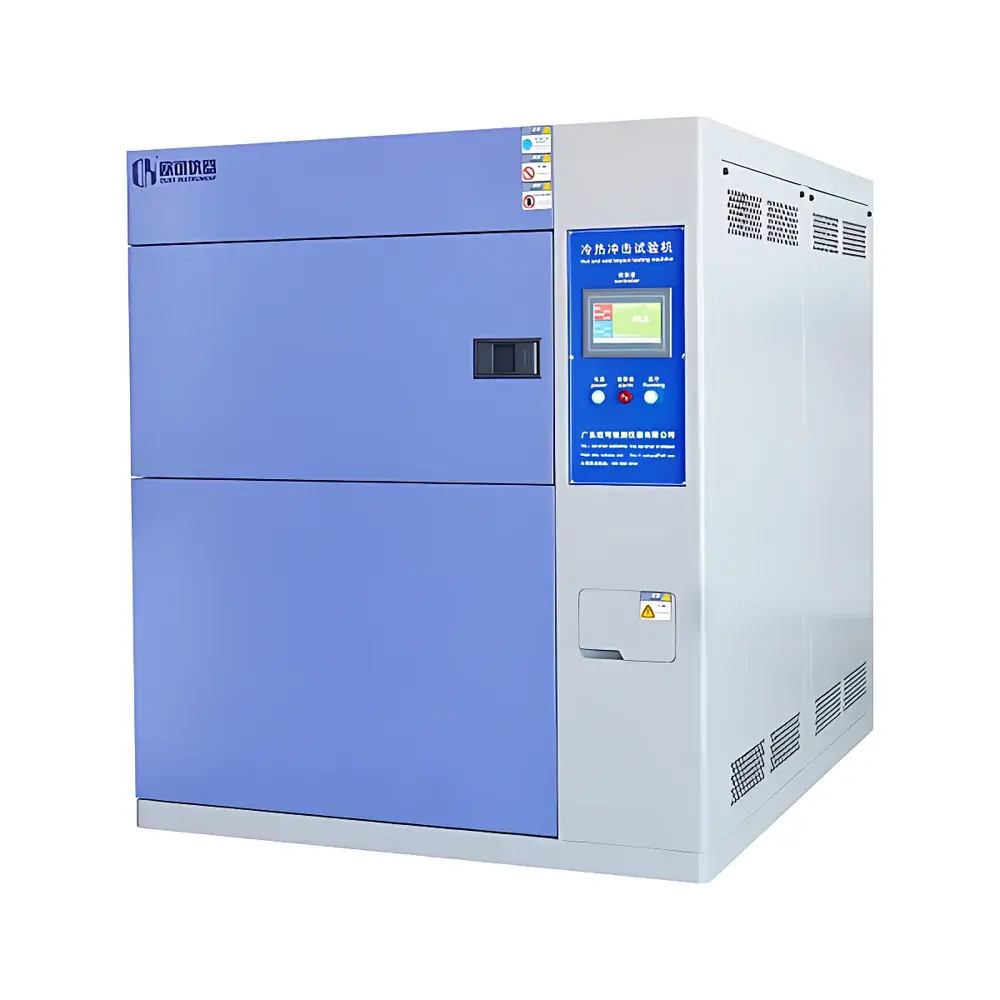
OK-TS-80.25 Thermal Shock Test Chamber
| Brand | OK Instruments |
|---|---|
| Origin | Guangdong, China |
| Manufacturer Type | Direct Manufacturer |
| Model | OK-TS-80.25 |
| High-Temperature Range | +150 °C |
| Low-Temperature Range | −70 °C |
| Thermal Shock Range | −70 °C to +150 °C |
| Temperature Stability | ±2 °C |
| Transition Time (Hot ↔ Cold) | ≤10 s |
| Heating/Cooling Rate (Chamber Air) | 5 °C/s (typical air temperature ramp in transition phase) |
Overview
The OK-TS-80.25 Thermal Shock Test Chamber is an engineered environmental stress screening (ESS) system designed to subject electronic components, aerospace assemblies, automotive modules, and advanced packaging materials to rapid, repetitive thermal transitions between extreme high- and low-temperature environments. Unlike temperature cycling or rapid thermal cycling chambers—which impose gradual, linear temperature ramps—this chamber executes discrete, step-function thermal shocks governed by precise dwell-and-transfer protocols. Its operational principle aligns with the fundamental physics of thermally induced mechanical stress: differential expansion coefficients across heterogeneous material interfaces (e.g., silicon die-to-leadframe, solder joints, polymer encapsulants) generate transient shear and tensile stresses during abrupt temperature transitions. These stresses may precipitate latent defects—including interfacial delamination, solder joint cracking, wire bond lift-off, or hermetic seal failure—often undetectable under static thermal conditions. The OK-TS-80.25 implements a dual-chamber (two-zone) basket-transfer architecture, where the test specimen is physically relocated between independently stabilized hot (+150 °C) and cold (−70 °C) zones via pneumatically actuated vertical lift mechanism, achieving a verified transfer time of ≤10 seconds—meeting the critical timing requirement specified in MIL-STD-883 Method 1010.8, IEC 60068-2-14 (identical to GB/T 2423.22), and JESD22-A104.
Key Features
- Dual-zone independent temperature control: Separate high-temperature chamber (up to +150 °C) and low-temperature chamber (down to −70 °C), each equipped with dedicated heating elements, cryogenic refrigeration circuits, and PID-controlled air circulation systems.
- High-speed pneumatic basket transfer: Stainless-steel test basket moves vertically between zones with repeatable positioning accuracy; transfer cycle time ≤10 s, validated per IEC 60068-2-14 Annex B.
- Thermal stability & uniformity: ±2 °C temperature stability over full operating range; chamber uniformity maintained within ±3 °C across usable sample volume (W×H×D: 400 × 400 × 500 mm).
- Robust mechanical architecture: Heavy-duty guide rails, shock-dampened carriage assembly, and fail-safe limit switches ensure long-term reliability under repeated mechanical cycling.
- Programmable test sequencing: Supports up to 999 cycles with user-defined dwell times (1 min–999 h), transition direction (hot→cold or cold→hot), and automatic termination on fault detection.
- Integrated safety systems: Over-temperature cut-off, low-refrigerant pressure alarm, door interlock, and emergency stop compliant with IEC 61000-6-2/6-4 EMC and UL 61010-1 safety standards.
Sample Compatibility & Compliance
The OK-TS-80.25 accommodates samples up to 25 kg gross weight and dimensions compatible with its internal basket (max. 350 × 350 × 400 mm). It is optimized for small- to medium-format electronics: PCBAs, IC packages (QFP, BGA, CSP), MEMS sensors, optoelectronic modules, and automotive ECUs. The basket-transfer design inherently subjects specimens to minor mechanical vibration during transit—making it unsuitable for highly fragile, unmounted bare dies or dynamically monitored live devices requiring continuous signal integrity. For such applications, a three-zone (air-switched) thermal shock system is recommended. The chamber satisfies mandatory compliance requirements for qualification testing under MIL-STD-883H (Method 1010.8), JEDEC JESD22-A104E, IEC 60068-2-14, and GB/T 2423.22–2012. Calibration traceability follows ISO/IEC 17025 guidelines, with optional NIST-traceable temperature sensor validation reports available upon request.
Software & Data Management
Control and monitoring are executed via a 10.1″ capacitive touchscreen HMI running embedded Linux-based firmware. All test parameters—including zone temperatures, dwell durations, cycle counts, real-time basket position status, and alarm logs—are stored internally with timestamped records (≥10,000 entries). Data export is supported via USB 2.0 port in CSV format for post-test analysis in Excel or statistical process control (SPC) platforms. Optional Ethernet connectivity enables remote supervision via Modbus TCP or HTTP API integration into centralized lab management systems. Audit trail functionality complies with GLP/GMP principles: all parameter changes, start/stop commands, and error events are logged with user ID and timestamp. While not FDA 21 CFR Part 11 certified out-of-the-box, configuration files and log archives support validation documentation for regulated industries when deployed under controlled SOPs.
Applications
- Failure analysis of solder joint reliability in lead-free electronics under accelerated thermal stress.
- Qualification of wafer-level chip-scale packages (WLCSP) for automotive AEC-Q200 Grade 1 environments.
- Screening of optical lens adhesives and housing seals for aerospace avionics enclosures.
- Evaluation of battery module thermal interface material (TIM) integrity after repeated shock exposure.
- Verification of conformal coating performance on military-grade printed circuit boards.
- Accelerated life testing of power semiconductor modules used in EV inverters.
FAQ
What distinguishes thermal shock testing from temperature cycling or rapid thermal cycling?
Thermal shock applies instantaneous, step-change thermal stress (e.g., −55 °C → +125 °C in ≤10 s), inducing mechanical fracture mechanisms. Temperature cycling uses controlled linear ramps (e.g., 10 °C/min) to simulate cumulative thermal fatigue over hundreds or thousands of cycles.
Does the OK-TS-80.25 support liquid nitrogen (LN₂) assist for faster cooling?
No—this model relies on mechanical two-stage cascade refrigeration. LN₂ injection is available as a factory-configurable option on larger variants (OK-TS-150 series) but is not integrated into the OK-TS-80.25 base configuration.
Can I monitor device-under-test (DUT) electrical parameters during shock transitions?
Not directly—the basket movement interrupts physical connections. For in-situ functional testing, consider a three-zone air-switched chamber where the DUT remains stationary and accessible via feedthroughs.
Is calibration included with purchase?
A factory calibration certificate (covering chamber temperature uniformity and transition timing verification) is provided. On-site IQ/OQ/PQ validation support and annual recalibration services are available under separate service agreement.
What maintenance intervals are recommended?
Compressor oil and refrigerant filter replacement every 24 months; basket rail lubrication and pneumatic cylinder inspection every 6 months; full system performance verification annually or after 5000 shock cycles—whichever occurs first.



