
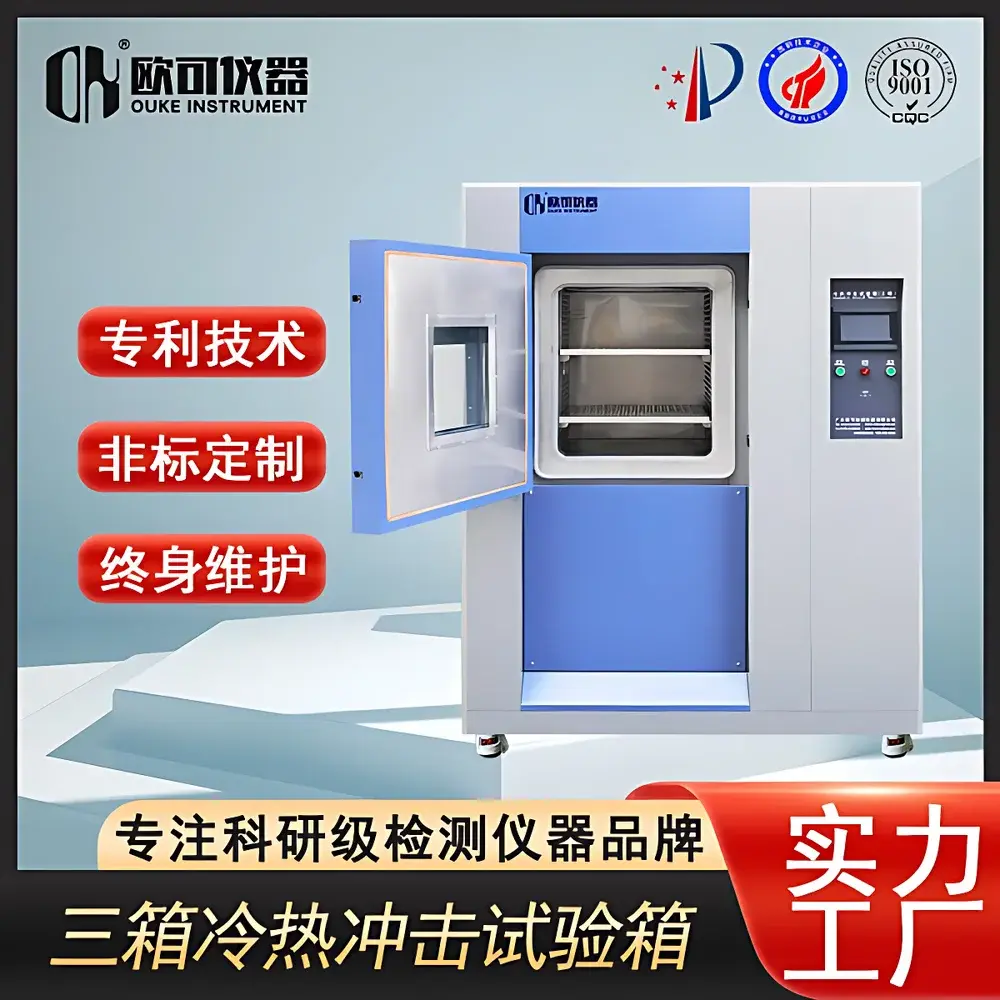
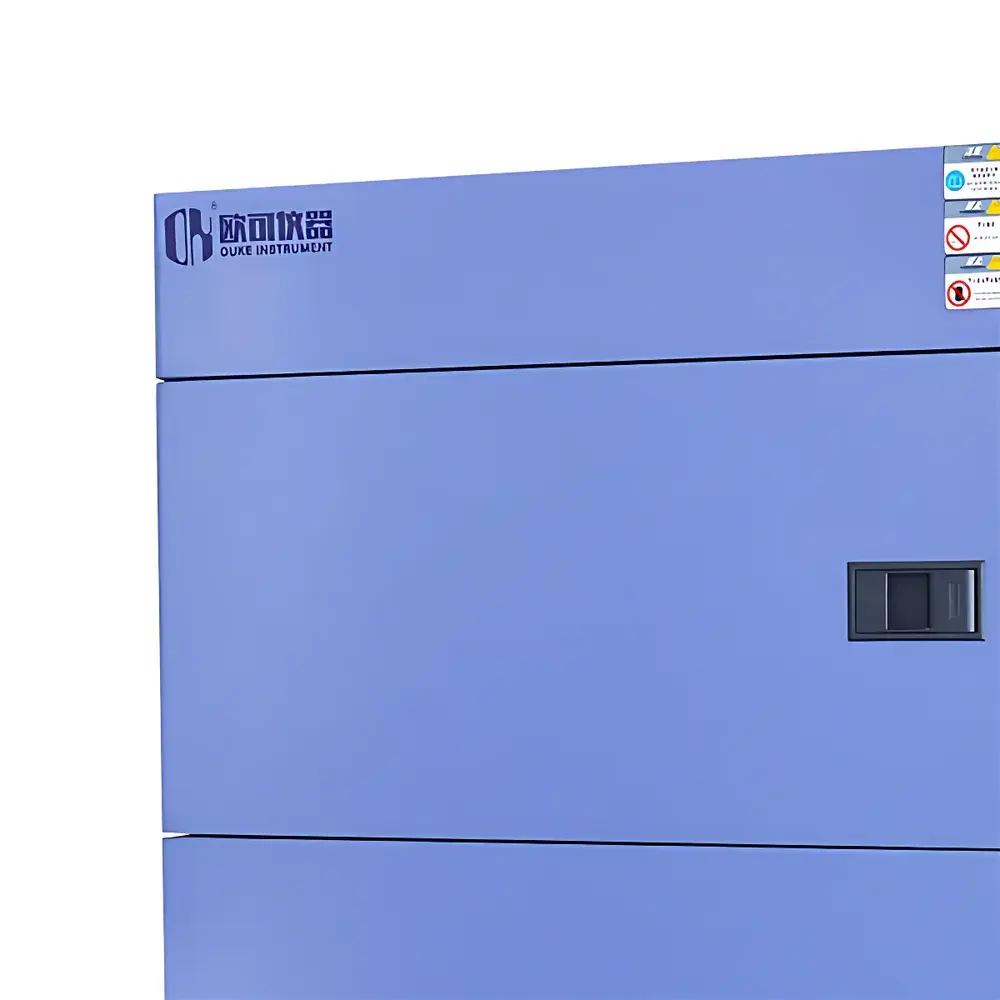
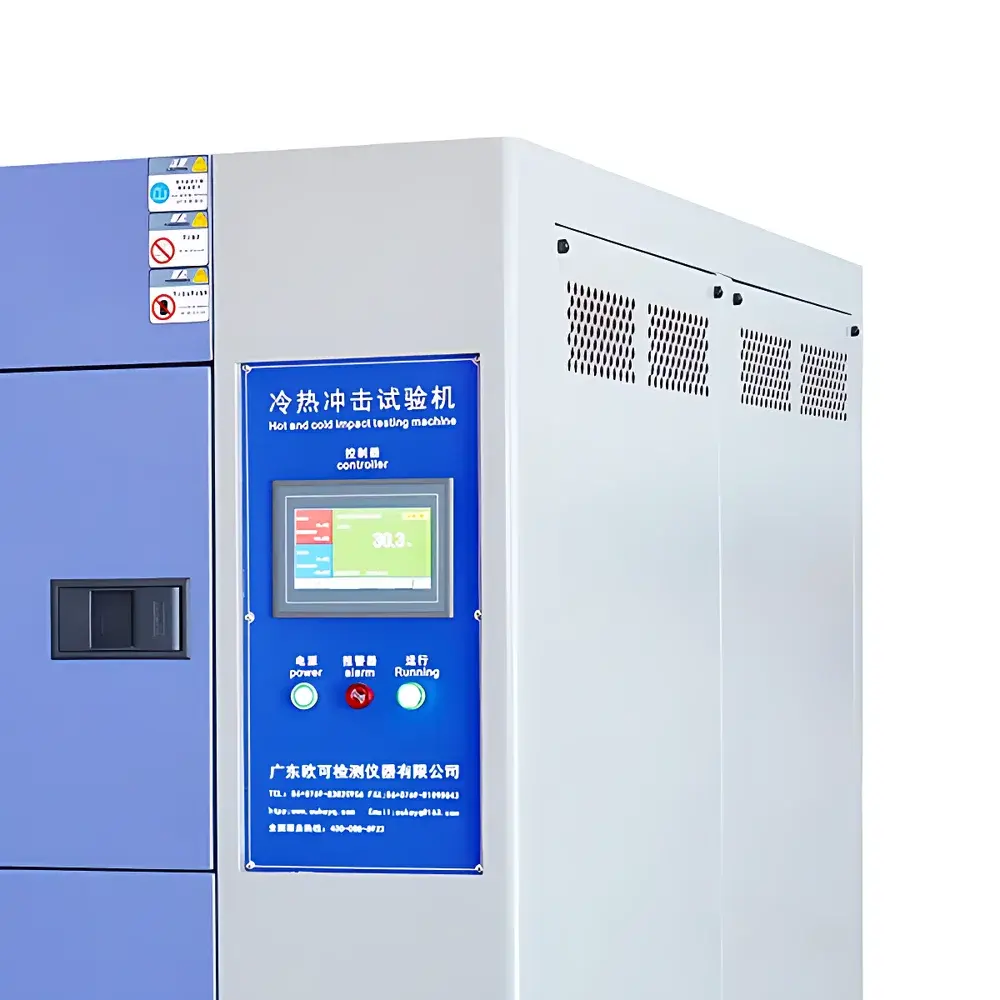
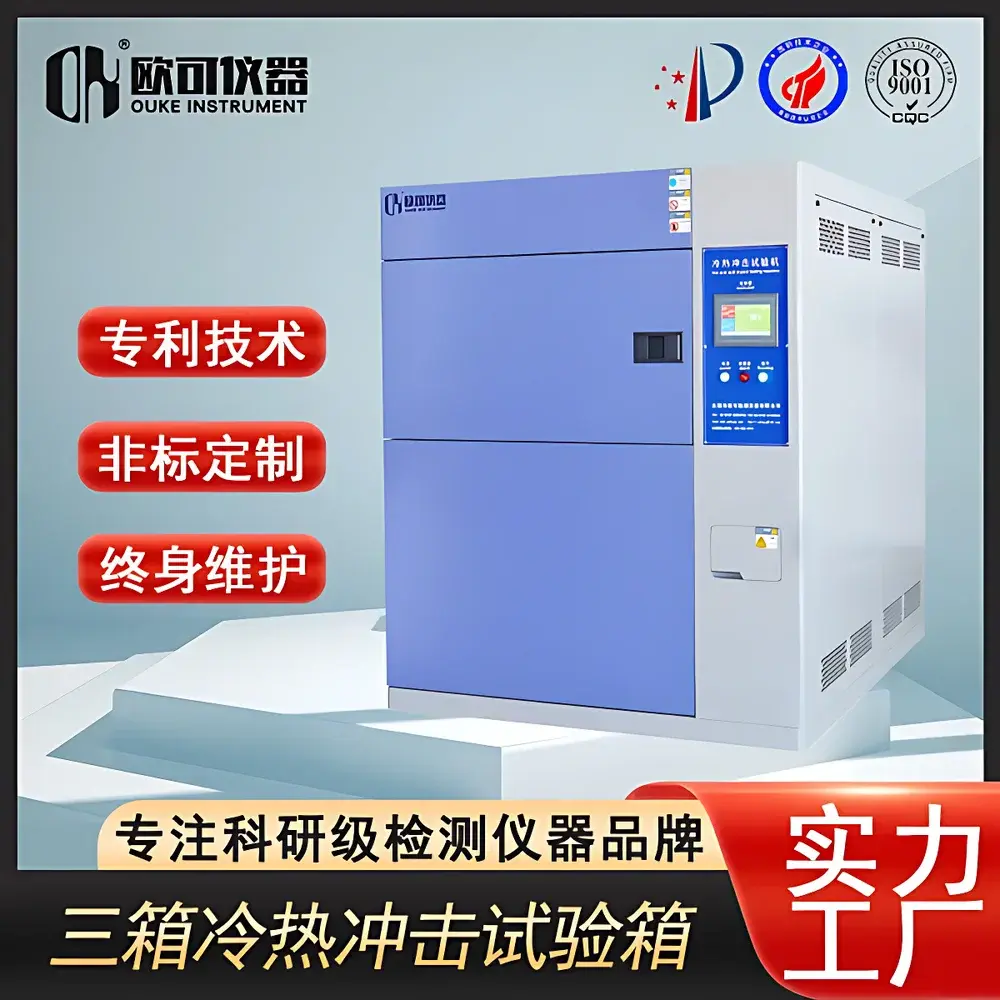
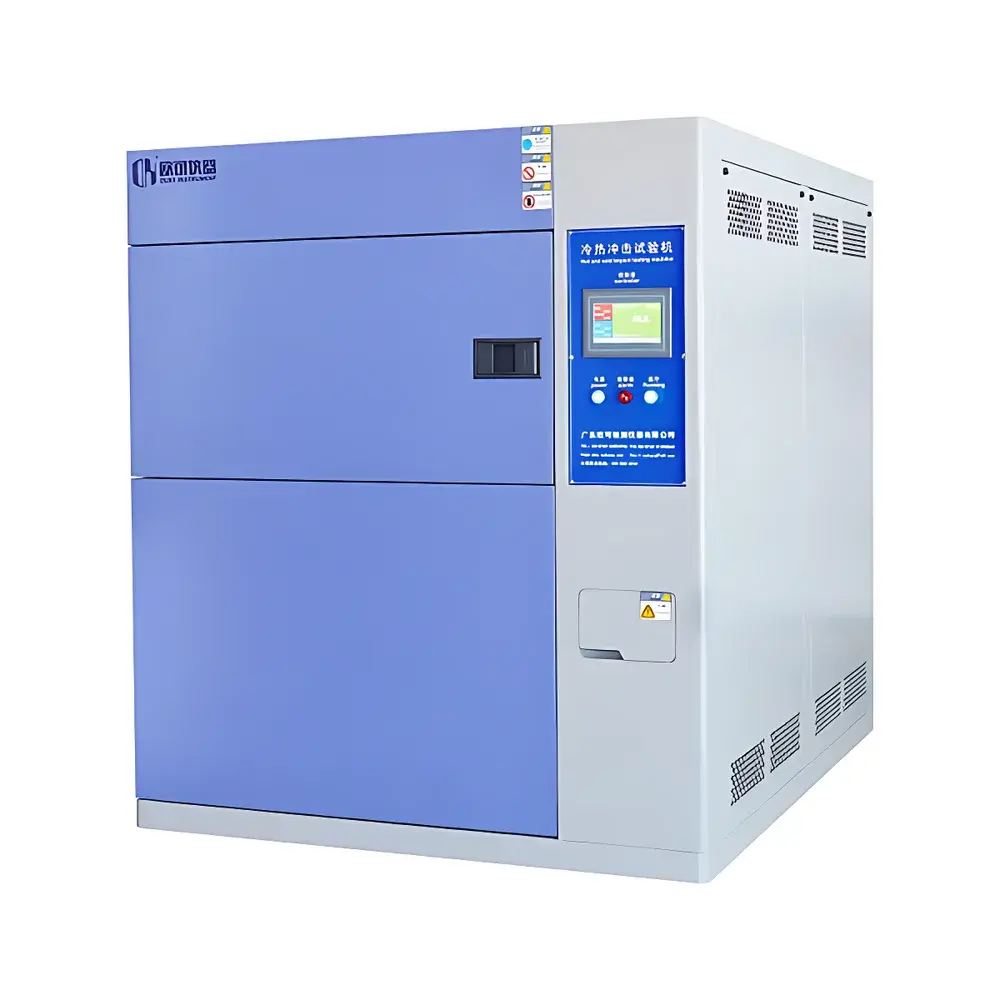
OK-TS-80.33 Thermal Shock Test Chamber
| Brand | OK Instruments |
|---|---|
| Origin | Guangdong, China |
| Manufacturer Type | Direct Manufacturer |
| Model | OK-TS-80.33 |
| High-Temperature Range | +150 °C |
| Low-Temperature Range | −40 °C |
| Thermal Shock Range | −40 °C to +150 °C |
| Temperature Stability | ±2 °C |
| Heating Rate | 5 °C/s |
| Cooling Rate | 5 °C/s |
Overview
The OK-TS-80.33 Thermal Shock Test Chamber is an engineered environmental test system designed to subject electronic components, automotive modules, aerospace assemblies, and packaging materials to rapid, repetitive transitions between extreme high- and low-temperature environments. Unlike temperature cycling or fast thermal ramp chambers—which impose gradual, linear thermal stress—the OK-TS-80.33 delivers true *thermal shock* by enforcing stepwise temperature discontinuities with sub-10-second transition times. Its operational principle aligns with the fundamental physics of transient thermal expansion mismatch: when dissimilar materials (e.g., silicon die, solder joints, plastic encapsulants, PCB substrates) experience abrupt thermal gradients, differential expansion generates mechanical shear, interfacial delamination, microcracking, or contact loss. This chamber replicates real-world failure modes such as cold solder joint fracture upon entry into a heated cabin from sub-zero ambient, or condensation-induced short circuits during rapid re-entry into humidified environments. It complies with the core timing and profile requirements of MIL-STD-883 Method 1010.8, IEC 60068-2-14 (equivalent to GB/T 2423.22), and JEDEC JESD22-A104D—standards that mandate precise control over dwell time, transfer time, and temperature overshoot/undershoot tolerances.
Key Features
- Two-chamber (basket-transfer) architecture optimized for high-fidelity thermal shock replication: independent high-temperature (+150 °C) and low-temperature (−40 °C) zones with thermally isolated insulation.
- Electro-pneumatic basket actuation system achieving ≤10-second specimen transfer between chambers—meeting Class 1 transition time per IEC 60068-2-14.
- Temperature stability maintained at ±2 °C during dwell phases, verified via NIST-traceable PT100 sensors positioned at sample plane level.
- Dynamic heating and cooling rates up to 5 °C/s, enabled by high-capacity refrigeration compressors, electric resistive heaters, and optimized airflow manifolds.
- Programmable controller with Ethernet interface supporting user-defined profiles, multi-step sequences, alarm logging, and real-time temperature trajectory monitoring.
- Stainless steel interior chamber (304 grade), reinforced structural frame, and integrated safety interlocks including over-temperature cutoff, door position sensing, and refrigerant pressure monitoring.
Sample Compatibility & Compliance
The OK-TS-80.33 accommodates specimens up to standard industrial package sizes (e.g., JEDEC trays, 19-inch rack-mounted units, automotive ECUs, and PCBAs with connectors). Its basket design supports uniform loading up to 15 kg per cycle without deformation or positional drift. The chamber meets essential regulatory and quality framework requirements: it enables testing under GLP-compliant conditions with audit-ready data logs; supports 21 CFR Part 11–aligned electronic record integrity when paired with optional OK-DataLink software; and provides traceable calibration documentation aligned with ISO/IEC 17025 principles. All thermal profiles are verifiable against ASTM E2214 (Standard Practice for Calibrating Thermal Shock Chambers) and satisfy pre-conditioning requirements for AEC-Q200 qualification of passive components.
Software & Data Management
The embedded OK-ControlSuite firmware offers intuitive profile creation, real-time graphical display of chamber zone temperatures, and automatic generation of test summary reports (CSV/PDF). Optional OK-DataLink PC software extends functionality: synchronized timestamped data export with dual-channel validation (chamber sensor + external reference probe), configurable pass/fail thresholds per test step, and encrypted database storage compliant with FDA 21 CFR Part 11 Annex 11 expectations. Audit trails include operator ID, parameter changes, calibration events, and system error codes—all retained for ≥36 months. Remote access via secure HTTPS allows lab supervisors to monitor active tests across distributed facilities without compromising network segmentation policies.
Applications
- Qualification of semiconductor packages (QFN, BGA, CSP) for solder joint integrity and die attach reliability under thermal shock stress.
- Validation of automotive ADAS sensors, battery management systems (BMS), and infotainment control units per ISO 16750-4 environmental stress screening protocols.
- Reliability assessment of medical device housings, sterilizable enclosures, and implant-grade polymer seals subjected to autoclave-to-cold-room transitions.
- Failure analysis support: isolating latent defects in MEMS devices, optical modules, and hybrid microcircuits prior to field deployment.
- Material science research on coefficient-of-thermal-expansion (CTE) mismatch effects in multilayer ceramic capacitors (MLCCs) and advanced packaging substrates.
FAQ
What distinguishes thermal shock testing from temperature cycling?
Thermal shock applies instantaneous, step-change thermal stress to induce brittle failure mechanisms (e.g., cracking, delamination); temperature cycling subjects samples to gradual, sinusoidal or ramped thermal gradients to assess fatigue life and degradation kinetics.
Does this chamber support liquid nitrogen (LN₂) assist for extended low-temperature capability?
The standard OK-TS-80.33 operates with mechanical refrigeration only (−40 °C min). LN₂ augmentation is available as a factory-configured option for −65 °C operation, requiring dedicated cryogenic plumbing and safety interlocks.
Is the basket transfer mechanism validated for repeatability across 10,000 cycles?
Yes—electro-pneumatic actuators and guide rail assemblies undergo accelerated life testing per ISO 13374-2 and are rated for ≥15,000 nominal transfers with ≤±0.3 s timing deviation.
Can I integrate live electrical biasing during thermal shock exposure?
The chamber includes feedthrough ports (2× SMA, 4× screw-terminal) rated for 300 VAC/5 A, enabling functional testing of powered devices during transition and dwell phases—subject to external power supply isolation and EMI mitigation.
How is temperature uniformity verified across the sample zone?
Uniformity mapping is performed per IEC 60068-3-5 using a 9-point sensor array during qualification; typical results show ±1.2 °C variation at steady state within the usable basket footprint.



