
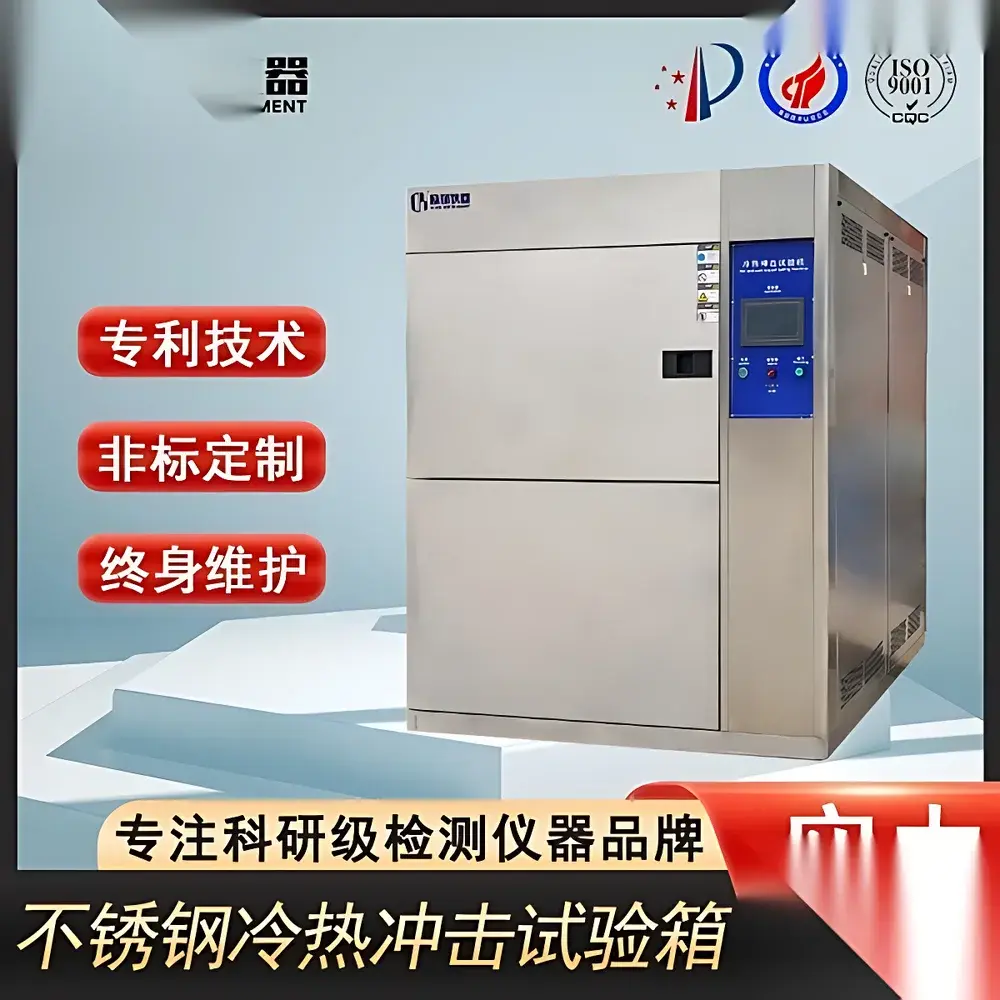
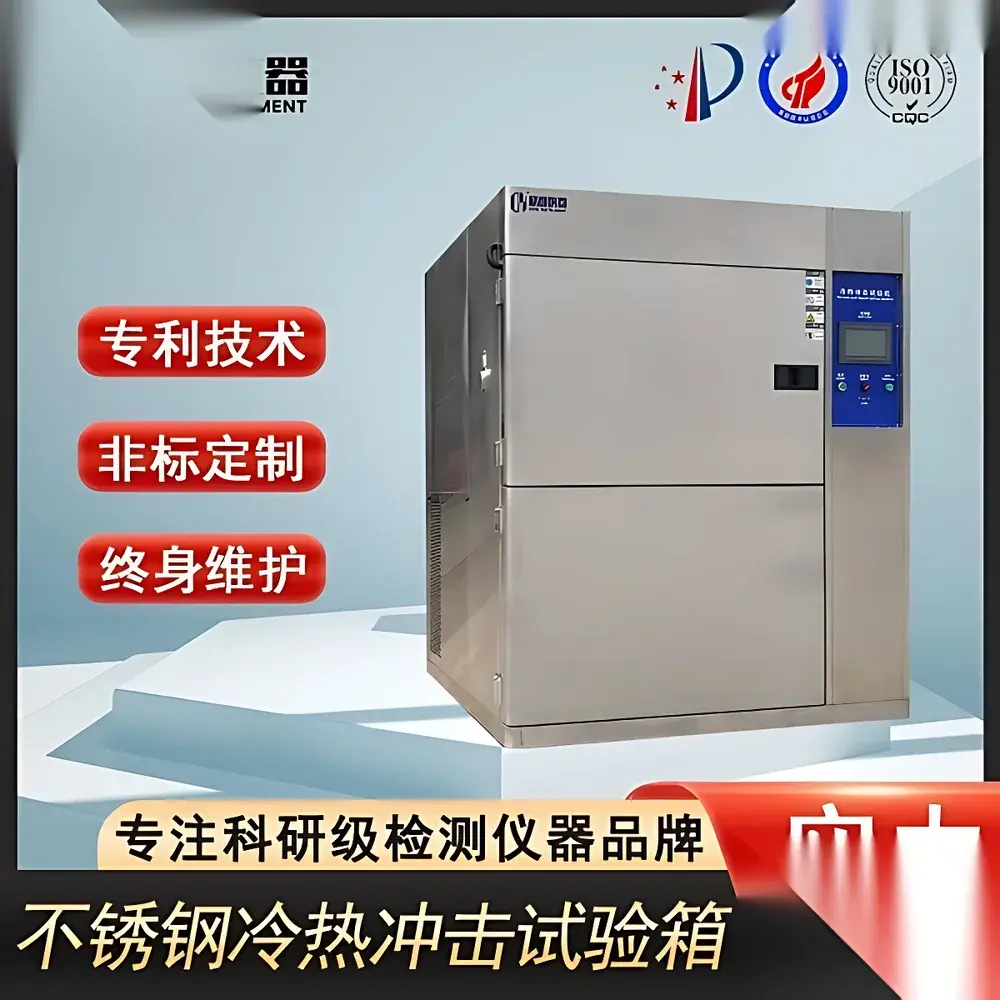
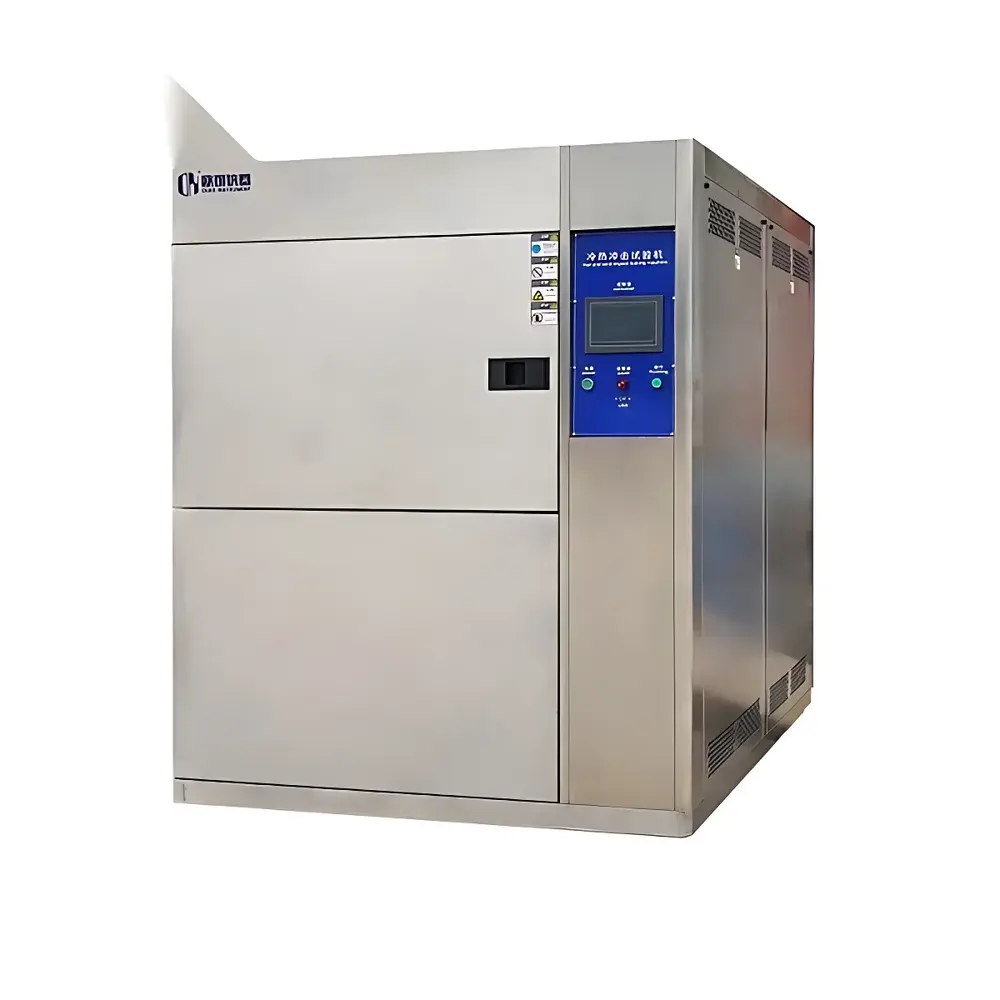
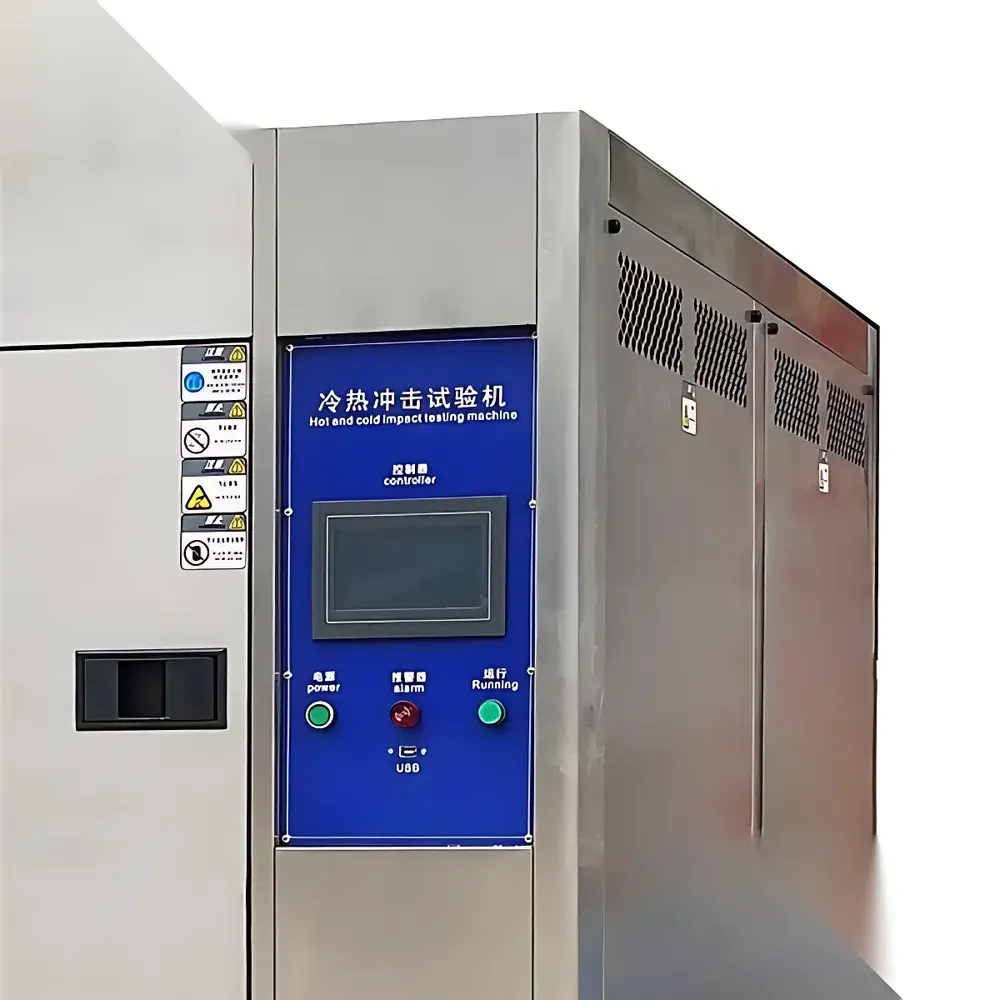
OK-TS-80 Three-Zone Thermal Shock Test Chamber
| Brand | OK |
|---|---|
| Model | OK-TS-80 |
| Internal Chamber Dimensions | 50 × 40 × 50 cm (W × D × H) |
| Inner Chamber Material | SUS 304 #8 mirror-finish stainless steel |
| Outer Chamber Material | Electrophoretically coated steel or SUS 304 brushed stainless steel |
| High-Temperature Zone Range | +60 °C to +200 °C |
| Low-Temperature Zone Range Options | A: −55 °C to −10 °C |
| B | −65 °C to −10 °C |
| D | −80 °C to −10 °C |
| Test Zone Temperature Range (Shock) | High: +60 °C to +150 °C |
| Low | A: −10 °C to −40 °C |
| B | −10 °C to −55 °C |
| D | −10 °C to −65 °C |
| Heating Rate | +60 °C to +200 °C in ≤35 min |
| Cooling Rate | +20 °C to −55 °C (A) in ≤75 min |
| Control System | PID-controlled PLC-based touchscreen interface with 96 programmable test profiles |
| Shock Cycle Count | 1–999 cycles |
| Soak Time per Zone | Adjustable up to 999 h 59 min |
| Switching Time (Air Valve) | ≤10 s |
| Temperature Recovery Time | ≤5 min |
| Test Port | Ø50 mm on left side wall |
| Refrigerant | R507 / R23 (zero ozone depletion potential, HFC-based) |
| Safety Protections | Overcurrent, ground fault, compressor high-pressure/low-pressure, overtemperature, phase failure, and emergency power cutoff |
Overview
The OK-TS-80 Three-Zone Thermal Shock Test Chamber is engineered for rigorous evaluation of material integrity under rapid, repetitive thermal transitions. Based on the air-switching principle—distinct from liquid-immersion or single-chamber ramp-and-soak methods—the system employs three physically isolated compartments: a high-temperature zone, a low-temperature zone, and a central test chamber. During operation, the test specimen remains stationary while thermally conditioned air is pneumatically routed into the test chamber via optimized ductwork and high-speed pneumatic dampers. This architecture eliminates mechanical stress from specimen movement and ensures precise, repeatable thermal shock exposure aligned with ASTM D5229/D5229M, IEC 60068-2-14, MIL-STD-810H Method 503.7, and JIS Z 8701-4. The chamber supports qualification testing for components subjected to extreme environmental variability, including solder joint reliability in BGA and CSP packages, intermetallic growth in PCB laminates, coefficient-of-thermal-expansion (CTE) mismatch in heterogeneous assemblies, and polymer chain mobility shifts in encapsulants and adhesives.
Key Features
- Triple-zone architecture with independent temperature control: high-temperature zone (+60 °C to +200 °C), low-temperature zone (configurable down to −80 °C), and static test chamber.
- PID-controlled PLC automation with full-cycle programmability: up to 999 shock cycles, soak durations adjustable to 999 h 59 min, and 96 pre-stored test profiles compliant with industry-standard specifications.
- High-efficiency cascade refrigeration system using dual-stage compressors and environmentally compliant refrigerants R507 and R23 (ODP = 0, GWP monitored per EU F-Gas Regulation).
- Large-format color LCD touchscreen controller with bilingual (English/Chinese) interface, real-time curve plotting, alarm logging, and audit-trail-capable event history (supports GLP/GMP documentation requirements).
- Thermal recovery time ≤5 minutes after zone switching, achieved through optimized airflow design, insulated transfer ducts, and high-velocity recirculation fans with turbulence-reducing blade geometry.
- Integrated safety subsystems: compressor discharge/return pressure monitoring, phase-loss detection, solid-state overtemperature cutout (dual-sensor redundancy), earth leakage protection, and emergency stop with hardware-latched power disconnection.
- Optional LN₂-assisted rapid cooling module available for applications requiring sub-second thermal transition rates or extended low-temperature hold stability below −80 °C.
Sample Compatibility & Compliance
The OK-TS-80 accommodates samples up to 40 L volume (50 × 40 × 50 cm internal cavity) and supports standard mounting fixtures for PCBs, IC packages, automotive sensors, aerospace fasteners, and composite laminates. Its static-test configuration eliminates vibration artifacts common in shuttle-type systems, making it suitable for delicate MEMS devices and optoelectronic modules. The chamber meets structural and operational requirements of ISO 17025-accredited laboratories when used with traceable NIST-calibrated reference sensors. All electrical and refrigeration subsystems comply with CE marking directives (2014/30/EU EMC, 2014/35/EU LVD), UL 61010-1, and RoHS 2011/65/EU. Optional validation packages include IQ/OQ documentation templates aligned with FDA 21 CFR Part 11 data integrity expectations.
Software & Data Management
The embedded controller firmware records timestamped temperature data at 1-second intervals across all zones and the test chamber, storing ≥30 days of continuous logs internally. Export options include CSV and PDF reports with digital signatures, configurable pass/fail thresholds, and deviation highlighting. Remote monitoring is supported via Ethernet (Modbus TCP) or optional RS-485 interface, enabling integration into centralized MES or SCADA environments. Audit trail functionality captures operator ID, parameter changes, manual overrides, and alarm acknowledgments—fully traceable for regulatory review. Firmware updates are performed via secure USB authentication to prevent unauthorized modification.
Applications
- Failure mode analysis of solder joints under CTE-induced shear stress in automotive ECUs and ADAS modules.
- Evaluation of delamination resistance in multi-layer ceramic capacitors (MLCCs) and wafer-level chip-scale packages (WLCSP).
- Qualification of thermal interface materials (TIMs) for high-power semiconductor modules under cyclic thermal loading.
- Stress screening of avionics enclosures per RTCA DO-160 Section 24 (Temperature Variation).
- Accelerated aging studies of polymer-based battery housings and gasketing compounds exposed to −40 °C to +125 °C extremes.
- Validation of hermetic seal integrity in medical implant electronics per ISO 10993-12 protocols.
FAQ
What is the minimum achievable temperature in the low-temperature zone?
The standard configuration supports −55 °C (Option A), −65 °C (Option B), or −80 °C (Option D); the −80 °C variant uses an enhanced cascade circuit with secondary R23 stage.
Can the chamber operate as a standalone high-temperature or low-temperature environmental chamber?
Yes—the controller allows independent activation of either thermal zone for steady-state conditioning, satisfying ASTM E1525 or IEC 60068-2-2/2-1 test requirements.
Is remote calibration verification supported?
Calibration verification ports accept external reference sensors; the system logs comparison deviations automatically and flags out-of-tolerance conditions per ISO/IEC 17025 Clause 6.6.
What maintenance intervals are recommended for the refrigeration system?
Compressor oil and filter replacement every 3,000 operating hours; annual inspection of heat exchanger fins, damper actuator torque, and refrigerant charge integrity.
Does the system support automated reporting for ISO 9001 internal audits?
Yes—preconfigured report templates include equipment ID, operator signature field, environmental parameters, pass/fail status, and electronic signature compliance with Annex SL clause 7.5.3.



