
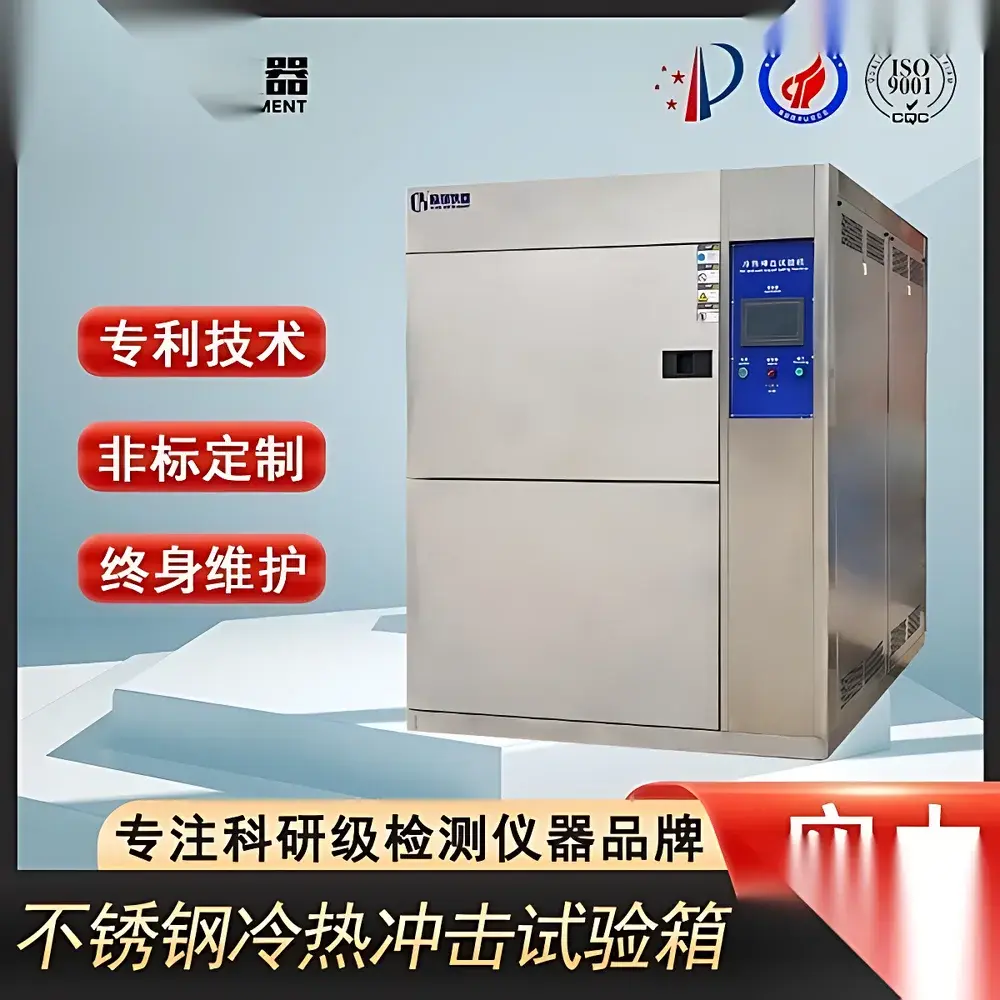
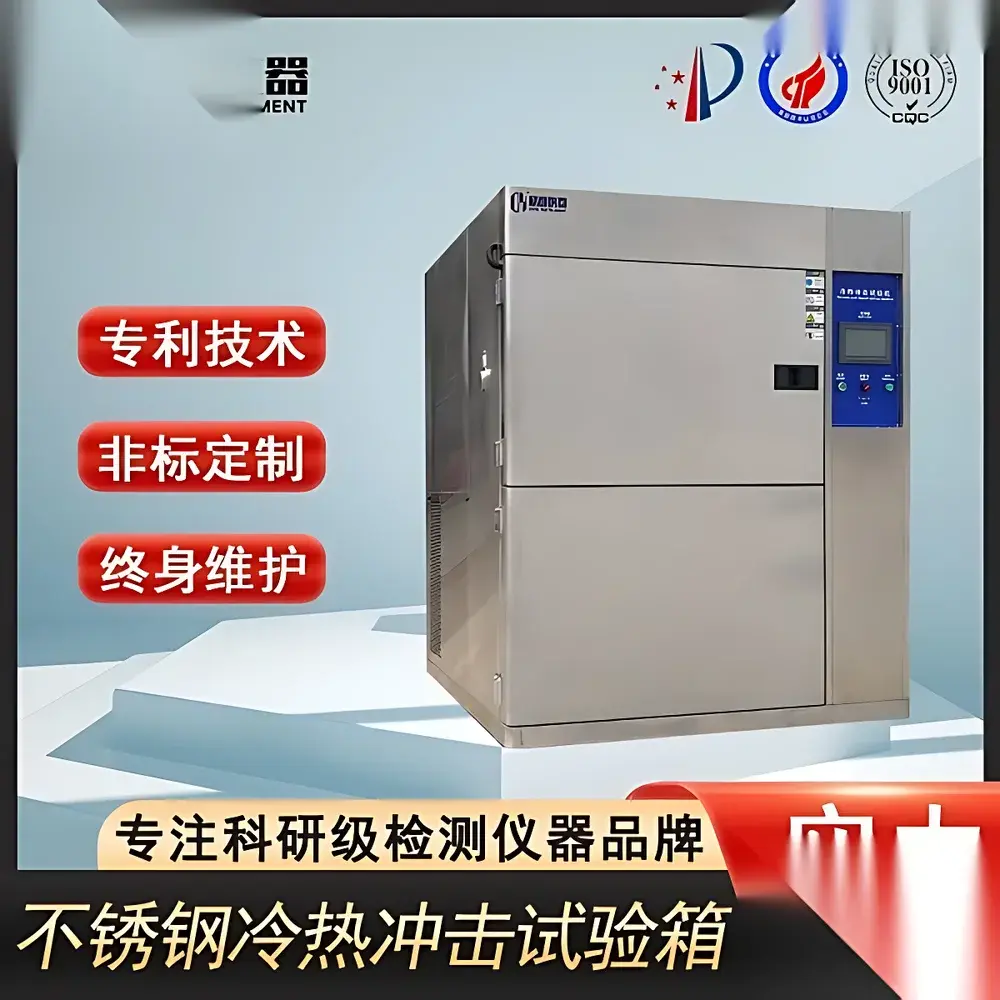
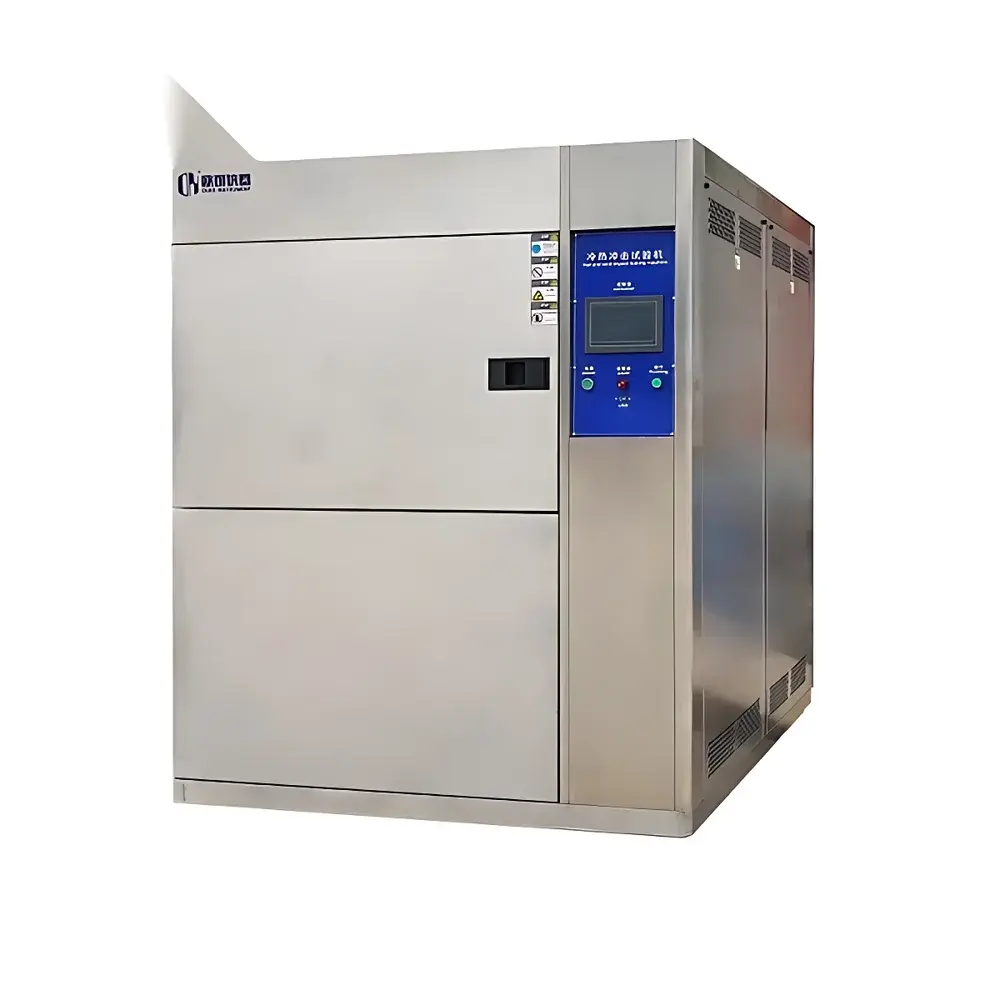
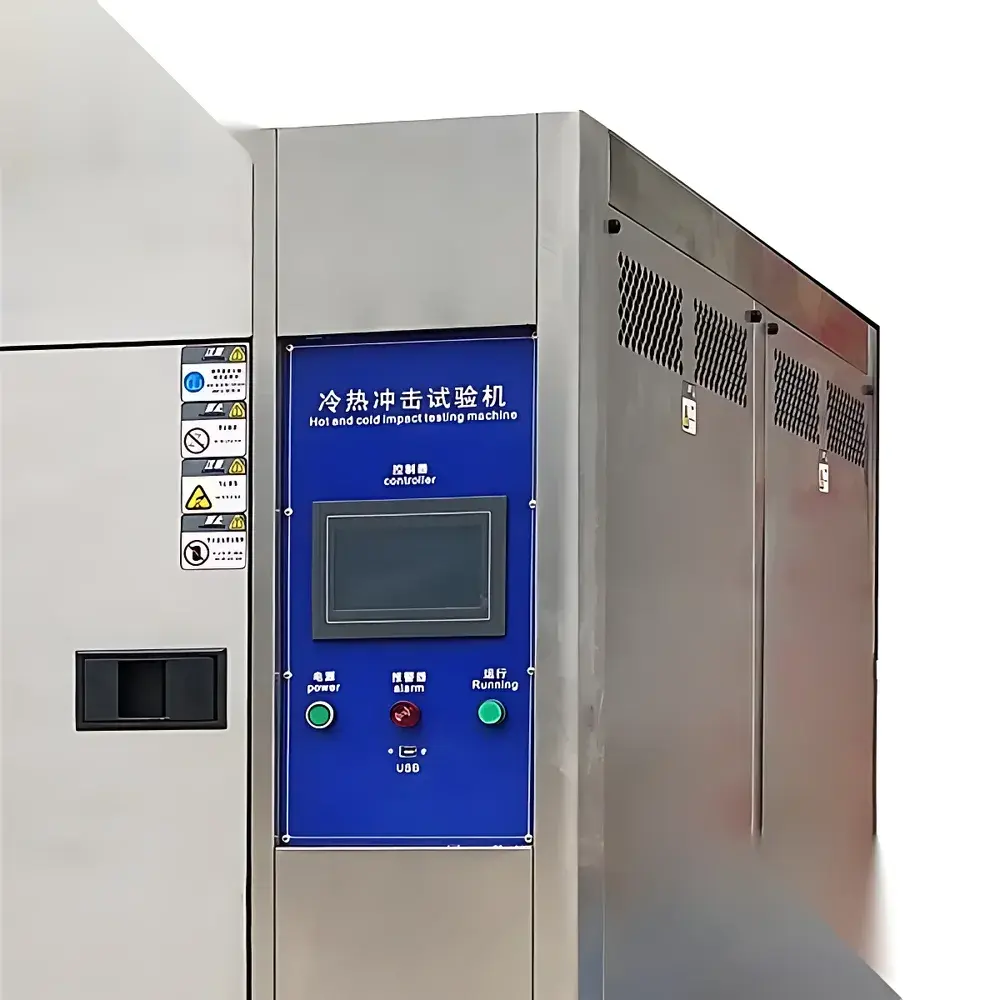
OK-TS Series Semiconductor Thermal Shock Test Chamber
| Brand | OK |
|---|---|
| Model | OK-TS-80 to OK-TS-1000 |
| Type | Dual-Zone Mechanical Thermal Shock Test Chamber (Gas-Actuated, Forced-Air Circulation) |
| Temperature Range | High Zone: +60 °C to +150 °C |
| Low Zone | −10 °C to −65 °C |
| Test Zone | −45 °C to +150 °C (Configurable: A/−45 °C, B/−55 °C, C/−65 °C) |
| Transition Time | ≤10 s |
| Temperature Recovery Time | ≤5 min |
| Temperature Uniformity | ±2.0 °C |
| Control Accuracy | ±0.5 °C |
| Heating System | Ni-Cr Alloy Wire Heaters |
| Cooling System | Twin-Zone Cascade Refrigeration with Hermetic “Tecumseh” Compressors (Imported French “Tecumseh” Units Standard) |
| Humidity Control | Surface-Evaporation Type (Optional) |
| Airflow | Wide-Band Forced Convection (Top-Exit / Bottom-Intake, Multi-Wing Centrifugal Blower) |
| Insulation | Rigid Polyurethane Foam + Ultra-Fine Glass Fiber |
| Interior Material | SUS304 Stainless Steel |
| Exterior Material | Cold-Rolled Steel with Electrostatic Epoxy Coating or Optional SUS304 Brushed Finish |
| Viewing Window | Double-Layer Tempered Hollow Glass |
| Test Port | Ø50 mm (Left Side) |
| Lighting | Fluorescent Lamp |
| Casters | Four Lockable Swivel Casters |
| Compliance | Designed per IEC 60068-2-14, MIL-STD-810H Method 503.7, JESD22-A104, and JEDEC J-STD-020 for semiconductor reliability qualification |
Overview
The OK-TS Series Semiconductor Thermal Shock Test Chamber is a dual-zone, mechanically actuated thermal shock system engineered for accelerated reliability evaluation of semiconductor devices, IC packages, PCB assemblies, and microelectromechanical systems (MEMS). It operates on the principle of rapid, controlled transitions between independently regulated high-temperature and low-temperature reservoirs—enabling precise simulation of extreme thermal cycling stress encountered during solder reflow, field operation, and storage. Unlike single-chamber ramp-based systems, the OK-TS architecture employs separate hot and cold zones with independent refrigeration and heating circuits, allowing sub-10-second transfer times via pneumatic or servo-driven specimen carriers. This design ensures minimal thermal inertia, high reproducibility across repeated cycles, and strict adherence to industry-standard thermal shock profiles defined in JEDEC J-STD-020 (Moisture Sensitivity Level testing), JESD22-A104 (Temperature Cycling), and MIL-STD-810H Method 503.7 (Thermal Shock).
Key Features
- Dual-zone cascade refrigeration system with imported hermetic compressors (Tecumseh brand standard), eliminating reliance on liquid nitrogen or cryogenic media and reducing long-term operational cost and maintenance frequency.
- P.I.D. + S.S.R. + microcomputer-balanced temperature control (BTSC) architecture with real-time adaptive compensation for load variation, ensuring ±0.5 °C setpoint accuracy and ±2.0 °C uniformity across the test chamber volume.
- Forced-air circulation using multi-wing centrifugal blowers and optimized top-exit/bottom-intake airflow path—validated to eliminate thermal stratification and achieve uniform exposure across all sample positions, including corners and stacked fixtures.
- Robust mechanical construction: interior chamber fabricated from seamless SUS304 stainless steel; exterior available in electrostatically coated cold-rolled steel or optional brushed SUS304 finish; double-layer tempered hollow glass viewing window with anti-fog coating.
- Integrated safety architecture: compressor overheat/overcurrent/overpressure protection; dry-run prevention for heaters and humidifiers; low-water cutoff; real-time internal temperature monitoring; silicone rubber door gaskets rated for −70 °C to +150 °C continuous operation.
- Standard interface suite: RS-485/RS-232 communication port, Ethernet option available; full PC-based control and logging software compliant with FDA 21 CFR Part 11 audit trail requirements (user authentication, electronic signatures, immutable event logs).
Sample Compatibility & Compliance
The OK-TS series accommodates standard JEDEC trays (TR-88, TR-176), wafer carriers (FOUPs/FOSBs), bare die packages (QFN, BGA, CSP, WLP), and assembled PCBs up to 1000 mm × 1000 mm × 1000 mm (OK-TS-1000 model). Adjustable stainless-steel sample racks support height customization without tools. All models comply with ISO/IEC 17025 calibration traceability frameworks when paired with NIST-traceable reference sensors. The system meets electromagnetic compatibility (EMC) requirements per EN 61326-1 and safety standards per IEC 61010-1. Optional IQ/OQ documentation packages are available to support GLP and GMP validation protocols required by semiconductor foundries and OSAT providers.
Software & Data Management
The bundled OK-Control Suite provides intuitive Windows-based operation with multilingual UI (English, Chinese, Japanese, Korean). It supports programmable multi-step profiles—including dwell time, ramp rate, cycle count, and conditional branching based on real-time sensor feedback. All test data—including chamber zone temperatures, specimen thermocouple readings (via optional input module), power consumption, and alarm events—are timestamped and stored in CSV and SQL-compatible formats. Built-in report generation includes statistical summaries (min/max/mean/stdev per cycle), deviation heatmaps, and failure trend analysis aligned with IPC-A-610 or AEC-Q200 pass/fail thresholds. Audit trails meet FDA 21 CFR Part 11 requirements, with role-based access control, digital signature enforcement, and automatic backup to network drives or cloud repositories.
Applications
- Qualification testing of flip-chip, wire-bonded, and fan-out wafer-level packages under JEDEC J-STD-020D and JESD22-A104D specifications.
- Failure mechanism analysis (FMA) of intermetallic growth, solder joint fatigue, delamination, and coefficient-of-thermal-expansion (CTE) mismatch-induced cracking.
- Process validation for reflow soldering profiles, conformal coating adhesion, and underfill cure stability.
- Reliability screening of automotive-grade semiconductors (AEC-Q100 Grade 0–3) and aerospace electronics subjected to extreme environmental duty cycles.
- Material compatibility assessment of encapsulants, substrates, and leadframe alloys under repeated thermal excursions.
FAQ
What is the difference between thermal shock and temperature cycling?
Thermal shock involves rapid transfer (<10 s) between extreme temperature extremes (e.g., −65 °C ↔ +150 °C), inducing high transient stress gradients. Temperature cycling uses slower ramp rates (typically 1–10 °C/min) and longer dwells, emphasizing cumulative fatigue rather than instantaneous fracture.
Can this chamber perform humidity-controlled thermal shock?
Yes—optional surface-evaporation humidification enables combined thermal-hygrothermal shock testing per JESD22-A110 (Highly Accelerated Temperature and Humidity Stress Test, HAST) with dew point control down to −40 °C.
Is calibration certificate included with shipment?
A factory calibration report (traceable to NIST standards) is provided. Full ISO/IEC 17025-accredited calibration services are available as an add-on option.
What maintenance intervals are recommended for the refrigeration system?
Compressor oil and filter replacement every 24 months; refrigerant leak inspection annually; blower motor bearing lubrication every 18 months—detailed in the OEM maintenance manual supplied with each unit.
Does the system support remote monitoring and alarm notification?
Yes—via optional Ethernet/WiFi module with SMTP email/SMS alerting, SNMP trap integration, and Modbus TCP server functionality for SCADA system interoperability.
Related Products



