
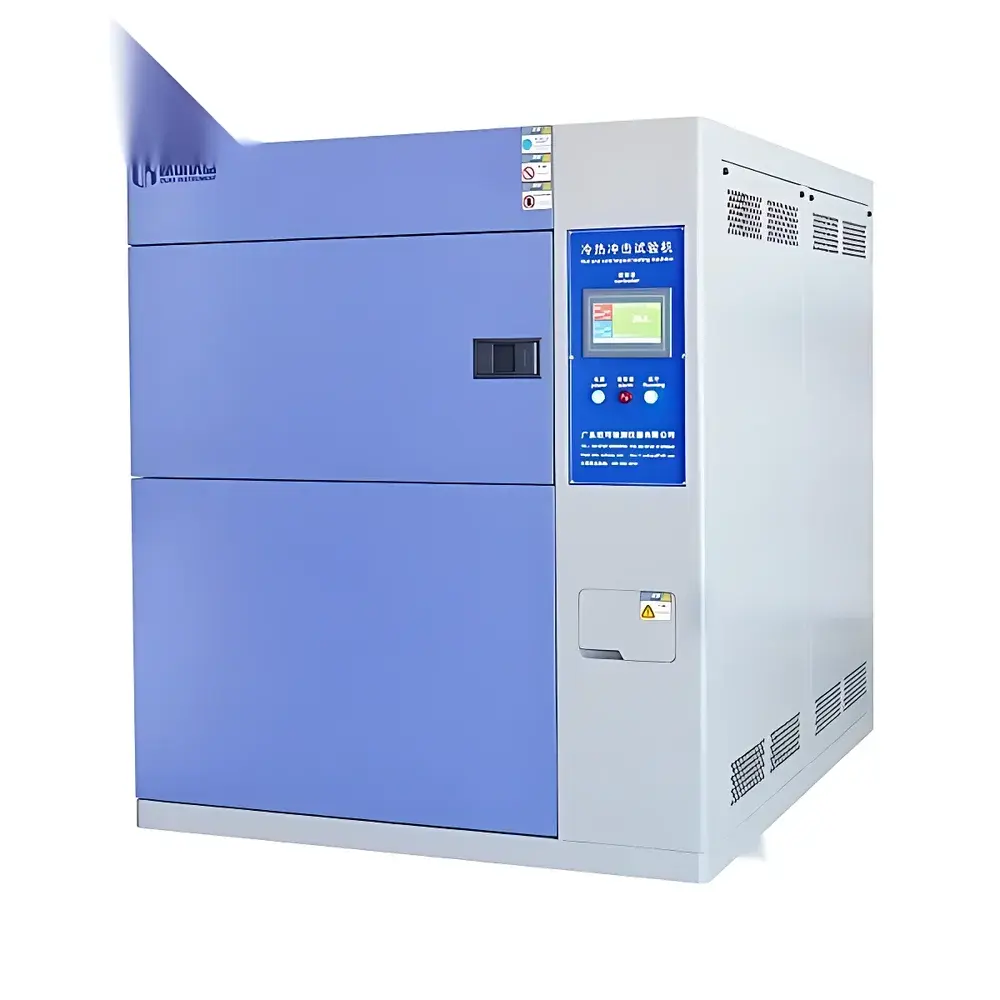
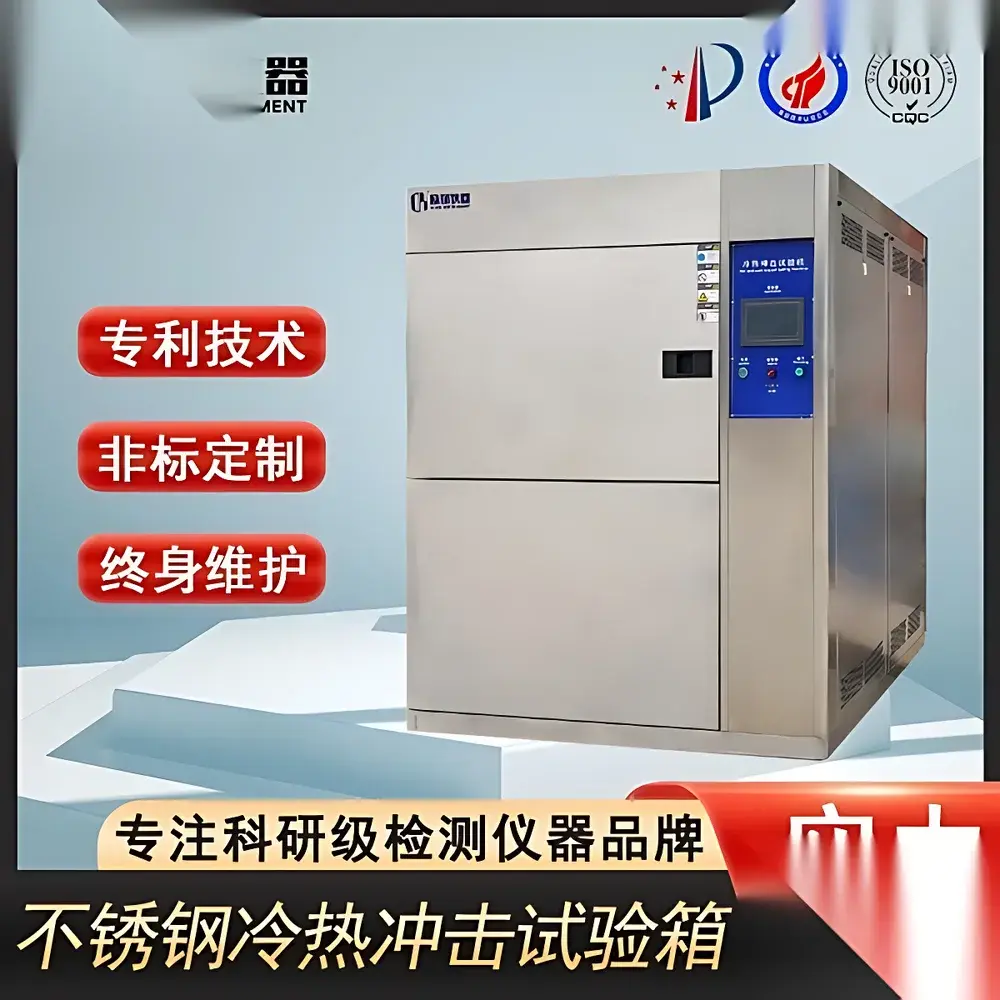
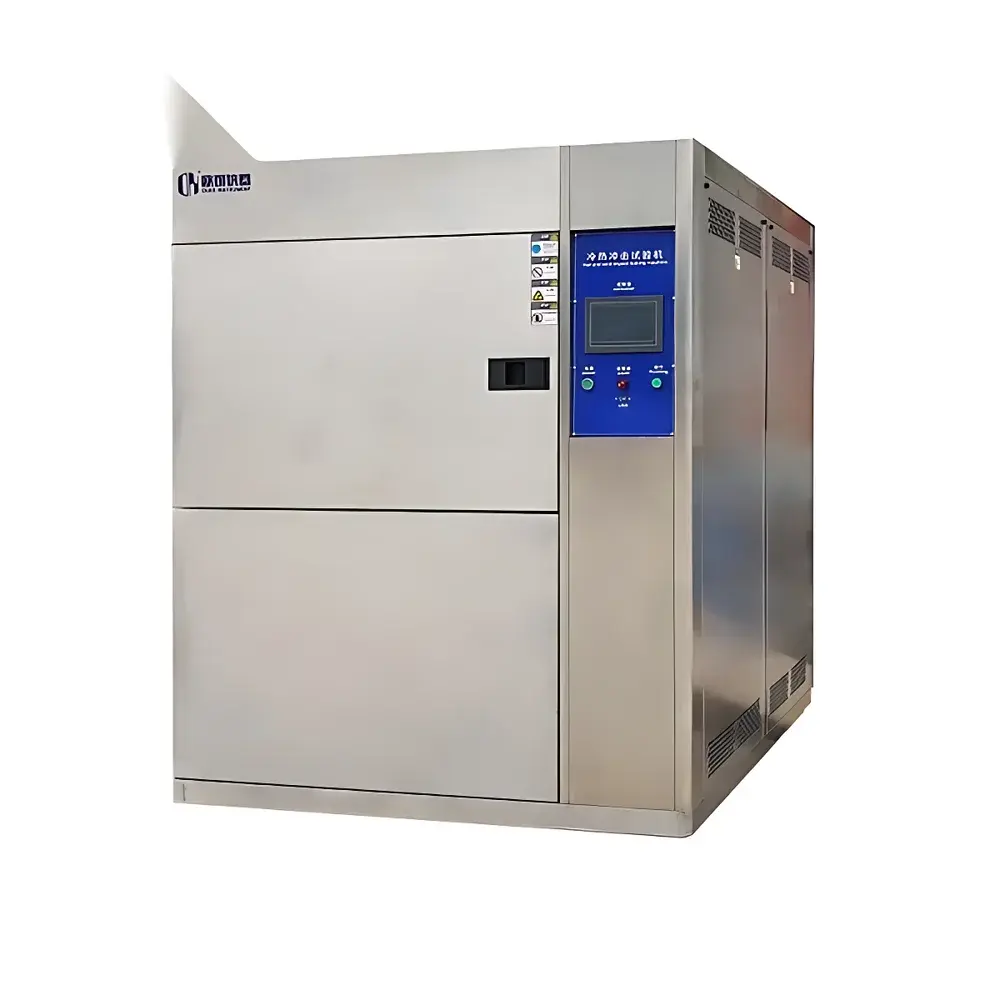
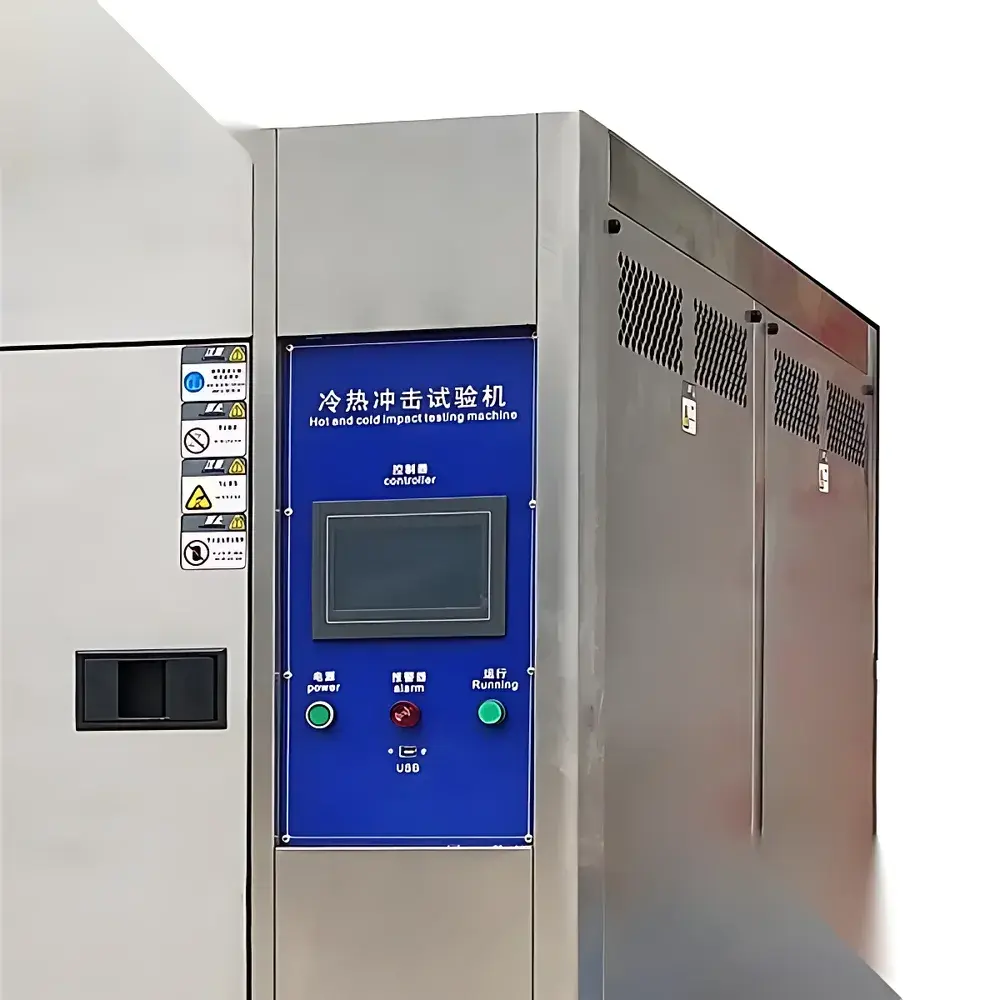
OK-TS Series Thermal Shock Test Chamber
| Key | Temperature Range (Hot Zone): RT to 150 °C (unloaded) |
|---|---|
| Temperature Range (Cold Zone) | RT to –20 °C (unloaded) |
| Low-Temperature Limit | ≤ –25 °C |
| Thermal Shock Transition | 150 °C ↔ –20 °C |
| Temperature Fluctuation | ±1 °C |
| Temperature Uniformity | ±3 °C |
| Temperature Recovery Time | ≤5 min |
| Sample Transfer Time | ≤15 s |
| Load Capacity | ≤30 kg |
| Ramp Rates | ≤25 min (RT→150 °C, avg.), ≤15 min (RT→–20 °C, avg.) |
| Controller | TEMI880 LCD touch interface, 0.1 °C resolution, PT100 sensors |
| Programmability | 100 programs × 100 segments × 999 cycles, max segment duration 99 h 59 min |
| Communication | RS-232 / RS-485 |
| Power Rating | 13–20 kW (model-dependent) |
Overview
The OK-TS Series Thermal Shock Test Chamber is a dual-zone, mechanical refrigeration-based thermal cycling system engineered for accelerated reliability assessment of electronic components, aerospace assemblies, automotive modules, and polymer-based packaging under rapid, repetitive temperature transitions. Unlike single-chamber thermal cycling systems, the OK-TS architecture employs physically isolated hot and cold chambers with a high-speed horizontal sample transfer mechanism—enabling true thermal shock conditions defined by abrupt exposure to extreme temperature differentials (up to 170 °C delta). This design conforms to the fundamental operational principle of ISO 16750-4, JEDEC JESD22-A106B, MIL-STD-810H Method 503.5, and IEC 60068-2-14, where test specimens undergo discrete dwell periods at stabilized high and low temperatures followed by near-instantaneous transfer between zones. The chamber’s performance envelope—spanning –25 °C to +150 °C, with ≤15 s transfer and ≤5 min temperature recovery—supports qualification testing for solder joint integrity, adhesive bond durability, CTE mismatch evaluation, and hermetic seal validation in mission-critical applications.
Key Features
- Dual independent chamber design with forced-air circulation and PID-controlled heating/cooling loops for precise thermal stabilization in both hot and cold zones
- High-speed horizontal shuttle mechanism with pneumatic actuation and position feedback, achieving ≤15 s sample transfer between chambers with repeatability < ±0.3 s
- TEMI880 programmable controller featuring 7-inch TFT-LCD touchscreen, multilingual UI (English/Chinese), real-time trend graphing, and password-protected operation modes
- PT100 Class A platinum resistance thermometers (PRTs) mounted at multiple spatial locations per chamber for uniformity mapping and closed-loop correction
- Automatic screen lock and configurable auto-sleep mode to prevent accidental interruption and extend display service life during extended unattended runs
- Integrated data logging with timestamped temperature profiles stored internally (≥10,000 records); export via USB or remote serial interface
- Comprehensive safety architecture including overtemperature cut-off, refrigerant pressure monitoring, door interlock, and phase-failure protection
Sample Compatibility & Compliance
The OK-TS Series accommodates standard industrial test loads up to 30 kg distributed across a stainless-steel sample basket compatible with DIN 50017, ASTM D4332, and IPC-TM-650 2.6.7.2 mounting configurations. Chamber internal dimensions range from 450×450×500 mm (OK-TS-100A) to 1000×1000×1000 mm (OK-TS-1000A), allowing flexibility for PCB subassemblies, molded connectors, battery modules, and encapsulated optoelectronic devices. All models are designed and verified to meet electromagnetic compatibility (EMC) requirements per EN 61326-1 and safety standards per IEC 61010-1. While not certified to UL or CSA out-of-the-box, the system supports third-party certification readiness through documented traceability of critical components, calibration records, and full electrical schematics provided upon request.
Software & Data Management
The TEMI880 controller supports bidirectional communication via RS-232 or RS-485 interfaces, enabling integration into centralized lab management platforms using Modbus RTU protocol. Users may develop, upload, and archive test programs remotely using PC-based configuration software (Windows-compatible, included). All executed test sequences generate time-stamped CSV-formatted log files containing chamber setpoints, actual temperatures (hot/cold zones), transfer timestamps, and alarm events—facilitating audit-ready documentation for GLP/GMP environments. Optional firmware upgrade paths support future compliance with FDA 21 CFR Part 11 requirements, including electronic signature capability, audit trail generation, and user role-based access control (RBAC).
Applications
- Qualification of printed circuit board assemblies (PCBAs) for automotive ECUs under ISO 16750-4 thermal shock stress
- Evaluation of die-attach and wire-bond reliability in semiconductor packages subjected to JEDEC JESD22-A106B cycles
- Validation of thermal interface material (TIM) adhesion and gap-fill stability across repeated expansion/contraction cycles
- Accelerated aging of lithium-ion battery modules to assess cell-to-cell thermal propagation behavior
- Testing of optical sensor housings and lens mounts for dimensional stability and seal integrity under extreme ambient transitions
- Material screening of conformal coatings, potting compounds, and encapsulants for microcrack initiation thresholds
FAQ
What is the minimum dwell time required per zone to ensure thermal equilibrium before transfer?
The controller enforces a minimum dwell time of 10 minutes per zone by default, though this is fully programmable down to 1 minute. Recommended dwell durations follow JEDEC and MIL-STD guidelines: ≥15 min for components >50 g mass or with thermal mass exceeding 200 J/K.
Can the system operate with nitrogen purge for moisture-sensitive samples?
Yes—optional inert gas purge ports (N₂ inlet/outlet with flow meter and pressure regulator) are available as a factory-installed accessory; purge functionality integrates seamlessly with the TEMI880 program logic.
Is calibration certificate included with shipment?
A factory calibration report (traceable to NIST or equivalent national metrology institute) is provided with each unit. Full ISO/IEC 17025-accredited calibration services are available separately upon request.
What maintenance intervals are recommended for long-term reliability?
Refrigeration oil and filter dryer replacement every 24 months; condenser coil cleaning quarterly; PT100 sensor verification annually; full system performance verification every 12 months per ASTM E2202.



