
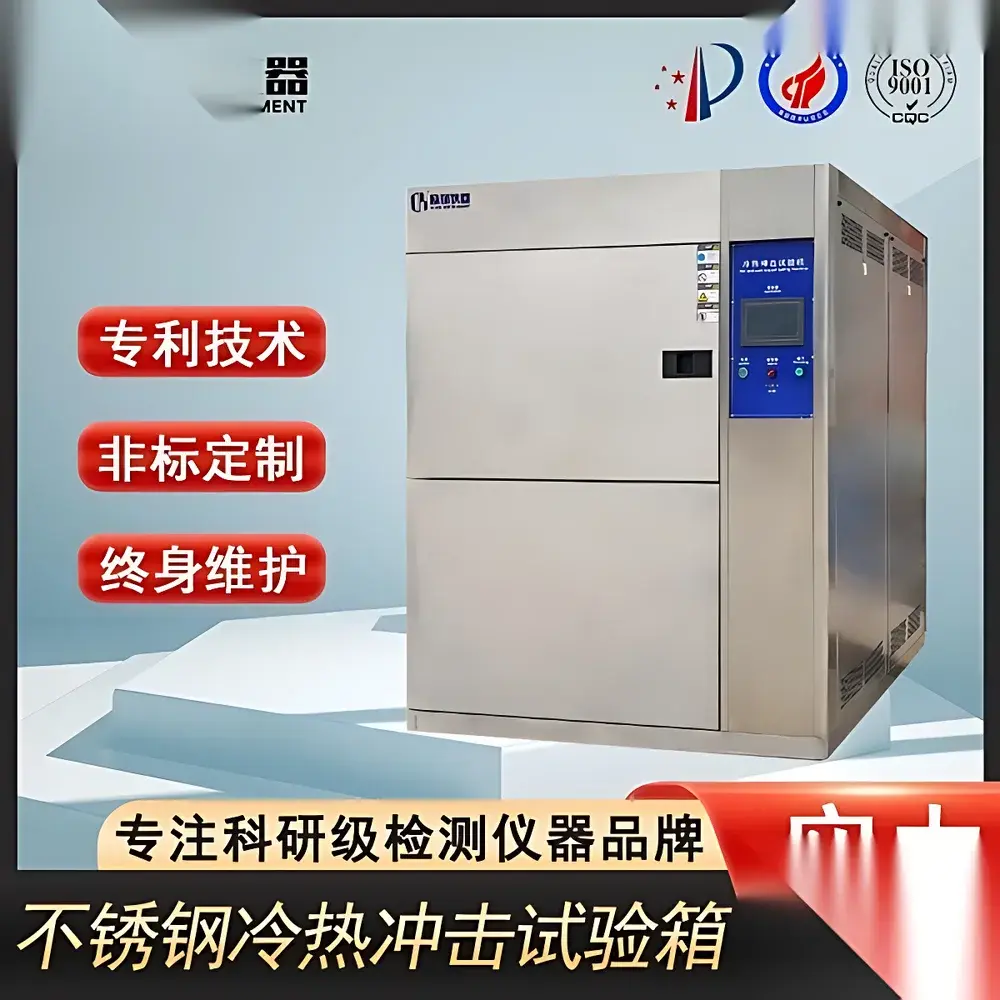
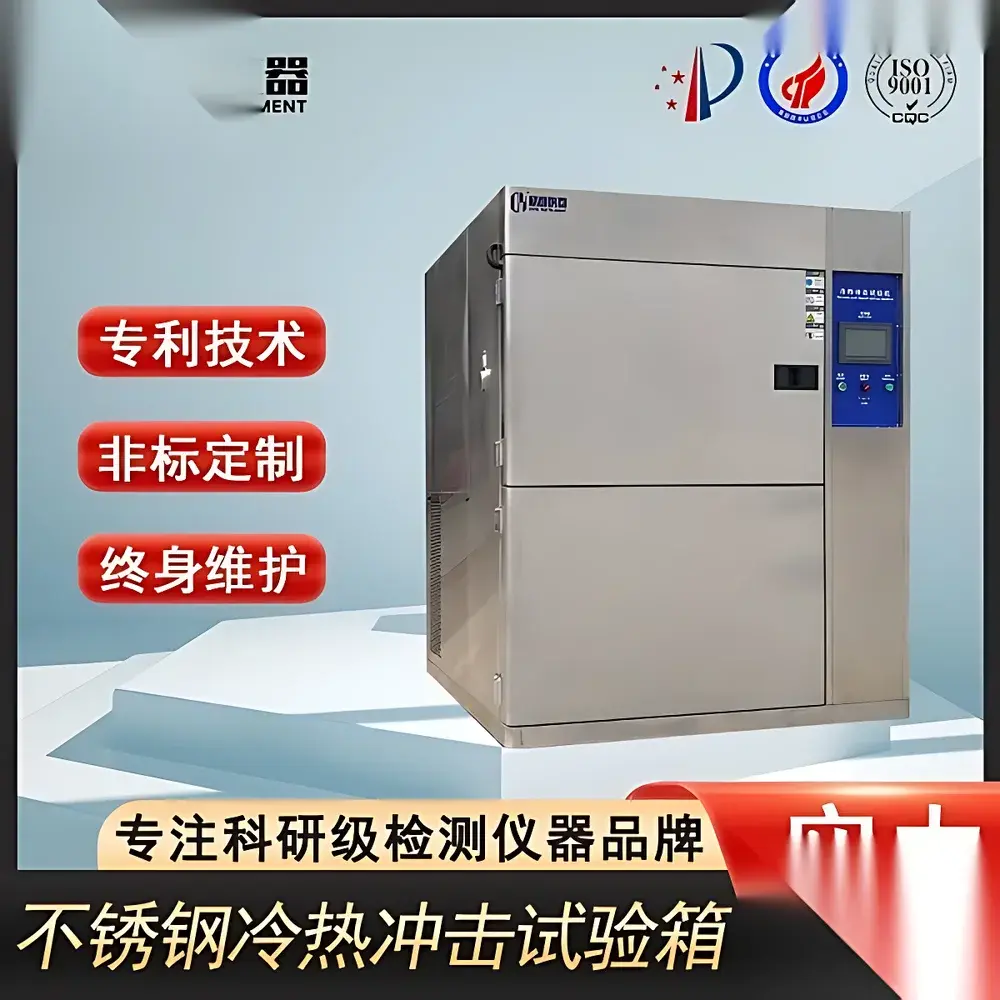
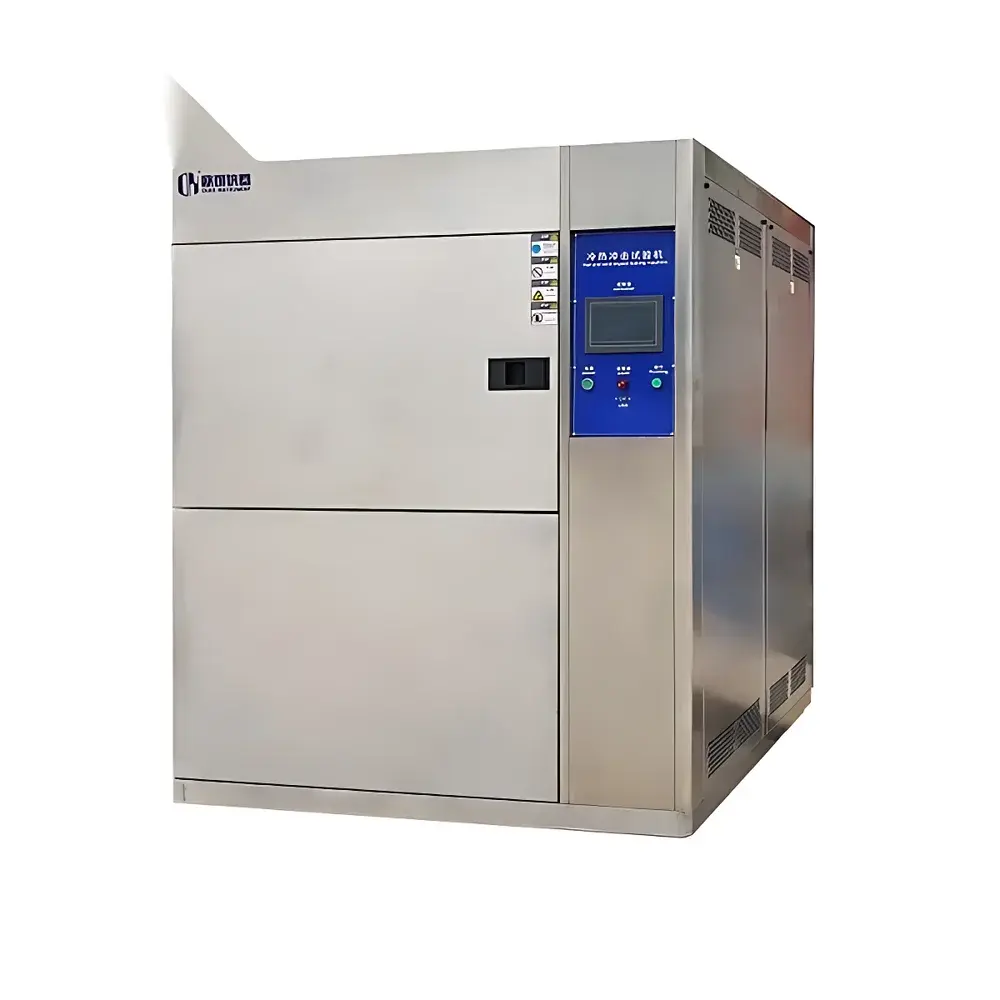
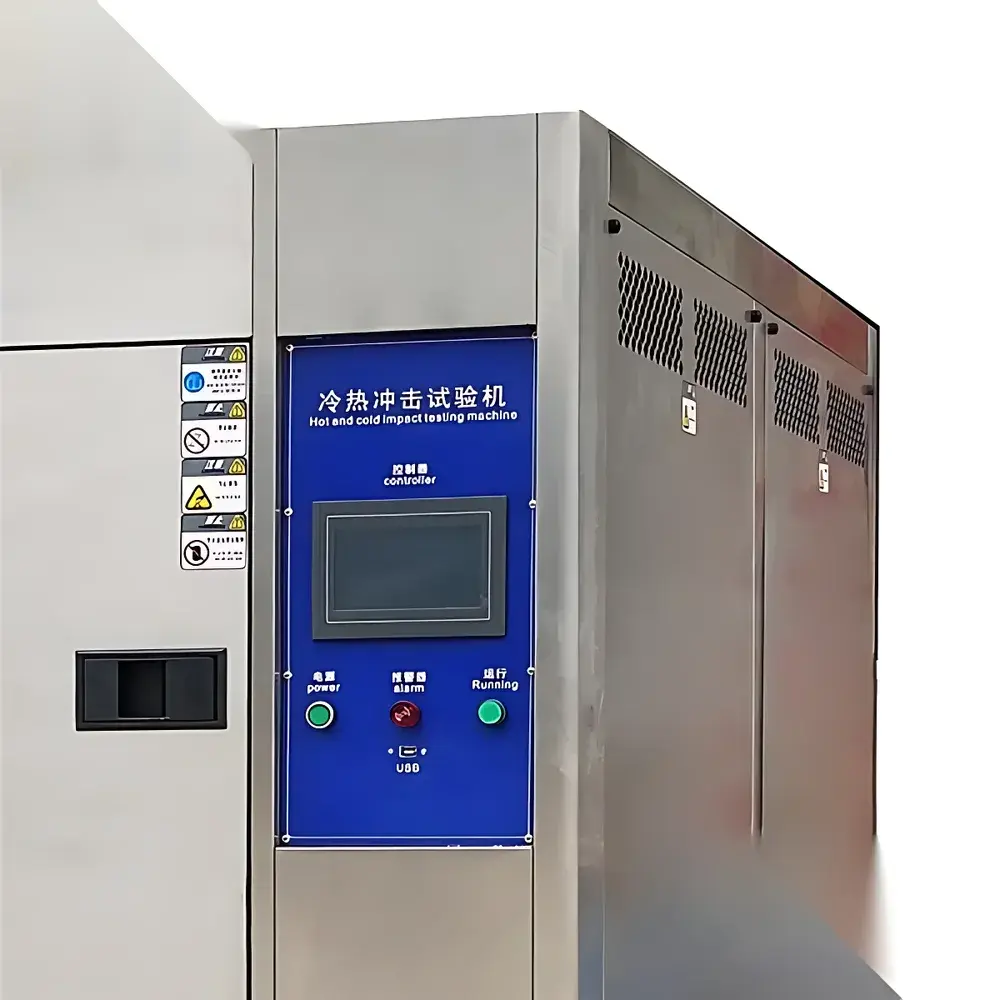
OK-TS Series Thermal Shock Test Chamber
| Key | Brand: Other brands |
|---|---|
| Origin | Imported |
| Manufacturer Type | General distributor |
| Price | USD 14,000 (approx.) |
| Temperature Range (A/B/C) | −20/−40/−60 °C to 100 °C |
| Temperature Uniformity | ≤ ±2.0 °C |
| Temperature Stability | ≤ ±0.5 °C |
| Temp. Deviation | ≤ 2.0 °C |
| Heating Rate | 3 °C/min |
| Cooling Rate | 0.7–1 °C/min |
| Refrigeration | Air-cooled single-stage mechanical compression system |
| Compressor | Imported hermetic industrial compressor |
| Controller | Imported intelligent temperature controller |
| Inner Chamber Material | SUS304 stainless steel |
| Internal Dimensions (W×D×H, mm) | 350×320×450 / 450×450×500 / 500×600×830 / 700×800×900 / 1000×1000×1000 |
| Power Supply | AC 380 V ±10%, 50 Hz |
| Ambient Operating Temp. | +5 to +35 °C |
| Compliance | GB 10589, GB 11158, GB 10586, IEC 60068-3-5, GB/T 2423-1/2/3/4 |
Overview
The OK-TS Series Thermal Shock Test Chamber is an engineered environmental test system designed for rapid, repeatable thermal cycling between extreme low and high temperature zones. It operates on the principle of air-based thermal shock—utilizing dual-zone or single-chamber forced-air circulation with independent heating and refrigeration circuits—to subject test specimens to abrupt temperature transitions. This methodology enables precise simulation of real-world thermal stress conditions encountered during product transport, storage, and operational life cycles. The chamber is widely deployed in reliability validation labs across aerospace, automotive electronics, semiconductor packaging, and medical device manufacturing sectors where compliance with accelerated life testing protocols is mandatory.
Key Features
- Optimized airflow duct design ensures uniform temperature distribution throughout the working chamber, achieving ≤ ±2.0 °C uniformity and ≤ ±0.5 °C stability under steady-state conditions.
- Imported hermetically sealed industrial-grade compressors deliver consistent cooling performance with low acoustic emission (<65 dB(A)), supporting uninterrupted operation over extended test durations.
- High-precision imported intelligent temperature controller provides fast response (<1 s), minimal hysteresis, and programmable ramp/soak profiles with ±0.1 °C setpoint resolution.
- Interior constructed entirely from electropolished SUS304 stainless steel—non-porous, corrosion-resistant, and compliant with ISO 14644-1 Class 8 cleanroom maintenance requirements.
- Dual-layer safety architecture includes independent over-temperature cut-off, compressor thermal overload protection, fan motor overheat detection, refrigerant low-pressure alarm, and water-level monitoring (where applicable).
Sample Compatibility & Compliance
The OK-TS series accommodates a broad range of sample geometries—from PCB assemblies and molded connectors to battery modules and optical sensors—via five standard internal volume configurations (50 L to 1000 L). Each unit is certified to meet national and international environmental testing standards including GB 10589 (Low-Temperature Test Chambers), GB 11158 (High-Temperature Test Chambers), GB 10586 (Damp Heat Test Chambers), and IEC 60068-3-5 (Environmental Testing—Part 3-5: Supporting Documentation and Guidance—Thermal Shock Tests). It fully supports test execution per GB/T 2423.1 (cold), 2423.2 (dry heat), 2423.22 (thermal shock), and 2423.34 (combined temperature/humidity shock) procedures. All models are designed for integration into GLP- and GMP-aligned quality systems, with optional audit-ready data logging and 21 CFR Part 11-compliant electronic signature support available upon configuration.
Software & Data Management
Equipped with a Windows-compatible control interface, the OK-TS chamber supports real-time monitoring of chamber temperature, ramp rates, dwell times, and alarm status via USB or RS-485 communication. Optional software packages provide automated test sequencing, multi-channel data acquisition (up to 8 external thermocouple inputs), CSV export, trend charting, and PDF report generation with embedded timestamps and operator ID. Data integrity safeguards include cyclic redundancy check (CRC) validation, write-protected archival storage, and configurable retention policies aligned with ISO/IEC 17025 documentation requirements.
Applications
- Qualification testing of solder joint integrity in surface-mount electronics under repeated thermal expansion/contraction cycles.
- Validation of encapsulant adhesion and delamination resistance in MEMS and optoelectronic packages.
- Accelerated aging assessment of polymer-based gaskets, seals, and insulating materials.
- Reliability screening of lithium-ion battery cells prior to automotive OEM acceptance.
- Verification of thermal management system performance in avionics enclosures operating across −55 °C to +125 °C mission envelopes.
FAQ
What temperature transition rates can the OK-TS chamber achieve?
Standard models deliver controlled heating at up to 3 °C/min and cooling at 0.7–1 °C/min within the specified operating range. Customized high-speed variants with enhanced refrigeration capacity are available upon request.
Is humidity control integrated into this thermal shock system?
The base OK-TS configuration is a dry thermal shock chamber. Humidity capability (up to 98% RH) is available as an optional upgrade compliant with GB 10586 and IEC 60068-2-30 standards.
Can the chamber be validated for IQ/OQ/PQ protocols?
Yes—each unit ships with a factory calibration certificate traceable to NIST standards. Full qualification documentation packages—including sensor mapping reports, alarm verification logs, and temperature uniformity test records—are provided upon order.
What power infrastructure is required for installation?
All models operate on three-phase AC 380 V ±10%, 50 Hz supply. A dedicated circuit with appropriate overcurrent protection and grounding per IEC 60364-5-54 is mandatory. Minimum ambient ventilation clearance of 800 mm on all sides is recommended.
How is long-term calibration stability maintained?
The controller features automatic drift compensation algorithms and supports periodic recalibration using external reference probes. Annual metrological verification against accredited standards is advised to maintain compliance with ISO/IEC 17025 and internal quality system requirements.



