
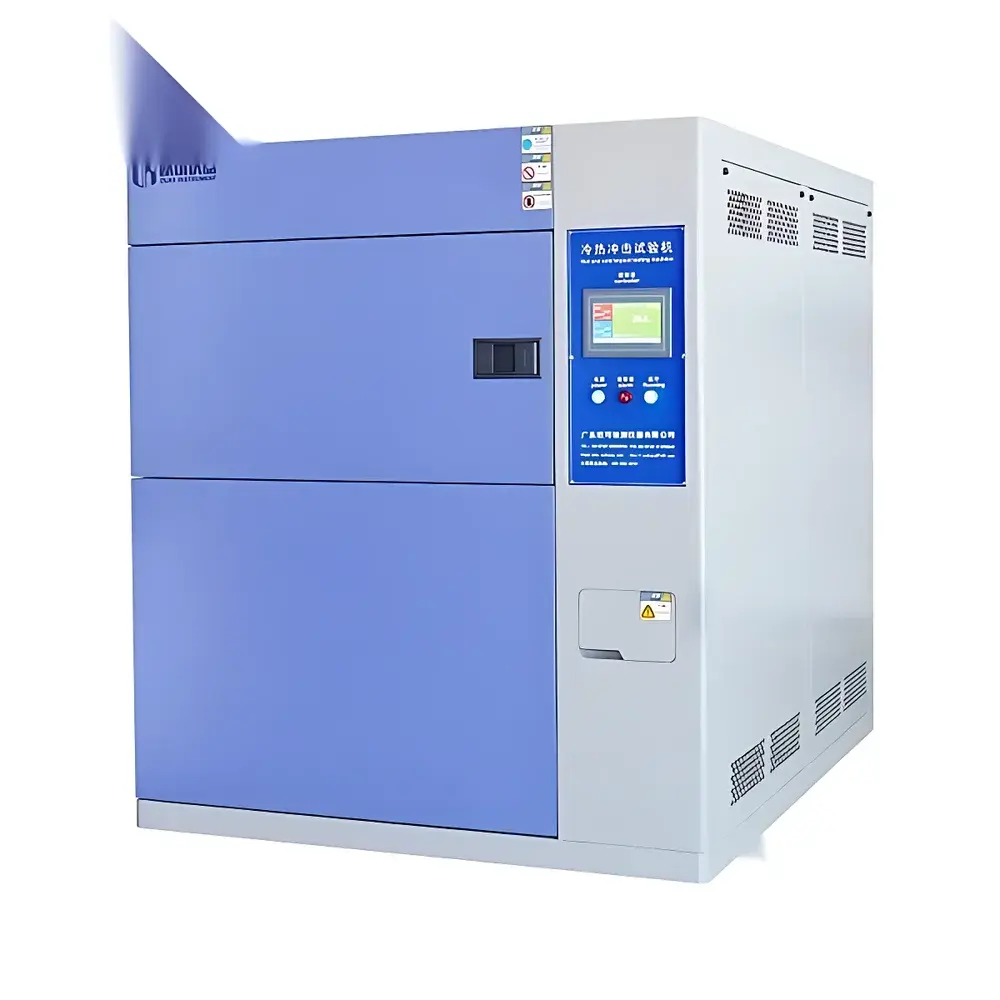
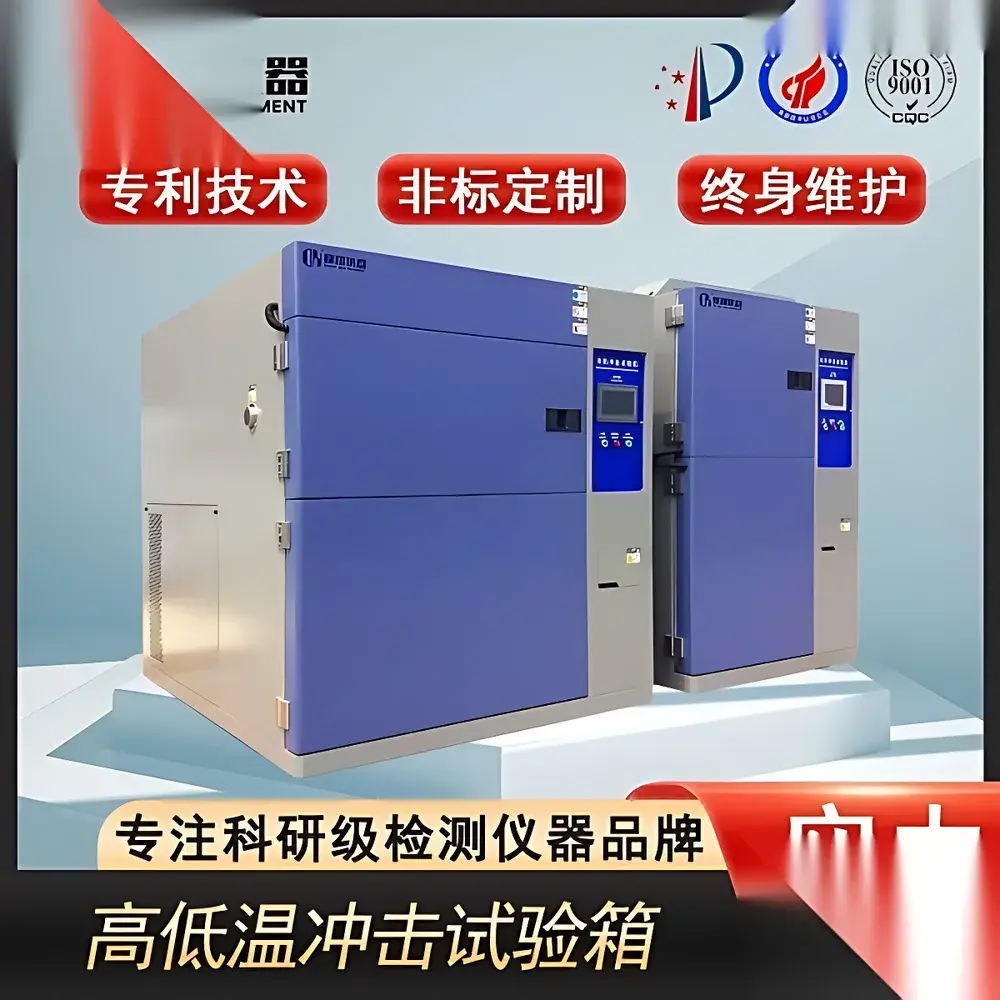
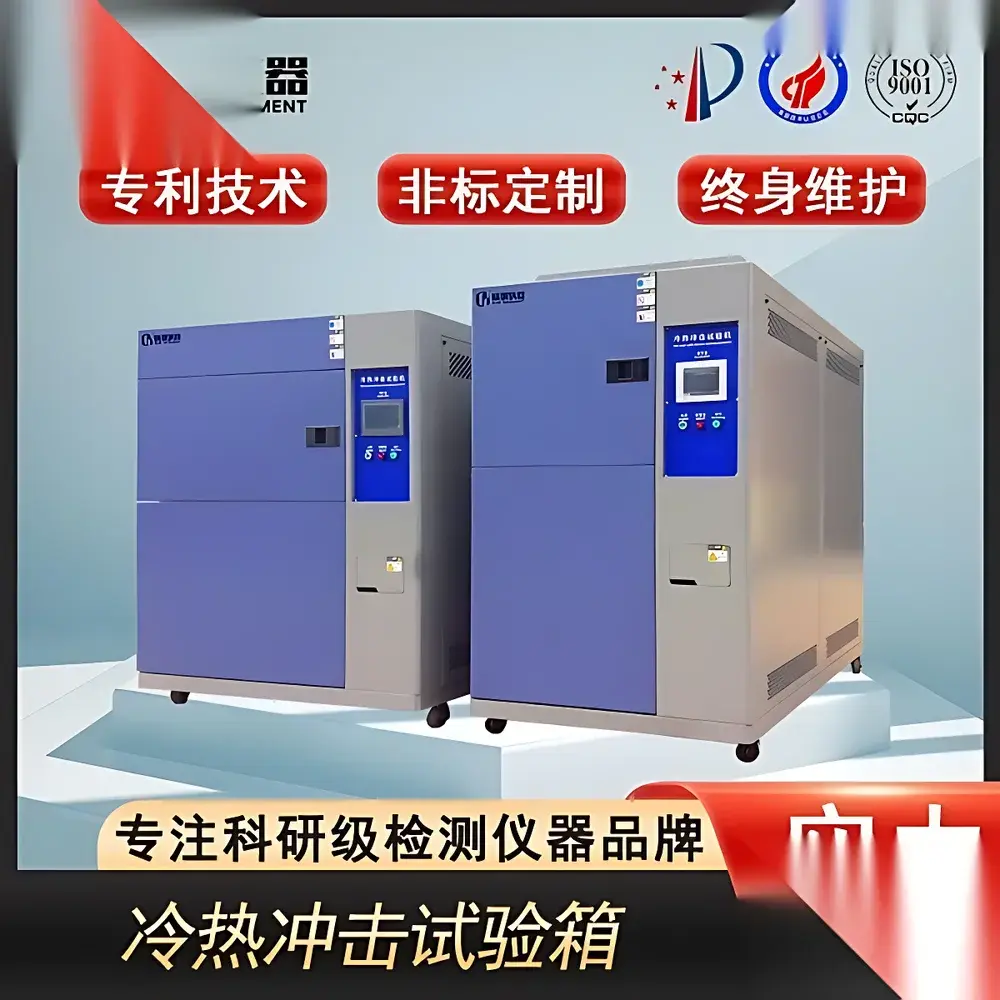
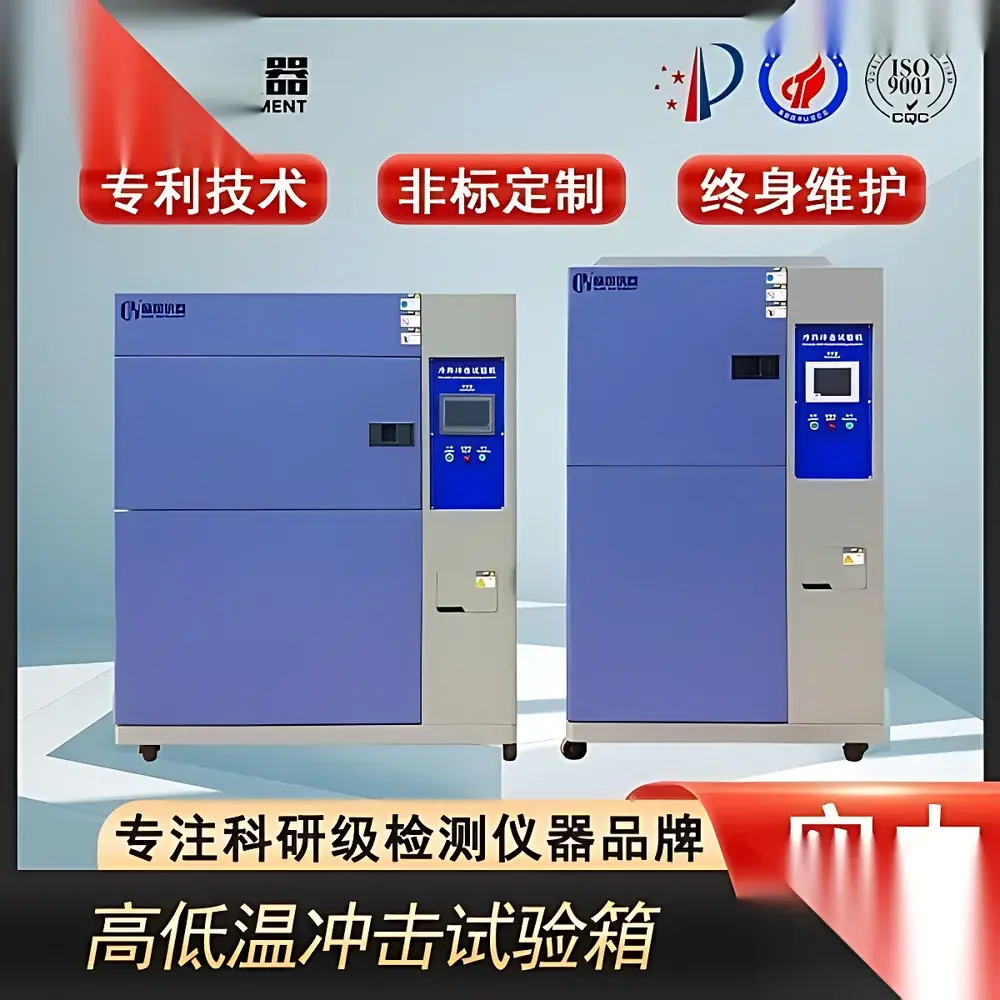
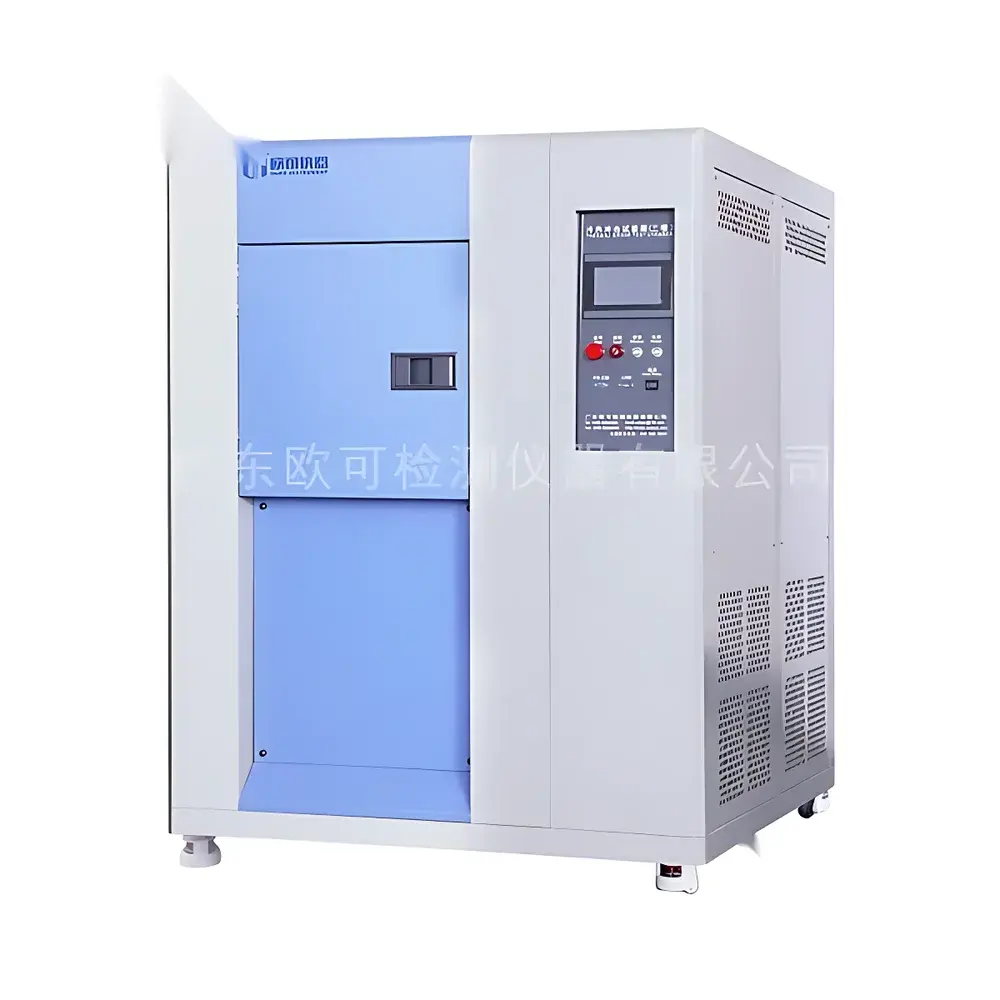
OK-TS Series Thermal Shock Test Chamber
| Temperature Range | -65 °C to 200 °C |
|---|---|
| Test Volume | 30 L (OK-TS-50 model) |
| Internal Dimensions (W×H×D) | 400 mm × 350 mm × 350 mm |
| External Dimensions (W×H×D) | 1250 mm × 1570 mm × 1320 mm |
| High-Temperature Zone | 60–200 °C |
| Low-Temperature Zone | -65–-10 °C |
| Thermal Shock Temperature Setpoints | +60–+150 °C / -10–-65 °C |
| Heating Rate | ≤45 min (60→200 °C) |
| Cooling Rate | ≤80 min (20→-65 °C) |
| Recovery Time | ≤5 min |
| Soak Time per Phase | 30 min (at +150 °C or -55 °C) |
| Inner Chamber Material | Mirror-Finished SUS 304 Stainless Steel |
| Insulation | Polyurethane (PU) Foam |
| Structural Frame | Standard GB Angle & Channel Steel |
| Outer Casing | SUS 304 Stainless Steel or Powder-Coated Rust-Resistant Steel |
| Power Consumption | 13.5 kW (OK-TS-50) |
Overview
The OK-TS Series Thermal Shock Test Chamber is a dual-compartment, forced-air thermal cycling system engineered for accelerated reliability assessment of electronic components, aerospace materials, automotive assemblies, and packaging systems under rapid temperature transitions. It operates on the principle of mechanical transfer—physically moving test specimens between independently controlled high-temperature and low-temperature chambers via a pneumatic or servo-driven lift mechanism. This architecture ensures precise, repeatable thermal shock profiles without cross-contamination of chamber environments, enabling compliance with international test standards including MIL-STD-810H Method 503.6, IEC 60068-2-14 (Test Nb), JIS Z 8701-1998, and ASTM D5229/D5229M. The chamber supports both two-zone (high/low) and three-zone (high/ambient/low) configurations depending on model variant, with programmable dwell times, transition rates, and cycle counts to replicate field-relevant stress conditions.
Key Features
- Independent dual-chamber design with separate heating and refrigeration circuits—eliminates thermal lag and ensures stable setpoint maintenance during soak phases.
- Mirror-finished SUS 304 stainless steel interior walls and floor for corrosion resistance, ease of cleaning, and minimal outgassing—critical for cleanroom-compatible qualification testing.
- High-efficiency polyurethane (PU) foam insulation (≥100 mm thickness) minimizing heat transfer between zones and reducing energy consumption during prolonged cycling.
- Robust structural frame fabricated from standardized GB-angle and channel steel, ensuring long-term dimensional stability and vibration resistance during automated basket movement.
- Intelligent safety interlocks including over-temperature cut-off, door position monitoring, refrigerant pressure sensors, and emergency stop circuitry compliant with IEC 61000-6-2/6-4 EMC requirements.
- Modular power architecture supporting scalable configurations: OK-TS-50 (13.5 kW), OK-TS-80 (23.0 kW), OK-TS-150 (28.0 kW), and OK-TS-250 (34.0 kW)—enabling selection based on thermal mass and throughput requirements.
Sample Compatibility & Compliance
The OK-TS series accommodates samples up to 30 kg per cycle with unrestricted geometry—flat PCBs, molded connectors, battery modules, optical housings, and hermetically sealed devices are routinely tested. Fixturing options include stainless steel trays, adjustable racks, and custom mounting plates compatible with DIN 41612 or IPC-7351 footprints. All models meet ISO/IEC 17025 calibration traceability requirements when operated with NIST-traceable reference thermocouples. The system supports validation protocols aligned with GMP Annex 15, FDA 21 CFR Part 11 (when paired with compliant software), and GLP documentation workflows—including IQ/OQ/PQ execution support packages and audit-ready event logs.
Software & Data Management
Equipped with a 10.1″ color touchscreen HMI running embedded Linux OS, the controller provides real-time graphing of chamber temperatures, basket position status, cycle progress, and alarm history. Data export is supported via USB 2.0 and Ethernet (Modbus TCP/IP) for integration into LIMS or MES platforms. Optional PC-based software enables full test sequence programming—including ramp-soak profiles, conditional branching (e.g., “if T₁ > 145 °C, extend soak by 5 min”), and automatic report generation in PDF/CSV formats compliant with ASTM E29 and ISO 5725 repeatability criteria. Audit trails record all parameter changes, user logins, and calibration events with time stamps and operator IDs—fully satisfying FDA 21 CFR Part 11 electronic record requirements.
Applications
- Failure mode analysis of solder joint integrity in lead-free PCB assemblies subjected to JEDEC J-STD-020 moisture sensitivity level (MSL) preconditioning.
- Qualification of adhesive bond strength in multi-material EV battery enclosures exposed to -40 °C ↔ +85 °C cycling per UN ECE R100 Annex 8A.
- Validation of optical window delamination resistance in satellite-grade housings per ECSS-Q-ST-70-08C.
- Accelerated aging of polymer-based medical device housings per ISO 10993-12 extraction protocols involving thermal shock pre-conditioning.
- Thermal fatigue screening of MEMS sensors used in avionics systems operating across extended ambient ranges (-55 °C to +125 °C).
FAQ
What is the minimum achievable transition time between temperature extremes?
Mechanical transfer enables typical air-to-air transition times of ≤5 seconds between chambers; total recovery to ±2 °C of setpoint within the specimen zone is guaranteed in ≤5 minutes per IEC 60068-2-14 Clause 6.2.
Can the chamber be validated for GMP-compliant environmental monitoring?
Yes—equipped with 6 calibrated PT100 sensors (3 per zone), the system supports full 3Q validation (IQ/OQ/PQ) with documented uncertainty budgets and as-found/as-left calibration reports traceable to national metrology institutes.
Is remote monitoring and control supported?
Standard Ethernet interface supports SNMP v3 and HTTP API access for integration with building management systems (BMS) or centralized lab monitoring dashboards—no proprietary cloud subscription required.
What refrigerant is used in the low-temperature circuit?
R-404A or R-507A (ODP = 0, GWP-compliant alternatives available upon request), certified to EN 378-1 and ASHRAE Standard 34.
Does the system meet CE marking requirements for electromagnetic compatibility?
Yes—all electrical subsystems comply with EU Directive 2014/30/EU (EMC Directive) and carry CE marking verified by third-party Notified Body testing per EN 61326-1:2013.



