
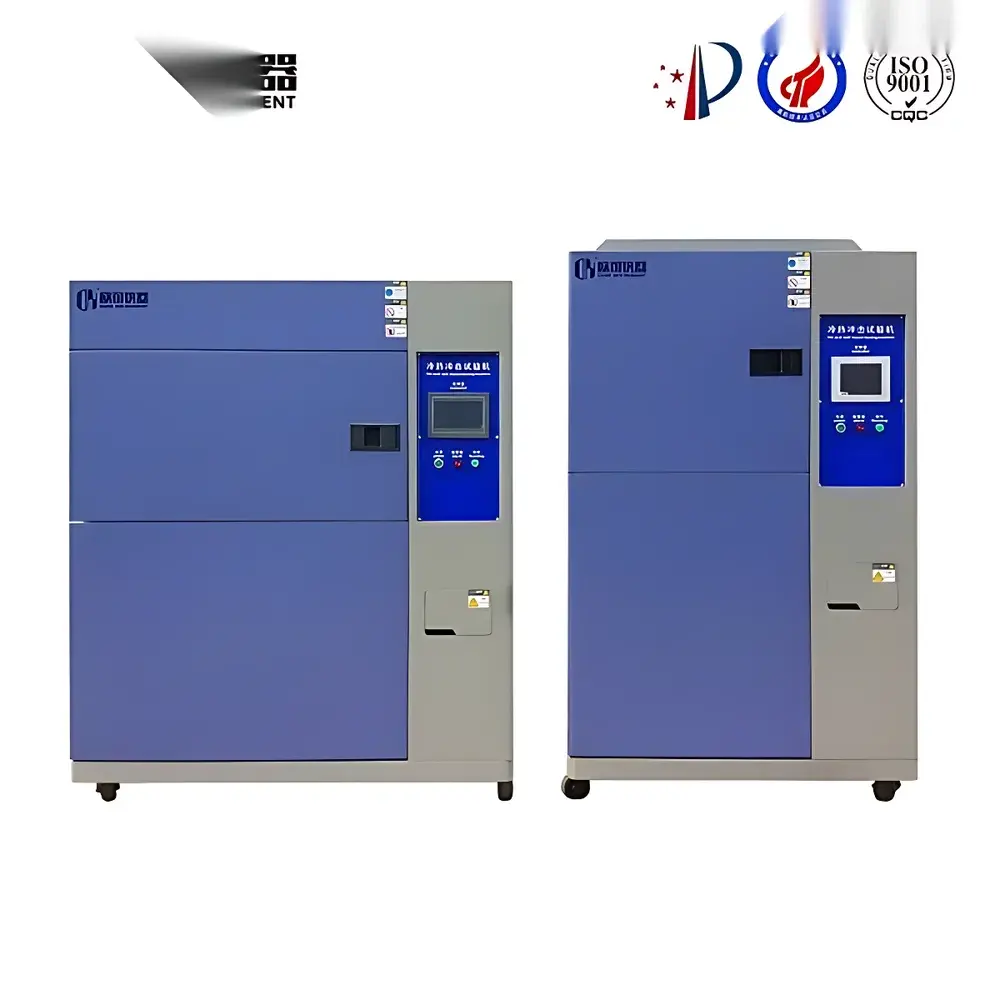
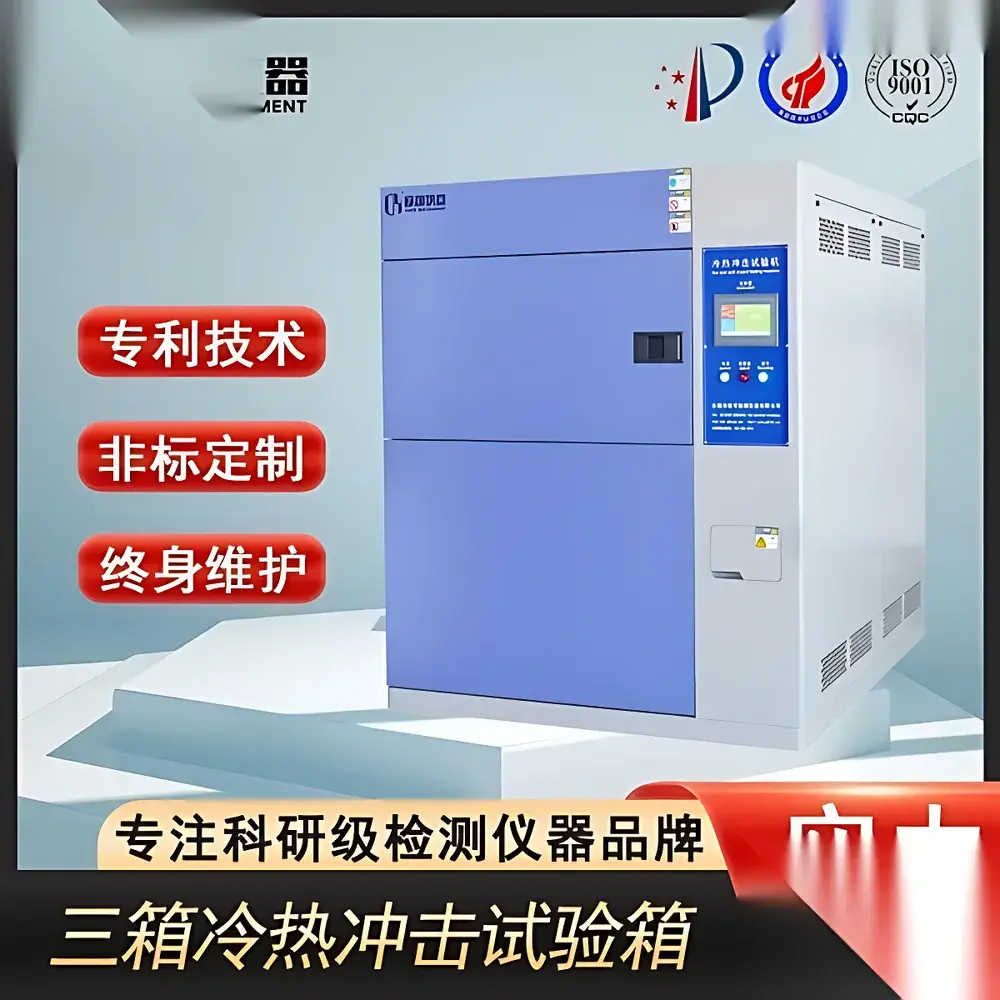
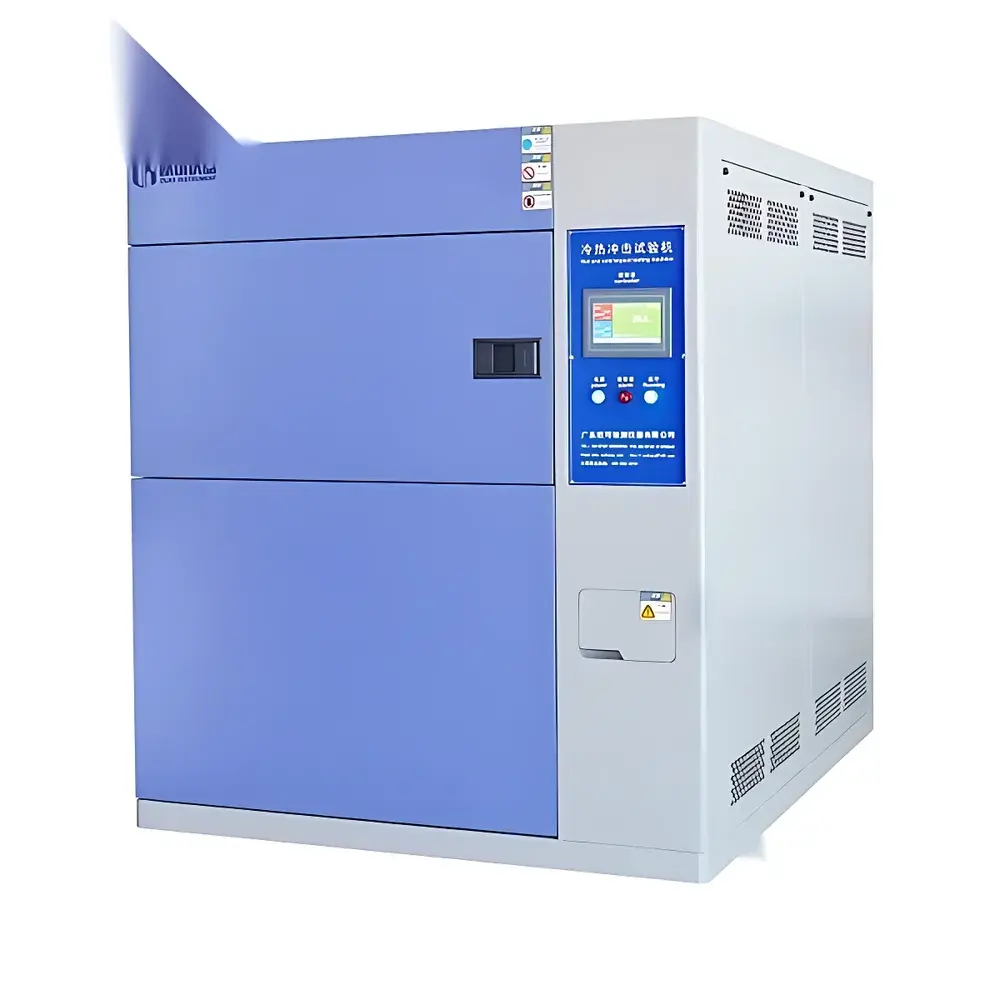
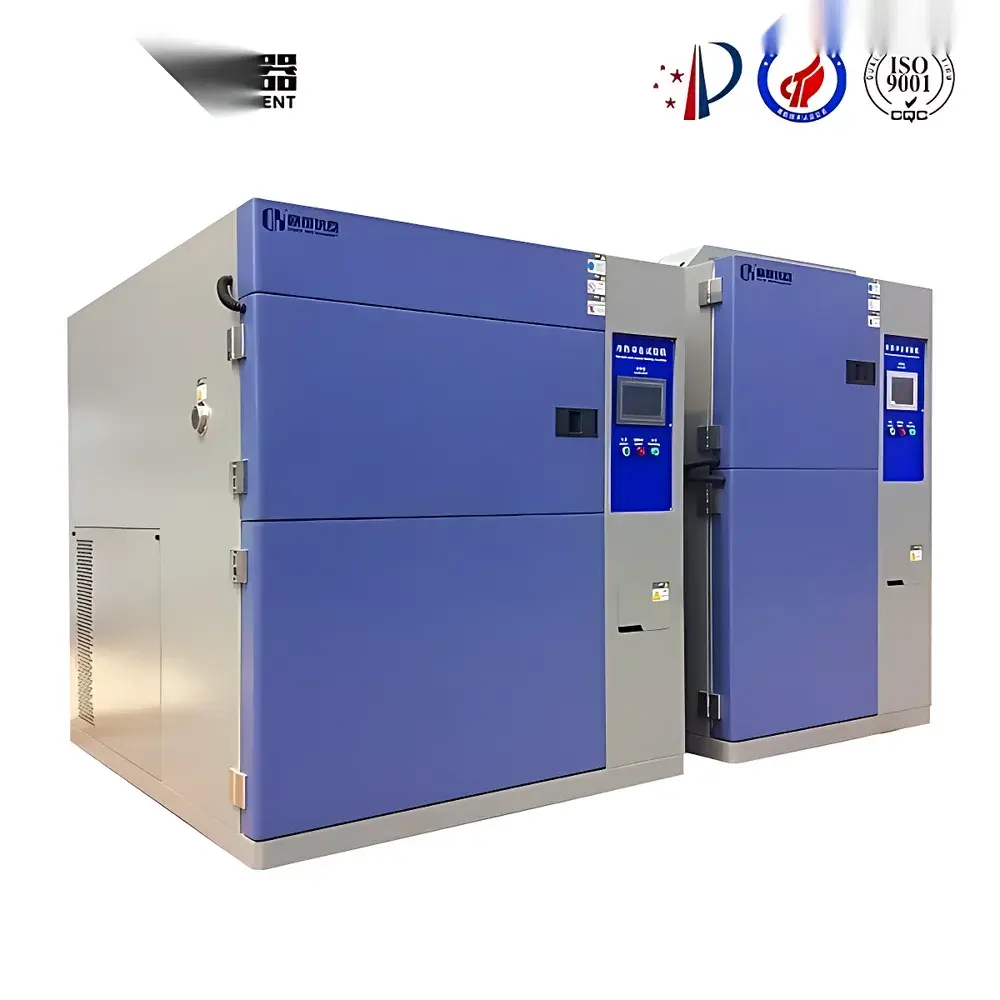
OK-TS Series Thermal Shock Test Chamber
| Brand | OK |
|---|---|
| Model | OK-TS-80 to OK-TS-1000 |
| Type | Semiconductor-Grade Dual-Zone Thermal Shock Chamber |
| Temperature Range | −65 °C to +150 °C (typical) |
| Transition Time | ≤15 s (−40 °C ↔ +125 °C, 15 kg aluminum load) |
| Control System | TEMI880 Color Touchscreen Controller (EN/CN Switchable) or TEMI300 Membrane Keypad Controller (EN only) |
| Refrigeration | Twin-Compressor, Dual-Zone Cascade System with French Tecumseh/Tecumseh-derived hermetic compressors |
| Internal Construction | SUS304 Stainless Steel |
| External Construction | Cold-Rolled Steel with Electrostatic Powder Coating or Optional SUS304 Brushed Finish |
| Insulation | Polyurethane Rigid Foam (≥100 mm thick) + Ultra-Fine Glass Fiber |
| Door Seal | Dual-Layer High-Temp/Low-Temp Resistant Silicone Gasket |
| Airflow | Wide-Band Forced Convection via Multi-Wing Centrifugal Blower (Top-Out/Bottom-In) |
| Compliance | Designed per IEC 60068-2-14, MIL-STD-810H Method 503.5, JESD22-A104, and JEDEC J-STD-020 for semiconductor qualification |
Overview
The OK-TS Series Thermal Shock Test Chamber is an engineered environmental stress screening (ESS) system specifically designed for reliability validation of semiconductor devices, IC packages, PCB assemblies, and advanced electronic components. It implements a true dual-zone thermal shock methodology—featuring independent high-temperature and low-temperature chambers separated by a rapid-transfer mechanism—to subject test specimens to abrupt, repeatable transitions between extreme thermal states. This architecture conforms to the physical principles defined in IEC 60068-2-14 (Change of Temperature) and supports accelerated life testing protocols required by JEDEC J-STD-020 (Moisture Sensitivity Levels) and JESD22-A104 (Temperature Cycling). Unlike single-chamber ramp-based systems, the OK-TS series delivers deterministic dwell times and sub-15-second transfer intervals under standardized thermal mass loading conditions—critical for detecting interfacial delamination, solder joint fatigue, and coefficient-of-thermal-expansion (CTE) mismatch failures in lead-free packaging.
Key Features
- Dual-zone cascade refrigeration system with two independent hermetic compressors (Tecumseh-derived), enabling stable operation across −65 °C to +150 °C without cross-contamination of thermal zones
- Multi-wing centrifugal blower with broadband forced-air circulation (top-out/bottom-in airflow pattern), ensuring ±0.5 °C temperature uniformity (per IEC 60068-3-5) across the working volume
- TEMI880 color touchscreen controller with programmable profiles, real-time data logging, EN/CN language toggle, and USB export capability; optional TEMI300 membrane keypad version for legacy integration
- Structural integrity optimized for semiconductor lab environments: SUS304 stainless steel interior, 100 mm polyurethane + glass fiber composite insulation, and dual-layer silicone door gaskets rated for −70 °C to +180 °C continuous service
- Standardized interface suite: RS-485/RS-232 serial port, Ethernet (Modbus TCP), analog 4–20 mA output, and dry-contact alarm terminals for integration into factory MES or LabVantage systems
- Integrated safety architecture including compressor overheat/overcurrent/overpressure protection, heater dry-run prevention, chamber over-temperature cutoff, and auto-refill water level monitoring for humidified variants
Sample Compatibility & Compliance
The OK-TS chamber accommodates standard JEDEC trays (JEDEC STD-20), 300 mm wafer carriers, QFN/QFP packages up to 35 mm × 35 mm, and populated PCBs up to 400 mm × 300 mm (depending on model). All models include dual-view observation windows with laminated tempered glass, a φ50 mm cable/port access port (left-side mounted), two height-adjustable stainless steel sample racks, and internal fluorescent lighting compliant with ISO/IEC 17025 lighting requirements for visual inspection. The system meets electromagnetic compatibility (EMC) per EN 61326-1 and safety per EN 61010-1. It supports GLP/GMP-aligned audit trails when paired with validated PC software—enabling 21 CFR Part 11-compliant electronic signatures, user-level access control, and immutable test record generation.
Software & Data Management
Bundled PC software provides full remote control, profile scheduling, real-time graphing (temperature vs. time), and automated report generation in PDF/CSV formats. Data acquisition operates at 1 Hz sampling resolution with timestamped metadata (operator ID, chamber ID, calibration certificate expiry). Software logs include event-driven alarms (e.g., “Door Open >3s”, “Temp Deviation >±2 °C”), cycle counter tracking, and cumulative exposure statistics. For regulated environments, optional IQ/OQ documentation packages are available—including sensor calibration certificates traceable to NIST standards, uncertainty budgets per ISO/IEC 17025, and FAT/SAT protocols aligned with ASTM E2500.
Applications
- Qualification testing of automotive-grade semiconductors (AEC-Q100 Grade 0–3)
- Process validation for flip-chip, wafer-level CSP, and SiP assembly lines
- Failure analysis root-cause correlation between thermal cycling history and X-ray CT-detected void growth
- Reliability screening prior to HAST (Highly Accelerated Stress Test) or TCT (Temperature Cycling Test)
- Material compatibility assessment of underfill epoxies, mold compounds, and die-attach adhesives
- Supporting IPC-9701A and IPC-TR-579 accelerated testing matrices
FAQ
What is the minimum achievable transition time between temperature extremes?
Typical transfer time from −40 °C to +125 °C (or vice versa) is ≤15 seconds with a 15 kg aluminum thermal mass, verified per JESD22-A104 Annex B.
Does the system support humidity-controlled thermal shock?
Yes—optional steam-based humidification module enables combined temperature/humidity shock testing per IEC 60068-2-30, with RH control range 10–95% RH at +40 °C to +85 °C.
Is the controller firmware validated for use in FDA-regulated facilities?
The TEMI880 controller supports configurable audit trail logging and user authentication; full 21 CFR Part 11 compliance requires installation qualification with documented configuration management and change control procedures.
What calibration standards are used for temperature sensors?
Internal PT100 sensors are calibrated against reference PRTs traceable to NIST SRM 1750, with as-found/as-left reports provided annually per ISO/IEC 17025-accredited calibration service.
Can the chamber be integrated into a central facility monitoring system?
Yes—standard Modbus TCP and optional OPC UA drivers enable seamless integration with Siemens Desigo, Honeywell Experion, or custom SCADA platforms for centralized alarm aggregation and predictive maintenance analytics.



