
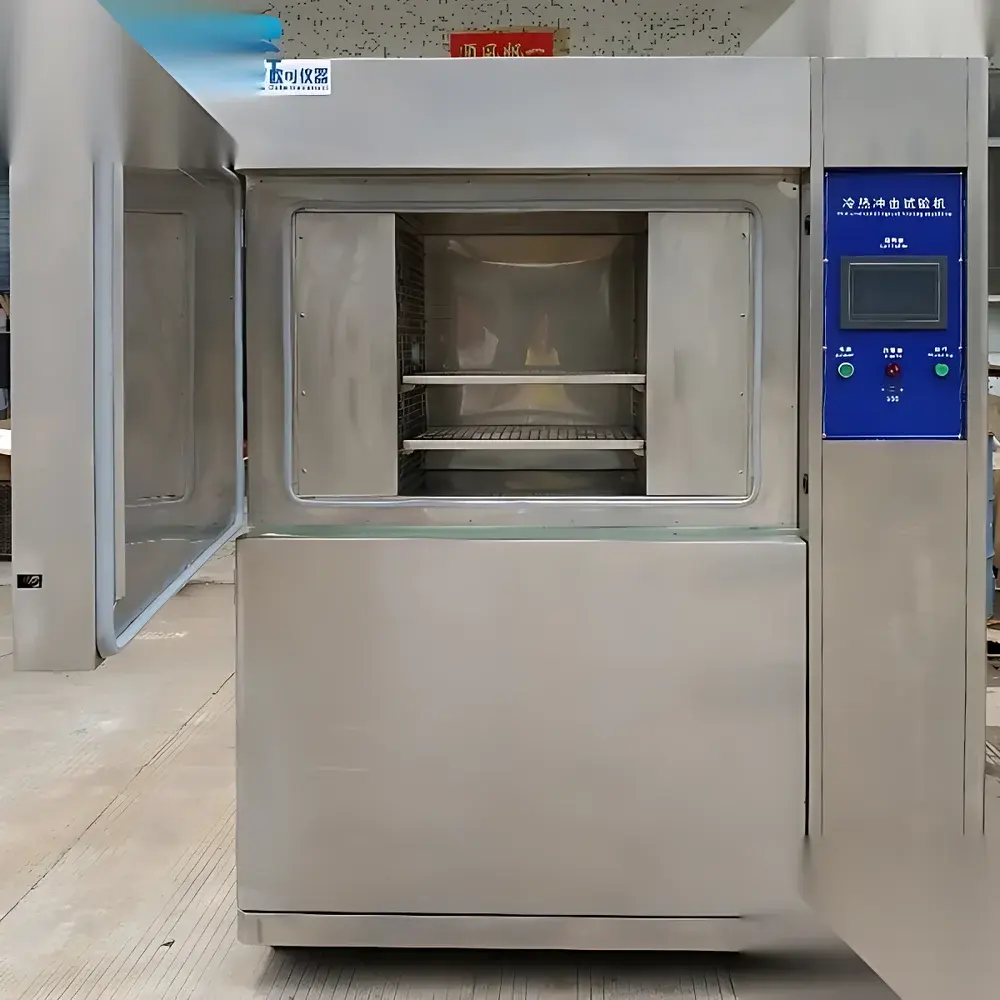
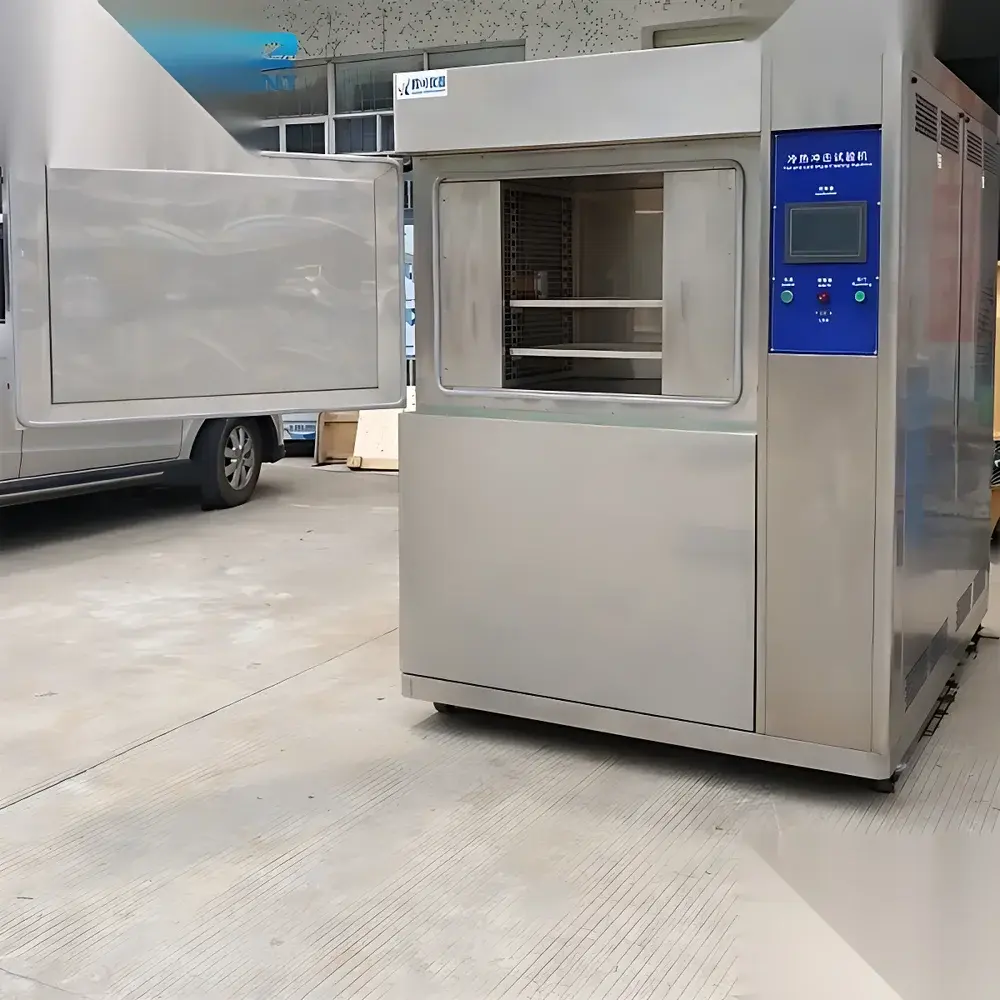
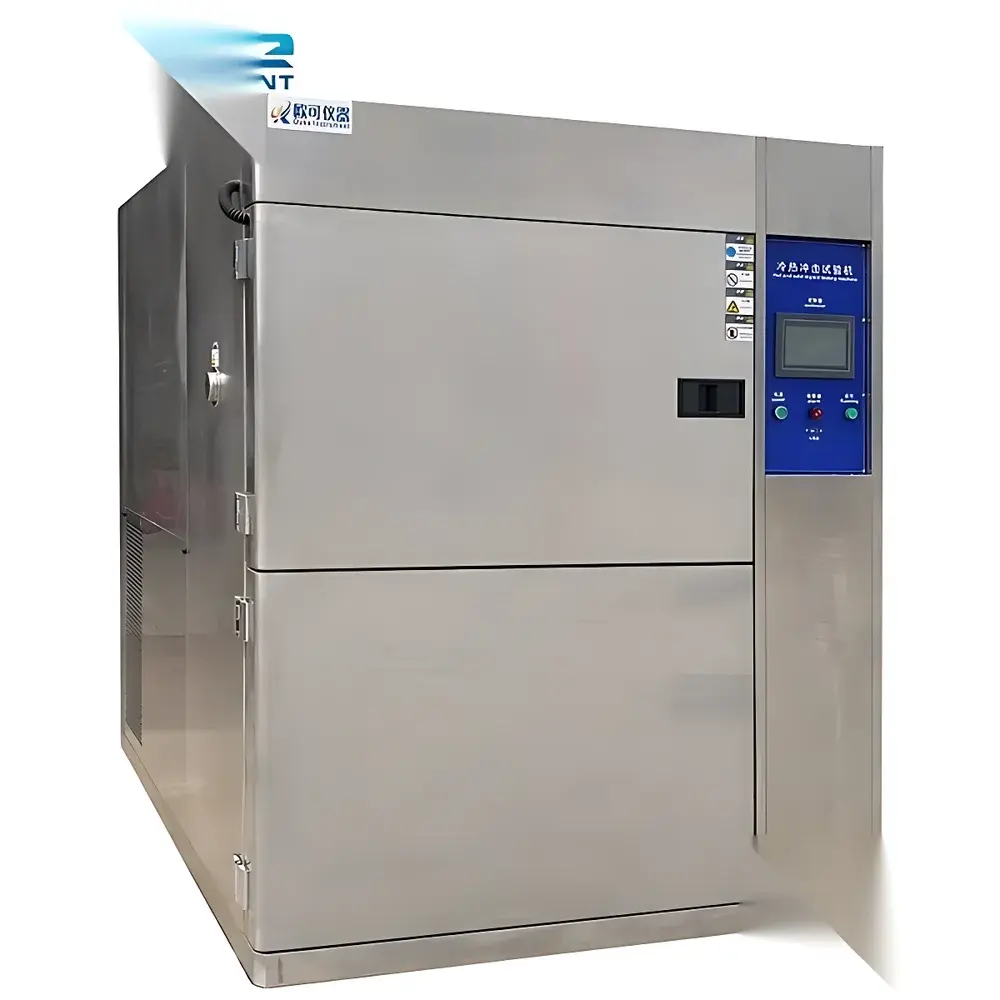
OK-TS Series Thermal Shock Test Chamber
| Brand | OK Instruments |
|---|---|
| Model | OK-TS-100A / OK-TS-225A / OK-TS-500A / OK-TS-010A |
| Internal Chamber Dimensions (W×H×D) | 450×450×500 mm / 600×600×600 mm / 800×800×800 mm / 1000×1000×1000 mm |
| External Dimensions (W×H×D) | 1560×870×1545 mm / 1710×1020×1845 mm / 1910×1220×2265 mm / 2110×1420×2665 mm |
| Refrigeration System | Dual-stage cascade refrigeration with two Copeland semi-hermetic scroll compressors |
| Oil Separator | ALCO (USA/EU) high-efficiency coalescing oil separator |
| Configuration Options | Two-zone (hot/cold) or three-zone (hot/ambient/cold) thermal shock mode |
| Operating Modes | Independent high-temperature chamber, independent low-temperature chamber, or programmable thermal shock cycling |
| Compliance | Designed to support ASTM D5229, ISO 11359-2, MIL-STD-810H Method 503.5, IEC 60068-2-14, and GLP/GMP-aligned test documentation workflows |
Overview
The OK-TS Series Thermal Shock Test Chamber is an engineered environmental simulation system designed for rapid, repeatable transitions between extreme temperature extremes—typically ranging from −70 °C to +180 °C—within seconds. It operates on the principle of mechanical thermal shock via physical transfer of test specimens between isolated hot and cold zones (two-zone configuration) or across hot, ambient, and cold chambers (three-zone configuration). Unlike conventional temperature cycling chambers relying solely on air circulation and heating/cooling coils, the OK-TS Series employs a dual-stage cascade refrigeration architecture with independent thermal reservoirs, enabling sub-zero cooling performance without reliance on liquid nitrogen or cryogenic media. This architecture ensures high thermal inertia control, minimal temperature overshoot, and stable dwell conditions—critical for evaluating material integrity under repeated thermomechanical stress.
Key Features
- Dual-stage cascade refrigeration system integrating two Copeland semi-hermetic scroll compressors—one for the high-stage (R404A) and one for the low-stage (R23)—enabling reliable operation down to −70 °C with consistent cooling ramp rates.
- ALCO (USA/EU) coalescing oil separator installed upstream of the evaporator to prevent lubricant carryover into heat exchangers, preserving long-term system efficiency and minimizing maintenance intervals.
- Modular chamber configurations: Selectable two-zone (hot/cold) or three-zone (hot/ambient/cold) layouts; optional lift-type or rotary basket specimen transfer mechanisms with pneumatic actuation and position feedback.
- Independent operational modes: Functions as a standalone high-temperature chamber (up to +180 °C), a standalone low-temperature chamber (down to −70 °C), or a fully programmable thermal shock tester—maximizing lab asset utilization.
- Stainless steel 304 inner chamber with electrostatically applied epoxy-coated outer enclosure; insulated with 150 mm thick polyurethane foam (thermal conductivity ≤ 0.022 W/m·K) for low heat leakage and energy-efficient operation.
- Integrated safety interlocks including over-temperature cutoff, compressor high-pressure shutdown, door-open inhibition during active shock cycles, and real-time refrigerant leak detection via embedded NDIR sensors.
Sample Compatibility & Compliance
The OK-TS Series accommodates a broad spectrum of sample geometries—from microelectronic packages (e.g., BGA substrates, IC dies, ceramic capacitors) to automotive powertrain components, aerospace composite panels, and polymer-based medical device housings. Standard payload capacity ranges from 15 kg (OK-TS-100A) to 100 kg (OK-TS-010A), with customizable fixtures available for DIN rail mounting, vacuum chucking, or strain-gauge-integrated load frames. The system supports compliance-driven testing per ASTM D5229 (low-temperature impact resistance of plastics), ISO 11359-2 (thermomechanical analysis of polymers), MIL-STD-810H Method 503.5 (temperature shock), and IEC 60068-2-14 (change of temperature). When configured with audit-trail-enabled controllers and electronic signature-capable HMI, it meets foundational requirements for GLP and GMP environments—including 21 CFR Part 11–aligned data integrity protocols for raw temperature logs, cycle event timestamps, and operator action records.
Software & Data Management
Equipped with OK-TestControl v4.2 firmware, the chamber features a 10.1″ capacitive touchscreen HMI with intuitive drag-and-drop test sequence programming. Users define multi-step profiles—including dwell times, transition durations (as short as 5 s), ramp rates (programmable up to 30 °C/min), and conditional branching based on real-time sensor feedback. All thermal data—including chamber setpoints, actual zone temperatures, compressor discharge pressures, and oil separator differential pressure—are logged at 1 Hz resolution and exported in CSV or XML format. Optional Ethernet/IP and Modbus TCP interfaces enable integration into centralized MES or LIMS platforms. Firmware includes built-in calibration verification routines traceable to NIST-certified references, with automatic generation of calibration certificates upon request.
Applications
This system is routinely deployed in reliability engineering labs for accelerated life testing of solder joints in automotive ECUs, delamination assessment in multilayer ceramic capacitors (MLCCs), coefficient-of-thermal-expansion (CTE) mismatch validation in heterogeneous packaging stacks, and glass transition behavior mapping in thermoset composites. In R&D settings, it supports DOE-based studies correlating shock cycle count with crack initiation thresholds in additively manufactured metal lattices. Quality assurance teams use it for incoming inspection of supplier-submitted PCB assemblies prior to reflow soldering qualification. Its ability to replicate field-relevant thermal transients—such as engine bay temperature spikes followed by rain-induced quenching—makes it indispensable for Tier-1 automotive suppliers validating under-hood electronics per AEC-Q200.
FAQ
What temperature ranges are achievable across the OK-TS model variants?
All models support standard operation from −70 °C to +180 °C; extended low-temperature options (−85 °C) and high-temperature upgrades (+225 °C) are available upon request.
Is the system compliant with FDA 21 CFR Part 11 for electronic records?
Yes—when equipped with the OK-DataSecure option, it provides role-based access control, electronic signatures, and immutable audit trails meeting Part 11 Annex 11 requirements.
Can the chamber be integrated with existing laboratory automation systems?
Yes—native support for Modbus TCP, Ethernet/IP, and OPC UA enables seamless communication with PLCs, SCADA systems, and enterprise QA databases.
What maintenance intervals are recommended for the refrigeration system?
Compressor oil analysis every 2,000 operating hours; ALCO oil separator element replacement every 5,000 hours; full refrigerant circuit integrity check annually.
Does the system include validation documentation for IQ/OQ/PQ protocols?
Standard delivery includes Factory Acceptance Test (FAT) report and user-installable IQ/OQ templates aligned with ISO 13485 and ISO/IEC 17025 frameworks.



