
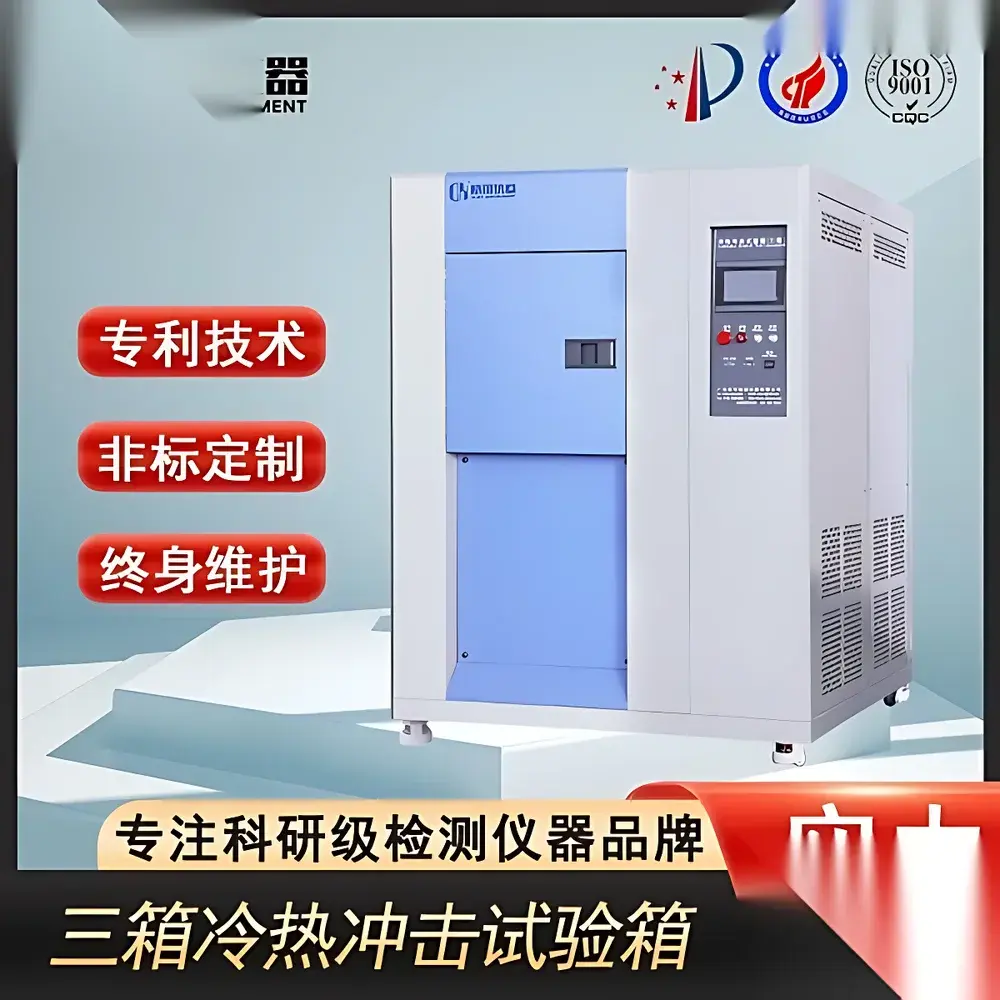
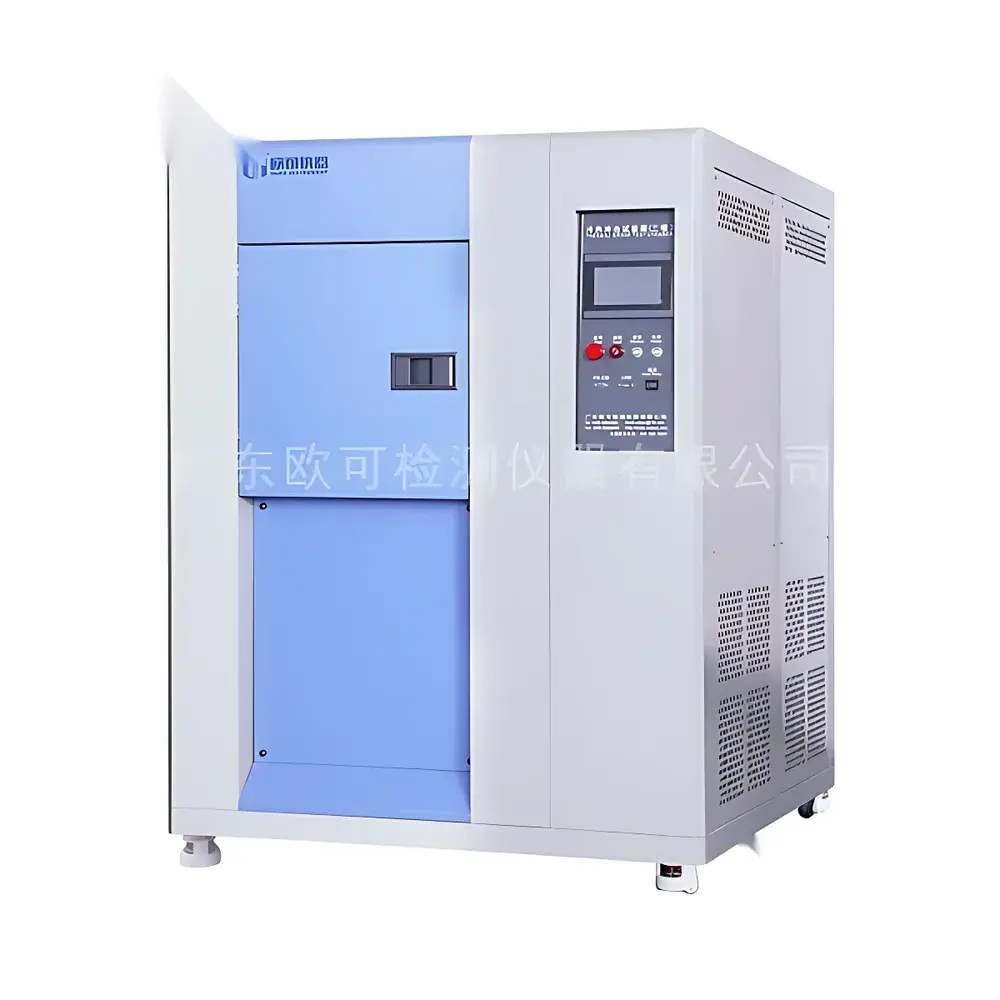
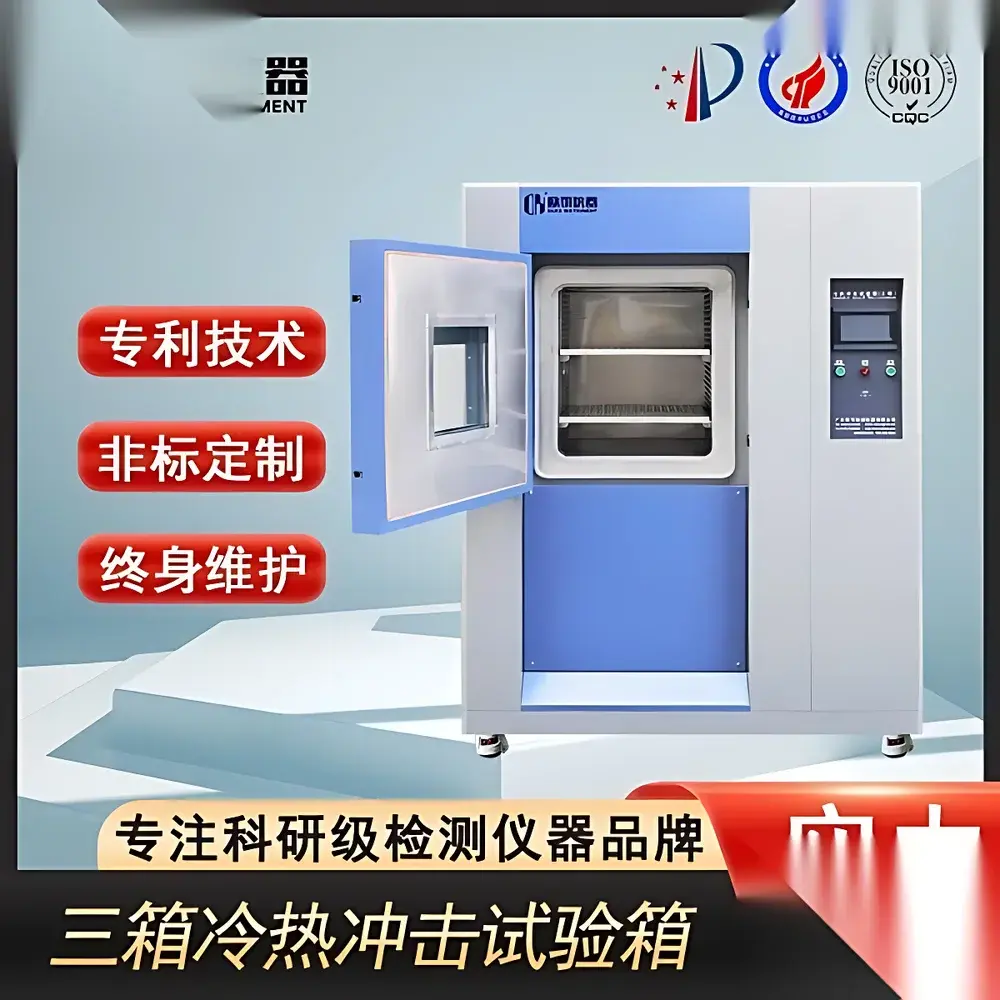
OK-TS Series Thermal Shock Test Chamber
| [Brand | Other brands |
|---|---|
| Origin | Imported |
| Manufacturer Type | General distributor |
| Price | USD 11,200 (approx.) |
| Temperature Range (Test Zone) | -45°C to +150°C (configurable to -65°C) |
| High-Temp Zone | +60°C to +150°C |
| Low-Temp Zone | -10°C to -65°C |
| Transition Time | ≤10 s |
| Temperature Recovery Time | ≤5 min |
| Control Accuracy | ±0.5°C |
| Uniformity | ±2.0°C |
| Heating System | Nickel-Chromium Alloy Wire Heater |
| Cooling System | Dual-Stage or Single-Stage Cascade Refrigeration with Original Tecumseh/Tecumseh-derived Hermetic Compressor |
| Insulation | Polyurethane Rigid Foam + Ultra-Fine Glass Fiber |
| Inner Chamber Material | SUS304 Stainless Steel |
| Outer Chamber Material | Cold-Rolled Steel with Electrostatic Powder Coating or Optional SUS304 Brushed Finish |
| Controller Options | TEMI880 Color Touchscreen (Bilingual), TEMI300 Membrane Keypad (English Only) |
| Compliance | Designed per IEC 60068-2-14, MIL-STD-810H Method 503.5, JIS Z 8705] |
Overview
The OK-TS Series Thermal Shock Test Chamber is an engineered environmental stress screening (ESS) system designed for rapid, repeatable thermal cycling between extreme high- and low-temperature zones. It operates on the principle of two-chamber (hot/cold) or three-chamber (hot/cold/transfer) thermal shock methodology—enabling precise, high-speed transitions that simulate real-world thermal fatigue conditions encountered during product launch, qualification, and reliability validation. Unlike standard temperature-humidity chambers, this system isolates test specimens in a transfer basket that moves mechanically between thermally stabilized zones, minimizing thermal inertia and ensuring true step-change exposure. The chamber supports both storage-type (static dwell) and transition-type (dynamic shock) profiles per IEC 60068-2-14 Ed. 4.0 (2021) and MIL-STD-810H Method 503.5, making it suitable for aerospace components, automotive ECUs, PCB assemblies, semiconductor packaging, and medical device housings subjected to abrupt ambient shifts.
Key Features
- High-fidelity dual-zone architecture with independently controlled hot zone (+60°C to +150°C) and cold zone (-10°C to -65°C), enabling programmable dwell times and ramp rates per test standard requirements.
- Ultra-fast transfer mechanism achieving ≤10-second basket movement between zones and ≤5-minute temperature recovery post-transfer—critical for maintaining thermal gradient integrity across successive cycles.
- Microprocessor-based P.I.D. + S.S.R. balanced temperature control system with auto-tuning capability, delivering ±0.5°C setpoint accuracy and ±2.0°C spatial uniformity across the full test volume.
- Dual-stage cascade refrigeration system utilizing original Tecumseh hermetic compressors and environmentally compliant R404A/R23 refrigerant blends, optimized for long-term stability and reduced maintenance intervals.
- Robust chamber construction: inner walls and basket structure fabricated from corrosion-resistant SUS304 stainless steel; outer enclosure available in electrostatic powder-coated cold-rolled steel or optional brushed SUS304 finish.
- Comprehensive safety architecture including compressor overheat/overcurrent/overpressure protection, dry-run prevention for heaters and humidifiers, low-water-level cutoff, and redundant temperature limiters.
Sample Compatibility & Compliance
The OK-TS series accommodates samples up to 1000 × 1000 × 1000 mm (W×H×D) across six standardized models (OK-TS-80 through OK-TS-1000). Standard features include dual-pane tempered observation window, Ø50 mm cable/port access on left side, adjustable sample trays (two sets), fluorescent interior lighting, castor-mounted mobility, and integrated water reservoir for optional humidity-enabled shock protocols. All units are configured to meet fundamental design and performance criteria outlined in IEC 60068-2-14 (Change of temperature — Method N: Change of temperature by air), ISO 16750-4 (Road vehicles — Environmental conditions and testing for electrical and electronic equipment), and JIS Z 8705 (Testing methods for thermal shock resistance of materials). While not certified to GLP or FDA 21 CFR Part 11 out-of-box, the TEMI880 controller supports audit-trail-ready data logging when connected to validated PC-based software—enabling traceability required under GMP-aligned quality systems.
Software & Data Management
The TEMI880 color touchscreen controller provides intuitive bilingual (English/Chinese) operation, multi-segment program editing, real-time curve display, and USB export of time-stamped temperature logs. Optional RS485/RS232 or Ethernet interfaces enable integration with centralized laboratory information management systems (LIMS) or SCADA platforms. The included PC software supports remote monitoring, automated report generation (PDF/CSV), alarm history review, and user-level access control—facilitating compliance with internal SOPs and external audit requirements such as ISO/IEC 17025 clause 7.7 (Control of Equipment). Data integrity safeguards include write-protected memory, timestamped event logs, and configurable password protection for critical functions including calibration offset adjustment.
Applications
- Accelerated life testing of solder joints, conformal coatings, and encapsulated ICs under repeated thermal expansion mismatch stress.
- Qualification of avionics modules per DO-160 Section 4.9 (Temperature Shock) and RTCA/DO-160G Amendment 4.
- Validation of battery pack thermal interface materials (TIMs) and cell-level structural adhesion integrity.
- Reliability assessment of MEMS sensors, optical lenses, and ceramic substrates exposed to diurnal or operational thermal transients.
- Pre-screening of automotive infotainment displays, ADAS camera housings, and power electronics prior to AEC-Q200 stress qualification.
FAQ
What is the difference between two-chamber and three-chamber thermal shock configurations?
Two-chamber systems rely on mechanical transfer of the test specimen between fixed hot and cold zones; three-chamber variants add a dedicated ambient or transfer chamber to reduce cross-contamination and improve repeatability for sensitive components.
Can this chamber perform humidity-assisted thermal shock tests?
Yes—when equipped with the optional surface-evaporation humidifier and TEMI880 controller, the system supports combined temperature/humidity shock profiles per IEC 60068-2-14 Annex B, though dew-point limitations apply below -20°C.
Is calibration documentation provided with shipment?
Factory calibration certificates (traceable to NIST or equivalent national metrology institutes) are available upon request; field recalibration services follow ISO/IEC 17025 procedures and include uncertainty budgets.
What maintenance intervals are recommended for the refrigeration system?
Compressor oil and filter-drier replacement is advised every 24 months under continuous operation; annual inspection of refrigerant charge, heat exchanger cleanliness, and door gasket integrity is strongly recommended.
Does the system support custom test profile import via CSV or XML?
The TEMI880 controller accepts segmented time/temperature targets via USB; advanced profile scripting (e.g., conditional logic, variable dwell) requires the optional PC software suite with API support.



