
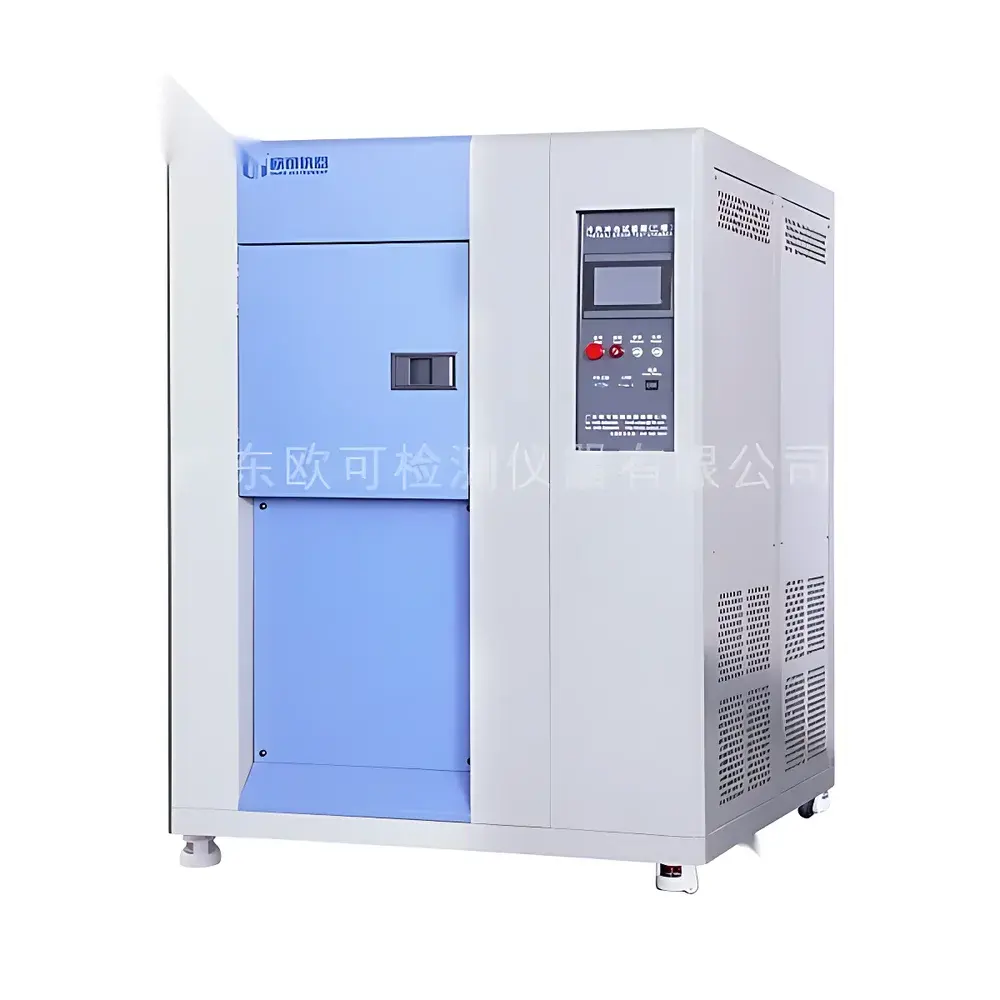
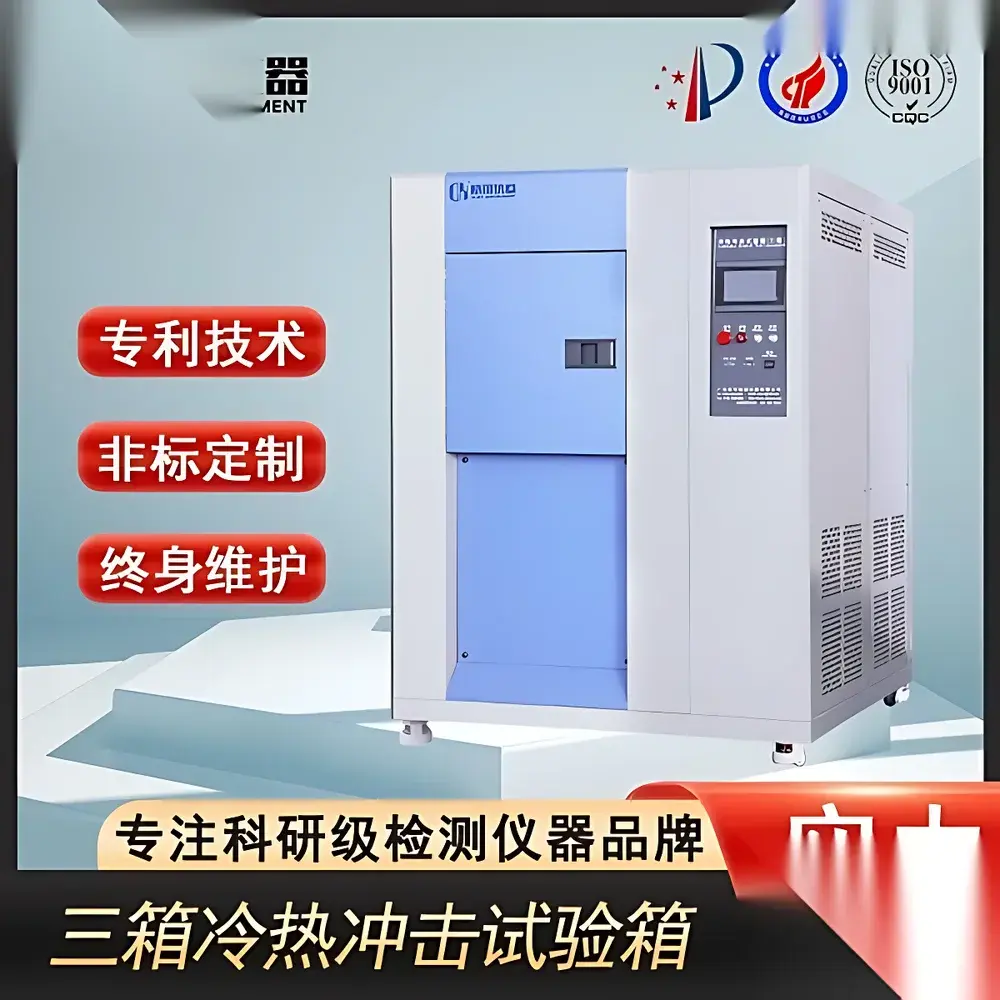
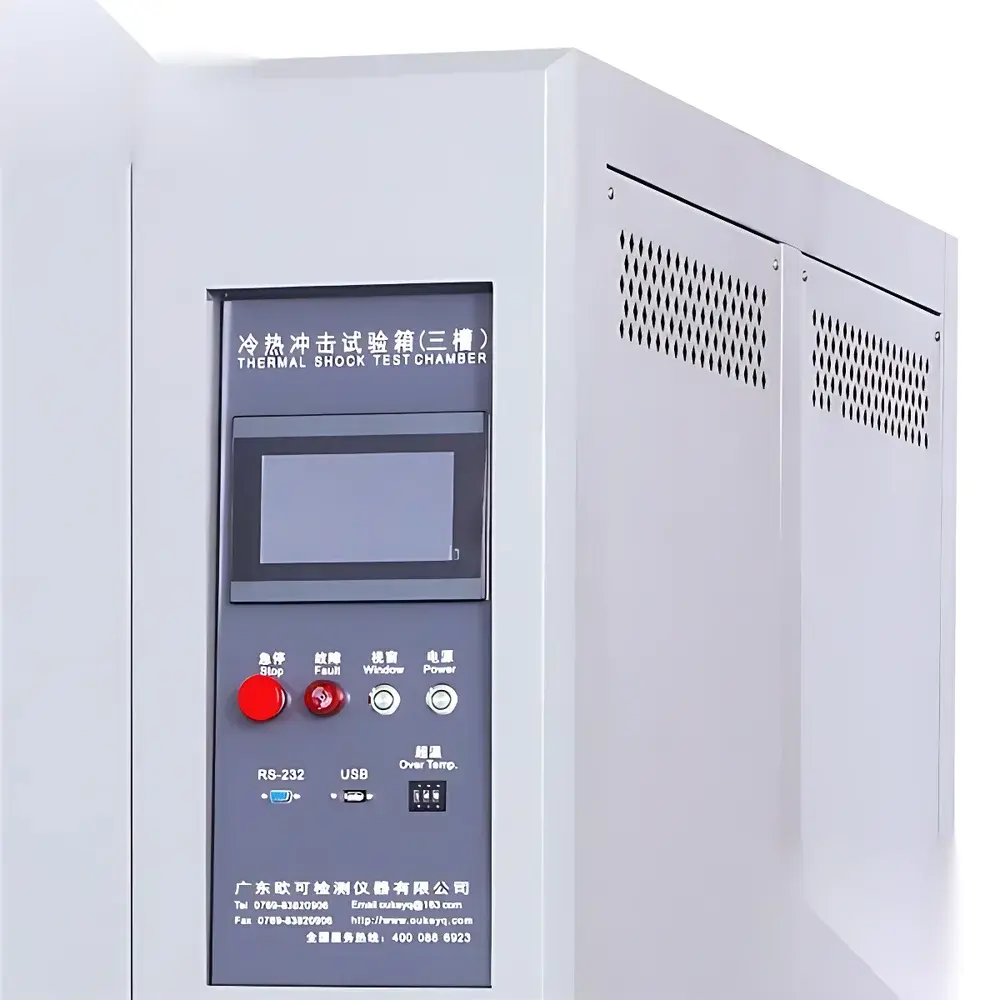
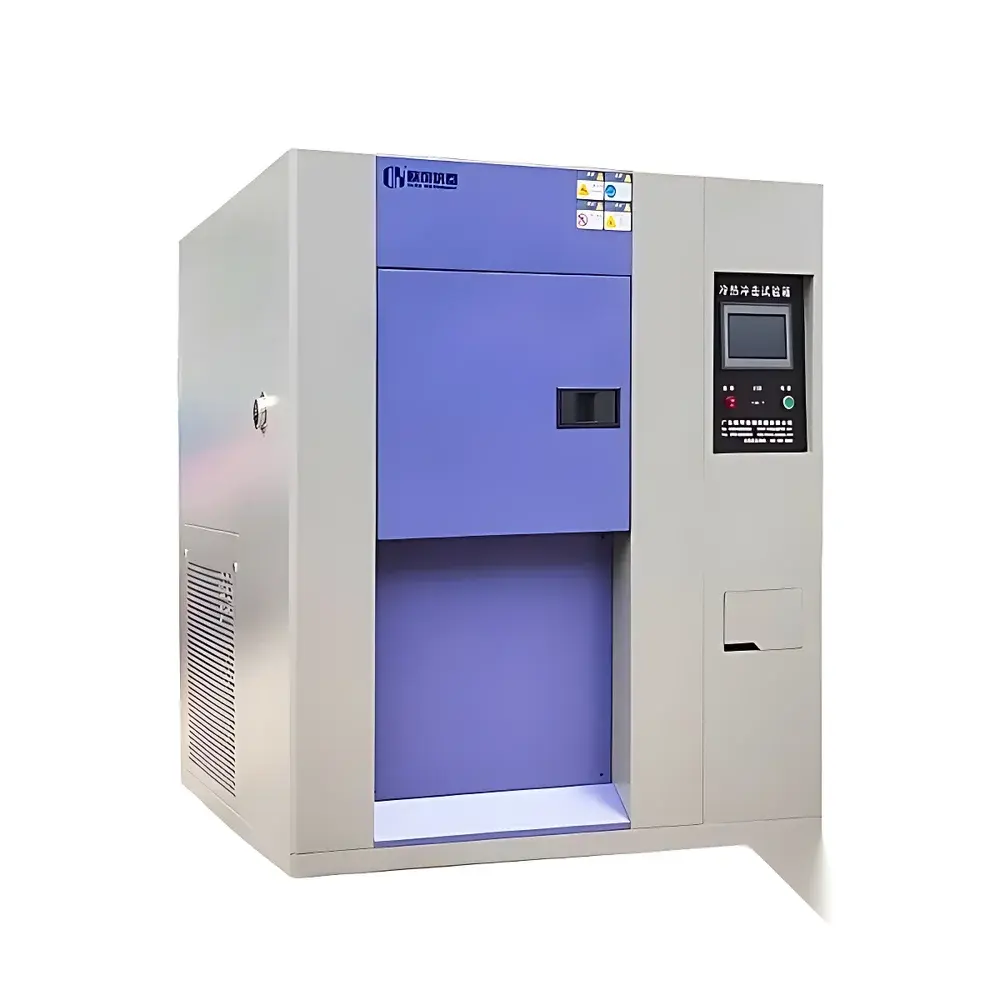
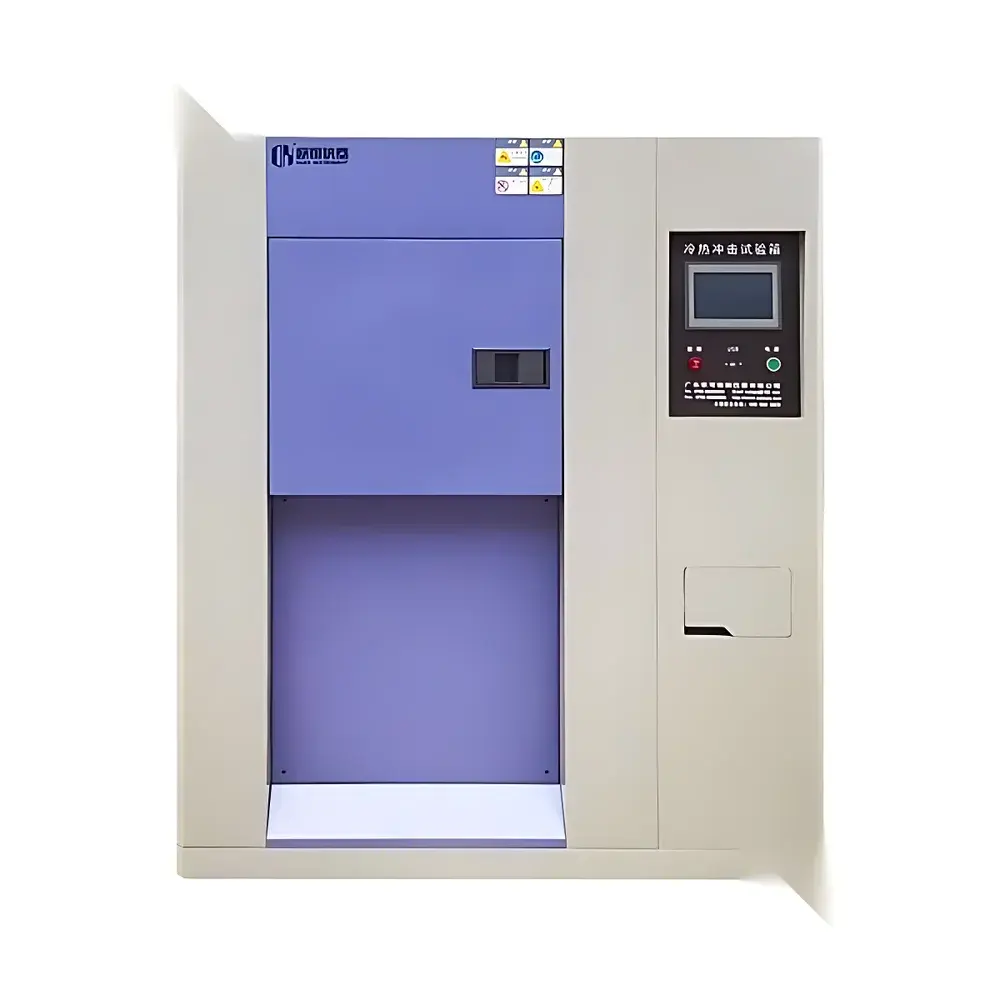
OK-TS Series Thermal Shock Test Chamber (Liquid Nitrogen-Compatible, -65°C to +200°C)
| Brand | OK Instruments |
|---|---|
| Temperature Range | -65°C to +200°C (configurable options: -80°C / +200°C) |
| Temperature Transition Time | RT → -75°C in ~95 min |
| Recovery Time | ≤10 s |
| Temperature Uniformity | ±0.5°C |
| Temperature Deviation | ±2.0°C |
| Basket Dimensions (mm) | 400×350×350 to 700×600×600 |
| External Dimensions (mm) | 1350×1800×1350 to 1600×2100×1650 |
| Drive Mechanism | Pneumatic or Mechanical Basket Actuation |
| Interior Material | 1.2 mm SUS#304 Stainless Steel |
| Exterior Material | 1.5 mm Galvanized Steel with Powder Coating or Optional SUS#304 |
| Insulation | Dual-layer — Rigid Polyurethane Foam + Glass Fiber |
| Communication Interfaces | RS-232, RS-485, USB, LAN (Ethernet) |
| Energy-Saving Mode | Adaptive Compressor Power Regulation (30% energy reduction vs. conventional heater-balanced systems) |
| Compliance | Designed per ISO 16750-4, ASTM D5229/D570, MIL-STD-810H Method 503.5, IEC 60068-2-14 |
Overview
The OK-TS Series Thermal Shock Test Chamber is an engineered environmental stress screening (ESS) system designed for rapid, repeatable thermal cycling between extreme high- and low-temperature zones. Based on the two-chamber (hot/cold) + basket transfer architecture, it subjects test specimens to abrupt temperature transitions—simulating real-world thermal fatigue conditions encountered in aerospace components, automotive electronics, semiconductor packaging, and high-reliability PCB assemblies. The chamber employs a dual-zone independent refrigeration/heating design with liquid nitrogen (LN₂) interface capability for ultra-low temperature extension (down to -80°C), enabling accelerated failure mode analysis per JEDEC JESD22-A104 and IPC-9701 standards. Its thermally optimized insulation system—comprising rigid polyurethane foam and glass fiber—minimizes thermal bridging and ensures stable zone separation during high-frequency shock cycles.
Key Features
- Modular thermal zone architecture with independently controlled hot chamber (RT to +200°C) and cold chamber (RT to -80°C)
- Pneumatic or mechanical basket actuation mechanism ensuring ≤10-second transfer time between zones, critical for maintaining thermal shock integrity
- Adaptive compressor power regulation system—dynamically modulates refrigerant flow based on real-time load demand, reducing energy consumption by up to 30% versus fixed-heater balancing methods
- Full 3D parametric modeling and pre-manufacturing virtual assembly validation to eliminate mechanical interference and ensure dimensional accuracy of moving components
- Standard LN₂ interface port for field-upgradable sub-zero performance enhancement (e.g., -65°C → -80°C operation)
- High-stability stainless steel interior (SUS#304, 1.2 mm thickness) and corrosion-resistant exterior (powder-coated galvanized steel or optional full SUS#304)
- Integrated digital communication suite: RS-232/RS-485 serial, USB host/device, and industrial-grade Ethernet (LAN) for remote monitoring, script-based test sequencing, and SCADA integration
Sample Compatibility & Compliance
The OK-TS chamber accommodates samples up to 700 × 600 × 600 mm (L×W×H) across four standard models (OK-TS-49 to OK-TS-225), supporting both single-unit and batch testing configurations. Internal baskets are removable and configurable for custom fixtures, including PCB carriers, wafer trays, and connector harness mounts. The system complies with key international test standards including ISO 16750-4 (road vehicles), ASTM D5229 (composite moisture resistance), ASTM D570 (plastic water absorption), MIL-STD-810H Method 503.5 (thermal shock), and IEC 60068-2-14 (environmental testing—change of temperature). Its temperature uniformity (±0.5°C) and deviation (±2.0°C) meet GLP/GMP audit requirements for qualification testing documentation.
Software & Data Management
The chamber operates via an embedded industrial controller with intuitive touchscreen HMI and supports optional PC-based software for advanced test protocol development. All data—including chamber temperatures, basket position status, cycle count, elapsed time, and alarm logs—are timestamped and stored locally (SD card) or streamed in real time over LAN using Modbus TCP or OPC UA protocols. Audit-trail functionality records user actions, parameter changes, and calibration events—fully compliant with FDA 21 CFR Part 11 requirements when configured with electronic signature modules. Export formats include CSV, PDF reports, and XML for LIMS integration.
Applications
- Qualification testing of avionics enclosures and flight control actuators under rapid thermal transients
- Reliability screening of solder joints, wire bonds, and die-attach interfaces in power modules and EV battery management systems (BMS)
- Material characterization of polymer composites, thermal interface materials (TIMs), and encapsulants used in LED lighting and 5G infrastructure
- Failure analysis of MEMS sensors and RF front-end modules subjected to seasonal ambient extremes
- Accelerated life testing (ALT) of medical device housings and sterilizable diagnostic components per ISO 13485
FAQ
What temperature ranges are available for the OK-TS series?
Standard configurations support -65°C to +200°C; optional LN₂ cooling extends low-temperature capability to -80°C, while high-temperature variants reach +200°C with reinforced heating elements.
Is the system compliant with FDA 21 CFR Part 11 for regulated industries?
Yes—when equipped with optional audit-trail logging, user access controls, and electronic signature modules, the system meets electronic record and signature requirements for pharmaceutical and medical device validation.
Can the chamber be integrated into an automated test cell?
Absolutely—the RS-485, LAN, and Modbus TCP interfaces enable seamless integration with PLCs, MES platforms, and robotic material handling systems.
What maintenance intervals are recommended for long-term reliability?
Compressor oil and filter replacement every 12 months; refrigerant leak inspection and calibration verification every 6 months; pneumatic actuator lubrication quarterly.
Does the system support custom thermal profiles beyond standard two-zone shock cycles?
Yes—via programmable multi-step sequences, users can define dwell times, ramp rates, number of cycles, and conditional triggers (e.g., “pause if internal humidity exceeds X%”).



