
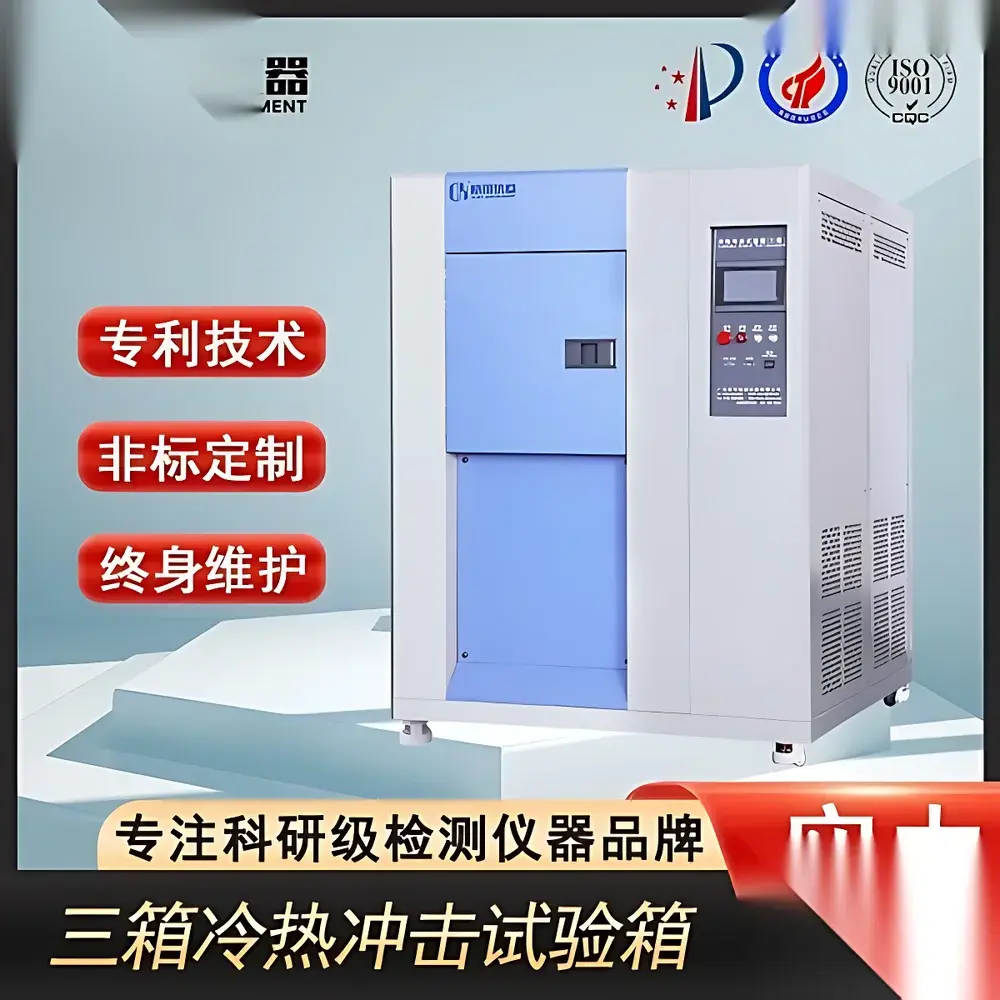
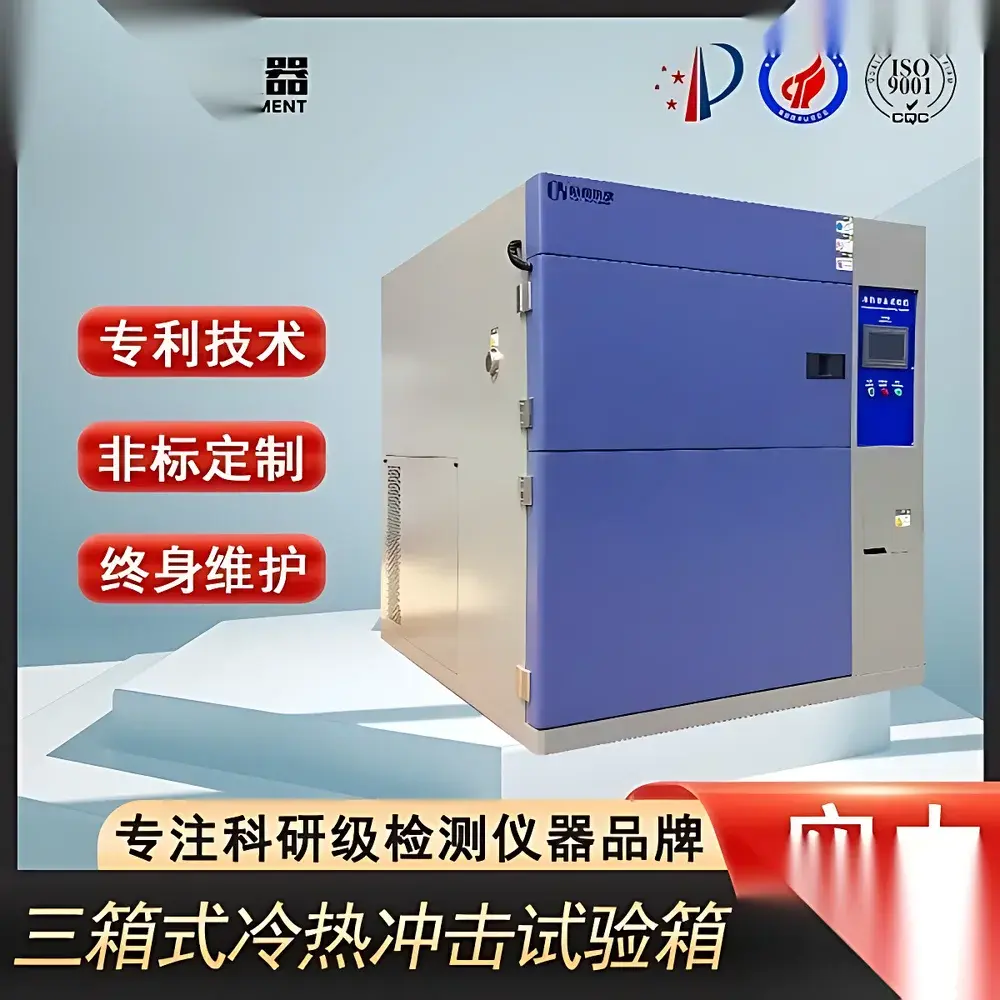
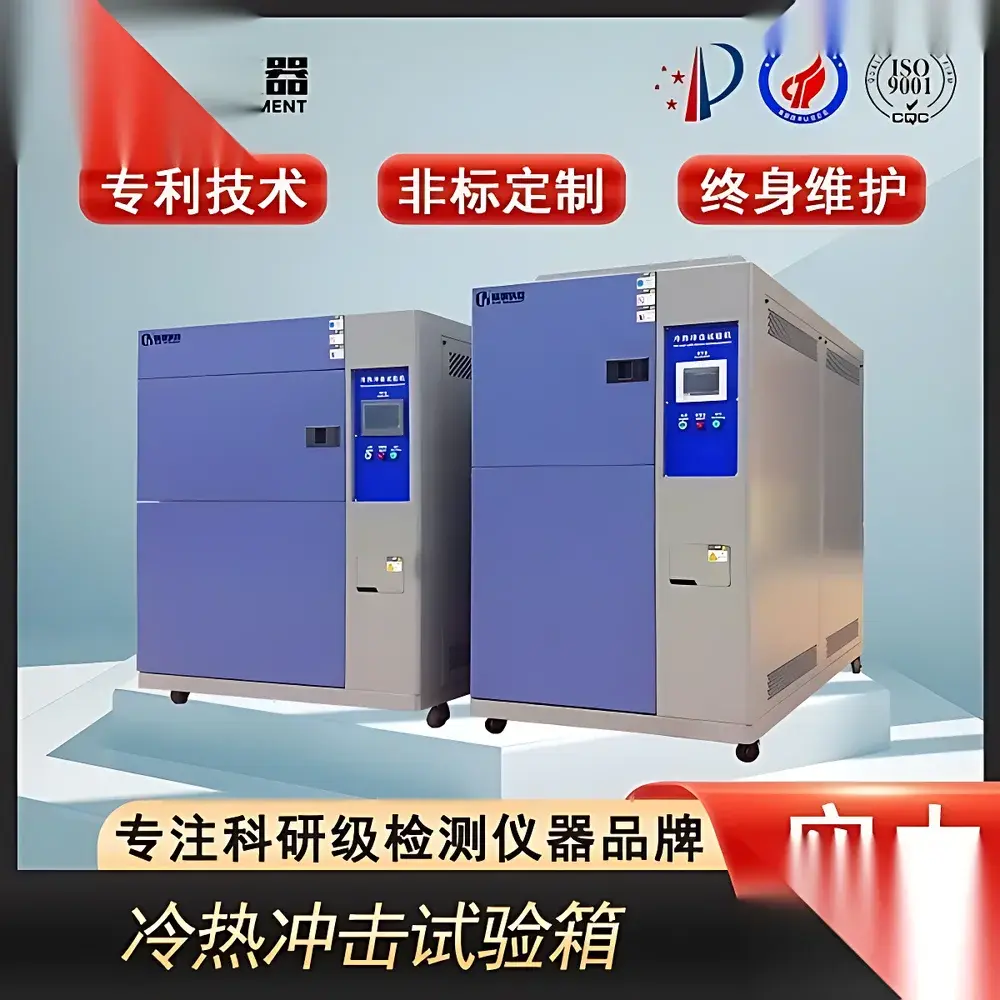
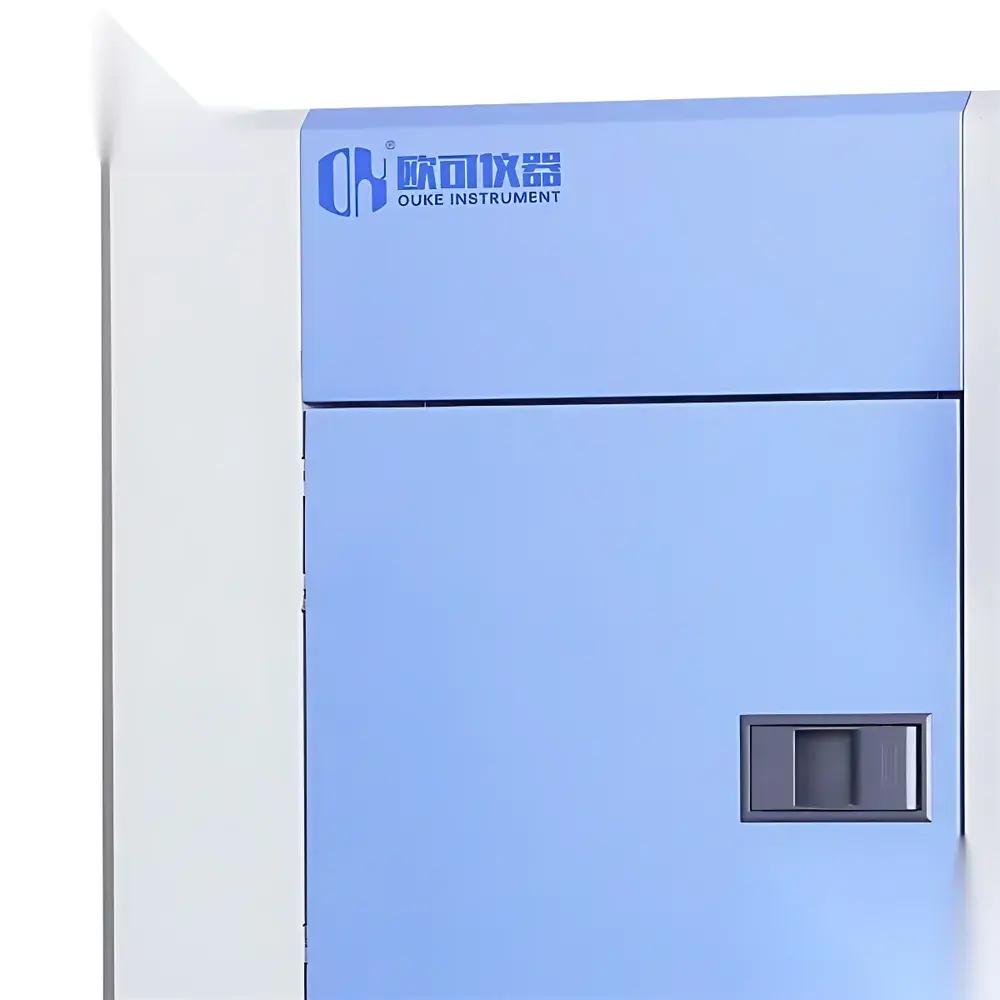
OK-TS Series Thermal Shock Test Chamber (Three-Zone, Air-to-Air, Rapid Transition)
| Brand | OK Instruments |
|---|---|
| Model | OK-TS-340 / OK-TS-500 / OK-TS-1000 |
| Temperature Range | -20 °C to +150 °C (standard) |
| optional | -40 °C, -60 °C, or -70 °C to +150 °C |
| Temperature Fluctuation | ±1 °C |
| Temperature Uniformity | ±3 °C |
| High-Temp Zone | RT to +150 °C |
| Low-Temp Zone | RT to -20 °C (precooling down to -25 °C) |
| Ramp Rate (Avg.) | ≤25 min (RT → +150 °C), ≤15 min (RT → -20 °C) |
| Transfer Time (Basket) | ≤15 s |
| Temperature Recovery Time | ≤5 min |
| Load Capacity | ≤20 kg |
| Basket Effective Size | 320 × 320 mm |
| Internal Chamber Dimensions (OK-TS-340) | 600 × 600 × 600 mm (D×W×H) |
| Power Supply | 380 V ±10%, 50 Hz, 7 kW |
| Refrigerants | R404A (high-stage), R23 (low-stage) |
| Compressor | Tecumseh (France) hermetic scroll type |
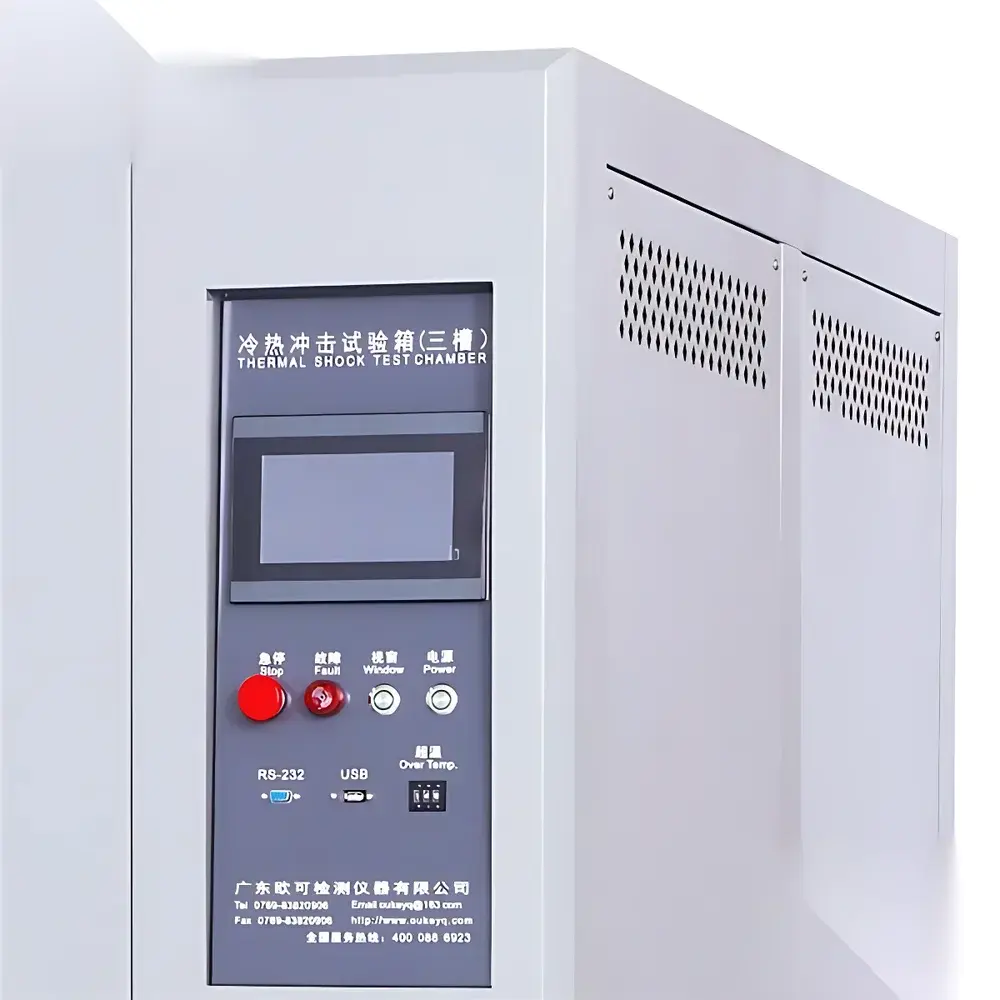
| Control System | Touchscreen PID controller with parameter lock, auto-tuning, and data logging interface |
Overview
The OK-TS Series Thermal Shock Test Chamber is an air-to-air, three-zone thermal shock system engineered for rapid, repeatable temperature transitions between extreme high- and low-temperature environments. It operates on the principle of dual-chamber thermal separation—comprising independent high-temperature and low-temperature zones—combined with a mechanically actuated sample transfer basket that shuttles test specimens between zones within ≤15 seconds. This architecture enables precise simulation of real-world thermal stress conditions encountered during product lifecycle validation, particularly in aerospace, automotive electronics, semiconductor packaging, and military-grade component qualification. The chamber conforms to key international thermal shock testing standards including MIL-STD-810H Method 503.7, IEC 60068-2-14, and JIS Z 8707, supporting both step-stress and cyclic shock protocols. Its robust mechanical design, calibrated temperature control, and traceable thermal performance make it suitable for use in GLP-compliant laboratories and ISO/IEC 17025-accredited test facilities.
Key Features
- Three-zone architecture: separate high-temp, low-temp, and ambient transfer zones for minimized cross-contamination and improved thermal stability
- High-speed pneumatic basket transfer mechanism with ≤15 s dwell-to-dwell transition time and ≤5 min temperature recovery post-transfer
- Stainless steel (SUS304) interior chamber with seamless welds and electropolished finish for corrosion resistance and ease of cleaning
- Double-layer insulated observation window with embedded heating element to prevent condensation and ensure unobstructed visual monitoring
- Multi-wing centrifugal circulation fan system with adjustable airflow distribution to maintain ±1 °C temperature fluctuation and ±3 °C uniformity across the working volume
- Certified refrigeration components: Sporlan expansion valves and filters, Castel solenoid valves, Alco oil separators, and Ranco pressure controls—all sourced from Tier-1 European and North American suppliers
- Integrated 50 mm diameter test port (left-side) with silicone gasket seal for external sensor feedthrough, power supply, or signal line routing under operational conditions
Sample Compatibility & Compliance
The OK-TS series accommodates samples up to 20 kg with dimensional constraints defined by the basket’s effective area (320 × 320 mm) and maximum height clearance. Compatible specimen types include PCB assemblies, molded plastic housings, solder-joint test coupons, optical sensors, battery modules, and hermetically sealed electronic enclosures. The chamber supports standardized thermal shock profiles per ASTM D5229/D5229M (composite materials), IPC-9701 (interconnect reliability), and AEC-Q200 (passive components). All units undergo factory calibration against NIST-traceable reference thermocouples and include a full compliance documentation package—including as-built drawings, refrigerant charge records, electrical safety certification (CE/IEC 61000-6-4), and material declarations per RoHS 2011/65/EU and REACH Annex XVII.
Software & Data Management
The integrated touchscreen controller features a real-time PID algorithm with adaptive tuning, programmable ramp/soak profiles, and user-accessible logging of chamber temperatures, basket position status, compressor discharge pressure, and cycle counter. Data export is supported via USB 2.0 (CSV format) and optional Ethernet TCP/IP interface for integration into centralized LIMS or MES platforms. Audit trail functionality complies with FDA 21 CFR Part 11 requirements when paired with optional password-protected user roles, electronic signature capture, and immutable event logs. Optional PC-based software provides advanced analysis tools—including thermal gradient mapping, cycle deviation alerts, and statistical process control (SPC) charting—for quality assurance teams performing reliability growth testing.
Applications
This thermal shock chamber is routinely deployed in failure mode and effects analysis (FMEA) studies for detecting latent defects such as intermetallic delamination, solder joint fatigue, encapsulant cracking, and coefficient-of-thermal-expansion (CTE) mismatch failures. It serves as a critical tool in accelerated life testing (ALT) programs for automotive ADAS modules, avionics cooling systems, LED lighting arrays, and medical device sterilization packaging. In R&D labs, it supports DOE-driven investigations into thermal interface material (TIM) performance, conformal coating adhesion integrity, and MEMS device hysteresis behavior under transient thermal loads. Its modular scalability—from OK-TS-340 (0.216 m³) to OK-TS-1000 (1.0 m³)—allows configuration alignment with both small-batch qualification and production-line environmental screening workflows.
FAQ
What is the minimum achievable low-temperature limit for the OK-TS series?
Standard configuration supports -20 °C; optional upgrades extend the low-temperature zone to -40 °C, -60 °C, or -70 °C using enhanced cascade refrigeration circuitry.
Can the chamber operate continuously in thermal cycling mode?
Yes—the system is rated for uninterrupted operation over 1,000-hour continuous thermal shock cycles, provided ambient room temperature remains within 15–30 °C and relative humidity does not exceed 80% RH.
Is third-party calibration support available?
Yes—OK Instruments maintains partnerships with ISO/IEC 17025-accredited calibration providers in North America, EU, and APAC regions; on-site verification and certificate issuance are available upon request.
Does the controller support remote monitoring via network connection?
The base model includes local USB data export; Ethernet communication and Modbus TCP protocol support are available as factory-installed options.
What maintenance intervals are recommended for the refrigeration system?
Compressor oil and filter replacement is recommended every 24 months or 4,000 operating hours, whichever occurs first; annual inspection of refrigerant charge and pressure switch calibration is advised.



