
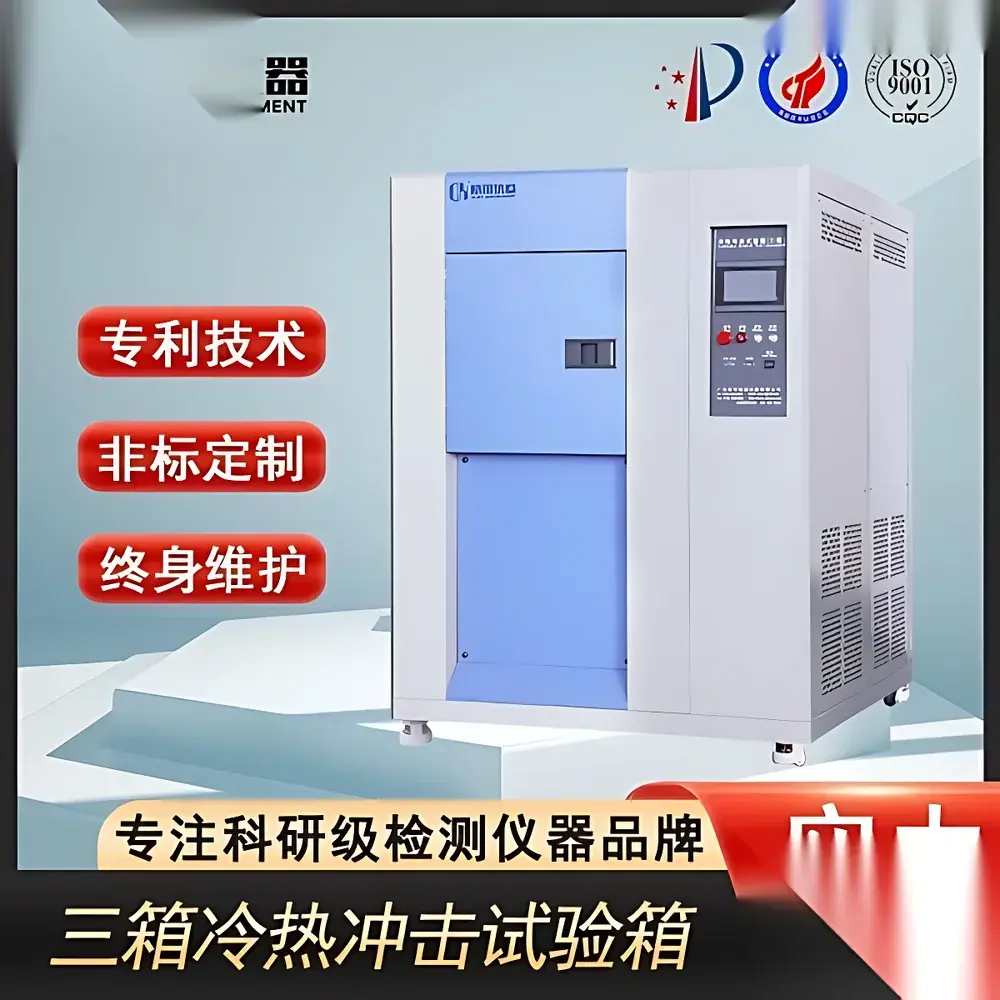
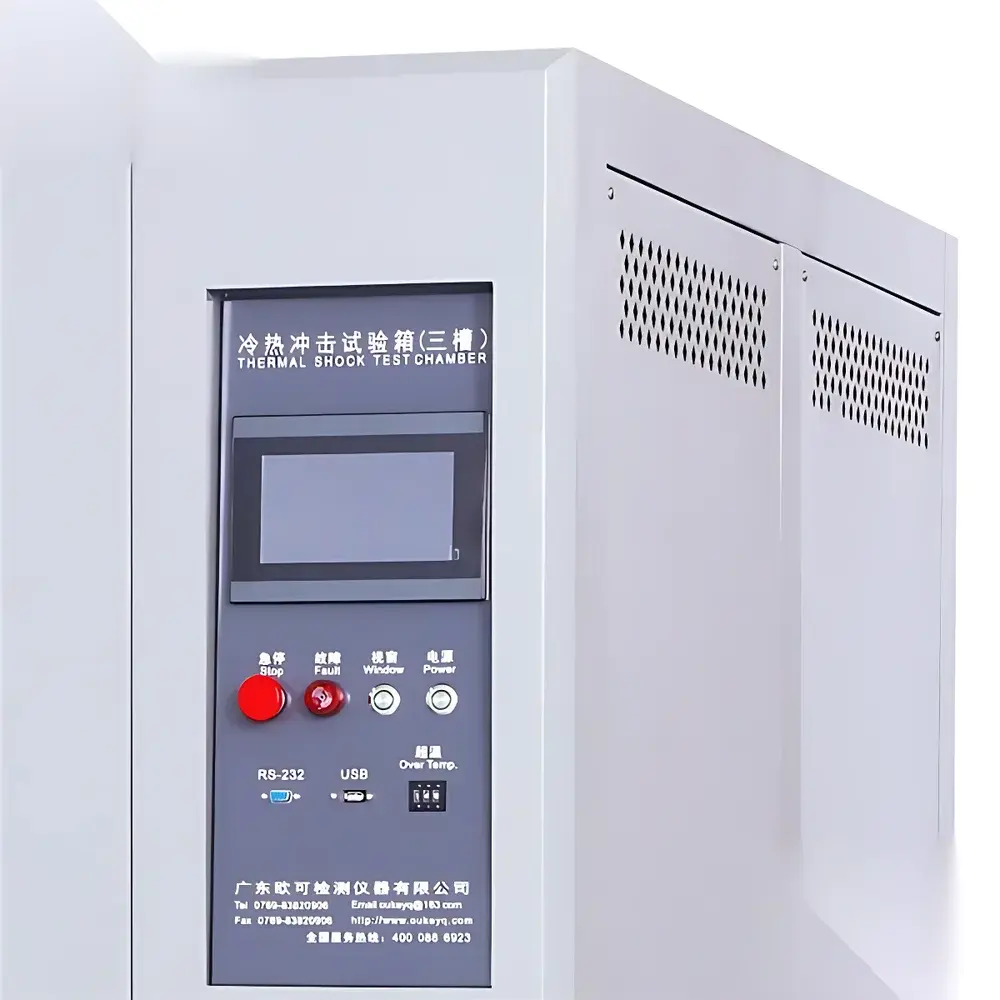
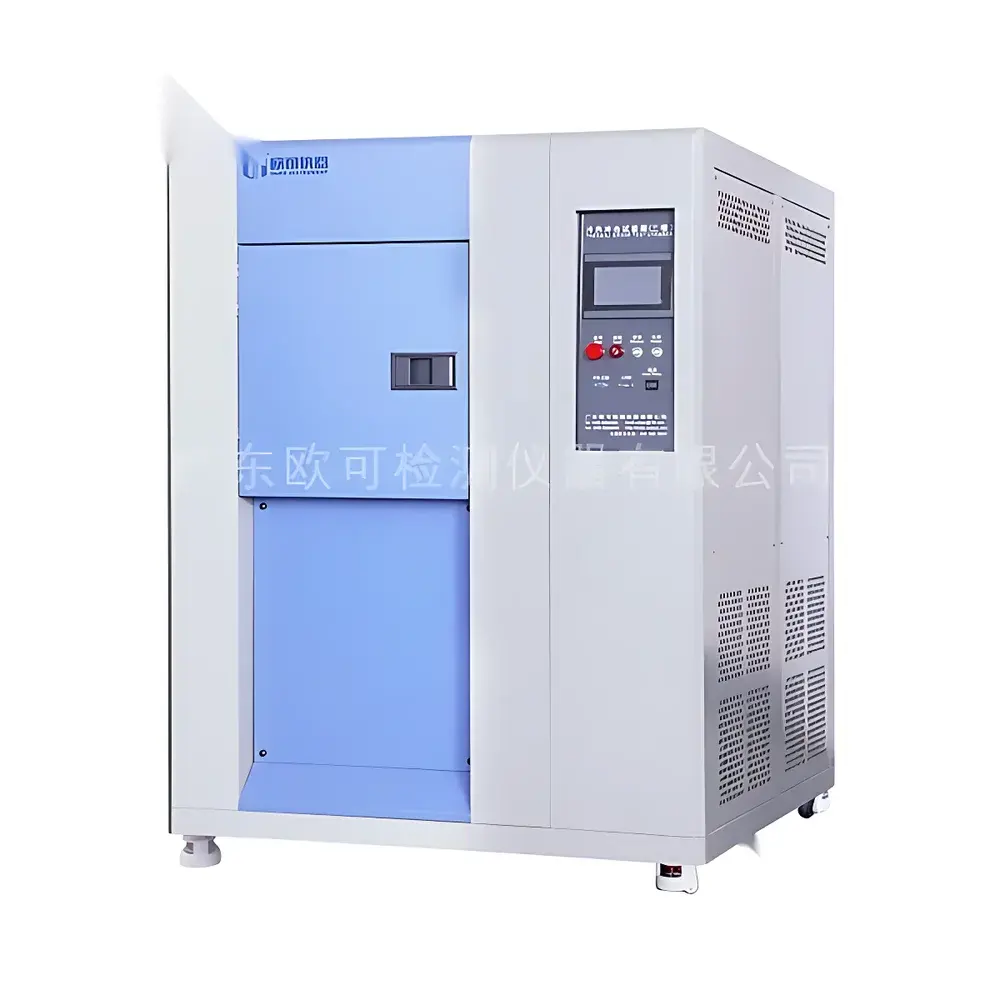
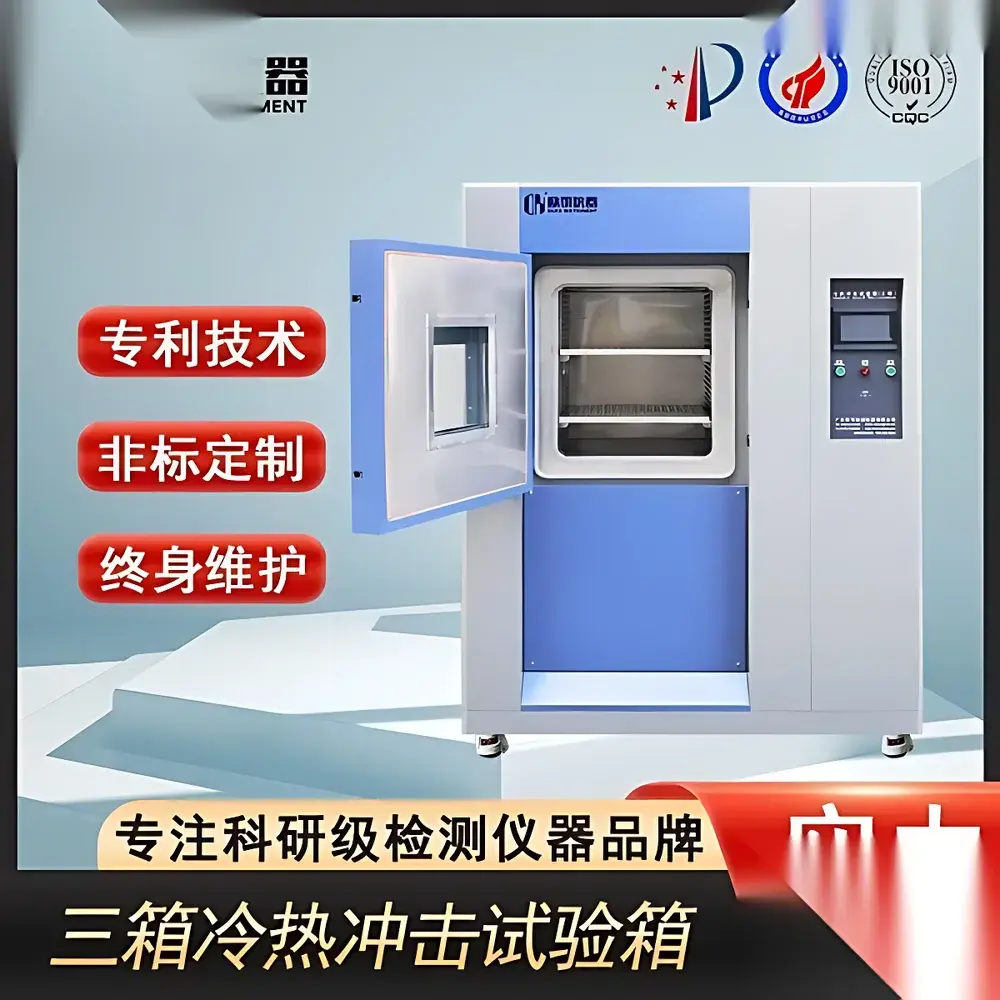
OK-TS Series Ultra-Low Temperature Thermal Shock Test Chamber
| Brand | OK |
|---|---|
| Origin | Imported |
| Manufacturer Type | Authorized Distributor |
| Temperature Range | -70°C to +150°C |
| Temperature Uniformity | ≤2.0°C |
| Temperature Fluctuation | ±0.5°C |
| Temperature Deviation | ±2.0°C |
| Ramp Rate (Heating) | 35 min (20°C → 100°C) |
| Ramp Rate (Cooling) | 25 min (20°C → 0°C), 40 min (20°C → -20°C), 60 min (20°C → -40°C), 90 min (20°C → -70°C) |
| Internal Dimensions (W×H×D, mm) | 400×450×400 to 1000×1000×1000 |
| Construction | SUS304B Stainless Steel Exterior & Interior |
| Cooling System | Dual-stage or Single-stage Low-Temperature Refrigeration Circuit with Hermetic “TECO” Compressor |
| Control System | TEMI880 Color Touchscreen Programmable Controller (English/Chinese) or TEMI300 Membrane Keypad Controller (English only) |
| Air Circulation | Wide-band Forced-Air Convection (Top-Exit / Bottom-Intake), Multi-wing Centrifugal Blower |
| Humidity Control | Surface Evaporation Type Humidifier |
| Safety Protections | Compressor Overheat/Overcurrent/High-Pressure Protection, Dry Heater Burnout Prevention, Chamber Overtemperature Alarm, Low-Water Level Detection |
Overview
The OK-TS Series Ultra-Low Temperature Thermal Shock Test Chamber is engineered for rigorous evaluation of material and component reliability under rapid, repeated transitions between extreme thermal extremes. Operating on the principle of two-zone or three-zone thermal shock—where specimens are mechanically transferred between independently controlled high-temperature and ultra-low-temperature chambers—the system enables precise simulation of real-world thermal stress conditions encountered in aerospace, automotive electronics, semiconductor packaging, and advanced battery development. With a certified operational range extending from –70°C to +150°C, the chamber supports both static temperature exposure and dynamic thermal cycling per ASTM D5229, IEC 60068-2-14, MIL-STD-810H Method 503.7, and JESD22-A104. Its robust refrigeration architecture—featuring a hermetically sealed TECO compressor and dual-stage low-temperature circuit—ensures stable sub-zero performance without cryogenic consumables, delivering reproducible shock profiles with minimal thermal inertia and high repeatability across thousands of cycles.
Key Features
- Stainless steel construction (SUS304B exterior and interior) with leak-tight TIG-welded chamber body and dual-layer silicone rubber door gasket for optimal thermal integrity and long-term vacuum-grade sealing.
- High-efficiency insulation using dense mineral wool between outer shell and test chamber, minimizing heat transfer and reducing energy consumption during extended low-temperature operation.
- Wide-band forced-air circulation system with multi-wing centrifugal blower and top-exit/bottom-intake airflow design ensures uniform temperature distribution (≤2.0°C uniformity) and rapid recovery (<60 s) after door opening—critical for GLP-compliant testing protocols.
- Dual-controller options: TEMI880 full-color touchscreen (bi-lingual English/Chinese interface, USB data logging, Ethernet connectivity) or TEMI300 membrane keypad controller (English-only, RS-232/485 communication support).
- Comprehensive safety suite including compressor overheat/overcurrent/high-pressure cutouts, dry-heater burnout prevention, chamber overtemperature alarm, and automatic low-water-level shutdown for humidification systems.
- Standard ergonomic features: double-glazed observation window, φ50 mm left-side cable port with silicone plug, adjustable-height sample racks (two sets included), fluorescent interior lighting, and four swivel casters for mobility.
Sample Compatibility & Compliance
The OK-TS chamber accommodates a broad spectrum of physical samples—from PCB assemblies and MEMS sensors to polymer housings, lithium-ion pouch cells, and optical lens mounts—without requiring custom fixtures. Internal dimensions span 400×450×400 mm (OK-TS-80) to 1000×1000×1000 mm (OK-TS-1000), supporting standard test specimen configurations defined in IPC-TM-650 2.6.7 and JEDEC JESD22-A106. All models comply with electromagnetic compatibility (EMC) per EN 61326-1 and safety requirements under EN 61010-1. Optional validation packages—including IQ/OQ documentation, NIST-traceable temperature mapping reports, and 21 CFR Part 11–compliant audit trails—are available for regulated environments operating under ISO 17025, GMP, or FDA QSR frameworks.
Software & Data Management
The TEMI880 controller integrates native PC-based software for remote monitoring, test program creation, real-time graphing, and automated report generation (PDF/CSV). Data logging supports timestamped temperature/humidity values at user-defined intervals (1s–60min), with onboard storage (≥100,000 records) and external backup via USB or network export. The software enforces role-based access control and maintains immutable audit trails for all parameter changes, start/stop events, and alarm acknowledgments—meeting ALCOA+ principles for data integrity. Optional API integration enables synchronization with LIMS platforms (e.g., LabWare, Thermo Fisher SampleManager) and MES systems for end-to-end traceability in production qualification workflows.
Applications
- Qualification testing of electronic components subjected to rapid thermal gradients in avionics and satellite subsystems.
- Evaluation of solder joint fatigue and intermetallic growth in lead-free PCB assemblies per IPC-9701.
- Accelerated aging studies of elastomeric seals, adhesives, and encapsulants used in EV battery modules.
- Thermal stress screening of medical device housings prior to ISO 10993 biocompatibility assessment.
- Material phase transition analysis in shape-memory alloys and polymer blends under cyclic cryogenic excitation.
- Pre-certification validation for automotive AEC-Q200 stress tests involving temperature shock and humidity soak sequences.
FAQ
What is the lowest achievable temperature, and how is stability maintained at –70°C?
The chamber achieves and sustains –70°C using a dual-stage refrigeration circuit with cascade condensation and oil management optimized for low-temperature lubricity. Temperature stability is ensured by continuous PID-controlled modulation of refrigerant flow and heater output, verified by internal Class A PT100 sensors calibrated per ISO/IEC 17025.
Can this chamber perform humidity-controlled thermal shock?
Yes—models equipped with the surface-evaporation humidifier support combined temperature-humidity shock per IEC 60068-2-30. Humidity range is 20–98% RH at temperatures ≥+10°C; humidity is disabled below 0°C to prevent ice accumulation.
Is calibration documentation provided with shipment?
Each unit ships with a factory calibration certificate referencing NIST-traceable standards for temperature sensors and controller outputs. Full validation support (IQ/OQ/PQ) and annual recalibration services are available upon request.
What maintenance intervals are recommended for the refrigeration system?
Compressor oil and filter replacement is recommended every 12 months or 4,000 operating hours—whichever occurs first. Annual inspection of refrigerant charge, blower bearings, and door seal integrity is advised to maintain thermal performance and compliance.



