
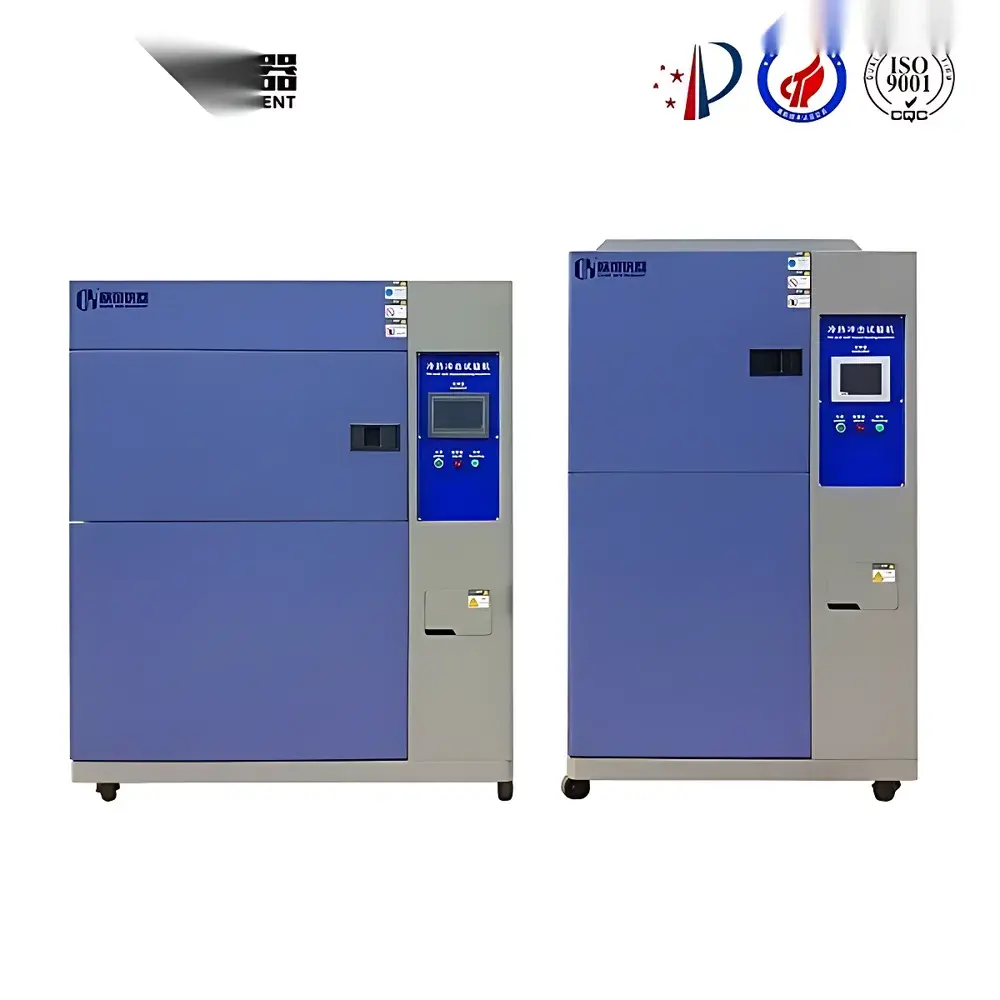
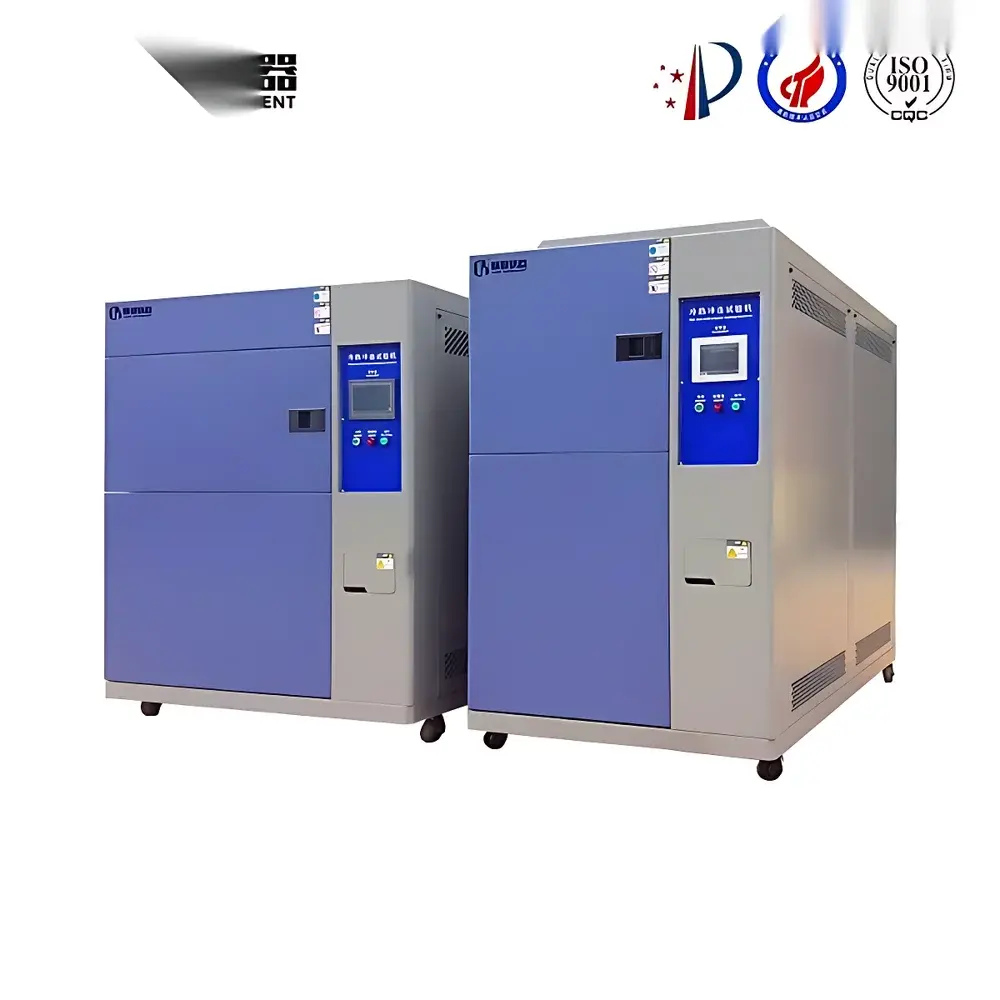
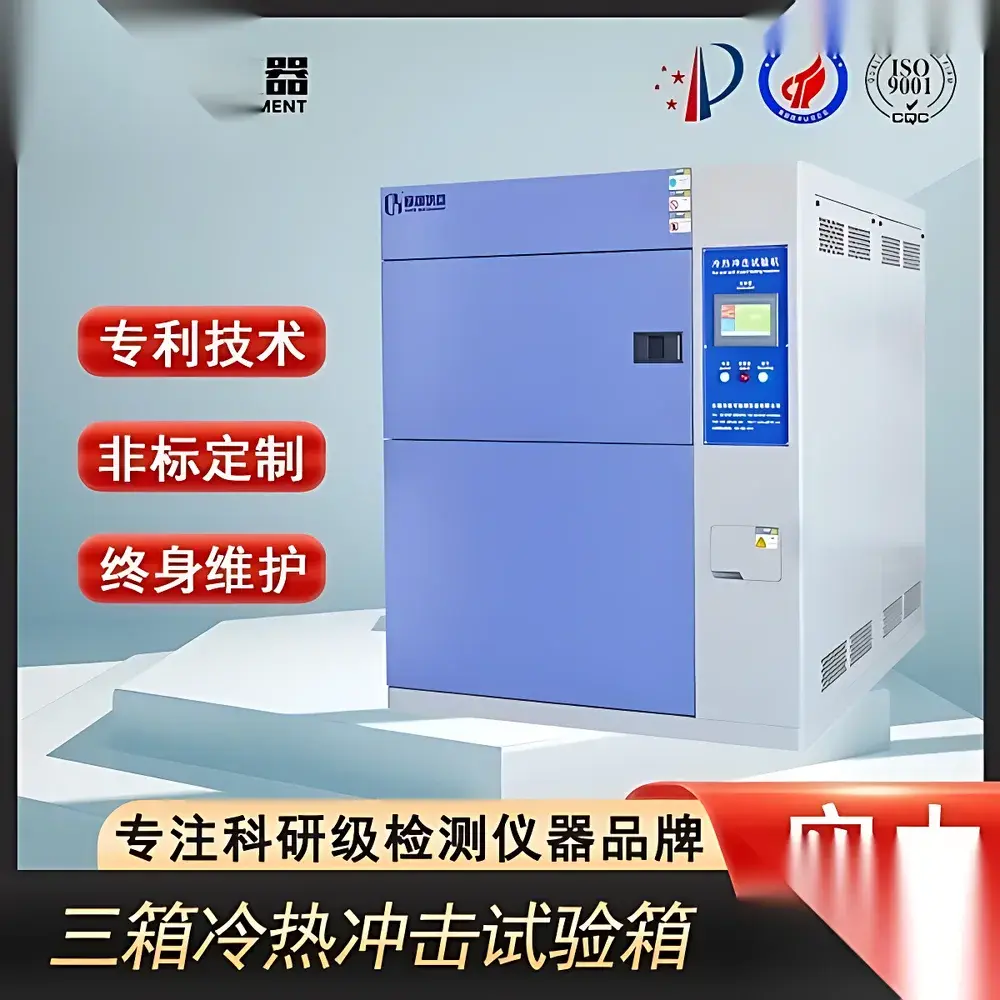
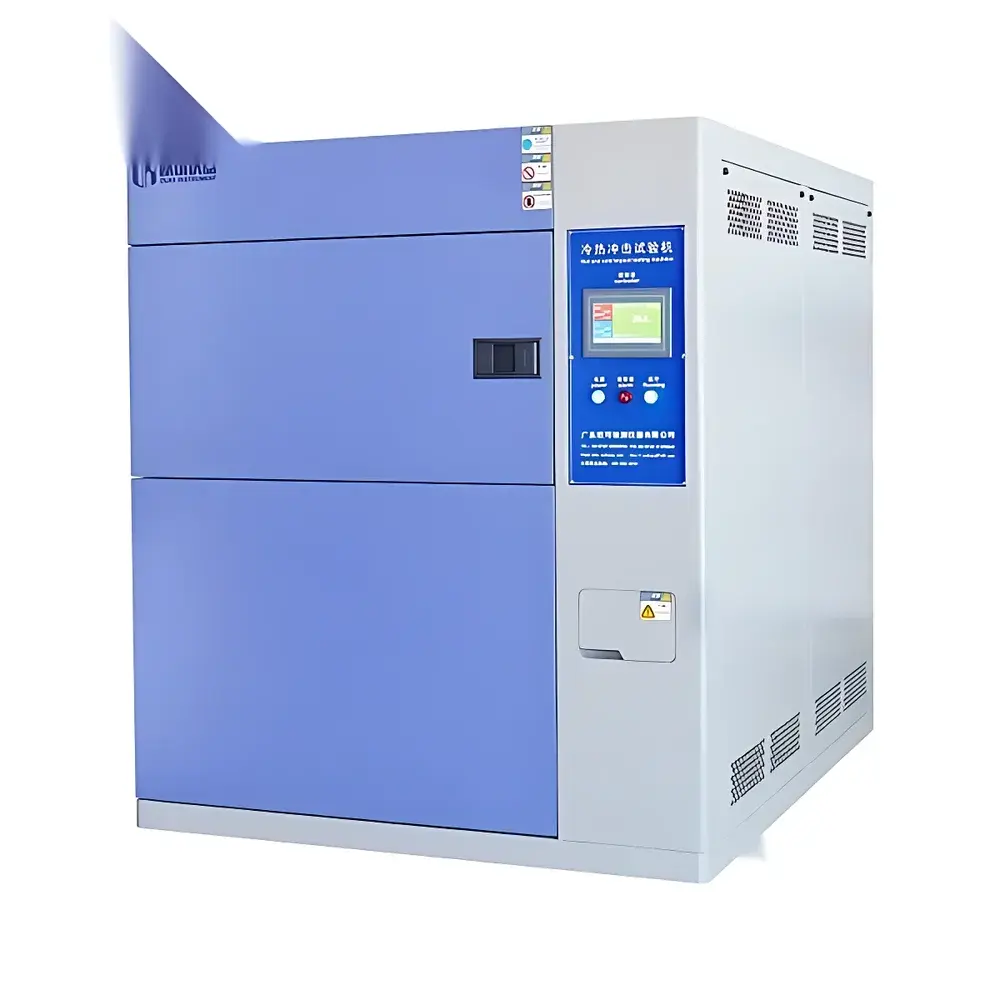
OK-TS Series Two-Zone Thermal Shock Test Chamber
| Brand | OK |
|---|---|
| Temperature Range | -65 °C to +150 °C (standard), optional -80 °C to +200 °C |
| Internal Volume | 30 L, 49 L, or 80 L |
| Internal Dimensions (W×H×D) | 300×330×300 mm, 350×400×350 mm, or 400×500×400 mm |
| High-Temp Zone Range | +60 °C to +200 °C |
| Low-Temp Zone Range | -80 °C to -10 °C |
| Thermal Recovery Time | ≤5 min |
| Cycle Count Setting | 1–999 cycles |
| Soak Time Setting | 00:01–999:59 h:min |
| Test Port | Ø50 mm on left side |
| Refrigerant | R507 / R23 (zero ozone depletion potential, HFC-based) |
| Construction | Interior and exterior SUS#304 stainless steel |
| Control System | PID-controlled touchscreen LCD interface with bilingual (EN/CN) UI |
| Compliance | Designed for ISO 16750-4, JEDEC JESD22-A104, MIL-STD-810H Method 503.5, IEC 60068-2-14 |
Overview
The OK-TS Series Two-Zone Thermal Shock Test Chamber is an engineered solution for evaluating material and component reliability under rapid, repetitive transitions between extreme high- and low-temperature environments. Based on the two-box (hot/cold chamber) mechanical transfer principle, the system utilizes a vertically actuated test basket to shuttle specimens between thermally isolated zones—eliminating thermal mass interference and enabling precise, reproducible shock profiles. This architecture conforms to standardized thermal shock protocols defined in ISO 16750-4 (road vehicles), JEDEC JESD22-A104 (semiconductors), and MIL-STD-810H Method 503.5 (military equipment). Unlike single-chamber ramp-based systems, the OK-TS achieves true step-function temperature transitions—critical for detecting latent interfacial failures in solder joints, conformal coatings, adhesives, and multilayer packaging structures. The chamber’s core function is not ambient conditioning but accelerated life-cycle stress induction via controlled thermal gradient exposure.
Key Features
- Independent dual-zone design with fully segregated hot and cold chambers, minimizing cross-contamination and enabling simultaneous stabilization at opposing extremes.
- PID-controlled, large-format color touchscreen interface with real-time graphical display of temperature curves, cycle progress, and alarm logs; supports English and Chinese language modes.
- Programmable test logic: up to 96 independent test profiles, each configurable for soak duration (1 minute to 999 hours 59 minutes), cycle count (1–999), and sequence direction (cold-to-hot or hot-to-cold first).
- High-efficiency cascade refrigeration system using dual-stage compressors (imported from Europe and North America) and environmentally compliant HFC refrigerants (R507/R23), certified zero ODP and low GWP.
- Structural integrity ensured by full SUS#304 stainless steel construction—interior chamber walls, shelves, and basket—all electropolished and grain-finished to resist corrosion and facilitate cleaning.
- Integrated safety architecture including over-temperature cut-off, compressor high-pressure/low-pressure shutdown, phase failure detection, ground fault interruption, and emergency power-off activation upon voltage instability.
- Optional manual or automatic defrost scheduling per cycle, reducing ice accumulation without interrupting test continuity.
- Standard Ø50 mm test port on left sidewall, fitted with silicone gasket and brass compression collar for external sensor feedthrough or powered device-in-test (DUT) operation.
Sample Compatibility & Compliance
The OK-TS accommodates samples up to 400 mm (W) × 500 mm (H) × 400 mm (D) and 25 kg maximum load per cycle. Its chamber geometry and airflow management ensure uniform thermal distribution (±1.5 °C deviation across active volume per ISO 16750-4 Annex B). The system supports compliance verification for automotive electronics (ISO 16750-4), aerospace avionics (RTCA DO-160 Section 4), semiconductor packages (JEDEC JESD22-A104), and medical device sterilization validation (IEC 60601-1 Clause 11). All controllers log timestamped temperature data with audit-trail capability, meeting GLP/GMP documentation requirements when paired with optional data export modules (CSV/USB). No proprietary firmware locks or vendor-specific calibration dependencies are implemented—calibration points traceable to NIST-certified reference standards.
Software & Data Management
The embedded controller records all operational parameters—including zone temperatures, basket position status, compressor runtime, and alarm events—with millisecond-level time stamping. Data export is supported via USB 2.0 port in CSV format, compatible with MATLAB, Python pandas, and statistical process control (SPC) platforms. Optional Ethernet connectivity enables remote monitoring through Modbus TCP or HTTP API endpoints, allowing integration into centralized lab infrastructure management systems. Firmware updates are delivered as signed binary packages with SHA-256 verification. All user-modifiable settings—including PID tuning constants, alarm thresholds, and profile libraries—are password-protected and version-locked to prevent unauthorized configuration drift. Audit trails retain operator ID, timestamp, and action type for every parameter change, satisfying FDA 21 CFR Part 11 electronic record requirements when deployed in regulated QC environments.
Applications
This thermal shock chamber serves critical qualification workflows across multiple industries: accelerated aging of PCB assemblies and chip-scale packages; validation of thermal interface materials (TIMs) and underfill epoxies; screening of battery cell housings for electric vehicle applications; durability testing of optical sensors exposed to diurnal cycling; qualification of MEMS devices under transient thermal loading; and reliability assessment of hermetic seals in implantable medical electronics. Its rapid recovery (10,000 cycle endurance for production-line incoming inspection stations.
FAQ
What is the difference between a two-zone thermal shock chamber and a single-chamber thermal cycling system?
A two-zone chamber physically separates hot and cold reservoirs, enabling instantaneous transfer and true step-function transitions. Single-chamber systems rely on air heating/cooling ramps, resulting in slower transitions and reduced thermal gradient magnitude.
Can the OK-TS perform dwell-only high-temperature or low-temperature tests?
Yes—the controller supports standalone high-temp soak, low-temp soak, and combined shock modes. Each zone operates independently when not engaged in transfer cycles.
Is third-party calibration certification available?
Yes—factory calibration includes certificate of conformance against ISO/IEC 17025-accredited reference probes. On-site calibration services with accredited documentation are available upon request.
What maintenance intervals are recommended for the refrigeration system?
Compressor oil analysis and filter dryer replacement every 24 months; refrigerant leak check and pressure verification annually; full cascade performance validation every 36 months.
Does the system meet CE and UKCA marking requirements?
Yes—fully compliant with EU Machinery Directive 2006/42/EC, EMC Directive 2014/30/EU, and RoHS 2011/65/EU. UKCA documentation is provided for shipments to Great Britain.



