
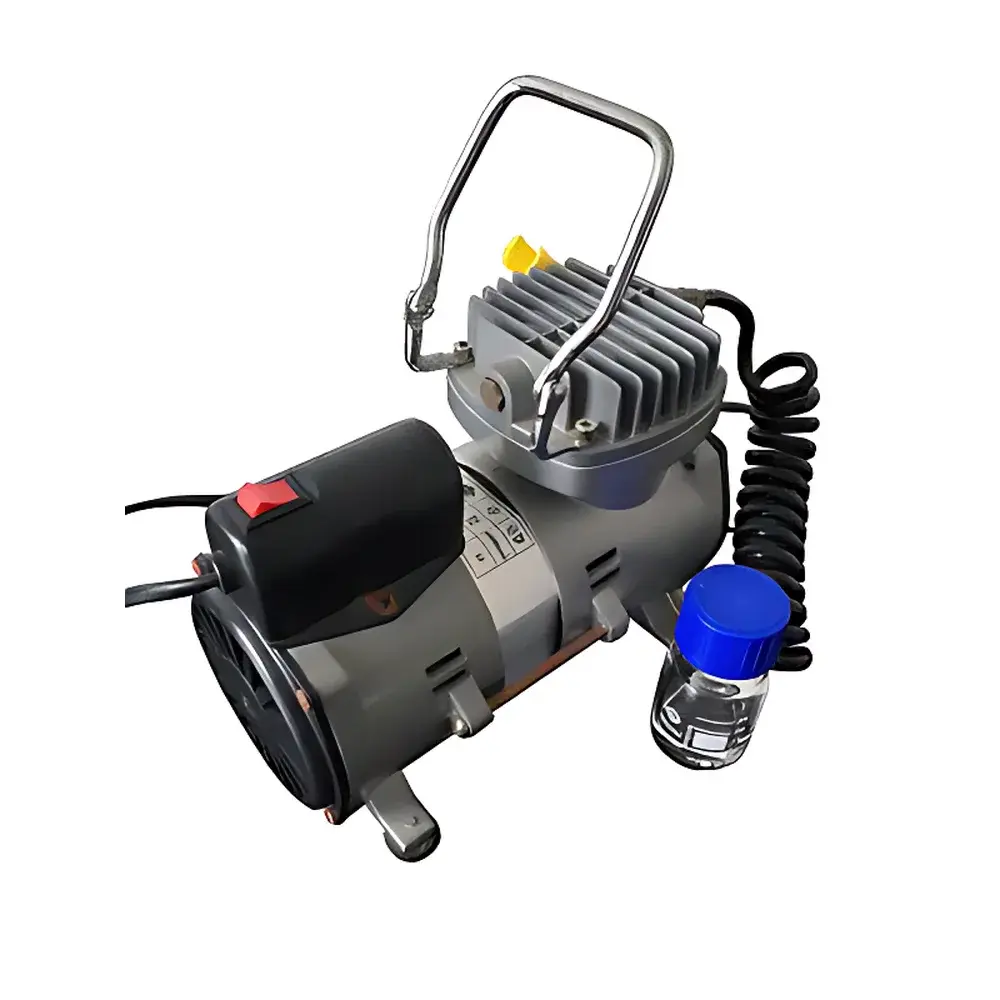
TS-I Ultra-Fine Electric Thin-Layer Spray Applicator by KEZHE SHANGHAI
| Brand | KEZHE SHANGHAI |
|---|---|
| Origin | Shanghai, China |
| Manufacturer Type | Direct Manufacturer |
| Product Category | Domestic |
| Model | TS-I |
| Price Range | USD 140–700 (FOB) |
| Instrument Type | TLC Spray Applicator |
| Scanning Method | Linear (N/A for spray applicator) |
| Wavelength Range | Not Applicable (Non-Optical Device) |
| Light Source | Not Applicable |
| Wavelength Accuracy | Not Applicable |
| Wavelength Repeatability | Not Applicable |
| Scan Speed | Not Applicable |
| Air Pressure Range | 10–30 psi |
| Nozzle Orifice Diameter | 0.2 mm |
| Spray Distance | 50 cm |
| Construction Material | Full Stainless Steel |
Overview
The TS-I Ultra-Fine Electric Thin-Layer Spray Applicator is a precision-engineered laboratory tool designed exclusively for uniform, controlled reagent delivery in thin-layer chromatography (TLC) workflows. Unlike optical scanning or densitometric instruments, the TS-I functions as a non-contact, pressure-driven spray applicator—operating on compressed air atomization principles to generate a fine, consistent aerosol mist across silica or alumina TLC plates. Its core function is to enable reproducible post-development visualization of separated analytes via derivatization (e.g., anisaldehyde, iodine vapor, ninhydrin, or sulfuric acid charring), minimizing spot diffusion and preserving chromatographic resolution. Engineered for integration into regulated QC/QA labs and academic research settings, the TS-I eliminates manual spraying variability while maintaining full compatibility with standard 5 × 10 cm, 10 × 10 cm, and 20 × 20 cm TLC plates.
Key Features
- Ultra-fine stainless steel nozzle with precisely machined 0.2 mm orifice—optimized for laminar airflow and monodisperse droplet generation (Sauter mean diameter < 20 µm under nominal 20 psi operation)
- Integrated compact oil-free diaphragm air compressor delivering stable 10–30 psi output with sound pressure level ≤ 48 dB(A) at 1 m distance
- Full 304 stainless steel housing and fluid pathway—resistant to corrosion from acidic, basic, and organic reagents including chloroform, methanol, and concentrated H₂SO₄
- Ergonomic handheld design (weight: 1.2 kg) with balanced center-of-gravity and 360° rotatable spray head for overhead, lateral, or angled application
- Tool-free nozzle and reagent reservoir interchange—enabling rapid switching between visualization reagents with ≤ 0.3 mL residual volume per changeover
- No external air supply required—eliminates dependency on central lab air lines or bulky compressors, supporting portable benchtop deployment
Sample Compatibility & Compliance
The TS-I is compatible with all commercially available TLC stationary phases—including silica gel 60 F254, aluminum oxide, cellulose, and reversed-phase C18 plates—as well as preparative TLC plates up to 2 mm thickness. It supports both aqueous and organic solvent-based visualization reagents without clogging or degradation. While the device itself is not subject to optical calibration standards, its mechanical repeatability (±0.5 psi pressure control, ±2 cm spray distance tolerance) ensures compliance with GLP documentation requirements for method transfer and SOP execution. The unit meets CE safety directives (2014/30/EU EMC and 2014/35/EU LVD) and conforms to ISO 9001:2015 manufacturing controls. No regulatory submission (e.g., FDA 21 CFR Part 11) applies, as the TS-I performs no data acquisition or electronic record generation.
Software & Data Management
The TS-I operates as a standalone electromechanical instrument with no embedded firmware, touchscreen interface, or digital connectivity. It generates no electronic records, metadata, or audit trails—consistent with its role as a manual sample preparation aid rather than an analytical data-generating device. Users maintain procedural traceability through standard lab notebook entries or LIMS-integrated workflow logs referencing batch numbers, reagent lots, plate IDs, and application parameters (pressure setting, distance, dwell time). Optional accessories include calibrated pressure gauges (0–50 psi, Class 1.0 accuracy) and digital spray timing modules (0.1–10 s programmable dwell) for enhanced protocol standardization.
Applications
- Routine qualitative identification of natural products (alkaloids, flavonoids, terpenes) in herbal extracts using Dragendorff’s or vanillin-H₂SO₄ reagents
- Quantitative densitometric validation where uniform derivatization is prerequisite for linear response (e.g., USP TLC-densitometry methods)
- High-throughput screening of reaction progress in combinatorial synthesis—enabling parallel visualization of 12–24 lanes per plate without cross-contamination
- Teaching laboratories requiring robust, low-maintenance instrumentation for undergraduate chromatography pedagogy
- GMP-compliant stability-indicating assays where reagent homogeneity directly impacts limit-of-detection reproducibility
FAQ
Is the TS-I compatible with corrosive reagents such as concentrated sulfuric acid or phosphomolybdic acid?
Yes—the entire fluid path, including nozzle, reservoir, and internal tubing, is constructed from ASTM A240 304 stainless steel, rated for continuous exposure to pH 1–13 solutions and common TLC visualization acids.
Does the unit require periodic calibration or certification?
No—calibration is not applicable, as the TS-I has no optical, thermal, or electronic measurement subsystems. Routine maintenance consists only of nozzle cleaning with acetone and compressor filter replacement every 6 months under daily use.
Can the spray distance be adjusted beyond 50 cm?
The optimal working distance is 40–50 cm for uniform coverage of standard 10 × 10 cm plates. Extending beyond 50 cm reduces droplet kinetic energy and increases drift risk; shorter distances (<30 cm) may cause localized oversaturation.
What is the expected service life of the 0.2 mm nozzle under routine use?
Based on accelerated wear testing with 5% phosphomolybdic acid in ethanol, the nozzle maintains dimensional integrity and spray pattern fidelity for ≥1,200 applications (approx. 18 months at 20 plates/day).
Is technical support available for method development assistance?
KEZHE SHANGHAI provides application notes, pressure–viscosity correlation charts, and derivatization optimization guides free of charge upon request—supporting method transfer across global laboratories.






