
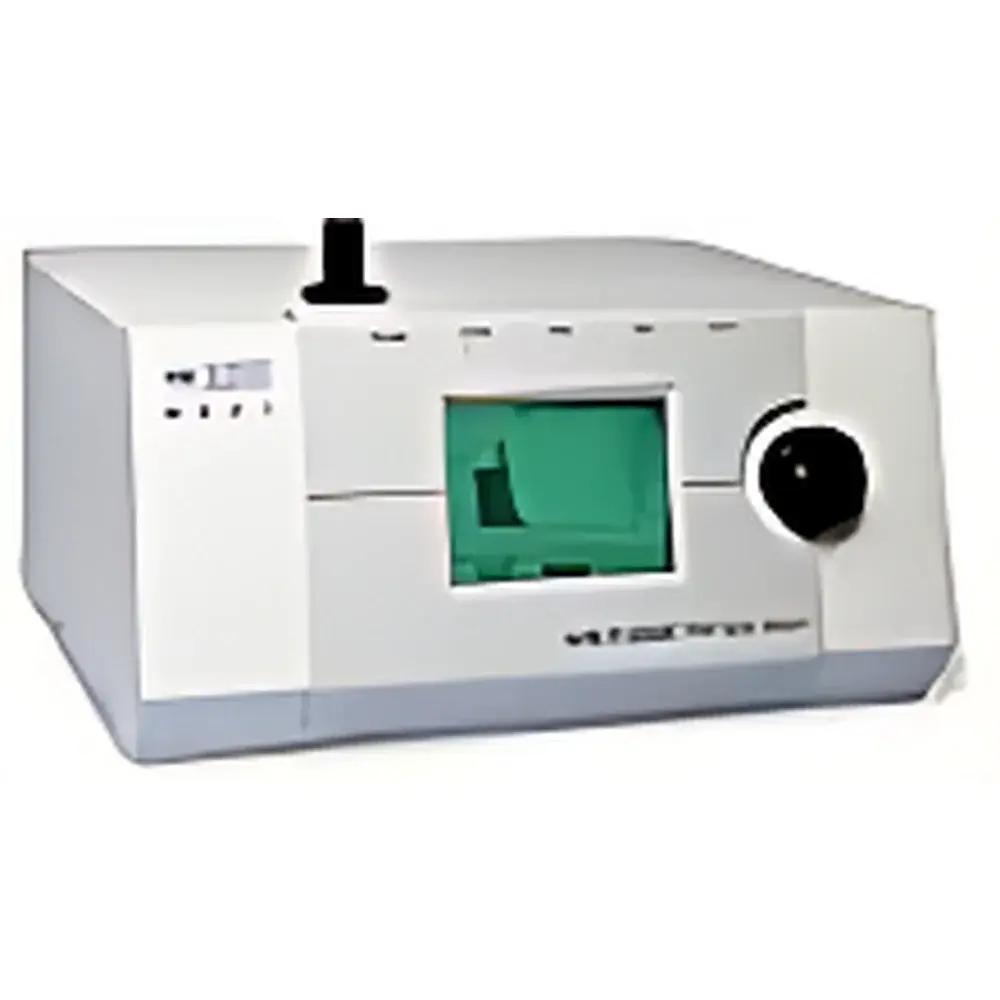
TSI APS-3321 Aerodynamic Particle Sizer Spectrometer
| Origin | USA |
|---|---|
| Manufacturer Type | Authorized Distributor |
| Origin Category | Imported |
| Model | APS-3321 |
| Pricing | Available Upon Request |
Overview
The TSI APS-3321 Aerodynamic Particle Sizer Spectrometer is a precision-engineered, single-particle counting instrument designed to measure the aerodynamic diameter of aerosol particles in real time using time-of-flight (TOF) aerodynamic sizing principles. Unlike optical scattering-based instruments that infer size from light intensity and are highly sensitive to particle refractive index, density, and morphology, the APS-3321 determines particle inertia directly—enabling robust, physics-based classification of airborne particulates across a broad size range. This fundamental measurement principle ensures high reproducibility and minimal dependence on particle composition, making it particularly valuable for health-related aerosol research, inhalation toxicology, filter efficiency testing, and regulatory compliance monitoring where aerodynamic behavior governs deposition fate (e.g., upper airway vs. alveolar regions). The instrument operates by accelerating particles through a nozzle into a laminar sheath flow, then detecting individual particles as they pass sequentially through two closely spaced laser beams; the time interval between beam interruptions yields the particle’s aerodynamic diameter with traceable metrological linkage to ISO 27891 and ASTM D6654 standards.
Key Features
- Real-time, dual-parameter measurement: simultaneous acquisition of aerodynamic diameter (0.5–20 µm) and optical scattering intensity (0.37–20 µm) for each detected particle
- High-resolution size distribution: 32 channels per decade across the full sizing range, enabling fine-grained differentiation of submicron and coarse-mode aerosols
- Stable, low-drift performance: engineered for long-term operational consistency in laboratory, cleanroom, and field-deployed environments
- Single-particle counting architecture: delivers true number concentration without assumptions about particle shape or optical properties
- Integrated flow control: precise 5.0 L/min sampling flow maintained via mass flow controller and temperature/pressure compensation
- Configurable acquisition duration: programmable sampling intervals from 1 second to 18 hours, supporting both transient event capture and extended ambient monitoring
Sample Compatibility & Compliance
The APS-3321 accommodates a wide variety of aerosol sources—including combustion emissions, pharmaceutical powders, occupational dusts, atmospheric urban haze, and bioaerosols—without requiring prior conditioning beyond standard dilution or impactor pre-separation. When paired with the TSI 3302A Aerosol Diluter (offering 20:1 and 100:1 dilution ratios, scalable to 10,000:1 via tandem configuration), the system maintains linear response up to 10⁴ particles/cm³. The optional 3306 Impactor enables size-selective collection at 2.5 µm or 4.7 µm cut-points for subsequent gravimetric or chemical analysis (e.g., ICP-MS, XRF), aligning with PM₂.₅ and PM₁₀ regulatory frameworks. The 3433 Powder Diffuser facilitates controlled dispersion of cohesive dry powders, extending applicability to inhalation drug formulation development under USP <1103> and FDA guidance. All hardware and firmware comply with electromagnetic compatibility (EMC) requirements per IEC 61326-1 and support GLP/GMP-aligned data integrity when used with validated AIM 3321 software configurations.
Software & Data Management
Data acquisition and post-processing are performed using the Windows-based AIM 3321 software suite, which provides real-time visualization of size-resolved number, surface area, volume, and mass concentration distributions. The software supports batch processing, customizable binning, export to CSV and HDF5 formats, and integration with third-party statistical tools (e.g., Python/Pandas, MATLAB). Audit trails, user access controls, electronic signatures, and 21 CFR Part 11-compliant archiving options are available through validated deployment packages—ensuring suitability for regulated environments including pharmaceutical QC labs and environmental testing facilities accredited to ISO/IEC 17025. Raw TOF data files retain full timestamped particle-by-particle records, enabling retrospective reanalysis and uncertainty quantification per GUM (JCGM 100:2008).
Applications
- Respiratory health research: correlating aerodynamic size with regional lung deposition patterns (ICRP Publication 66)
- Filter and respirator certification: evaluating penetration efficiency across relevant aerodynamic cut-points (NIOSH 42 CFR Part 84, EN 149)
- Industrial hygiene monitoring: characterizing workplace aerosols for OSHA PEL and ACGIH TLV assessments
- Atmospheric science: resolving coarse-mode mineral dust, sea salt, and biomass burning particles in haze and smog studies
- Inhalation drug development: assessing emitted dose and fine particle fraction (FPF) of dry powder inhalers (DPIs)
- Instrument intercomparison studies: serving as a reference-grade aerodynamic sizing platform in multi-laboratory validation campaigns
FAQ
How does the APS-3321 differ from optical particle sizers (OPS) or laser diffraction analyzers?
The APS-3321 measures aerodynamic diameter via inertial time-of-flight, whereas OPS and diffraction systems infer size from scattered light intensity or angular distribution—making them sensitive to particle refractive index, shape, and homogeneity.
Can the APS-3321 be used for regulatory reporting under EPA or EU directives?
Yes—when operated within documented SOPs and paired with appropriate calibration and maintenance records, its aerodynamic sizing output supports compliance with PM monitoring requirements in EPA Method PS-11 and EU Directive 2008/50/EC Annex XII.
What is the maximum allowable aerosol concentration for accurate sizing?
The instrument maintains linear response up to 10⁴ particles/cm³; higher concentrations require dilution using the 3302A Aerosol Diluter to prevent coincidence error.
Is calibration traceable to national standards?
Yes—TSI provides NIST-traceable calibration services using polystyrene latex (PSL) spheres and certified aerodynamic reference aerosols aligned with ISO 27891 Annex B.
Does the APS-3321 support remote operation or networked data streaming?
Via AIM 3321’s TCP/IP interface and OPC UA-compatible drivers, the system supports integration into centralized SCADA or LIMS platforms for unattended, multi-instrument monitoring networks.
Related Products







